Session 5 - Targeting Attractive Market Segments
 Call Kai
 Learn
Learn Practice Test
 Spaced Repetition
 Match
Match Flashcards
 Knowt Play
1/22

There's no tags or description
Looks like no tags are added yet.
Name | Mastery | Learn | Test | Matching | Spaced | Call with Kai | Chat |
|---|
No analytics yet
Send a link to your students to track their progress
23 Terms
Why Segmentation
customers are different
provide different offering for different segments
happier customers leads to more profits
less competition leads to more profits
Market Segmentation
process by which a market is divided into distinct subsets of customers with similar needs and characteristics that lead them to respond in similar ways to a particular product offering and marketing program.
Steps - STP
1) segmentation
2) targeting
3) positioning
Targeting
Evaluating the relative attractiveness of various segments and choosing the most attractive one

Positioning
creating a unique brand image, or position

Market Segmentation (3 components)
1) Criteria for segmenting customers
2) Identifying a homogenous segment that is different from others on those criteria
3) Segment size and potential.
Segmentation Criteria
1) who are the customers (demographical)
2) where they are (geographical)
3) how they behave (behavioral)
market segmentation (demographical)
Age
Gender
Income
Occupation; education
market segmentation (geographical)
People in the same geographical regions tend to be relatively homogenous
Different regions vary in their sales potential, growth rates, customer needs, competitive structure
Particularly important in retailing and many services businesses.
market segmentation (geo-demographical segmentation)
Segmenting market demographically within the geographic regions.
Useful in assessing the size and market potential of a market segment defined by a particular trade area.
Behavioral Segmentation (How)
Focus on what a specific segment of consumers do
Behavioral attributes can be classified in terms of:
Consumer needs
Expressed in benefits sought
Similarity in choice criteria
Product usage
Amount of consumption
Lifestyle (sometimes referred to as segmentation by psychographics)
Consumer’s activities, interests, and opinions
Example Lifestyle Segmentation Scheme: VALS2
Based on how consumers pursue and acquire both products and services that provide satisfaction and shape their identities.
Behavioral Examples
Examples:
Innovators: sophisticated, high self-esteem, upscale and image is important
Thinkers: conservative, practical, income allows many choices, look for value
Makers: practical people, do it yourself, unimpressed by material possessions, prefer value to luxury
Gathers data on what each segment bought, what their media habits are, etc.

Targeting Effective Market Segments (2 things to think of)
1) The segment’s current and future attractiveness
2) The firm’s ability to effectively and competitively meet the needs of the segment
Targeting Defined
evaluating the attractiveness of each market segment, selecting one or more segments to pursue, and then designing marketing programs to serve them.
Targeting (5 step process)
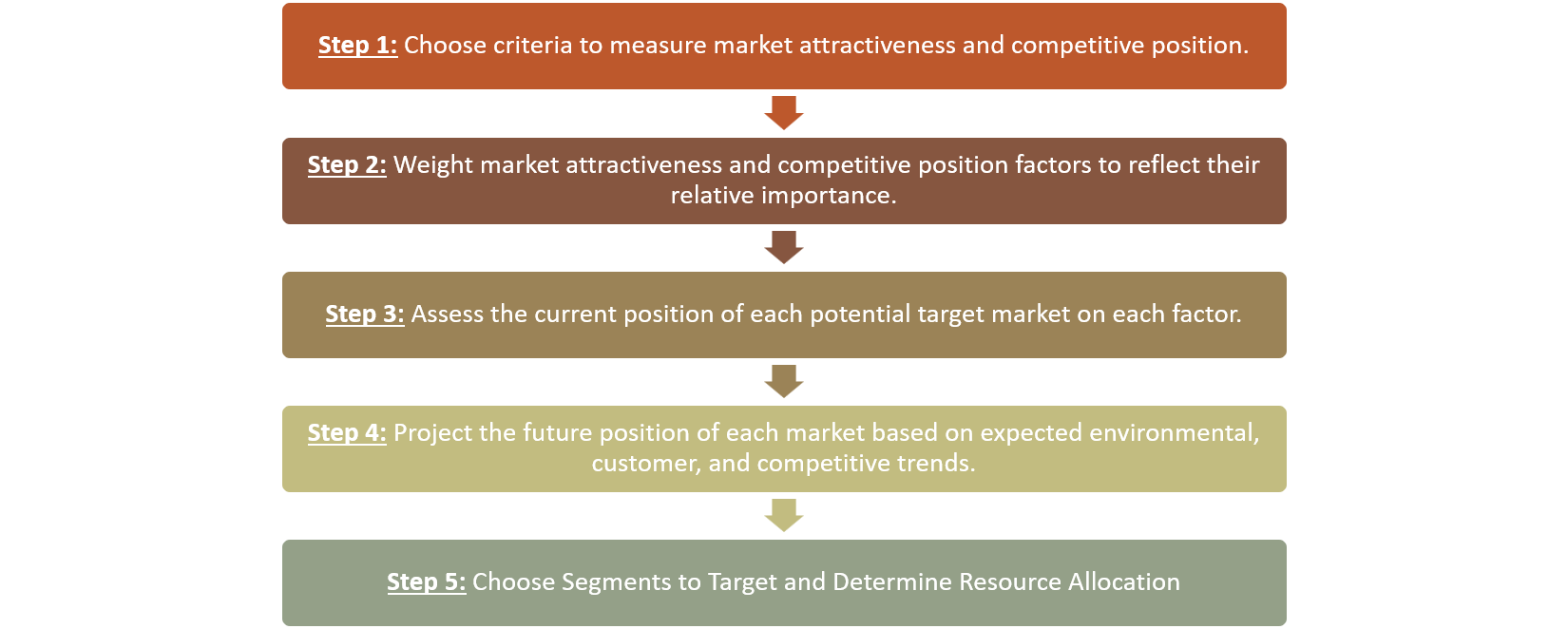
Targeting Step 1
Selecting marketing attractiveness factors and competitive-position factors
Market attractiveness factors
Most critical is the presence of unmet or underserved needs within the segment
Market potential
Growth rate
Macro trends
Competitive-position factors
Extent to which firm’s product or service in the segment will be different from competitors.
Firm capabilities relative to competitors
Industry macro level factors (e.g., Porter’s Five Forces)

Targeting Step 2
Weight the Selected Factors
Assign a numerical score to each of the factors from Step 1
In terms of their relative importance
e.g., rating on a 0 -10 scale
both market attractiveness and competitive position should add up to 1

Targeting Step 3
Rate Segments on Each Factor
Assign a rating to each the factors identified in Step 1
Evidence-based approach
Both quantitative and qualitative data


Targeting Step 4
Project the Future Position of Each Segment
Harder to predict the future than assess the present
Need to get a sense of how factors viewed as important for each segment will change in the next 3 to 5 years:
Market Attractiveness
Competitive-Position
Targeting Step 5
Choose Segments to Target and Determine Resource Allocation
General rule of thumb is that you should only target a segment if:
One of the dimensions is rated as “Strong”
The other dimension is at least rated as “Moderate”
A few exceptions may justify targeting a segment (in spite of this rule of thumb):
Either of the two dimensions (Market Attractiveness, Competitive-Position) are expected to improve in time
Segments are viewed as initial steps towards more attractive opportunities
Existence of synergies with current targeted segments or planned ones
Niche-market Strategy
Involves serving one or more segments that, while not the largest, consist of a sufficient number of customers seeking somewhat-specialized benefits from a good or service
Mass-market Strategy
A business can pursue a mass-market strategy in two ways
Ignore any segment differences and design a single product-and-marketing program that will appeal to the largest number of consumers.
Design separate products and marketing programs for the differing segments (differentiated marketing)
Growth-market Strategy
Businesses pursuing this strategy target one or more fast-growth segments, even though these segments may not currently be very large.
Usually requires strong R&D and marketing capabilities, plus the resources to finance rapid growth.