Skeletal System
 Call Kai
 Learn
Learn Practice Test
 Spaced Repetition
 Match
Match Flashcards
 Knowt Play
1/180

There's no tags or description
Looks like no tags are added yet.
Name | Mastery | Learn | Test | Matching | Spaced | Call with Kai | Chat |
|---|
No analytics yet
Send a link to your students to track their progress
181 Terms
The second hardest substance in the body
Bone
It is very good at being able to repair itself after an injury.
True
The cells that produce bone
Osteoblasts
What do osteoblasts secrete?
The matrix of the bone
The osteoblast hardens the matrix through a process called
Ossification
Once the ossification process has taken place, the osteoblasts are then called
Osteocytes
Osteocytes are the cells that
Maintain bone tissue
The most basic function of the skeletal system
Support
The firm strength of the bones does what?
Protects the delicate organs and tissue by either completely or partially surrounding them.
Bones act as _____ for the skeletal muscles.
Levers
The skeletal muscles are attached to bones by
Tendons
They are _____ _____ for minerals like calcium
Storage Sites
The body is able to deposit and withdraw calcium when needed
to control the level in the blood
Some of the bones are sites for
blood cell formation
Blood cell formation is called what?
hematopoesis
Where does hematopoesis occur?
In bone marrow
The outer surfaces of the bone are covered with a membrane called the what?
Periosteum
Where is the periosteum not found?
The joint (articular) surfaces of bones
The inner layer of the periosteum contains what?
Contains osteoblasts
What is the inner layer of the periosteum involved in?
The healing of fractures
The outer layer of the periosteum is composed of what?
Fibrous tissue
It is sometimes called spongy bone because it has the appearance of a sponge
Cancellous Bone
The spaces between the bone are filled with
Marrow
Cancellous bone is light, but very strong
True
This bone is very dense, heavy, and strong
Compact Bone
What type of bone is found in the shafts of long bones, and in the outer layer of how many bones?
Compact bon is found in ALL bones
Osteogenic cell
Develops into an osteoblast
Osteoblast
Forms into a bone matrix
Osteocyte
Maintains bone tissue
Osteoclast
Functions in resorption, the breakdown of bone matrix
As the long bone grows what ossifies near the diaphysis and epiphyses?
The metaphysis which contains the growth plate
Where does the blood supply come from?
Tiny blood vessels that penetrate the periosteum
Once through the periosteum, where do they pass through?
Channels in the bone matrix called Volkmann’s Canals
Volkmann Canals join to blood vessels in what canal that bring nutrients to osteocytes?
Haversian Canals
Large blood vessels, lymph vessels, and nerves enter many of the larger bones through large holes called …..
Nutrient Foramina
What does the nutrient foramina primarily do?
Carries blood in and out of the bone marrow
What do nutrient foraminas look like on radiographs?
A crack-type fracture
Osteoblasts are cells that form what?
Bone
Osteoblasts secrete what and then supply what to harden it?
Matrix of bone and minerals
Osteocytes have the ability to what?
Revert back into osteoblasts and form new bone if an injury occurs
Osteocytes’ function is debatable, but it thought that they what?
Maintain the bone tissue
Osteoclasts are responsible for what?
Breaking down bone?
What does it mean when osetoclasts break down bone?
They remove bone from where it is not needed
Osteoclasts are needed for what?
For bone remodeling to take place
Osteoclasts allow what to be withdrawn from the bone when the levels in the blood drop too low?
Calcium
Most bones in the body develop by this method
Endochondral Bone Formation
In endochondral bone formation the body lays down a what that is gradually replaced by bone?
Cartilage template
In endochondral bone formation the long bones (femur) start developing in the what of the cartilage?
Diaphysis (the shaft)
The diaphysis is also know as what in endochondral bone formation?
The primary growth center
The what of the bone are the secondary growth centers in endochondral bone formation?
The epiphysis (ends)
Epiphyseal plates are what in endochondral bone formation?
The two areas of the bone where cartilage remains in long bons when an animal is born.
Where are the epiphyseal plates located?
Between the diaphysis and the epiphysis
The epiphyseal plates allow what to happen for endochondral bone formation?
Long bones to lengthen as the animal grows
Intramembranous bone formation one happens where?
In certain bones of the skull
In intramembranous bone formation the process creates what?
The flat bones of the cranium (skull) that surround the brain
In intramembranous bone formation it occurs in what?
Primitive connective tissues (collagen fibrils)
Red marrow is what kind of tissue?
Hematopoietic tissue
What does hematopoietic tissue do?
Forms red blood cells
What makes up the majority of the marrow in young animals, but there is only a small amount present in older animals?
Red marrow
Red marrow can be found in older animals but only in specific sites. What sites?
Ends of some long bones, interiors of the pelvic bones, and the sternum
Yellow bone marrow consists of mainly what?
Adipose tissue
This kind of marrow is most common in adults
Yellow Bone Marrow
Yellow marrow does not produce red blood cells but has the ability to do what?
Revert back to red marrow if the body needs extra
Skull, hyoid bone, spinal column, ribs , and sternum are all bones of the what?
Axial Skeleton
All bones of the axial skeleton lie on or near the what?
Median plane of the body
What is the most complex part of the skeleton?
The skull
How many bones does the skull consist of?
37-38
In the skull most of the bones are united by what?
Sutures
What are sutures?
Immovable joints, fibrous joints
What is the only movable joint connected to the skull called?
The mandible
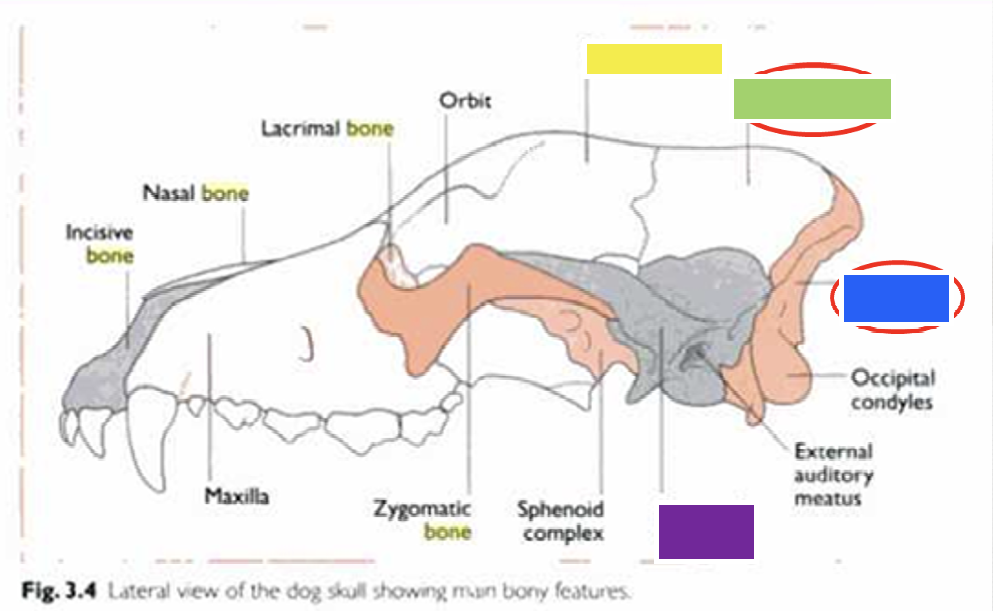
Yellow
Frontal Bone

Green
Parietal Bone
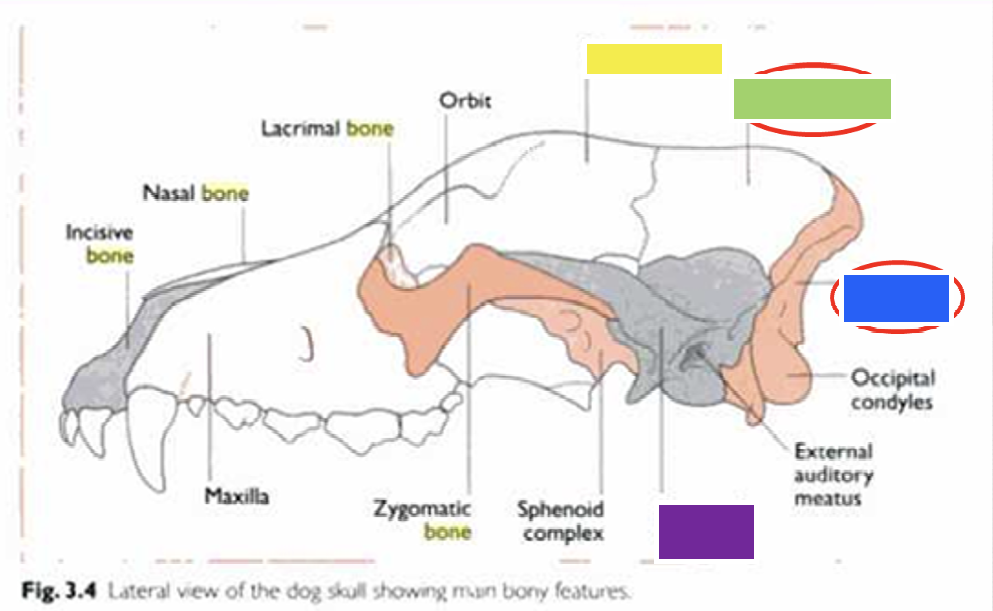
Blue
Occipital Bone
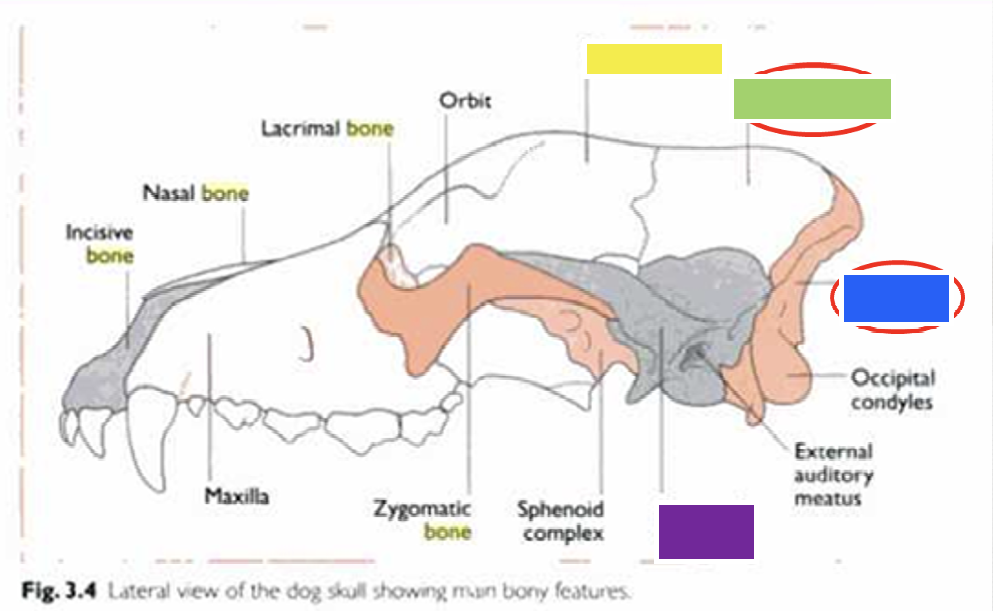
Purple
Temporal Bone
There are two, located below the parietal bones
Temporal Bones
Temporal bones form the what walls of the skull?
Lateral
The temporal bones house what structures?
The middle and inner ear
“Forehead” region of the skull
Frontal bone
The frontal bone forms the front part of the skull and a portion of the….
Eye socket (orbit)
What sinuses are contained in the frontal bone?
Paranasal and frontal
Incisive bones
House the upper incisors
Nasal bones
Form the bridge of the nose
Maxillary bones
Make up most of the upper jaw
Lacrimal bones
Form the medial part of the orbit, and have a small space that houses part of the tear drainage system of the eye
Zygomatic bones
Form the zygomatic arches
Mandible
The lower jaw, and the only moveable skull bone, joined by a cartilage joint (mandibular symphysis)
Shaft of the mandible
Houses all the teeth
Ramus
Where the jaw muscles attach and the articular condyles are located
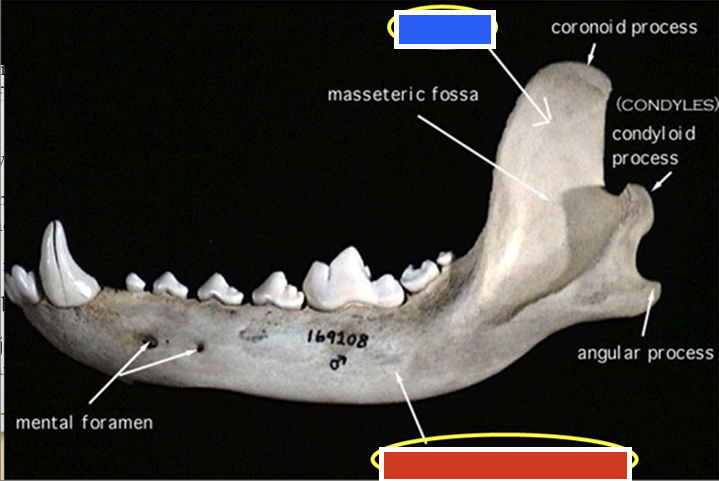
Blue
Ramus
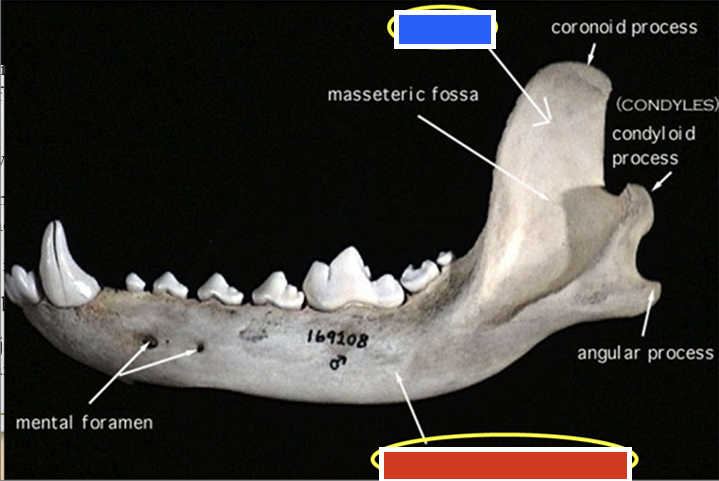
Red
Mandibular Body/Shaft

Red
Incisive
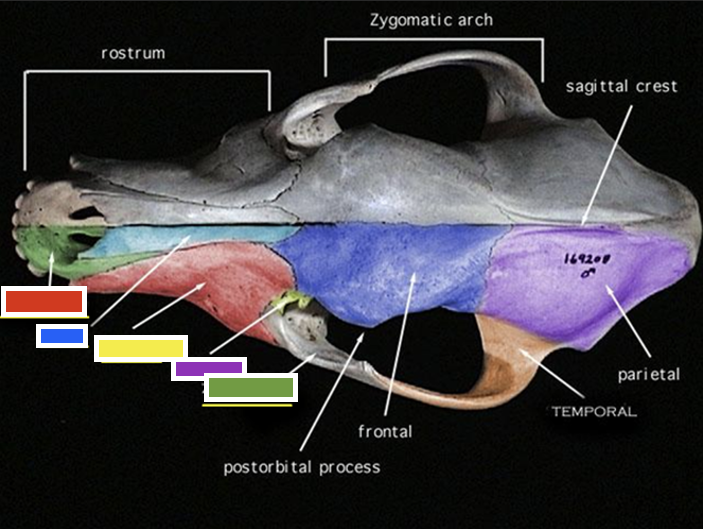
Blue
Nasal
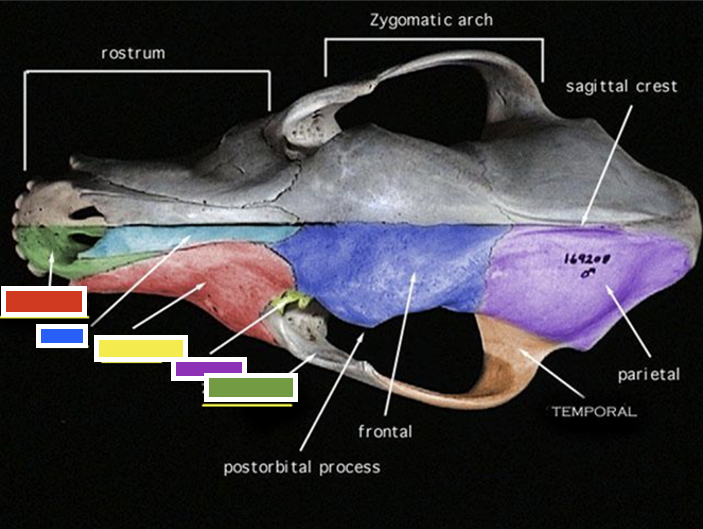
Yellow
Maxillary
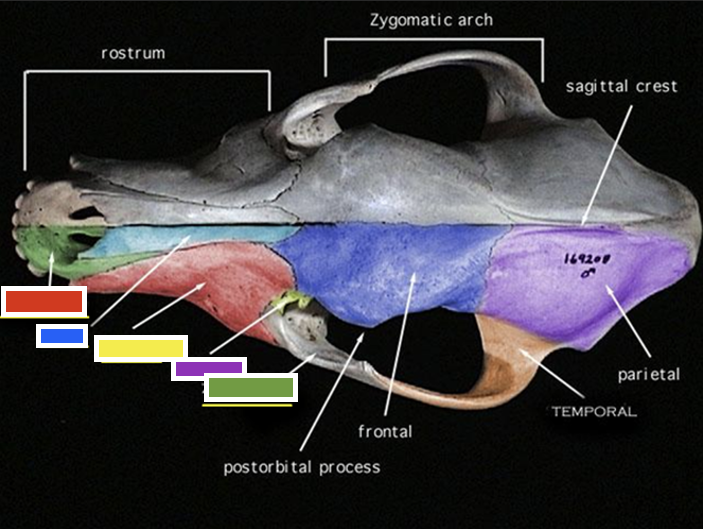
Purple
Lacrimal
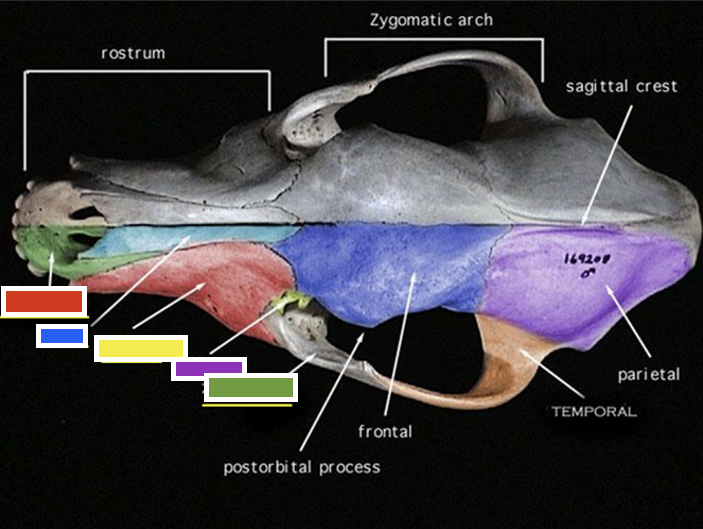
Green
Zygomatic
Palatine Bone
Makes up the caudal portion of the hard palate
Pterygoid bone
2 small bones that support part of the lateral walls of the throat
Vomer bones
Forms part of the nasal septum
Turbinates
Scroll like bones that fill the nasal cavity
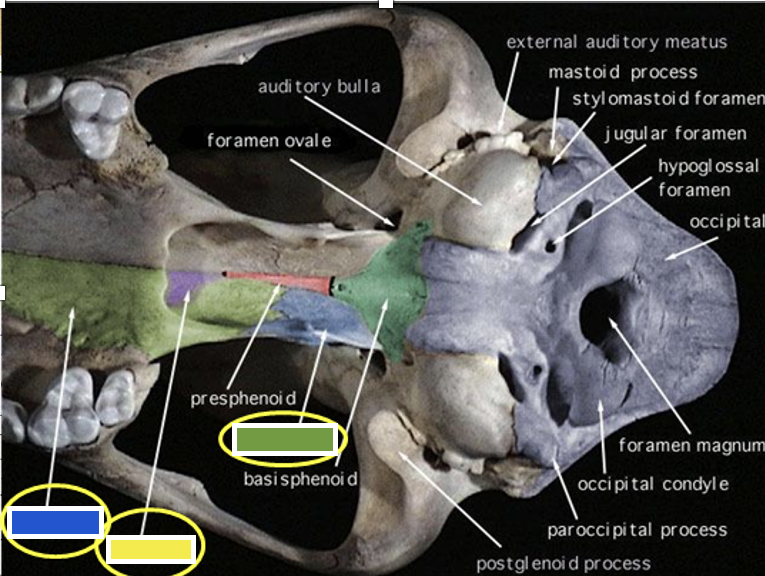
Blue
Palatine