ECONOMICS UNIT4 AOS1B - MONETARY POLICY
 Call Kai
 Learn
Learn Practice Test
 Spaced Repetition
 Match
Match Flashcards
 Knowt Play
1/30

There's no tags or description
Looks like no tags are added yet.
Name | Mastery | Learn | Test | Matching | Spaced | Call with Kai | Chat |
|---|
No analytics yet
Send a link to your students to track their progress
31 Terms
KK1 - The role of the RBA with respect to monetary policy as outlined in its charter
what is monetary policy?
Monetary Policy is operated by the RBA on behalf of the government and involves the manipulation of key financial variables (primarily interest rates).
role of rba in mp
improving the welfare or prosperity of Australians is the ultimate goal of monetary policy
'the stability of the currency' is a medium term objective
The RBA's medium term objective is to keep consumer price inflation between 2-3% on average over time. Once low inflation is achieved the RBA can then focus on achieving other economic goals e.g. full employment and economic growth.
Section 10(2) of the Reserve Bank Act 1959
KK2 - conventional monetary policy (cash rate target) and how it affects interest rates
define cash rate
The cash rate is the interest rate that applies to borrowing and lending by banks in the overnight money market (aka cash market).
conventional mp
The traditional way the RBA implements monetary policy is via the manipulation of interest rates.
While the RBA has no direct control over all interest rates in the economy it does have the ability to impact the ‘cash rate’ which enables it to indirectly affect all other interest rates (especially variable rate mortgages).
overnight money market
Every Australian bank is legally required to have an exchange settlement account (ESA) with the RBA in order to settle interbank transactions.
At the end of each day each bank is required to have a positive cash balance. This creates a market for cash as those with surplus balances will be seeking to lend out excess funds while those with deficits will be seeking to borrow.
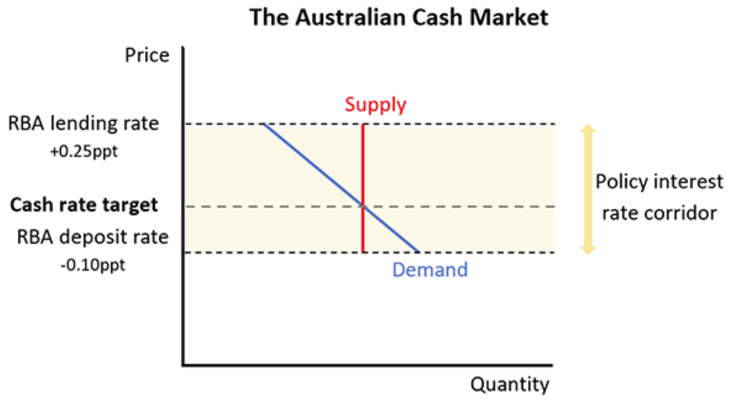
Like any market, equilibrium occurs when the price of cash is such that demand equals supply.
the corridor system
The RBA operates a corridor system whereby a ‘cash rate target’ is announced (currently 3.85%).
Banks who have a deficit balance can borrow unlimited funds from the RBA, however, at a rate that is 0.25% (or 25 basis points) higher than the cash rate target. This incentivises borrowing from other banks.
Banks that have a surplus balance can earn interest from the RBA at a rate 0.10% (or 10 basis points) lower than the target cash rate. This incentivises lending to other banks.
When the RBA announces a change in the cash rate target, either higher or lower, the rates paid on the ESA balances will also change. Therefore, banks will always lend and borrow inside the corridor set by the RBA as doing so outside would cost more or provide less return.
open market operations (omos)
RBA engaged in Prior to changes COVID-19 - to ensure that the actual cash rate traded as closely to the target as possible. This process is currently still suspended.
OMOs involves that RBA managing the level of liquidity in the cash market (how much cash there is) in order to either increase or decrease the actual cash rate and get it as close as possible to the target cash rate.
To decrease the actual cash rate the RBA would purchase Australian Government Securities (AGS) or repurchase agreements (repos) from the banks in exchange for cash. This would increase the amount of cash in the cash market (increasing liquidity) and putting downward pressure on the cash rate.
To increase the actual cash rate the RBA would do the opposite and sell AGS and repos to the bank in exchange for their cash. This reduces liquidity in the cash market and causes the cash rate to rise. OMO used to be done on a daily basis and is expected to return in the near future. Currently the RBA only engages in OMO when they feel necessary.
affect on cash rate/interest rate
The RBA aims to keep inflation between 2-3% on average over time. This means that the RBA is prepared to tolerate some level of short term volatility over the economic cycle.
The underlying rate of inflation is a key statistic that provides insight into what is likely to happen to the headline rate of inflation in the future.
The underlying rate allows the RBA to ignore temporary factors that influence the CPI therefore allowing the setting of monetary policy to be proactive.
KK3 - one example of the operation of an unconventional monetary policy tool from the past two years
unconventional monetary policy
involves the usage of tools or methods other than the direct manipulation of the cash rate in order influence market interest rates and economic activity.
The COVID-19 pandemic (and the high need for stimulus) caused the RBA to make use of unconventional policies such as:
Asset purchases/quantitative easing
Forward guidance
Policy interest rate setting
Term funding facility
In the last couple of years the RBA has used less of the above unconventional policies and have focused on forward guidance to indicate future interest rate cuts.
foward guidance
provides the markets and economic agents with information about the future directions of interest rates.
In late 2020 and for much of 2021, the then RBA Governor Philip Lowe and the board indicated that the first interest rate increase was not expected for ‘at least three years’, and then not until ’2024 or later’.
This indication by the RBA provided many households and businesses with the confidence to borrow as they had the expectation that rates wouldn’t rise for an extended period. The cash rate aggressively started rising in May 2022 due to unanticipated high inflation.
Higher interest rates have increased the cost of servicing debt for many households and businesses. With many claiming that they would not have borrowed as much had it not been for the RBA’s statements about the future direction of interest rates.
term funding facility
The term funding facility enabled the banks (and some other financial institutions) to borrow from the RBA at a low cost for 3 years. $188 billion dollars was accessed from the term funding facility by banks and other financial institutions.
The term funding facility was designed to reduce the funding costs of the banking system which in turn results in lower costs for borrowers.
Additional low cost funding was provided for banks and other financial institutions that lent to businesses, especially small and medium sized enterprises.
monetary policy - tightening and loosening
Tightening – RBA announcing a higher cash rate target (e.g. 1.5% to 1.75%) the afternoon of its regular meeting (8 per year). This higher rate will take effect immediately as the RBA has a monopoly in the cash market.
Loosening – RBA announces a lower cash rate (e.g. 4.1% to 3.85%), the market will immediately adjust as the RBA is a highly credible central bank.
unconventional mp example in the last 2 years
APRIL 2025 - rba introduced a 7 day repo facility along its existing 28 day repo facility
provided banks with short term access to liquidity
helped maintain the smooth functioning of financial markets and supply of crdit
NOTE: this was not intended to change overall stance of MP
KK4 - transmission mechanism of monetary policy and its effect on the level of aggregate demand, including the four channels of savings and investment, cash-flow, exchange rate, and asset prices and wealth
transmissions mechanisms
When the RBA makes a change to the cash rate there is a change to other interest rates in the economy. This is referred to as 'the interest rate pass-through'.
For example, if the cash rate rises it can be expected that other forms of funding for the banks will also increase. Essentially the banks will face higher costs of production which they pass on in the form of higher interest rates.
There are 4 specific ways in which a change in the cash rate will affect the economy (the transmission mechanisms). They are:
-Cost of credit channel (Savings & Investment)
-Cash flow channel
-Asset prices and wealth channel
-Exchange rate channel
cost of credit channel (savings and investment)
This channel focuses upon the willingness of consumers to borrow money as well as their propensity to save. In addition, this channel includes the willingness of businesses to borrow to invest.
Higher interest rates discourages households and businesses from borrowing funds and encourages more saving as the rate of return is higher. This leads to a reduction of AD (and therefore inflation) via lower C and I.
Lower interest rates encourages households and businesses to borrowing funds and encourages less saving as the rate of return is lower. This leads to an increase of AD (and therefore GDP) via higher C and I.
cash flow channel
The cash flow channel focuses upon the discretionary income of households. Those with variable rate mortgages will see changes in their repayments based upon movements in the cash rate.
For example, a fall in the cash rate leads to lower rates on variable rate mortgages. Therefore, those with a variable rate mortgage will need to make lower repayments increasing their discretionary income. With higher discretionary income C should rise as a component of AD leading to more economic growth.
asset prices and wealth channel
The asset prices channel refers to how the price of assets (e.g. shares and property) will likely change based upon the changes in interest rates. This affects the wealth of households and therefore their propensity to spend.
For example, with higher interest rates the price of property and shares should fall (as there is less demand). This means those who own these assets are seeing a fall in their wealth on paper (or real wealth if they choose to sell). This reduces their C (as they feel less wealthy) and therefore AD, reducing inflationary pressure.
exchange rate channel
Changes in the cash rate (and therefore interest rates) will generally lead to changes in the exchange rate.
For example, with lower interest rates the AUD should depreciate. This is because capital outflow should occur whereby investors seek higher rates of return elsewhere. As more AUD exits Australia there is less demand for the AUD pushing down its price. A lower AUD increase exports which increases AD (X) and economic growth. A lower AUD also makes imports more expensive which will increase inflationary pressure.
KK5 - the stance of monetary policy: expansionary (accommodative), contractionary (restrictive) or neutral
stance of mp
Monetary policy neutrality exists when the RBA's target cash rate has neither an expansionary nor contractionary impact upon the economy. Currently, a cash rate of 3-3.5% is considered to be neutral.
A cash rate lower than 3-3.5% is considered expansionary (or accommodative). This stance stimulates AD and increases inflationary pressure.
A cash rate higher than 3-3.5% is considered contractionary (or restrictive). This stance aims to slow inflationary pressures by restraining AD.
KK6 - the stance of monetary policy over the past two years and its likely effect on the achievement of the domestic macroeconomic goals and living standards
stance of mp over the past 2 years
Monetary policy stance: Over the past two years, the RBA has generally maintained a restrictive stance, with high interest rates used to reduce inflation. Rates were gradually lowered during 2025 as inflation eased, before tightening again in 2026 as inflationary pressures increased.
stance effect on eco goals
Inflation: Higher interest rates reduce consumption and investment, decreasing aggregate demand (AD) and inflationary pressure, helping return inflation towards the 2–3% target.
Economic growth: Restrictive monetary policy can reduce economic growth by lowering household spending and business investment.
Full employment: Lower AD can reduce demand for labour, making it harder to achieve full employment.
Living standards: Higher interest rates can reduce living standards in the short term through higher mortgage repayments and lower disposable income, but lower inflation protects purchasing power and supports living standards in the long term.
Overall: The RBA has had to balance reducing inflation with supporting economic growth, employment and living standards.
KK7 - the strengths and weaknesses of using monetary policy to affect aggregate demand and influence the achievement of the domestic macroeconomic goals and living standards
strengths of mp
Free from political bias – policy is implemented independently by the RBA. Decisions should be made based upon consideration of the economy alone.
Short implementation lag - once the policy decision is made to change the cash rate markets will start to adjust immediately.
Influence on expectations - concerns expressed by the RBA Governor can shape consumer behaviour without actual changes to monetary policy.
Effective at constraining AD - powerful at quickly reducing the discretionary income of households.
weaknesses
Monetary Policy is a blunt tool – Monetary policy cannot target specific sectors of the economy.
Impact lag - It takes time (up to 2 years) for Monetary Policy actions to fully impact the economy e.g. consumers may take a while to change their behaviour. It is possible that MP could become pro-cyclical as opposed to counter cyclical.
Lack of direct control - the RBA does not directly control interest rates and it relies upon competitive pressures to cause the desired effect.
Less effective at stimulating AD - during a downturn cuts to interest rates may not actually increase AD as households may not spend their higher discretionary income.
Cannot directly reduce inflationary pressures from the supply side.
extra *** exchange rate intervention
Changes in interest rates will impact the value of the AUD via international capital flows.
The RBA does not have an exchange rate target and will not adjust the cash rate to impact the value of the AUD on foreign exchange markets.
However, the RBA will occasionally intervene in the foreign exchange market if it believes that the AUD is highly under or over-priced. It does this by buying or selling AUD.
Intervention in the foreign exchange market is referred to as a dirty float.