WMM
 Call Kai
 Learn
Learn Practice Test
 Spaced Repetition
 Match
Match Flashcards
 Knowt Play
1/11

There's no tags or description
Looks like no tags are added yet.
Name | Mastery | Learn | Test | Matching | Spaced | Call with Kai | Chat |
|---|
No analytics yet
Send a link to your students to track their progress
12 Terms
who developed this model
Baddeley and hitch
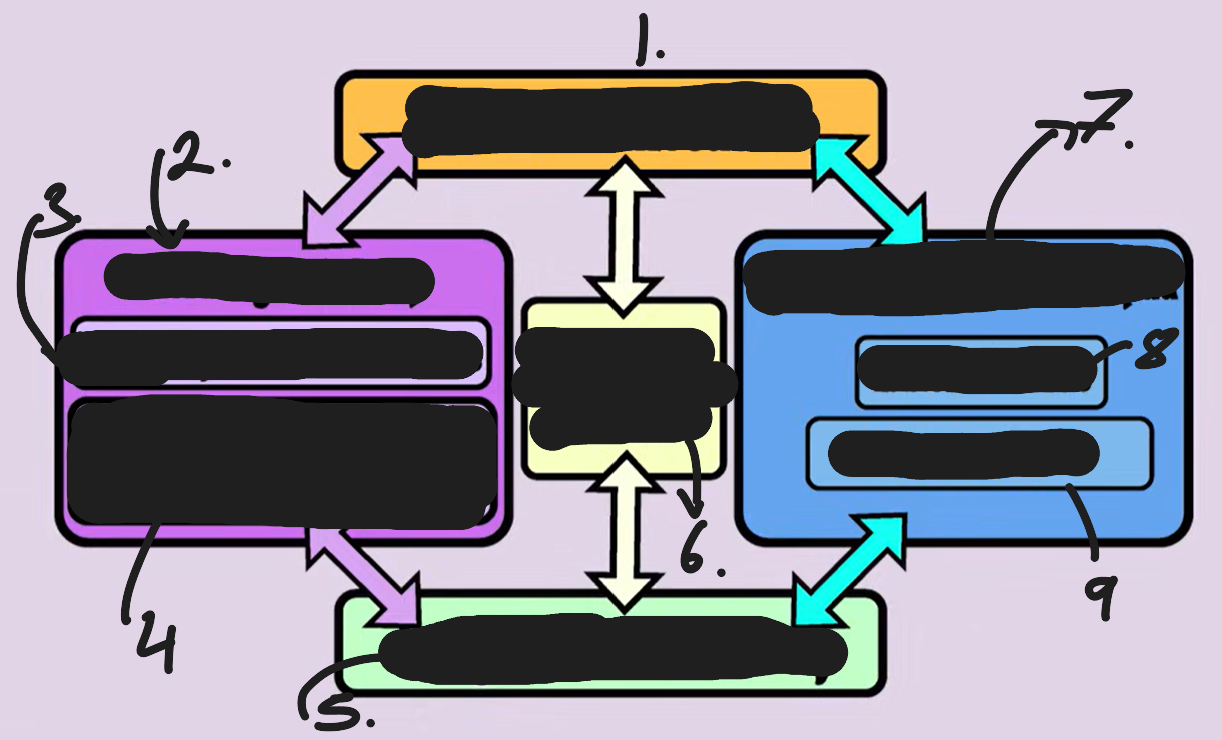
central executive
phonological loop
articulatory system
phonological store
LTM
episodic buffer
visuospatial scratchpad
inner scribe
visual cashe
The central executive (controller)
controls and coordinates operation of the other components ( salve systems) . Has limited capacity.
The phonological loop (the sound system)
responsible for the processing of sound based information. This consists of articulatory systems and phonological store
The articulatory system ( inner voice)
The articulatory system (the inner voice) – limited capacity verbal rehearsal component used to prepare speech and think in words. Capacity is determined by how long it takes to say something not the number of items.
The phonological store (the inner ear)
limited capacity auditory rehearsal system which receives sound information from the environment. Also receives information from our own internal speech (e.g. when we ‘hear’ in our heads what we are thinking).
The visuospatial sketchpad (the inner eye)
visuospatial rehearsal system where we can image and manipulate visual and spatial information. made up of inner scribe and visual cash
The episodic buffer
a temporary store for information, integrating visual, spatial and verbal information processed by the other stores and maintaining time sequencing. It is the storage system of the central executive and has limited capacity of 4 chunks. It also links working memory with LTM and cognitive processes such as perception.
what are the 2 types of forgetting in STM
displacement and decay
One strength is case study evidence in support
A key strength of the Working Memory Model is that it is supported by case study evidence showing that short-term memory is not a single, unitary store. For example, Shallice and Warrington’s (1970) case study of KF, who suffered brain damage resulting in amnesia, found that his digit span for auditory information was severely impaired, whereas his recall of visually presented digits was much better. This suggests that different components of STM are responsible for processing different types of information. The WMM can explain this by proposing separate systems such as the phonological loop (for auditory information) and the visuospatial sketchpad (for visual information). In contrast, the Multi-Store Model cannot account for this finding because it views STM as a single store, meaning all information should be equally affected by damage. Therefore, this evidence supports the WMM’s multi-component structure, increasing its explanatory power and making it a more accurate representation of short-term memory.
Real world applications
Another strength of the Working Memory Model is that it has important real-world applications, particularly in the assessment and treatment of learning difficulties. The model suggests that short-term memory is made up of separate components, such as the phonological loop, which is responsible for the temporary storage and rehearsal of verbal and auditory information. Research has shown that children with reading difficulties often perform poorly on tasks that rely on the phonological loop, such as phonological awareness tasks (e.g. deciding whether two words rhyme). This suggests that impairments in the phonological loop may underlie some reading and language problems. As a result, the Working Memory Model has influenced the development of targeted interventions, such as training programmes that aim to improve phonological processing. This increases the practical value and usefulness of the model, as it can be applied to real-life educational and clinical settings, which is a strength compared to more abstract memory theories.
One limitation is that the working memory model is that not much is know about the central executive
A limitation of the Working Memory Model is that the central executive is poorly understood, despite being described as the most important component of working memory. The central executive is responsible for attention control, task coordination, and the allocation of processing resources to the phonological loop and visuospatial sketchpad. However, it is considered to be theoretical and oversimplified, as there is little direct evidence to show exactly how it works. Some researchers argue that the central executive is not a single system but is instead made up of several separate components that control different types of attention. Because the precise structure and functions of the central executive are unclear, this means the Working Memory Model lacks completeness and may not fully explain how working memory operates. This reduces the explanatory power of the model and is therefore a significant weakness.