Intro to Probability
 Call Kai
 Learn
Learn Practice Test
 Spaced Repetition
 Match
Match Flashcards
 Knowt Play
1/22

There's no tags or description
Looks like no tags are added yet.
Name | Mastery | Learn | Test | Matching | Spaced | Call with Kai | Chat |
|---|
No analytics yet
Send a link to your students to track their progress
23 Terms
key aspect of solving real business problem
dealing with uncertainly
sources of uncertainty
demand for products
stock price returns
time between arrivals
daily sales
random variables
the name of uncertainty in numerical quantity in probability and statistics
probability
a way to deal with and manage uncertainty , an intuitive concept
experiment
any process whose outcome is not known in advance
sample space
the set of all possible outcomes of an experiment
event
a set of possible outcomes of an experiment
probability
the chance that an event will occur

properties of porbability
all probabilities are between 0 and 1
the closer of an event is to 1, the more likely it is to occur
if event a is a subset of event b, then the probability of b is greater than or equal to probability of a
event a = sunny
event b = sunny, cloudy
P(b) greater than equal to P(a)
rule of complements: P(a^c) = 1 - P(a)
a^c is the event that event a doesn’t occur

addition rule
conditional probability and multiplication rule
probabilistic independence
law of total probability
random variable
a variable that can take on different values, each with an associated probability
will hold the outcome of a random event
probability distribution
describes the likelihood of a random variable
its a list of possible outcomes (sample space/population) and their associated probabilities
population probability is made up w assumptions or estimate it using historical data
discrete random variable
take on only a countable number of distinct values
the probability mass function, pmf

X = random variable, x = fixed outcome
expected value:
is the weighted average of all the k values, with their probabilities serving as weights
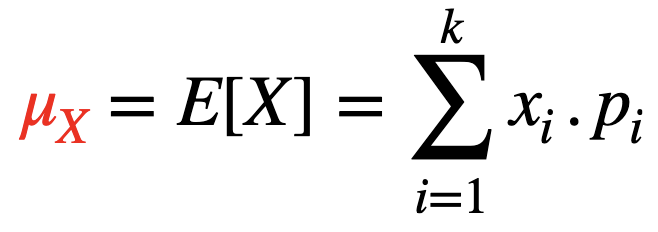
E[.] is a function we apply to random variables
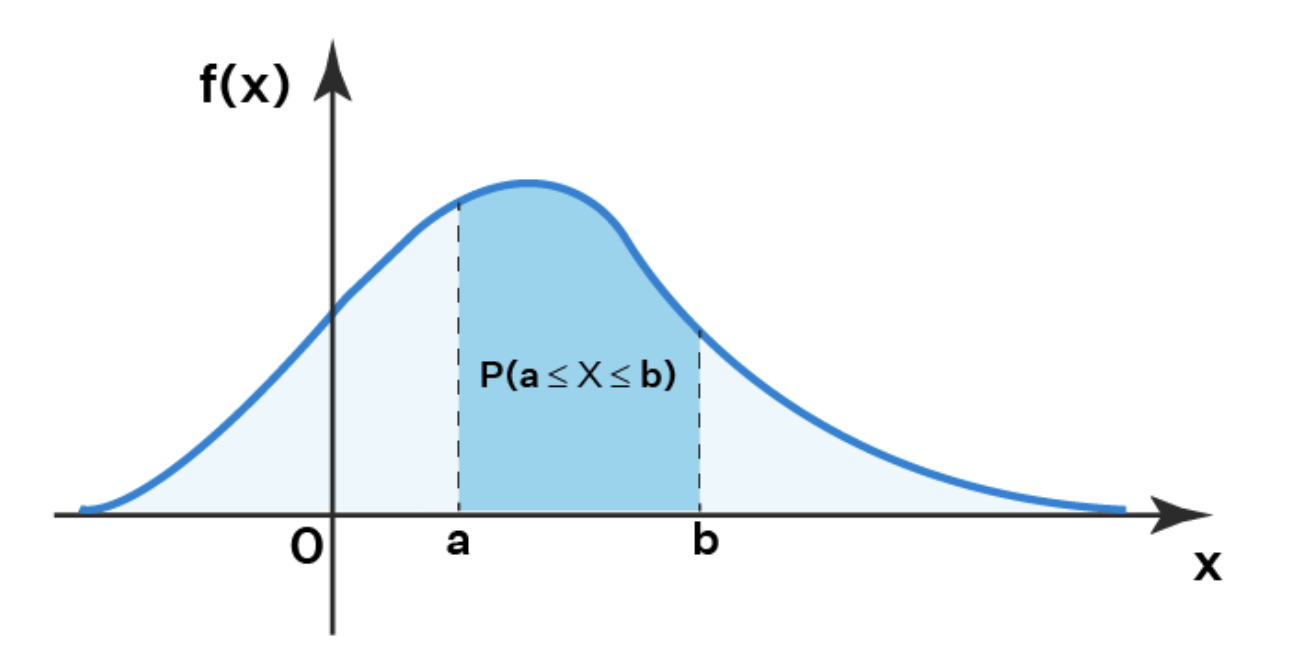
continuous random variable
takes on an infinite number of real values in some sane
the probability density function f(x), PDF, is the likelihood of x. CDF is denoted as F(x). the area under f(x) within a given interval

x is a continuous RV, then P(X=x)=0, for every real number x
cumulative probability distribution function, cdf
describes the probability that the random variable is less that or equal to some value

continuous random variable
the probability density function f(x) (PDF), is the likelihood of x.
CDF = F(x)


expected value of a discrete random variable
the weighted average of all the k values, with their probabilities serving as weights

E[.] is a function applied to random variables
expected value
long run average
variance of a random variable
quantify the variability of a random variable. variance measures the variability of the outcomes of X around its expected values (mean) X

Var(.) like E[.]
correlation of two random variables
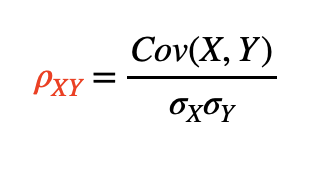
independence of two events
intuition: the occurrence of one event (A) doesn’t affect the probability of occurrence of the other event (B)
P(A|B) = P(A)
P(B|A) = P(B)
P(A and B) = P(A)P(B)
if two events are independent
P(A and B) = P(A)P(B)
variance of sum of random variables if variables are independent
Var(X+Y) = Var(X)+Var(Y)
variance of sum of random variables if variables are dependent
Var(X+Y) = Var(X)+Var(Y)+2Cov(X,Y)