Water of crystallisation
 Call Kai
 Learn
Learn Practice Test
 Spaced Repetition
 Match
Match Flashcards
 Knowt Play
1/5

Earn XP
Description and Tags
https://www.youtube.com/watch?v=9sEj8htfrEM
Name | Mastery | Learn | Test | Matching | Spaced | Call with Kai | Chat |
|---|
No analytics yet
Send a link to your students to track their progress
6 Terms
What is water of crystallisation
crystals of a formula contain water molecules bonded into the crystal structure
It is shown by the dot in the formula.
They are called hydrated compounds as they have WOC
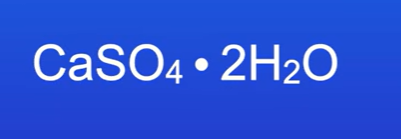
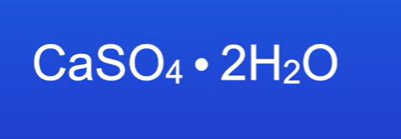
What does the dot tell us in this formula
Tells us that the crystal contains two molecules of water for every calcium sulfate.
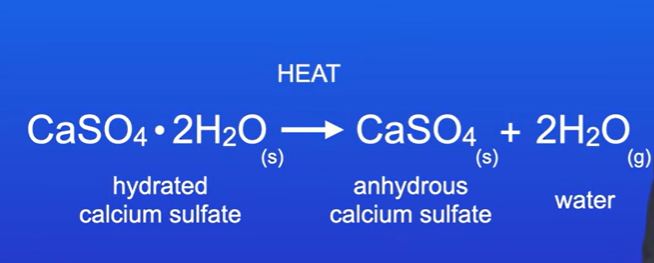
What happens when we heat hydrated compounds
We can break the bonds holding the water molecules into the crystal
This drives the water molecules off as steam
We are left with anhydrous compound, means it does not contain WOC.
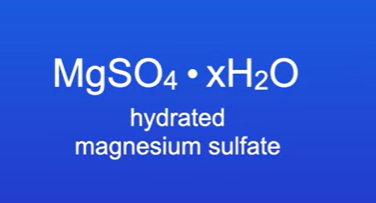
How do you determine the value of the water of crystallisation for this example , includes X.
Hydrated magnesium sulfate has relative formula mass of 264.4g / mol. Determine val of X
We know hydrated magnesium sulfate has Mr of 264.4 g / mol, includes the water as well
We can calculate Mr of mgso4 without the water, which is 120.4g / mol
Mass of water is now 246.4 - 120.4 = 126
Each molecule of water has a relative molecular mass of 18.0 g / mol. Dividing total mass of water by 18 gives us 7.
So value of x is 7
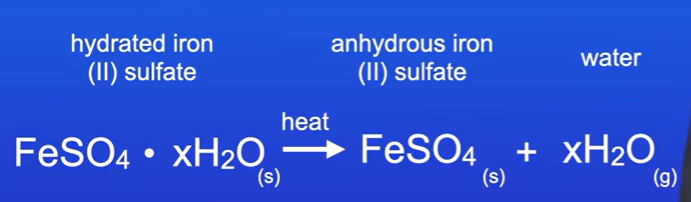
9.816g of hydrated ion (II) sulfate was heated until the mass stopped decreasing. The final mass was 5.369 g. Calculate value of x.
Mass of water lost must have been 4.447g (9.816 - 5.369)
We know mass of feso4 and h2o, so we can calculate moles of each (N = M/Mr)
0.035 moles of iron II sulfate, and 0.247 moles of water
We find ratio of these numbers by dividing by smallest number, so ratio of 1 iron (II) sulfate to 7 waters, so x is 7