Chapter #6 - Network Layer
 Call Kai
 Learn
Learn Practice Test
 Spaced Repetition
 Match
Match Flashcards
 Knowt Play
1/36

There's no tags or description
Looks like no tags are added yet.
Name | Mastery | Learn | Test | Matching | Spaced | Call with Kai | Chat |
|---|
No analytics yet
Send a link to your students to track their progress
37 Terms
Why is L2 (Data Link Layer) insufficient for large-scale communication?
L2 uses broadcasts, causes large switch tables, and cannot cross different L2 technologies.
What are the primary tasks of the Network Layer (L3)?
Data transmission (datagram or virtual circuit), routing, internetworking, addressing, fragmentation & reassembly.
What are secondary/optional tasks of the Network Layer?
Congestion control, QoS (bandwidth, delay, error rate), multiplexing of network connections, error detection/correction, flow control, maintaining transmission sequence.
What is a Subnetwork (IS 7498 definition)?
One or more intermediary systems (IS) that provide switching functionality through which end systems (ES) can establish network connections.
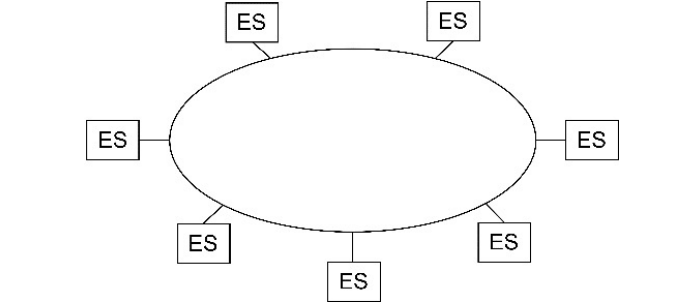
What must the Network Layer know to route data?
Subnetwork topology, address/location of end system, network status (utilization), QoS requirements of the data stream.
What is the data entity at the Network Layer called?
Packet (vs. Frame at L2, Bit/Byte at L1).
What does the Network Layer service guarantee?
Services are standardized for end systems, independent of underlying network technology, topology, and number of subnetworks.
What are the four switching approaches at the Network Layer?
Circuit switching - switching a physical connection
Message switching - message stored and forwarded
Packet switching - store and forward, limited in size
Virtual circuit switching - pakcets over a pre defined path
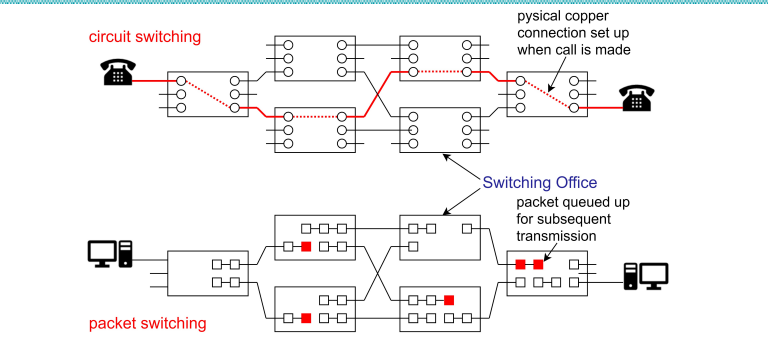
Circuit Switching – principle and key pros and contras?
Dedicated physical path reserved for entire call duration.
Fixed bandwidth → no congestion,
no processing at intermediate nodes → constant low delay.
Requires connection setup. Wasteful for bursty traffic (resource underutilization).
Message Switching – principle and pros/contras
Entire message treated as one unit; store-and-forward at each node (receive → check → store → forward whole). High memory requirements at nodes (message of any size). A node can be blocked by one large message. Example: early telegram service.
Packet Switching – principle and key properties?
Data split into limited-size packets; each packet independently and dynamically routed (no dedicated path).
No connect phase; dynamic bandwidth → good utilization for bursty traffic.
But: congestion possible, variable end-to-end delay, no sequence guarantee. Example: Internet (IP).
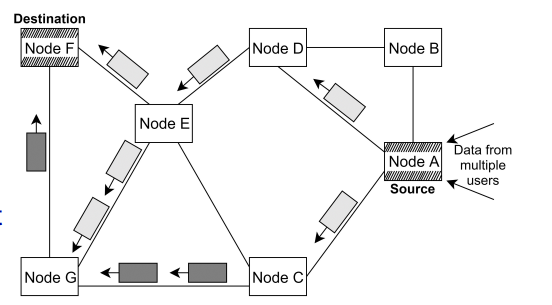
Virtual Circuit Switching – principle and key properties?
Path established before transfer, using state information in nodes(so not physical connection)
All packets (carry only circuit ID) of a connection follow the same predefined path.
PROS:
Sequence preserved; easier QoS. Examples: ATM (PVC = permanent, SVC = signaled), Internet IntServ (RSVP).
Key difference: Message switching vs. Packet switching?
Both store-and-forward; packet switching limits size → nodes not monopolized, pipelining possible.
Compare Circuit vs. Packet Switching (bandwidth, delay, congestion, pricing).
Circuit: reserved BW, no congestion, constant delay, poor bursty-traffic utilization; priced by connection duration.
Packet: dynamic BW, congestion possible, variable delay, efficient for bursty traffic; priced by volume.
Virtual Circuit vs. Packet Switching?
Virtual circuit: pre-set path, sequence preserved, easier QoS.
Datagram: each packet routed independently, variable routes, no sequence guarantee.
What are the two service models at the Network Layer?
Connection-oriented (virtual circuit) and connectionless (datagram).
Connection-oriented communication – properties?
3 phases: connect → data transfer → disconnect. QoS negotiation possible (throughput, error rate, delay). Reliable: no loss, no duplicates, correct sequence. Flow control included. Complex protocols. Example: telephone, ATM, X.25.
Connectionless communication – properties?
No connection setup. Packets treated as isolated datagrams. Unreliable: loss, duplication, reordering possible. No L3 flow control (delegated to L4+). Simple protocols. Example: IP.
Which service suits real-time communication?Why?
Connection-oriented; predictable QoS, controlled delay.
Which service suits simple data transfer? Why?
Connectionless; no setup overhead, simpler, flexible routing.
What is routing?
Determining the path packets take from source to destination through a network.
Non-adaptive vs. Adaptive routing?
Non-adaptive: static routes, not dependent on current network state. Adaptive: routes updated dynamically based on topology/traffic.
Non-adaptive Shortest Path Routing – algorithm?
Dijkstra's algorithm. Computes shortest-path tree from source using static link weights. Iteratively selects the unvisited node with lowest tentative cost.
Non-adaptive Flooding – principle and properties?
Every packet forwarded on all links except the incoming one.
+ Robust, guaranteed delivery if path exists.
- Generates many duplicates; →controlled by hop limit (TTL) or seen-packet list.
Distance Vector Routing (Bellman-Ford / RIP) – principle?
Each router maintains a cost vector to all destinations. Routers periodically send their vector to direct neighbors. Update rule: cost(dest) = min over neighbors of [cost_to_neighbor + neighbor's_cost(dest)]. RIP metric: hop count.
What is the "count-to-infinity" problem in Distance Vector Routing?
When a link fails, routers loop updates, each incrementing the failed route's cost by 1 until reaching infinity. Caused by routing loops from stale info.
Link State Routing – 5 steps?
Discover neighbors and their addresses.
Measure cost to each neighbor.
Build a Link State Packet (LSP) with this info.
Flood the LSP to all routers.
Each router runs Dijkstra on the complete topology to compute its routing table.
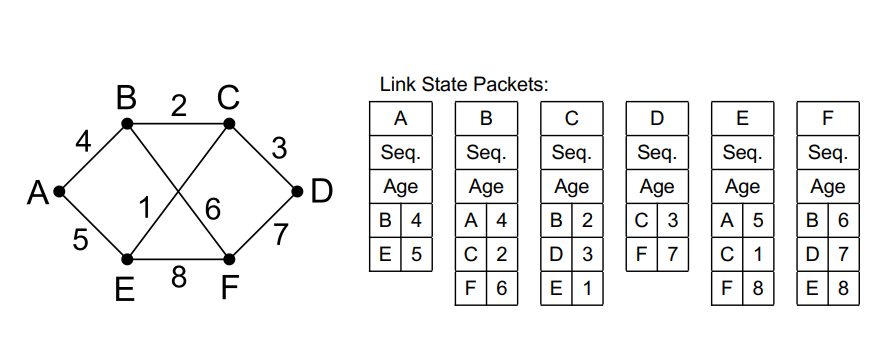
Why is Link State Routing not suited for very large networks?
Full topology stored at every router; LSP flooding creates O(n²) message overhead. Memory and bandwidth scale poorly.
Distance Vector vs. Link State – key comparison?
DV: only local info, simple, slower convergence, count-to-infinity risk. Used in RIP.
LS: global topology at each node, fast convergence, loop-free after convergence, but high overhead. Used in OSPF.
What does a routing table entry contain?
Next-hop address/output interface
Destination IP + Mask
How does a router forward a packet (longest prefix match)?
Bitwise AND between the destination IP and mask of each table entry.
Result == entry’s network address? match→send
What makes a valid subnet mask?
Must be a contiguous block of 1-bits followed by 0-bits. Example: /26 = 255.255.255.192 (valid). 255.255.255.125 = invalid (non-contiguous 1s).
Formula: usable hosts in a subnet with prefix length /n?
2^(32-n) − 2 (subtract network address and broadcast address).
What is CIDR?
Classless Inter-Domain Routing — uses variable-length prefix notation (e.g., /17) instead of fixed class boundaries.
What is route aggregation (supernetting)?
Merging multiple contiguous network blocks into one entry with a shorter prefix. Reduces routing table size. All blocks must share the same leading bits.
What is an exception route?
A more-specific (longer prefix) entry added alongside an aggregated route to redirect a subset of addresses via a different interface. Longest prefix match ensures the exception takes precedence.
Why is IPv4 being replaced by IPv6?
IPv4 has only 2^32 ≈ 4.3 billion addresses; IPv6 uses 128-bit addresses (2^128). IPv4 address space is exhausted.