Chapter 6.2: Signal Molecule Receptors Can Be Classified into Several Groups
 Call Kai
 Learn
Learn Practice Test
 Spaced Repetition
 Match
Match Flashcards
 Knowt Play
1/9

Name | Mastery | Learn | Test | Matching | Spaced | Call with Kai | Chat |
|---|
No analytics yet
Send a link to your students to track their progress
10 Terms

Signal receptors
Proteins that bind a particular signal molecule
Grouped on position of reversible ligand binding
These utilize carbohydrate residues that affect folding

Intracellular receptors
Receptors located inside the cell that can bind to nonpolar substances

Membrane receptors
Transmembrane proteins with a ligand-binding and cytosolic region that initiates transduction and often functions as an enzyme

Signal regulation
Often performed through the production of competitive ligands
Seen with caffeine and adenosine both binding to an adenosine-dependent drowsiness receptor

Ligand-gated ion channels
Channels that allow ions to pass through when activated by a ligand
Seen with the acetylcholine receptor (AChR) requiring ACh to allow Na+ through

G proteins
Membrane proteins that can bind both the GDP and GTP molecules

G protein-coupled receptors (GPCRs)
Receptors that immediately activate G proteins in the cytosol

Heterotrimers
A GPCR-interacting G protein with three different monomers
Has an alpha subunit that can bind GDP or GTP based on activation state, exchanging for GTP when activated
This causes an effector protein activation for further changes

Protein kinase receptors
Receptors that change shape upon binding, phosphorylating and exposing a cytosolic kinase enzyme
These target the amino acids serine, threonine, and tyrosine
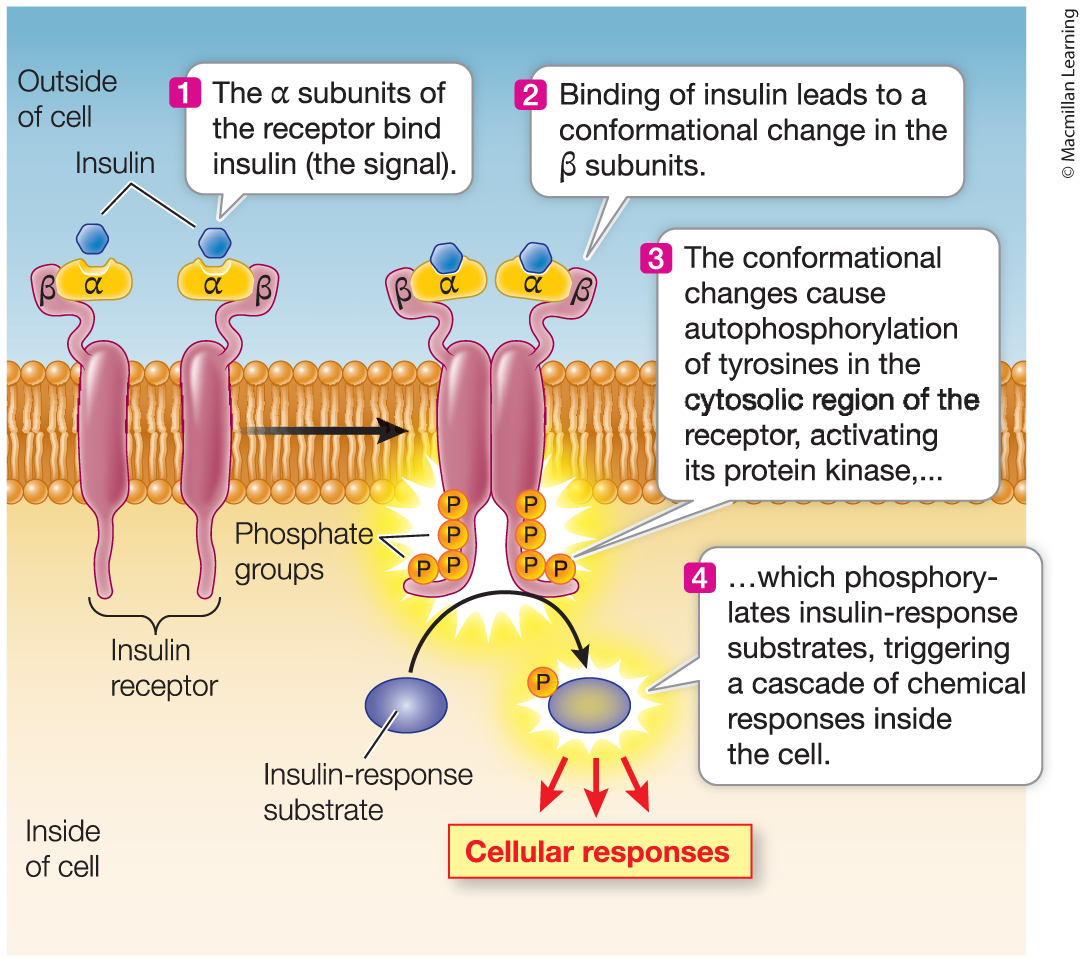
Autophosphorylation
The phosphorylation of a receptor’s own residues, particularly in kinase protein receptors
Seen with the receptor for insulin, which binds, changes shape, does this, and triggers a response