Ap bio chp 3
 Call Kai
 Learn
Learn Practice Test
 Spaced Repetition
 Match
Match Flashcards
 Knowt Play
 Podcast
1/47

There's no tags or description
Looks like no tags are added yet.
Name | Mastery | Learn | Test | Matching | Spaced | Call with Kai | Chat |
|---|
No analytics yet
Send a link to your students to track their progress
48 Terms
Cohesion
phenomenon of a substance being held together by hydrogen bonds. (water sticks to water)
Adhesion
of water to vessel walls counteracts the downward pull of
gravity. (water sticks to something else).
Surface tension
– measure of how difficult it is to stretch or break the surface of a liquid
Specific heat
amount of heat that must be absorbed or lost for one gram of a
substance to change its temperature by one degree Celsius.
Heat of vaporization
– quantity of heat a liquid must absorb for 1 g to be converted to the
gaseous state.
hydration shell
is a blanket of water molecules that wraps around dissolved particles to keep them separated in water.
What type of bonds holds the hydrogen to the oxygen within a water molecule?
Polar covalent bonds hold the hydrogen atoms to the oxygen atom within a single water molecule. Because oxygen is significantly more electronegative than hydrogen, it pulls the shared valence electrons closer to its nucleus.
What type of bond holds water molecules together?
Hydrogen bonds hold separate water molecules together.
Why does ice float?
Ice floats because water expands as it freezes, making solid ice less dense than liquid water.
Hydrophilic
(hydro – water; philo – loving); property of having an affinity for water. Some
large hydrophilic molecules can absorb water without dissolving.
Hydrophobic
(hydro – water; phobos – fearing); property of not having an affinity for water,
and thus, not being water-soluble.
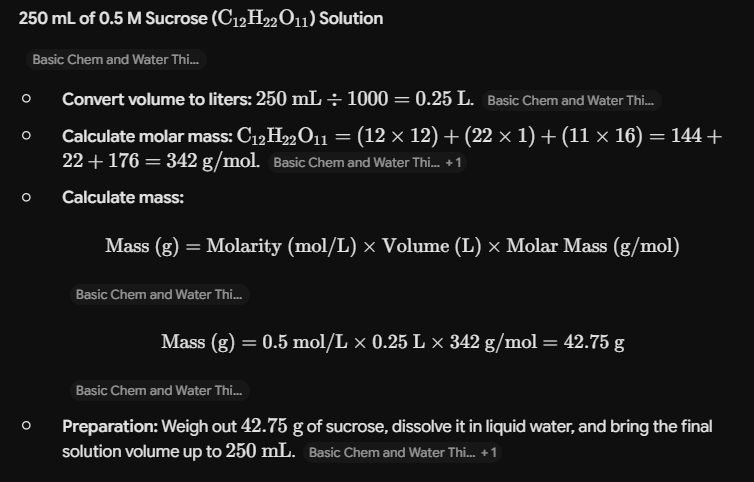
know how to prepare solutions of various concentrations.. prepare 250 ml of a 0.5 molar sucrose
What pH Measures
How many H+ (hydrogen) ions are in a liquid.
Neutral (pH 7):
equal H+ and OH- ions
Acid (pH < 7)
Adds extra H+ ions
Base (pH > 7)
Removes H+ ions (or adds OH-)
Finding Ion Amounts:
Take the pH number and put it in the exponent: a pH of 3 means H+ = 10 -3 M. Because H+ AND OH- exponents must total -14, OH- = 10-11 M.
pH 3 vs. pH 6 Acidity
Moving 3 steps down (6 - 5 - 4 -3) means 10 × 10 × 10 = 1000 times more acidic.
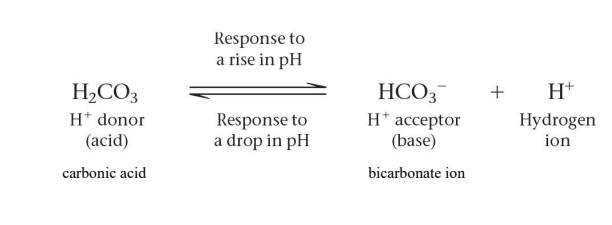
Buffer
substance that minimizes large sudden changes in pH.
Buffer - Are combinations of
of H+
-donor and H+
-acceptor forms in a solution of weak acids or bases
Buffer - Work by accepting
H+
ions from solution when they are in excess and by donating H+
ions to
the solution when they have been depleted
Example of Bicarbonate buffer
pH scale
scale used to measure degree of acidity. It ranges from 0 to 14.
Water molecule that lost a proton has a net negative charge and is called
a hydroxide ion (OH-)
By convention, ionization of H2O is expressed as
the dissociation into H+
and OH-
.
At equilibrium in pure water at
25°C: Number of H+ ions = number of OH- ions.
Mole (mol)
– the number of grams of a substance that equals its molecular weight in daltons and
contains Avogadro’s number of molecules, expressed in grams
Molarity
number of moles of solute per liter of solution, to make a 1M sucrose solution, weigh
out 342 g of sucrose and add water up to 1L.
Molecular mass
the sum of all the masses of all the atoms in a molecule, expressed in daltons
Nonpolar compounds
which have symmetric distribution in charge are not water
soluble, repel water molecules (do not dissolve in water), example – vegetable oil
Ionic compounds
are water soluble (dissolve in water)
- Charged regions of polar water molecules have an electrical attraction to
charged ions
- Water surrounds individual ions separating them from one another
- Forms a hydration shell
Polar compounds
in general are water soluble
- Charged regions of polar water molecules have an affinity for the oppositely
charged regions of other polar molecules
Water is the solvent of life
yes
Solution
a liquid that is a completely homogenous mixture of two or more substances.
Solvent
dissolving agent of a solution.
Solute
substance dissolved in a solution.
Aqueous solution
solution in which water is the solvent.
Evaporative cooling
cooling of a liquid's surface when a liquid evaporates. The surface molecules with the highest kinetic energy are most likely to escape into
gaseous form; the average kinetic energy of the remaining surface molecules is thus lower.
Vaporization
(evaporation) – transformation from liquid to a gas. Molecules with enough
kinetic energy to overcome the mutual attraction of molecules in a liquid, can escape into the air.
A large body of water can act as a heat sink, absorbing heat from sunlight during the day and
summer
and releasing heat during the night and winter as
the water gradually cools. As a result:
i. Water, which covers three-fourths of the planet, keeps temperature fluctuations within a
range suitable for life.
ii. Coastal areas have milder climates than inland.
iii. The marine environment has a relatively stable temperature.
Kinetic energy
the energy of motion.
Heat
total kinetic energy due to molecular motion in a body of matter.
Temperature
– measure of heat intensity due to the average kinetic energy of molecules in a
body of matter.
Calorie (cal)
amount of heat it takes to raise the temperature of one gram of water by one
degree Celsius.
Kilocalorie (kcal or Cal)
amount of heat required to raise the temperature of one kilogram of
water by one degree Celsius
Water has extraordinary properties that emerge as a consequence of its polarity and hydrogen-bonding.
Some of these properties are that water:
a. Has cohesive behavior
b. Resists changes in temperature
c. Has a high heat of vaporization and cools surfaces as it evaporates
d. Expands when it freezes
e. Is a versatile solvent
Water is a
a polar molecule. Its polar bonds and asymmetrical shape give water molecules opposite
charges on opposite sides.