copper study guide
 Call Kai
 Learn
Learn Practice Test
 Spaced Repetition
 Match
Match Flashcards
 Knowt Play
1/18

There's no tags or description
Looks like no tags are added yet.
Name | Mastery | Learn | Test | Matching | Spaced | Call with Kai | Chat |
|---|
No analytics yet
Send a link to your students to track their progress
19 Terms
What is the deficiency disease of copper?
Copper deficiency or Menkes disease (ATP7A mutation).
What happens during copper deficiency?
Iron becomes trapped in enterocytes, less iron reaches tissues, anemia develops.
What are the symptoms of Menkes disease?
Brittle or kinky hair, developmental delay, neurological problems, copper buildup in intestinal cells, poor copper delivery to tissues.
What is copper toxicity called?
Wilson's disease (ATP7B mutation).
What happens during Wilson's disease?
Copper cannot be excreted into bile, so copper accumulates in the liver and other tissues. golden-brown or copper-colored rings around the outer edge of the eyes
Copper Absorption Facts
Where is copper absorbed?
Mainly the small intestine.
How much copper is absorbed?
About 50–80% of dietary copper.
What form is copper in before absorption?
Mostly Cu²⁺ (cupric copper).
What form is absorbed?
Cu⁺ (cuprous copper).
What is required for absorption?
Cu²⁺ must be reduced to Cu⁺ by reductases before absorption.
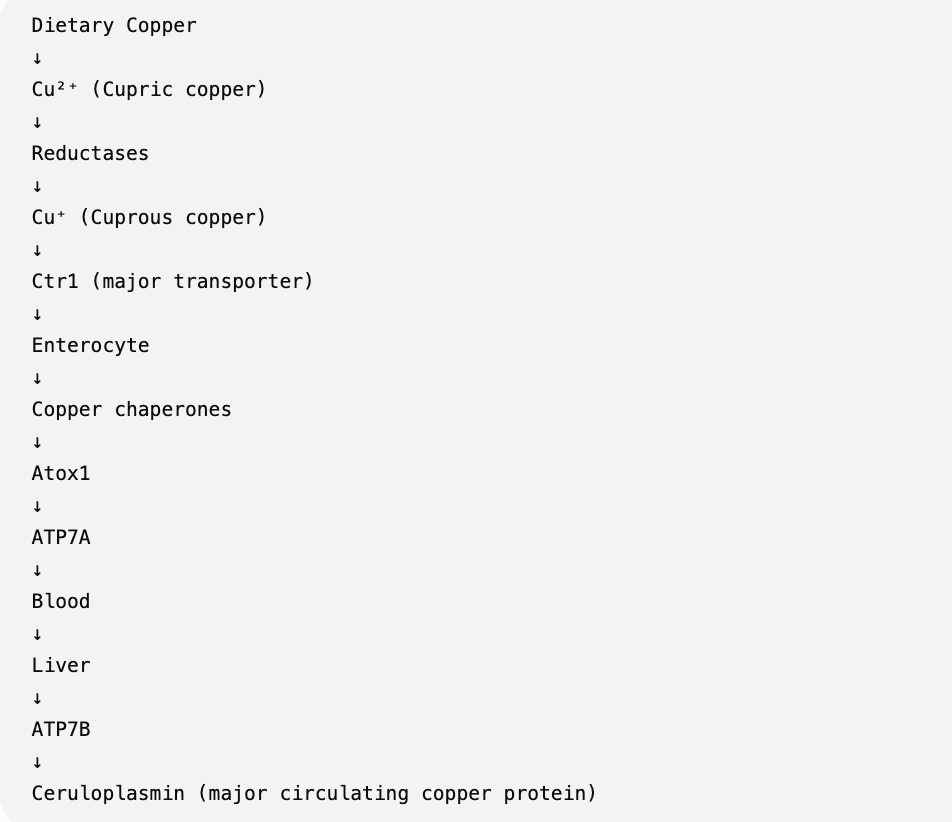
Copper Absorption Pathway
Food copper
↓
Cu²⁺
↓
Reductases
↓
Cu⁺
↓
Ctr1
(main uptake transporter)
↓
Enterocyte
↓
Copper chaperones
↓
Atox1
↓
ATP7A
↓
Blood
↓
Liver
↓
ATP7B
↓
Ceruloplasmin
(major circulating copper protein)
Requirements for Absorption
Copper must be reduced from Cu²⁺ to Cu⁺.
Ctr1 transports Cu⁺, not Cu²⁺.
study knowt
Enhancers
Acidic pH
Histidine
Cysteine
Organic acids
Inhibitors
High zinc
High iron
High calcium
Phytates
Alkaline pH (antacids)
High-yield summary for abs
Into the enterocyte
Ctr1 (main)
DMT1 (minor)
Inside the enterocyte
Copper chaperones
Atox1
Out of the enterocyte
ATP7A
In the liver
ATP7B
In the blood
Ceruloplasmin
circulating form of copper
Ceruloplasmin
storage form of copper
Metallothionein
functions of copper
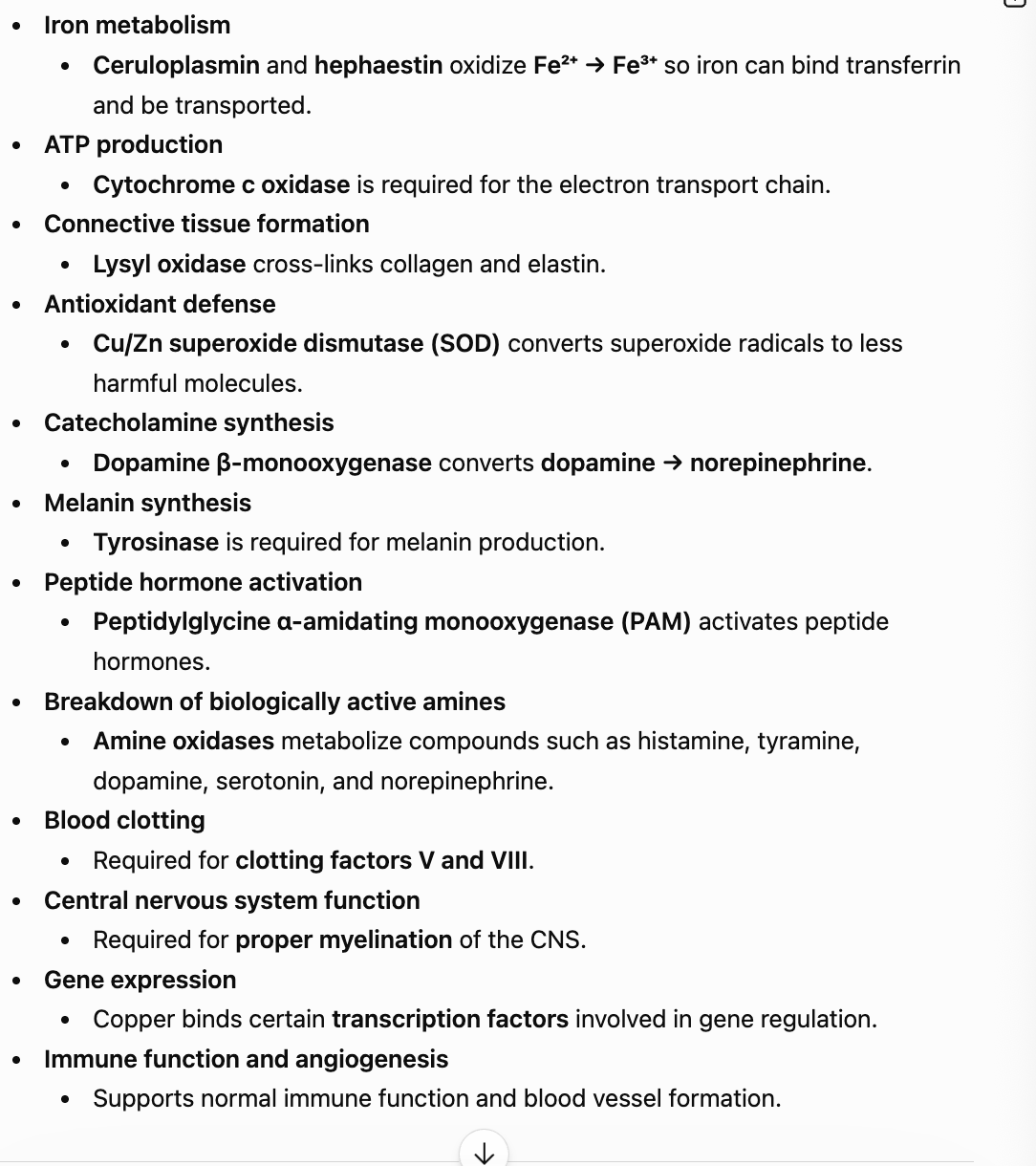
interaction between zinc and copper
High zinc intake
↓
↑ Metallothionein synthesis in the enterocyte
↓
Metallothionein binds copper more strongly than zinc
↓
Copper becomes trapped in the enterocyte
↓
When the enterocyte is naturally shed, the copper is lost in the feces
↓
↓ Copper absorption
↓
Copper deficiency
copper deficiency causes anemia
true
high zinc
copper deficiency
absoption