12 Biology 4.1 DNA
 Call Kai
 Learn
Learn Practice Test
 Spaced Repetition
 Match
Match Flashcards
 Knowt Play
1/55

There's no tags or description
Looks like no tags are added yet.
Name | Mastery | Learn | Test | Matching | Spaced | Call with Kai | Chat |
|---|
No analytics yet
Send a link to your students to track their progress
56 Terms
Nucleotide
Composed of a nitrogenous base (adenine, thymine, cytosine, guanine), a sugar (deoxyribose in DNA, ribose in RNA) and a phosphate group.
Deoxyribonucleic acid (DNA)
Double helix structure resembling a twisted ladder
Ribonucleic acid (RNA)
Single stranded
Histones
Are small protein molecules essential for the coiling and supercoiling of DNA in chromatin.
Nucleosome
Is the basic structural unit of chromatin, consisting of a segment of DNA wound around a histone octamer.
Chromatin
Consists of DNA wrapped around DNA proteins, forming nucleosomes.
Chromatin =
DNA + all the proteins associated with it (mainly histones)
DNA in Prokaryotes
Unbound circular DNA in the cytosol, known as the genophore. Small rings of DNA called plasmids may also be present (additional DNA).
Exons
Any part of the gene that will code for a protein=
Introns
Non coding regions of DNA
Centromeres
The region of a chromosome where the two sister chromatids are joined.
It plays a role in chromosome segregation during cell division.
Telomeres
Repetitive DNA sequences at the ends of chromosomes that protect them from dehydration and fusion with other chromosomes.
Interphase
The cell grows larger.
The cell produces more organelles and proteins it will need for division.
The DNA is copied so each chromosome now has two identical chromatids.
The DNA is spread out as loose chromatin in the nucleus, so individual chromosomes cannot yet be seen.
Anaphase 1
The chromatin coils tightly and becomes visible as chromosomes.
The nuclear membrane and nucleolus break down.
Homologous chromosomes (one from each parent) pair up.
Non-sister chromatids may exchange sections of DNA. This process is called crossing over and increases genetic variation.
Crossing Over
The process in Prophase 1, where homologous chromosomes pair up closely to form bivalents.
Alleles
Different variations of the same gene located on a chromosome.
Spermatogenesis
The process of male gamete formation, where diploid stem cells in the testes undergo meiosis and differentiation to produce four functional, motile haploid sperm cells (n). This process occurs continuously from puberty throughout life.
Oogenesis
The process of female gamete formation, where diploid stem cells in the ovaries undergo meiosis to produce a single functional haploid egg cell (ovum) and three non-functional polar bodies. This process begins before birth, pauses, and is completed only after fertilization.
Process of making recombinant DNA
Isolation
Prepare the plasmid
Glue in the DNA
Bacteria transformation
Produce the protein
Recombinant DNA Step 1 - Isolation
A restriction enzyme identifies a specifici DNA base sequence and cuts the DNA at that exact site. If two DNA fragments have complementary sticky ends, they can join together easily.
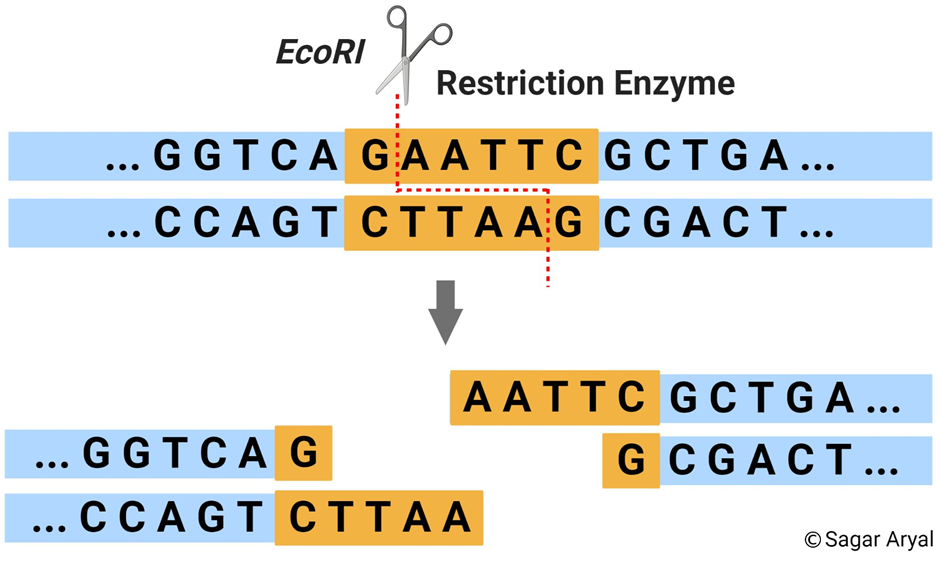
Restriction Enzymes:
Restriction enzymes (or DNA scissors) cut DNA at specific recognition sites. Scientists use restriction enzymes to cut out a gene (e.g. human insulin).
Recombinant DNA Step 2 - Prepare the Plasmid
The same restriction enzyme used to cut out the DNA fragment in step 1 is used to cut the plasmid once.
The recombinant plasmid is then placed back into a backterium.
Plasmids
Contain extra DNA and extra coding along with bacterial DNA.
Scientists use plasmids as tools to transfer genes between organisms.
Plasmids are used as vectors - vehicles to deliver genetic material into cells.
Recombinant DNA Step 3 - Glue in the DNA
DNA ligase joins the gaps in the DNA backbone.
In recombinant DNA, it connects the DNA fragments to the plasmid, forming a recombinant plasmid that contains the gene.
Recombinant DNA Step 4 - Bacteria Transformation
Plasmids can be inserted into bacteria through a process called transformation.
Specially prepared bacterial cells are exposed to a heat shock, which helps them absorb foriegn DNA.
Recombinant DNA Step 5 - Produce a Protein
Once a bacterial colony containing the correct plasmid is identified, it can be grown into a culture.
PCR Uses:
Enables us to extract a small amoutn of DNA from a single hair or drop of blood at the scene of a crime and amplify it so there is enough that it can be analysed.
PCR Purpose
PCR purpose: to take a very small sample of DNA and amplify it (make lots of copies) to a large enough amount to study in detail.
Gel electrophoresis purpose
To seperate DNA fragents based on size
Gel electrophoresis uses
Determine paternity or criminals: DNA profiling
Gel electrophoresis in DNA profiling.
DNA profiling uses gel electrophoresis to create a visible pattern of DNA bands, then compares that pattern between samples.
Evolution
Evolution refers to changes in the genetic makeup of a population across many generations, which may eventually result in the formation of a new species.
Microeveolution
Refers to small scale changes in allele frequencies within a species or population.
These changes occur over relatively short periods of time andd o not result in the formation of a new species.
The descendants remain within the same taxonomic group as their ancestors.
Macroevolution
Involves large scale changes in allele frequencies that occur at or above the species level over geological time.
This process results in thed viergenceof taxonomic groups, leading to the formaiton of new species.
The descendants in macroevolution are in different taxonomic grup compared to their ancestors.
Drivers of Evolution
The drivers of evolution include:
sexual reproduction
mutation
genetic drift
gene flow
natural selection
These occur with an accumulation of microevolutionary changes leading to macroevolution.
Comparative Genomics
Compares genome sequences between species to find similarities and differences.
Scientists can use conserved sequences - regions of DNA that haven’t largely changed across different species over evolutionary time - to estimate the divergence time between species.
Homologous genes
Similar DNA sequences
Speciation
The formation of a new species when populations become reproductively isolated and genetically diverge.
Isolating Mechanisms in Speciation
Populations of the same species can become isolated, causing for different selection pressures and thus resulting in speciation.
Geographic Isolation
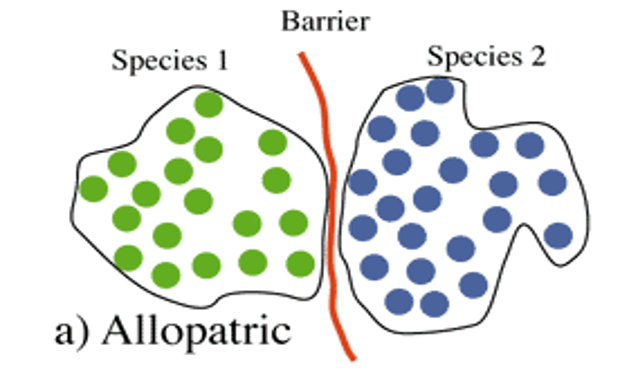
Occurs when a physical barrier seperates populations
Reproductive Isolation
Occurs when barriers prevent different species from interbreeding and producing viable offspring through gametic, mechanical, or behavioural discrepancies.
Spatial Isolation
Where a species is limited to reproductive capabilities due to a vast distance between habitats.
Temporal Isolation (time)
Species that breed during different times of the day, different seasons, or different years cannot mix gametes.
Types of speciation
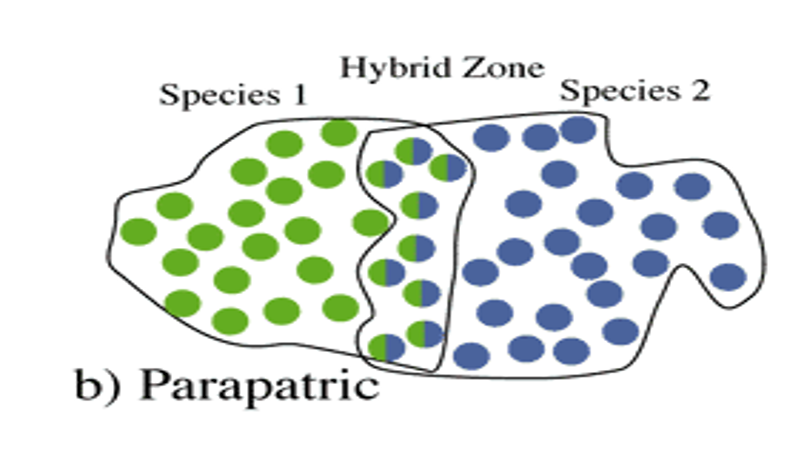
Allopatric
Sympatric
Parapatric
Allopatric Speciation
Organisms with a common ancestor evolve into a new species after a period of physical seperation (geographical isolation).
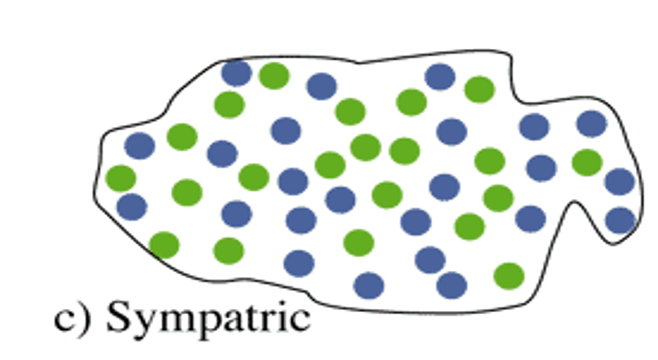
Sympatric Speciation
Organisms with a common ancestor that become reproductively isolated and diverge into a new species without any physical seperation (geographical isolation).
Parapatric Isolation
Rare, but occurs when populations within the same geographical area that only tend to breed with individuals in close proximity.
This can cause slight variations in phenotypes of individuals to the point whereinterbreeding is no longer possible, despite not being geographically isolated