C10.1 Water
 Call Kai
 Learn
Learn Practice Test
 Spaced Repetition
 Match
Match Flashcards
 Knowt Play
1/7

There's no tags or description
Looks like no tags are added yet.
Name | Mastery | Learn | Test | Matching | Spaced | Call with Kai | Chat |
|---|
No analytics yet
Send a link to your students to track their progress
8 Terms
Name 2 tests that can be used to test for presence of water
Cobalt (II) chloride
Copper (II) sulfate
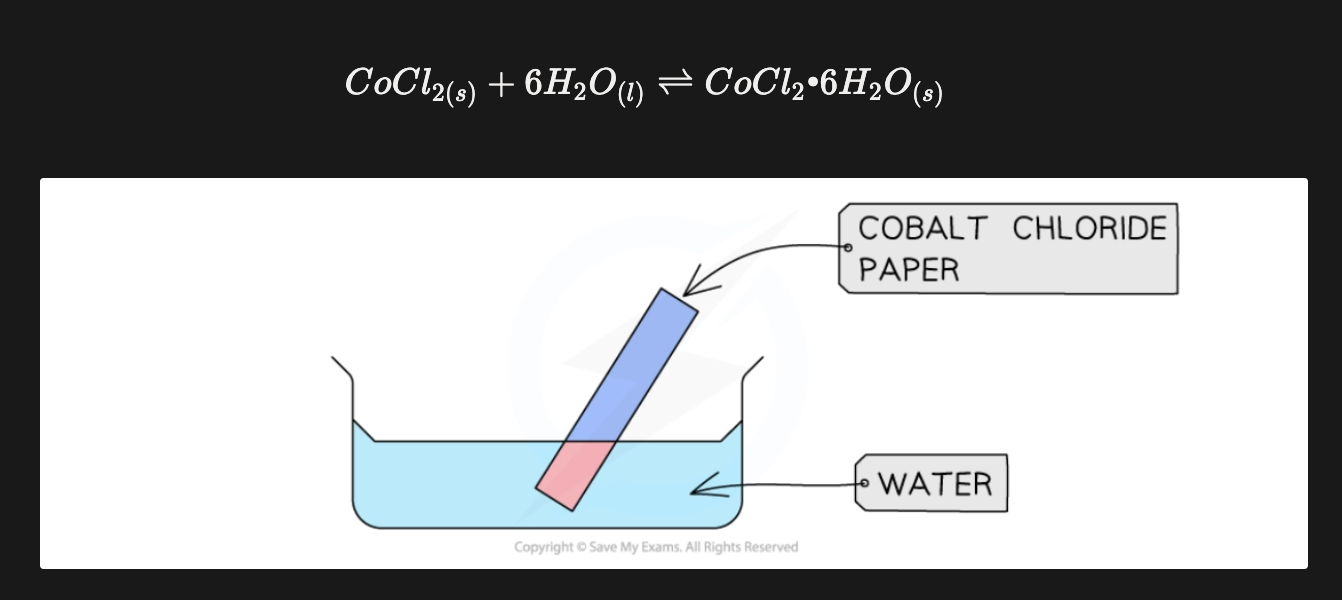
State colors for cobalt (II) chloride and equation with water
Cobalt chloride paper used to test for water (changes pink in water)
Anhydrous cobalt (II) chloride (CoCl2) is blue
Hydrated cobalt (II) chloride (CoCl2•6H2O) is pink
State colors for copper (II) sulfate and equation with water
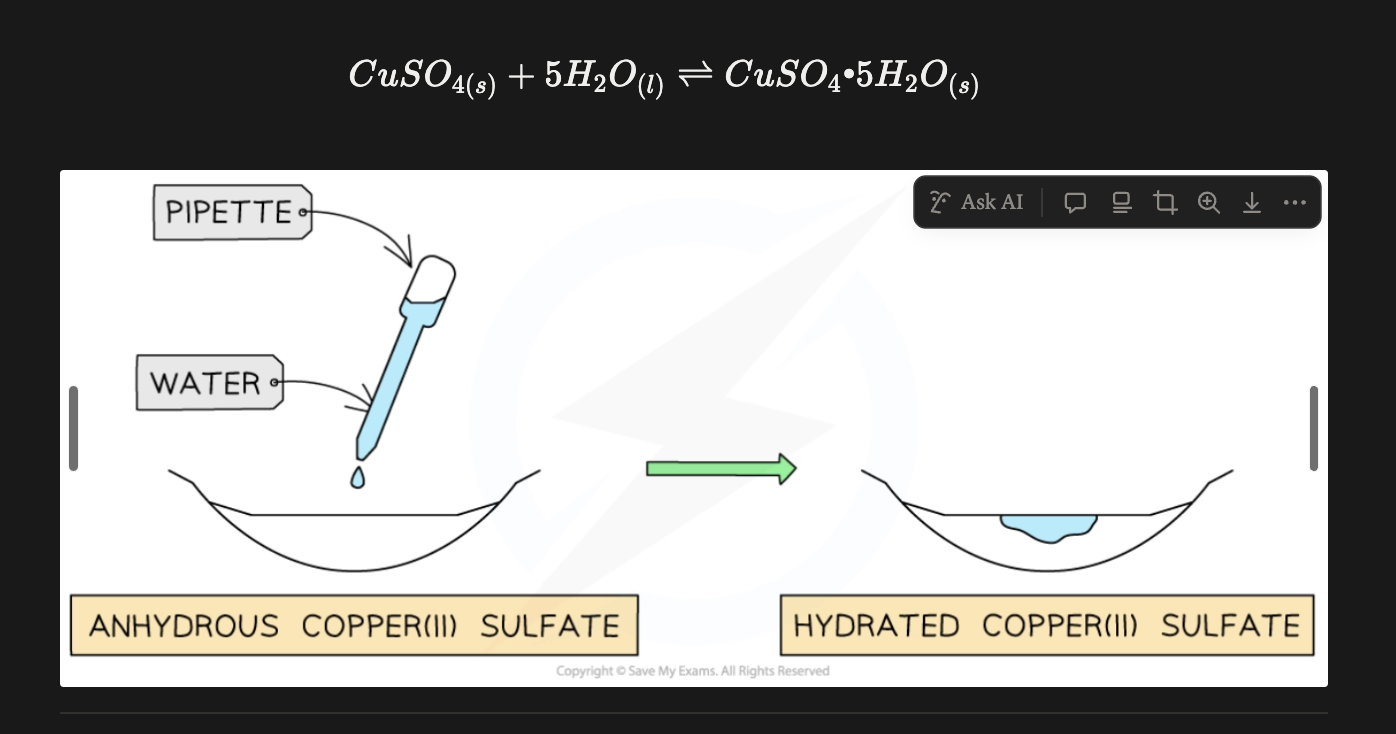
Anhydrous copper (II) sulfate ca be used to test for water (changes blue in water)
Anhydrous copper (II) sulfate (CuSO4) is white
Hydrated copper (II) sulfate (CuSO4•5H2O) is blue
Explain purity of water
Pure substances boil and melt at specific temperatures
Water has a boiling point of 100 °C and a melting point of 0 °C
Mixtures have a range of boiling and melting points as they consist of different substances that melt or boil at different temperatures
Impurities tend to increase boiling point of water and decrease melting point of water
What is distilled water and what is it used for?
Made by heating water to form vapour and then condensing it back to a liquid, which removes most dissolved impurities
Used in practical chemistry rather than tap water because it contains fewer chemical impurities
Uses for water
Domestic: drinking, cooking, showering..
Agricultural: watering crops, animal hydration..
Industrial: solvent, coolant, heated to make steam used to generate electricity…
State substances which can be found in natural water sources and their benefits/consequences
Dissolved oxygen
Beneficial: essential for aquatic life
Metal ions
Beneficial: some provide essential minerals necessary for life
Plastic
Harmful: aquatic life can be trapped or starve
Sewage
Harmful: contains microbes which cause disease
Harmful microbes
Harmful: disease
Nitrates and phosphates (fertilisers)
Harmful: deoxygenation of water can harm aquatic life
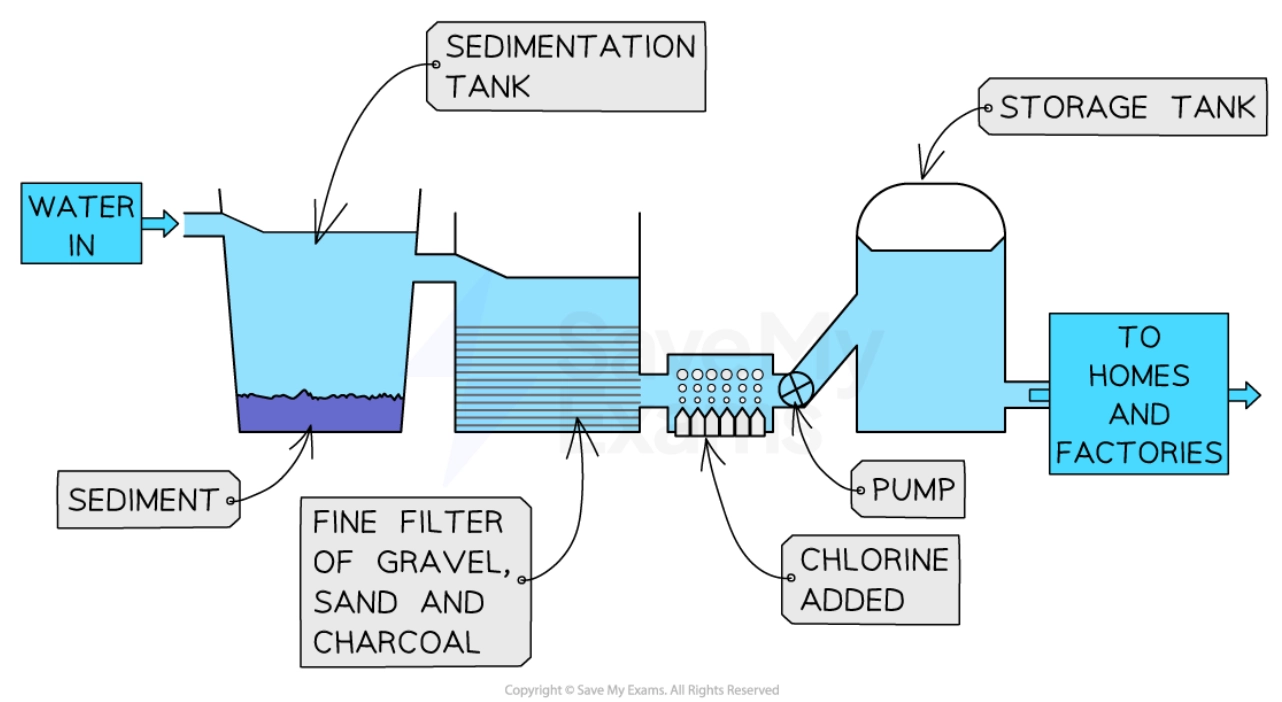
Describe the stages of water treatment
Sedimentation and filtration:
Water pumped into sedimentation tanks
Mud, sand and other particles fall to bottom of tank due to gravity, forming a layer of sediment
Water then filtered through sand and gravel to remove smaller particles
Filtration through carbon:
Removes unpleasant tastes and odours
Chlorination:
Kills microbes (pathogens)