HISTORY
 Call Kai
 Learn
Learn Practice Test
 Spaced Repetition
 Match
Match Flashcards
 Knowt Play
1/108

There's no tags or description
Looks like no tags are added yet.
Name | Mastery | Learn | Test | Matching | Spaced | Call with Kai | Chat |
|---|
No analytics yet
Send a link to your students to track their progress
109 Terms
Existed for almost as old as human history. it started with ___ and gradually evolved into a process that was strongly based on scientific evidence and involved multidisciplinary studies
Drug discovery
serendipitous discovery
provided a brief view of the transition from traditional drug discovery to modern drug discovery and particularly emphasized the protocol involved in drug development
Umashanka & Gurunathan
reviewed the impacts of molecular biology on drug discovery development
Drews
focused on the pivotal technologies in the drug discovery process.
Gershell and Atkins
presented challenges of drug discovery after the COVID 19 pandemic
Villoutreix
knew about using bitter plants with poison or psychotropic plants for self-medication
Paleolithic humans
human race settled from nomad life and grow their plants for food, setting off the agricultural evolution that brought civilization as well as plagues of infectious diseases
10,000 years ago
primary source of medicine for the treatment of diseases, which were mostly discovered by chance
plants
Some of the “drugs” discovered were without medicinal value such as
alcohol and tea
some other drugs discovered that are harmful and addictive
cannabis and opium
The functions of plants as medicines were transmitted ___ and the practices were greatly affected by ___
verbally or engraved on caves
cultures and religions
The practices of Egyptian medicine can be found in a few documents such as? which was produced in?
Ebers Papyrus
1536 BCE
Ebers Papyrus is one of the oldest medical documents that recorded some disease conditions and the use of ___ that originated from plants to produce ___
328 ingredients
876 prescriptions
At around ___, the Greeks transformed the superstitious beliefs in medicine by introducing ___, under the influence of Greek philosophers such as ___ and ___
500 BCE
empirical rational-based medicine
Empedocles
Pythagoras
Greek physician who is renowned as the ‘Father of Medicine’. He created the?
Hippocrates
Hippocratic Corpus
The Hippocratic Corpus included around ___ and influenced the ___
130 medicines
Galenic medicine
Greek physician ___ systematically documented ___ used as drugs in ___which laid the foundation of ___ medicine
Pedanius Disocorides
500 plants
De Materia Medica
homoeopathic
During the ___ (___ century), translation projects were implemented by the rulers and those collections of books from ___, and other countries were translated, studied, and modified into Arab
Golden period of Arab science
9th to 13th
Greek, Roman, Persian, Indian, Chinese, Syrian
___ were adopted and modified by Arabic physicians based on their studies and experience
Hippocratic and Galenic medicines
The practices and development of medicine blossomed with the rise in the civilization of Arabs. They set up the ___ in history and built a ___ that operated independently
first apothecary
hospital with an apothecary
Muslim scholar, produced a book named “___" which defined the role of a pharmacist. These developments planted the root of the pharmacy profession
Al-Biruni
Saydanah Fit-Tibb
most popular medicinal system in India
Ayurveda
Ayurveda is also known as ‘___’, and has been established since the ___
the science of life
2nd century BCE
Ayurveda is a sophisticated ancient medicine that developed a treatment based on ___
products, diet, lifestyle, and environment
recorded the categories, properties and pharmacology of over ___ in Ayurvedic medicine
Charak Samhita and Sushrut Samhita
700 plants
Ayurveda involves the use of ___ in treatment as well as the knowledge of ___ of those materials
plant and animal products, minerals and metals
collection, preparation, and storage
In ___ use of herbs and materials that originated from other natural resources has been the main practice in ___ since the ___ (AD 25 – 220)
China
Traditional Chinese Medicine (TCM)
Eastern Han Dynasty
Chinese medicine was developed from ___ to the establishment of systematic herbal medicines
trial and error
A few documents of TCM were produced and the most famous compilation was ‘___’ or “___”
Compendium of Materia Medica
Ben Cao Gang Mu
TCM comprises more than ___ which can be categorized based on tastes and four properties, as well as the site of action
11,000 documentary herbs
The herbal formulation in TCM and the herbs’ interaction were studied based on the herbs’ ___
taste, properties, site of actions, and seven relations theory
Ancient medicine records produced in Europe
Greece
Hippocratic corpus
De materia medica
Ancient medicine records produced in Middle East
Egypt
Kahun Papyrus
Ebers Papyrus
Arab
Saydanah Fit-Tibb
Ancient medicine records produced in Asia
India
Charak Samhita
Sushrut Samhita
China
Compendium of Materia Medica
among the oldest practising medicine in the world and both medicines are still popular in China and India today.
Chinese med and Ayurveda med
From ___, natural resources believed to have beneficial values continued to be discovered.
ancient times until the 17th century
___ was found to relieve migraine and help in digestion in 800 BCE
Coffee
___ was discovered in 1532 and was used to relieve pain and feelings of starvation
coca
Coca is one of the ingredients in ___, a drink which was first introduced in 1885. The drink was reformulated in 1907 and the coca leaves were ___ before being used in the formulation
Coca-Cola
decarbonised
discovered in 1639 was ___ which was used to treat malaria fever
cinchona bark
In 1681, ___ was found to have a therapeutic effect on iron deficiency illnesses
ferrous sulfate
In the ___, the practices of clinical trials and preventive medicine were started when ___ reported his study on the ___ with his established first controlled clinical study in 1753 which founded the concept of ___
18th century
James Lind
prevention of scurvy
scientific testing on drug efficacy
In 18th century: In ___, the first vaccine was born when an English physician ___ used ___ to immunize people for the prevention of ___which eventually led to the eradication of this diseases in ___
1796
Edward Jenner
cowpox
smallpox
1979
18th century: in 1979, ___ was founded by ___
homeopathic medicine
Samuel Hahnemann
In the ___, the advancement of chemistry allowed the ___ from herbal plants bringing drug discovery to ___
19th century
extraction and isolation of active substances
small molecule drug discovery
19th century: In the ___ important active substances such as ___ were first extracted and isolated from the plants
early 1800s
alkaloids, morphine, quinine, and atropine
19th century: ___ is still the most effective painkiller for severe pain today.
Morphine
19th century: Advances in synthetic chemistry led to the production of ___, the blockbuster drug derived from ___
Aspirin
salicylic acid
19th century: Aspirin was marketed as an ___ in 1899 and was effective in relieving pain and anti-inflammation
analgesic
19th century: In 1982, owing to the ___ effect of aspirin, it was repurposed for use in ___
antiplatelet
cardiovascular disease
19th century: Progress in ___ was also observed in the 19th century.
biomedicine
19th century: A new discipline known as ___ was founded by ___ in 1847, to understand the physiology of organisms and relate it to therapeutics
pharmacology
Rudolf Buchheim
19th century: ___ after the establishment of pharmacology discipline, German pathologist ___ proposed ___ which strengthened the knowledge in ___
11 years
Rudolf Virchow
cell theory
biology, cell pathology and medicine
19th century: ___ is a chemist who discovered the science of ___ and in 1878, he proposed the ___ which played an important role in the development of ___ and ___ in medicine
Loius Pasteur
isomers and stereochemistry
germ theory
vaccination
sterilization or aseptic technique
Another important achievement in the late 19th century was the introduction of ___ by ___ which boosted the development of ___ (Valent et al., 2016). This also created interest in the ___ or ___
receptor-ligand theory
Paul Ehrlich
chemotherapy
ligand-receptor approach
target-directed drug discovery
drug discovery research from the 18th century
1753: publication of first controlled clinical study
1796: first vaccine (smallpox vaccine) & founded homeopathic medicine
drug discovery research from the 19th century
early 1800s: extraction and isolation of active substances from plants
1847: establishment of pharmacology
1858: introduction of cell theory
1878: introduction of germ theory and aseptic technique
1899: first synthetic drug (aspirin)
1900: introduction of receptor-ligand theory
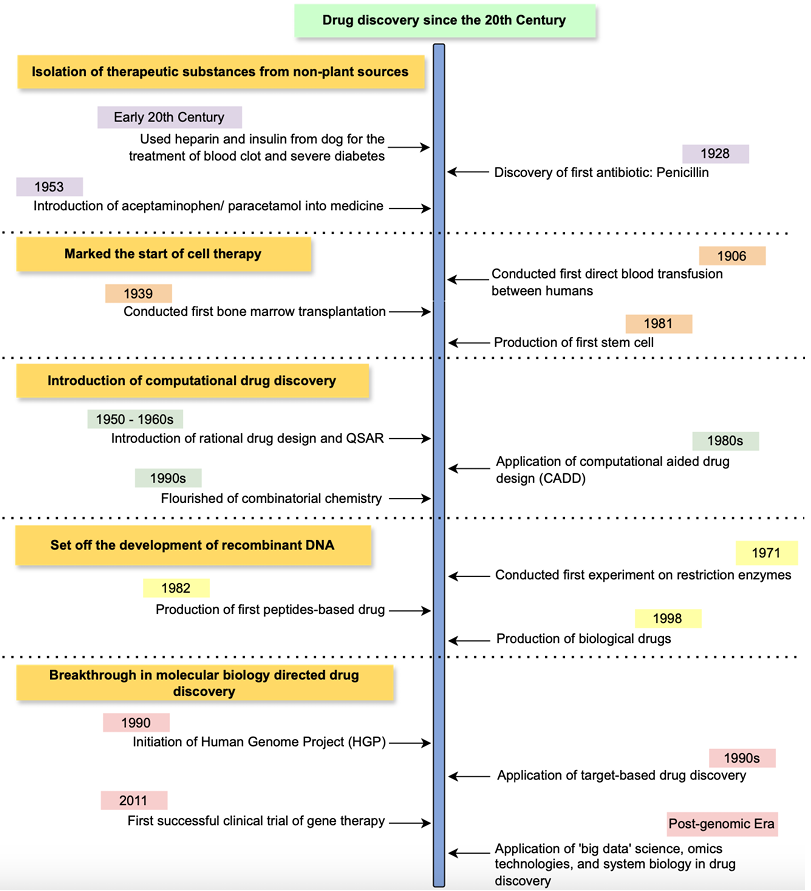
Drug discovery since the 20th century
Isolation of therapeutic substances from non-plant sources
Cell therapy
Computational drug discovery
Development of recombinant DNA
Molecular biology directed drug discovery
20th century isolation of therapeutic substances from non-plant sources: Drugs that did not originate from plants started to be produced.
Isolation of therapeutic substances from non-plant sources
In the early 20th century,
___ isolated from ___: treat ___
___ from ___: treat ___
heparin
dog’s livers
blood clots
insulin
dog’s pancreas
severe diabetes
20th century: Antibiotic drugs such as ___ were isolated from the ___ while ___ were isolated from ___
penicillin, ciclosporin, and tacrolimus
fungus
streptomycin and tetracyclines
soil bacteria
___ is the first antibiotic drug discovered by ___ in 1928
Penicillin
Alexander Fleming
successful elucidation of penicillin structure subsequently produced many other structure-related antibiotics such as ___
ampicillin
___ remains one of the most commonly used antibiotics today
Penicillin
___ was discovered to be able to diminish fever, however, it was also found to cause ___
acetanilide
hematotoxicity
The discovery of acetanilide led to the synthesis of ___ used as an ___ in the first few decades of the 20th century
phenacetin
antipyretic
The metabolites of Phenacetin were analysed and it was found to produce ___. On the other hand, one of its metabolites was found to be a reactive compound known as ___, which became a blockbuster antipyretic after its introduction in 1953
toxic anilide
acetaminophen or paracetamol
first direct blood transfusion between humans in surgery was conducted successfully signifying the start of ___
cell therapy
the first bone marrow transplantation to cure ___ was conducted and initiated studies in therapy using ___
aplastic anaemia
bone transplantation
the ___ were used to produce the first ___ and the potency of it in cell therapy has been studied intensively until now
murine embryos
stem cell
Before the 1950s, the discovery of drug compounds was through ___ of a large number of natural or synthetic compounds.
indiscriminate screening
Together with the advancement of ___ and the concept of drug actions, ___ started to be adopted in drug discovery research
organic synthesis
rational drug design
rational drug design was followed by the introduction of the ___
quantitative structure-activity relationship (QSAR)
the publication of the article “___” in Fortune magazine captivated high attention of researchers in ___
The Next Industrial Revolution: Designing Drugs by Computer at Merck
computational aided drug design (CADD)
___ was first introduced and large libraries of small molecules can be generated for high-throughput screening
combinatorial chemistry
A large number of compounds in the screening libraries were found failed to identify promising drugs, instead ___ is more practical when a small library focuses on certain scaffolds and adoption of ___ methods together in drug discovery
combinatorial library
hit-to-lead optimization
CADD had successfully brought a few drugs to approval which included ___ for hypertension (1981), ___ for glaucoma (1995), ___ for HIV (1995), ___ for HIV (1996), ___ for influenza virus (1999), and ___ for hypertension
captopril
dorzolamide
Saquinavir
ritonavir and indinavir
zanamivir
Aliskiren
Discoveries of ___ started in the 1950s and the first experiment was conducted in ___
restriction enzymes
1971
restriction enzymes set off the development of ___ and transformed the chemistry-based drug discovery industry. This enabled the production of the first peptide based drug, ___
recombinant DNA
Humulin or human insulin
not only peptide-based drugs but biological drugs also have been produced such as ___, which is a ___
trastuzumab (Herceptin)
monoclonal antibody
One of the biggest contributions to molecular biology and drug discovery research is the initiation of the ___ and took ___ to finish and eventually launched a ___
Human Genome Project (HGP)
15 years
post-genomic era
Along the way, HGP set off the application of ___, fostered the development of ___ and the advancement of multi disciplines such as computational and mathematics
“big data” science
omics technologies
The understanding of ___ has also been improved and steered the drug discovery research perspective to ___ which the drug is developed and evaluated not only from its structure but also from its action mechanisms as well as its effect on interactions within biological systems
biomedical sciences
systems biology
HGP also aided in identifying new potential targets for diseases which eventually drifted the ___ to ___
phenotypic drug discovery
target based drug discovery
Another breakthrough in molecular biology-directed drug discovery is the advancement of ___
gene therapy
Gene therapy has come a long way from the failure of its first clinical trial in ___ and finally attained success in the treatment of ___ in 2011. From 2011 to 2020, the number of approvals for gene therapy products reached ___
1988
haemophilia B
16
The functions of small molecules
RNA targeting molecules, protein-protein interaction inhibitors, antibody-drug conjugates compounds, PROTACs
small molecules are also developed as ___ to investigate biological systems
molecular probes
The drug discovery and development in the 19th century had started industrialised leading to an increase in drug trading and problems such as ___
false labels or unsafe medications.
To tackle the problems of unsafe medications, the ___ was approved in the United States in ___ and the ___ was founded which changed to the ___ in ___
Pure Food and Drug Act
1906
Bureau of Chemistry
Food and Drug Administration (FDA)
1930
unprecedented successful drug discovery in the 20th century has experienced two major drug disasters. the production of ___ using ___ as a solvent which caused the death of patients in the United States and led to the approval of the ___. Since then, the test for ___ has become compulsory before being marketed
elixir sulfanilamide
toxic diethylene glycol
Federal Food, Drug, and Cosmetic Act in 1938
drug toxicity and FDA approval
Another disaster happened in 1957 in countries including the ___ due to thalidomide
United Kingdom, Canada, Africa, Australia, Japan, and Europe
___ was marketed as a sedative to treat nausea and morning sickness during pregnancy however caused severe birth defects and affected approximately ___ children. banned in ___
Thalidomide
10,000
1961
___ rules and regulations have become the golden standard reference for drug regulation
FDA
FDA approved ___ which included ___ and ___ to ensure the public has some basic understanding of the medicine they use
direct-to-consumer advertisements
disease-awareness ads
product-claim ads
Highlights of drug discovery research since the 20th century
the research and development cost in drug discovery has increased dramatically but the rate of drug approval clinically remained stagnant
Current challenges and perspectives in drug discovery
Current challenges and perspectives in drug discovery
Complexity of the diseases
Knowledge gaps in new research fields and the use of cutting-edge technologies
Insufficiency of study in new human proteins as drug targets
Challenges in small molecule drug discovery
Research today faces the challenges of solving more complicated and difficult diseases such as
rare genetic diseases
multi-targets diseases
antimicrobial resistance
new and recurring viruses infections
diseases associated with ageing
more efforts are required to fill the knowledge gaps in the application of ___ to better translate drug actions and disease mechanisms in preclinical research as well as the clinical level
cutting-edge technologies