Ati - Science
 Call Kai
 Learn
Learn Practice Test
 Spaced Repetition
 Match
Match Flashcards
 Knowt Play
1/90

There's no tags or description
Looks like no tags are added yet.
Name | Mastery | Learn | Test | Matching | Spaced | Call with Kai | Chat |
|---|
No analytics yet
Send a link to your students to track their progress
91 Terms
Inflammation, production of interferon, and ingestion of pathogens by phagocytes are nonspecific cellular responses by which of the following?
The internal aspect of the innate immune system
The ventricles will not contract
Which will occur in the cardiac cycle if the impulse triggered at the sinoatrial node never reaches the Purkinje fibers of the heart.
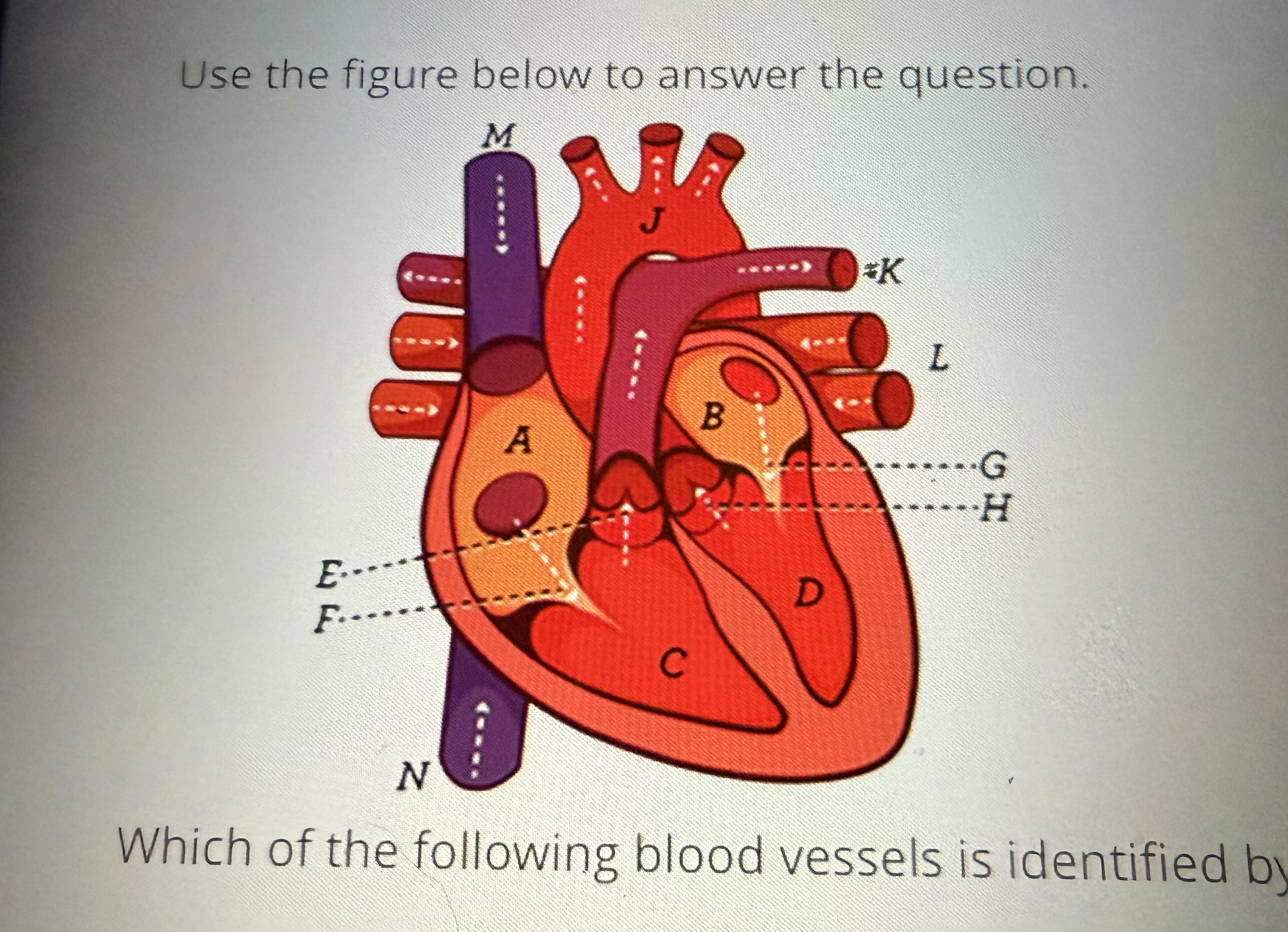
Pulmonary Artery - Identified by the letter “K”
The major blood vessel that carries deoxygenated blood from the heart's right ventricle to the lungs for oxygenation.
Small Intestine
responsible for the majority of the chemical digestion and absorption of nutrients in the digestive system
Vitamin D
Produced by the skin when a cholesterol-based precursor is modified by the presence of ultraviolet radiationand is essential for calcium absorption and bone health.
Osteoclasts
Bone cells that perform mineral resorption & break down bone tissue, releasing minerals into the blood.
Medullary cavity
The central cavity of a long bone, containing bone YELLOW bone marrow and blood vessels, which plays a critical role in the production of blood cells.
Gametes
Leaves the body via the vas deferens
Gonads
Organs that produce gametes, such as (SPERM) testes in males and (EGGS) ovaries in females.
Saltatory Conduction
A method of nerve impulse transmission where action potentials jump between node to node in an axon. - Allows for faster conduction along myelinated axons.
Mitosis
New body cells that replace damaged body cellsthrough a process of cell division that results in two identical daughter cells.
Respiration
Respiration is an oxidative, degradative pathway that correctly describes a major metabolic pathway.
Metabolic Pathway
interconnected series of chemical reactions cells use to survive.They convert nutrients into energy and building blocks for growth and maintenance: ie. Glycolysis, Krebs cycle, and oxidative phosphorylation.
An atom lost an electron becomes_______ in charge and is called a ______.
positively charged; cation
What are characteristics of a graph displaying the physical states of a substance under varying temperature and pressure?
Phase Diagram-Having temp and pressure as its axes.The graph shows phase transitions (solid, liquid, gas)
Protons
the atomic number is determined by the number of protons in each atom
Which of the following particles will differ for each isotope of the same element?
Neutrons in its nucleus
Mass of an object is -
An extensive property and physical property
The Bonds holding together nonpolar covalent molecules
are formed by equal sharing of electrons between atoms and result in a balanced distribution of charges throughout the molecule.
Milli
The appropriate prefix to measure the amount of space taken up by a pennywhich is approximately 1.9 millimeters in diameter.
SI Units
SI Units are part of a standard system of measurement that is used in science
Link between damaged villi and malnutrition
is that damaged villi reduce nutrient absorption in the intestine, leading to deficiencies and malnutrition.
Memory Cells
Feature of the adaptive immune system which decreases the amount of time it takes for the body to respond to particular antigens.
Contraction occurs when the thin _____ filaments slide past the thicker ____ filaments, causing the sarcomere unit to shorten or contract
Actin, myosin
The endocrine system is a collection of ductless glands that produce what response?
A slowly initiating but prolonged response on other body system- Hormonal responses that regulate various bodily functions.
A gland that has an exocrine function and aids in the regulation of blood glucose.
Pancreas
Dermis
The middle layer of the skin that is made of connective tissue.
Connective tissue
Serves to fasten and support body parts- A type of tissue that supports, binds together, and protects other tissues and organs. It is characterized by a matrix that contains different types of cells and fibers.
Polysaccharide
A carbohydrate that is made of many sugar molecules - linked together, serving as a long-term energy storage form in organisms.
Dehydration Reaction
A chemical reaction between two molecules in which a water molecule is released and a covalent bond forms
Codon
A triplet of nitrogenous bases that codes for an amino acid - A sequence of three nucleotides in mRNA that specifies an amino acid during protein synthesis.
Inheritance
Transmission of characteristics to offspring-The process where genetic information is passed from parents to offspring, determining traits and characteristics.
Nucleus
where genetic information describing the characteristics of an organism is found
The function of Ribosomes
They facilitate protein synthesis-is to synthesize proteins by translating messenger RNA (mRNA) sequences into amino acid chains during protein synthesis.
Atomic mass has a decimal because it is the average ____ of all the isotopes for a particular element. The atomic number of an element is the number of ____ in its nucleus
mass number, protons
They are located in the nucleus of an atom
Protons
Frontal Plane (anatomical positions)
A vertical plane that divides the body into anterior (front) and posterior (back) sections.
Transverse Plane (anatomical postions)
A horizontal plane that divides the body into superior (Top / upper) and inferior (bottom/ lower) sections.
Sagittal Plane / Median Plane (anatomical positions)
A vertical plane that divides the body into left and right sections.
Superior (anatomical positions)
towards the head or upper part of the body
Inferior (anatomical postions)
towards the feet or lower part of the body. - away from the head - opposite of superior.
Front of the body (anatomical Planes)
The front of the body is referred to as the anterior or ventral side in anatomical terms.
Back of the Body (anatomical positions)
The back of the body is referred to as the posterior side in anatomical terms.
Lateral (anatomical positions)
←——- away from the midline- Lateral.
-Refers to the sides of the body,
-lateral indicates a position further from the center of the body.
Medial (anatomical planes)
Toward or at the midline, medial ———>the body; it describes a position closer to the center than another part.
Patellar
-The anatomical term for the front of the knee.
-Patellar region is located at the front of the knee.
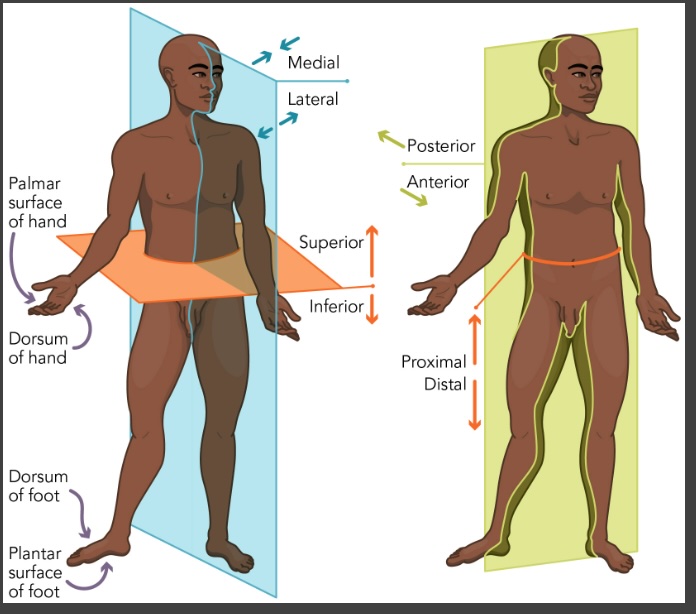
Anatomical positions to Look over
Anatomical positions to Look over
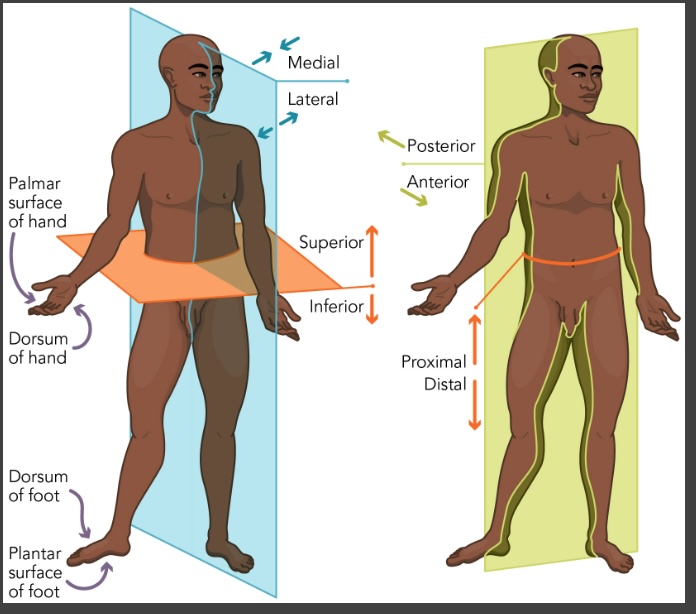
Superficial (anatomical positions)
-a position closer to the surface of the body compared to another structure.
Deep (anatomical positions)
-toward the interior of the body
-a position farther away from the surface of the body compared to another structure.
Anterolateral (anatomical positions)
ext{-located towards the front and side of the body, indicating a position that is both anterior and lateral to another structure.
Distal (anatomical positions)
-farther away (distal) from the point of attachment or origin compared to another structure.
-opposite of proximal
-example: The fingers are distal to the wrist. The shoulder is proximal to the elbow.
Proximal (anatomical positions)
-closer to the point of attachment compared to another structure.
-opposite of distal.
example: The fingers are distal to the wrist. The shoulder is proximal to the elbow.
Planes of Reference are used to separate the body into various two-sided portions
Planes of Reference are used to separate the body into various two-sided portions
Sagittal planes separate the body structures into right and left divisions
Sagittal planes separate the body structures into right and left divisions
midsagittal plane divides the body into equal right and left halves; paramedian planes divide it into unequal sections.
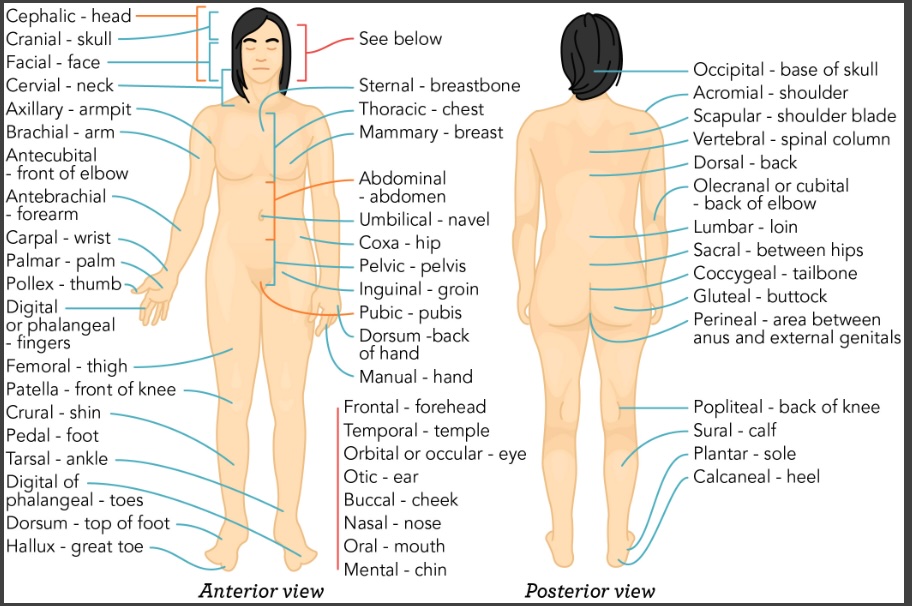
Principal regions include the head, neck, trunk, upper limbs, and lower limbs.
Principal regions include the head, neck, trunk, upper limbs, and lower limbs. Each region is divided into subregionssuch as the thorax, abdomen, and pelvis, with specific functions and structures.
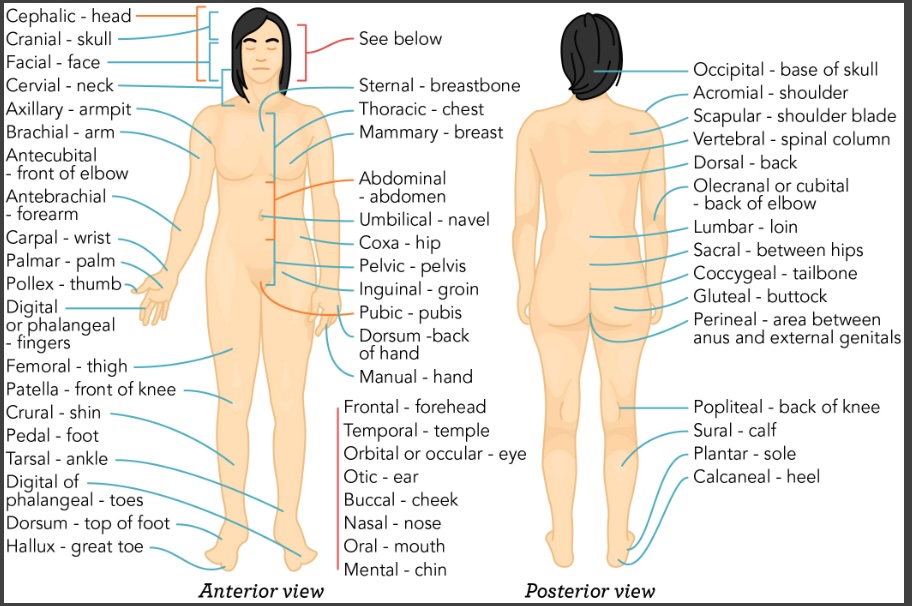
a Anatomical plane that divides the body into left and right portions
Sagittal Plane
The “Umbilicus” is Anterior because it is in the front
the “Buttocks” is Posterior because it’s in the back
Veins—→ DeOxygenated Blood to the Heart.
are blood vessels that carry blood toward the heart, often deoxygenated.
Arteries——> Oxygenated Blood away from the Heart
Oxygenated Blood away from the Heart.
Diastole - The heart FILLS with Blood
refers to the phase of the cardiac cycle when the heart muscle relaxes and the chambers fill with blood.
Systole - Heart Expels Blood
The heart contracts to pump blood out.
(1.) The Right side of the heart fills with Deoxygenated Blood and pumps it to the lungs where it gets oxygen
(2.) The Left side of the Heart receives the Oxygenated blood from the lungs and pumps it to the rest of the body. - The Cycle then Repeats ——> (1.)
Myocardium - Cardiac tissue
The thick muscular layer of the heart responsible for contraction and pumping blood.
Pericardium
The double-walled sac that encloses the heart, providing protection and cushioning.
The Heart Has 4 Chambers - (think AV)
Two Superior Heart Chambers - Right Atrium & Left Atrium.
Two Inferior Heart Chambers - Right Ventricle & Left Ventricle
Interatrial Septum - divides the superior heart chambers (right atrium, left atrium)
The wall that separates the right and left atria of the heart, preventing the mixing of oxygenated and deoxygenated blood.
Are Atria the Blood-Receiving chambers in the Heart?
Yes
The Blood pumping chambers - separated by interventricular septum
-The two inferior heart chambers
- The Right and Left ventricles
-Responsible for pumping blood out of the heart.
Interventricular Septum
Muscular wall separating right and left ventricles.
The Four (4) Heart Valves that regulate blood flow
(1.) Two Atrioventricular Valves (on each side of the heart)
(2.) Two Semilunar Valve (at the base of the aorta and pulmonary artery)
They ensure unidirectional blood flow.-Prevent backflow of blood into the heart chambers.
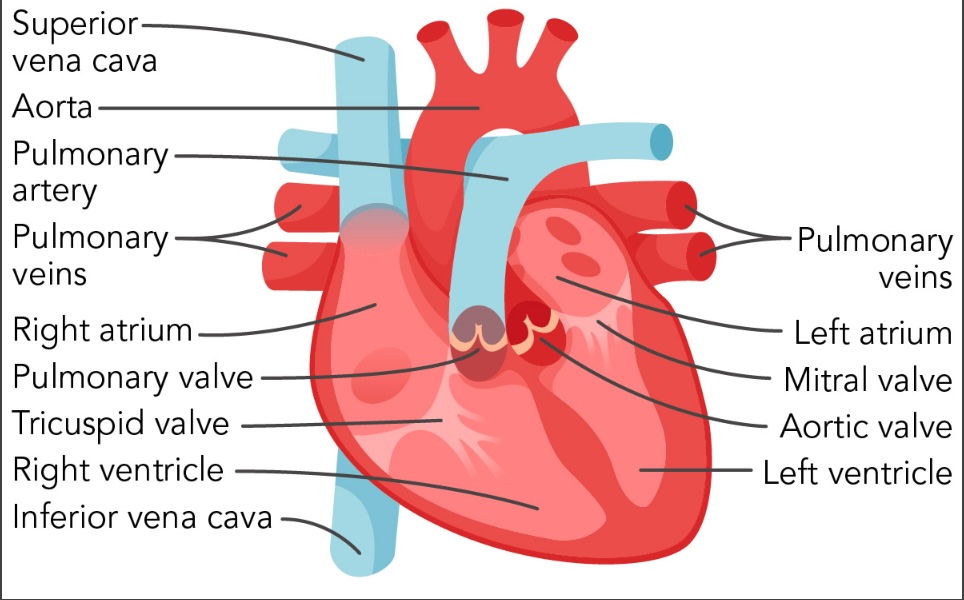
Label the Heart
Identify the major structures of the heart including the atria, ventricles, septum, and valves, highlighting their functions in circulation.
Arteries carry blood away from the Heart.
They transport oxygen-rich blood to the body, except for the pulmonary arteries, which carry deoxygenated blood to the lungs.
Veins carry deoxygenated blood from the body towards the heart — Except for the pulmonary veins, which carry oxygenated blood from the lungs.
Veins are connected to capillary beds via venules (smaller branches of veins) that collect blood from tissues and organs, returning it to the heart for reoxygenation.
The Conduction System - Internal Control (cardiac cycle)
-Regulates the Heartbeat by coordinating electrical impulses.
-Includes: sinoatrial node, atrioventricular node, bundle of His, and Purkinje fibers
1. triggers an impulse in the sinoatrial SA node (pacemaker- upper wall of right atrium)
2. The impulse spreads to the R/L atrium which causes contraction of the atria, pushing blood into the ventricles.
3. The impulse reaches AV node, which introduces a slight delay to allow ventricles to fill with blood before contraction.
4. The signal then travels down the bundle of His and into the Purkinje fibers, resulting in ventricular contraction, pumping blood to the lungs and body.
Systole
The phase of the cardiac cycle when the heart muscles contract, pumping blood from the chambers into the arteries.
Diastole
the phase of the cardiac cycle when the heart muscle relaxes and chambers fill with blood.
Erythrocytes (red blood cells) of the blood Transport oxygen and carbon dioxide
to and from tissues and organs, playing a crucial role in respiratory gas exchange.
Pulmonary arteries and the vena cava carry deoxygenated blood
to the heart from the body.
The endocrine system is a collection of ductless glands that produce a slowly initiating but prolonged response on the other body systems.
Endocrine System- Slowly initiating but prolonged responses to regulate bodily functions.
Osteoclasts
Bone cells that perform mineral resorption
DNA Segment used as a template for RNA:
GGA TAC ATA
CCU AUG UAU is the resulting mRNA sequence.
mitosis
produces new body cells that replace damaged body cells
Describe a major metabolic pathway
Respiration is an oxidative, degradative pathway
An atom that has lost an electron becomes Positive in charge and is called a cation
A negatively charged ion is called an anion.
Phase diagram
A graphical representation of the physical states of a substance under varying temperature and pressure conditions, indicating phase transitions.
Neutrons in the nucleus will differ for each isotope of the same element
Neutons in the nucleus will differ for each isotope of the same element, resulting in different atomic masses.
Mass
an extensive property and physical property
Data that is collected from an experiment that includes a control is required to develop a sound conclusion
Data needs a CONTROL (key word for question)
Independent variables
manipulated during an experiment
Base pairing rules for transcription of DNA —> mRNA
A —→ U
T—→ A
G —→ C
C —→ G