OMM PPOM 2 Block 1
 Call Kai
 Learn
Learn Practice Test
 Spaced Repetition
 Match
Match Flashcards
 Knowt Play
1/29

There's no tags or description
Looks like no tags are added yet.
Name | Mastery | Learn | Test | Matching | Spaced | Call with Kai | Chat |
|---|
No analytics yet
Send a link to your students to track their progress
30 Terms
Steps of BLT
Disengage 2. Exaggerate 3. Balance
Which nerve passes through the Foramen rotundum
CN V2 (Maxillary)

Through which skull opening do CN IX, X, XI, the Internal jugular vein, and the Posterior meningeal artery pass?
Jugular foramen

Which skull opening do CN 7/8 pass through
Internal acoustic meatus

Through which skull opening do CN III, IV, V1, VI, and the Superior ophthalmic vein pass?
Superior orbital fissure

Which nerves, arteries, or veins pass through the Superior orbital fissure?
CN III (Oculomotor nerve), CN IV (Trochlear nerve), CN V1 (Ophthalmic nerve branches: Frontal, Lacrimal, Nasociliary), CN VI (Abducens nerve)

Which nerves, arteries, or veins pass through the Optic canal?
Nerves: CN II (Optic nerve)
Arteries: Ophthalmic artery
The patterns in cranial are based on the
Sphenoid
List of non-physiologic strains
Lateral strain, superior vertical strain, inferior vertical strain, sphenobasilar synchondrosis compression
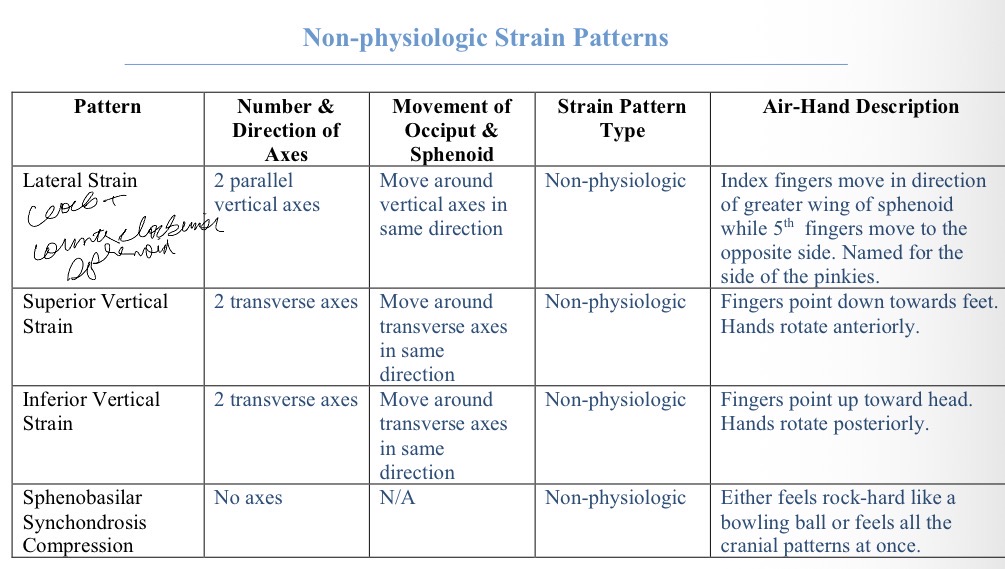
BLT is inherently
Indirect

What is this hold?
The vault hold

What is this hold
Fronto-occipital hold

What is this hold
The Becker Hold

What is this hold
Occipitoatlantal Decompression
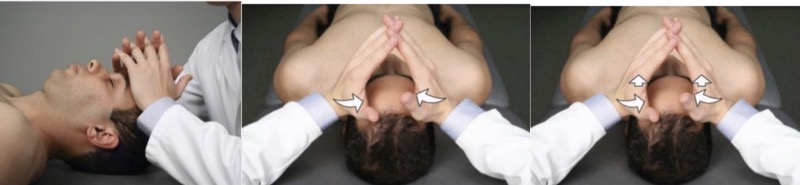
What is this
The frontal lift

What is this
Naso-frontal suture release
Number of axis and direction for Sidebending and rotation (right or left)
2 parallel vertical axes and 1 anterior/posterior axis

Number of axis and direction for lateral strain (right or left)
2 parallel vertical axes

Number of axis and direction for superior vertical strain/shear
2 transverse axis

Number of axis and direction for inferior vertical shear/strain
2 transverse axis


Which hold is this
Cranial vault hold
Hands slant. Index fingers
on GW of sphenoid move
opp to direction of pinkies on
occiput. BUT Named for
direction of basisphenoid
(which is the same direction
as the pinkies, opp the
direction of the GW)
Lateral strain

Fingers point down towards
feet (wrists ulnar-
deviate). Named for direction of
basisphenoid
Superior strain/shear

Fingers point up toward
head. (wrists radial-
deviate) Named for direction of
basisphenoid
Inferior vertical shear/strain

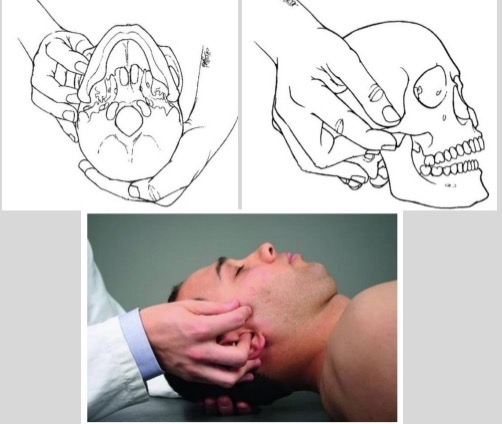
What is this hold
Unilateral temporal hold
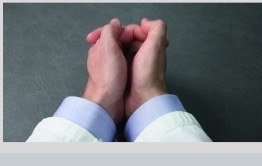
What’s this hold used for
Compression of the fourth ventricle
Flexion number of axis and direction
2 transverse axes

Extension number of axis and direction
2 transverse axis

Number of axis and direction for torsion
1 anterior/posterior axis


What is this
The parietal lift