5E- Redox
 Call Kai
 Learn
Learn Practice Test
 Spaced Repetition
 Match
Match Flashcards
 Knowt Play
1/56

There's no tags or description
Looks like no tags are added yet.
Name | Mastery | Learn | Test | Matching | Spaced | Call with Kai | Chat |
|---|
No analytics yet
Send a link to your students to track their progress
57 Terms
which half equation will show electrons as reactants
reduction
which half equation will show electrons as products
oxidation
how do you balance a half equation in acidic conditions
add waters to balance oxygens, add H+ to balance hydrogens, add electrons to balance charge
how do you balance a half equation in alkaline conditions
add double OH- needed to balance oxygen, add H2O to balance hydrogen, add electrons to balance charge
how to form a redox equation from half equations
multiple them so they have the same number of electrons, add them
how can you balance a redox reaction
use oxidation numbers- total increase in oxidation no. = total decrease in oxidation no., once oxidation and reduction are balanced remaining elements can be balanced
how to find a half equation from the redox equation and other half equation
write the redox equation as an ionic equation, scale known half equation up so the key species are removed when subtracted, move electrons (add any other species) onto the correct side (so they are added not subtracted) and simplify half equation if needed
what titration is used to find the concentration of reducing agents
manganate (VII) titration
what is the manganate (VII) titration used for
used to find concentration of reducing agents
what titration is used to find the concentration of oxidising agents
iodine/thiosulfate titration
what is the iodine/thiosulfate titration used for
to find the concentration of oxidising agents
what happens during a manganate (VII) titration
manganate (VII) ions are reduced to manganese (II) ions
write the balanced half equation for the reduction of manganate (VII) ions to manganese (II) ions in the manganate (VII) titration
MnO4- + 8H+ + 5e- → Mn2+ + 4H2O
what is the set up for the Manganate (VII) titration
burette is filled with a solution of manganate (VII) ions, test solution is measured into a conical flash using a pipette, excess sulfuric acid added
why is excess of sulfuric acid added to either the manganate solution or test solution before titrating in the manganate (VII) titration
to provide H+ ions needed for MnO4- to be reduced
what’s the indication of the end point of the manganate (VII) titration
first permanent pale pink colour
what are manganate ions often used to find the concentration of
2 specific reducing agents: iron (II) ions and ethanedioic acid
why might it be unsuitable to use the manganate (VII) ions and iron (II) ions redox reaction in a redox titration at very high concentrations of iron (II)
Fe3+(aq) is orange so it would make the pale pink end point hard to see
what is the set up for the iodine/thiosulfate titration
standard solution of thiosulfate ions is added to the burette, a sample solution of oxidising agent to be analysed is added to the conical flask with an excess of potassium iodide- iodide ions oxidised to form iodine
what happens to the iodide ions from the potassium iodine when they are added to the oxidising agent at the start of an iodine/thiosulfate titration
they are oxidised to form iodine
how can iodine/thiosulfate reaction be used to find the concentration of oxidising agent
iodine- formed by oxidising agent when excess potassium iodide is added- can be titrated against a standard solution of thiosulfate ions
what is added close to the end point of an iodine/thiosulfate titration and why
starch- at low concentrations the brown colour of iodine is hard to see, makes judging end point when iodine has been reacted away very challenging, starch provides a clearer colour change as it turns blue black in presence of iodine and is colourless in the absence
why is the starch not added before the iodine/thiosulfate titration begins
once it is added it’s impossible to judge how close the end point of the titration is, once iodine is straw coloured (fairly pale) end point is approaching, starch is added and from this point thiosulfate can be added dropwise
what is iodine/thiosulfate titration often used for
find concentration of oxidising agents: copper (II) ions and chlorate (I) ions
what is in a half cell
contains an element in two different oxidation states, together with a means of electrical contact e.g. piece of metal
what is the function of a salt bridge
allows ions to flow between the 2 half cells
why is a salt bridge necessary in half cells
completes the circuit, otherwise charge would build up in the half cells
what are the ways charge is carried in circuits using half cells
movement of electrons through wire joining the two half cells, movement of ions through salt bridge
what is generally used as a salt bridge
concentrated solution of an electrolyte that doesn’t react with the materials in either half cell e.g. piece of filter paper soaked in saturate KNO3 (aq)
if there is no solid involved in the half reaction what material is conventional to use as the electrode
platinum- it’s inert
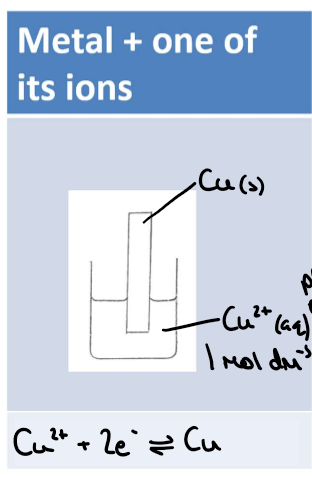
what is the diagram for a half cell that has a metal and one of its ions
metal electrode and solution with metal ions
what is the diagram for a half cell that has two aqueous substances
platinum electrode, solution with both metal ions

what is the diagram for a half cell that has a gas and solution of one of its ions
platinum electrode, solution with ion, gas chamber with gas

what needs to be included when drawing half cell diagrams
salt bridge, voltmeter, temperature, conc. of solutions, pressure if there are any gases
define standard electrode potential of a half cell
the e.m.f. of a half cell compared with a standard hydrogen half cell measured at 298K with solution concentrations of 1 mol dm-3 and a gas pressure of 100 kPa
what is the standard against which the potential of a half cell electrode is measured
standard hydrogen half cell
labelled diagram of standard half cell
platinum electrode, H+ solution, H2 in gas chamber

when measuring standard electrode potential why is it necessary to arrange things so that no current is allowed to flow
once current starts to flow, solution concentrations will have changed, conditions will no longer be standard
what does it mean if an electrode potential is negative
the half cell is more likely to give up electrons than standard hydrogen half cell- acts as electron donor/reducing agent
what does it mean if the electrode potential is positive
half cell is less likely to give up electrons than hydrogen half cell- accepts electrons/oxidising agent
what type of half cell equation is most likely to donate electrons
the most negative one
how do you calculate the E0 for the cell
E0 (more positive electrode) - E0 (more negative electrode)
E0 should always be a positive number

why even when combinations of half cells are correctly connected the predicted reaction may not occur
activation energy of the reaction may be very high so rate of reaction is too slow to be observed
actual conditions used may not be standard so predictions are no longer valid (equilibria position and electrode potential will change)
what are the conditions E0 values are measured
1 mol dm-3, 298K, 100kPa
what is needed for a redox to be feasible
half-reaction for the oxidising agent must have a more positive standard redox potential than the half-reaction for the reducing agent
how to work out feasibility of redox reactions
use E0 data for relevant half equations to predict the reaction that should occur, compare the prediction to the scenario present e.g. are the species being talked about both on the reactant side
what are storage cells
often known as batteries, consist of fixed amounts of chemicals, all materials remain in the cell, these materials are used up as the cell discharges and energy is used, when stock of reacting materials is exhausted cell is flat and no more energy can be drawn from it- storage cell has a specific amount of energy it can supply
depending on type of cell it may be possible to reverse the chemical reaction and recharge the cell by re-forming original materials
what are fuel cells
uses fuel and oxygen which undergo an exothermic chemical reaction, fuel and oxygen flow into cell and products flow out, electrolyte remains- can be acid or alkaline fuel cells depending on electrolyte used, reaction is arranged so the energy is produced in the form of electrical energy, as long as fuel and oxygen are available the fuel cell can continue to operate, fuel cell can in principle supply an infinite amount of energy
what are the types of cells used to deliver electrical power on the go
primary cells, secondary cells, fuel cells
what is the difference between a primary and secondary cell
primary cells are non-rechargeable and can only be used one, secondary cells are rechargeable and can be used many times. both storage cells
what are some uses of primary cells
torches, remote controllers, bike lights
what are the main advantages of secondary cells over primary cells
can be recharged and reused, reducing environmental impact- waste and raw materials- and overall long term costs
examples of uses of different types of secondary cells
lead acid batteries in motor vehicles
lithium ion batteries in phones
NiCD and NiMH batteries in radios etc.
which reaction occurs at the positive elctrode
the more positive reaction (reduction)
which reaction occurs at the negative electrode
more negative reaction (oxidation)
what are the main advantages of fuel cells over conventional engines
more efficient so reduces greenhouse gas emissions
other than hydrogen state another fuel which is sometimes used in fuel cells
ethanol
CH3CH2OH + 3O2 → 2CO2 + 3H2O