Mutli - Chap 11
0.0(0)
Studied by 1 person Call Kai
 Learn
Learn Practice Test
 Spaced Repetition
 Match
Match Flashcards
 Knowt Play
Card Sorting
1/72

Last updated 10:31 PM on 10/24/22
Name | Mastery | Learn | Test | Matching | Spaced | Call with Kai | Chat |
|---|
No analytics yet
Send a link to your students to track their progress
73 Terms
1
New cards
What is the distance formula 2D
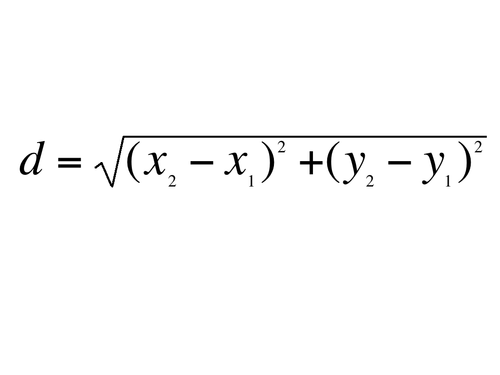
2
New cards
Distance formula 3D
d = √[( x₂ - x₁)² + (y₂ - y₁)² + (z₂ - z₁)²]
3
New cards
If k is constant, then x=k represents a plane parallel to what plane
yz plane
4
New cards
If k is constant, then y=k represents a plane parallel to what plane
xz
5
New cards
If k is constant, then z=k represents a plane parallel to what plane
xy
6
New cards
What is the equation of a sphere
r^2 = (x-h)^2 + (y-k)^2 + (z-l)^2
7
New cards
equation of an ellipse
(x-h)^2/a^2 + (y-k)^2/b^2 = 1
b is ALWAYS greater than a
b is ALWAYS greater than a
8
New cards
in the equation for an ellipse what is the center
(h,k)
9
New cards
In the equation for an ellipse what is the major axis and what is the minor axis
The major axis is b and the minor axis is a
10
New cards
How do you find the dot product of two vectors
You multiply the corresponding parts and then add the numbers you get all together

11
New cards
How do you find the magnitude of a vector
|a| = square root (x^2 + y^2 + z^2)
12
New cards
What is an alternate way to find dot product
|a|(|b|)cos(theta) if you have both magnitude and theta
13
New cards
how can you find the angle between two vectors
use the equation
dot product = |a|(|b|)cos(theta)
and solve for theta
dot product = |a|(|b|)cos(theta)
and solve for theta
14
New cards
If the dot product is zero what does that mean
The vectors are perpendicular
15
New cards
How do you know that vectors are parallel
They are scalar multiples
16
New cards
what is a direction cosine
cos(a) = dot product of vectors / |a|
- corresponds to the coefficient of the "i" in an equation like a=-2i + j + 5k
- corresponds to the coefficient of the "i" in an equation like a=-2i + j + 5k
17
New cards
what is a scalar projection of b onto a
dot product of a and b/ ||a||
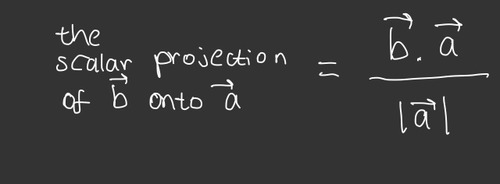
18
New cards
what is a scalar projection aka. component of b along a
You are putting b onto the same direction as vector a and finding its value
"how much of vector b is pointed in the same direction as vector a"
"how much of vector b is pointed in the same direction as vector a"
19
New cards
What is vector projection
you are projecting a vector onto another vector for its direction only (the mag of the second vector doesn't matter)
- magnitude of comp b along a with direction
- magnitude of comp b along a with direction
20
New cards
What is the formula for the comp b along a
||b||cos(theta)
- cuz of right triangle
- cuz of right triangle
21
New cards
what is the formula for projection of u onto v
(u⋅v)/(||v||^2)^* V
22
New cards
If you have the projection of u onto v (W1), how do you find the vector component of u orthogonal to v
W2 = U - W1
- since it is like the vector addition thing "tip to tail" so when you subtract one vector from the total vector you get the individual parts
- since it is like the vector addition thing "tip to tail" so when you subtract one vector from the total vector you get the individual parts
23
New cards
If the component of one vector along the direction of another is zero what can you conclude about these two vectors?
the vectors are orthogonal
24
New cards
under what circumstances is comp b onto a = comp a onto b
If the dot product is not zero, then that means the magnitude of a and b are the same, so the vector a and b are the same length
25
New cards
what is the cosine, sine identity
cos^2 = 1 - sin^2
26
New cards
what is the sec, tan identity in terms of tan
sec^2 = 1 + tan^2
27
New cards
what is the sec, tan identity in terms of sec
tan^2 = sec^2 - 1
28
New cards
when you are left with sec(theta)d(theta) in the integral, what do you do
you multiply by (sec + tan)/(sec + tan)
29
New cards
when you are left with sec(theta) in the integral what is the shortcut
It ends up as ln|sec + tan| + C but in terms of theta so have to change it to x
30
New cards
when you are left with csc(theta)d(theta) in the integral, what do you do
you multiply by (csc + cot)/(csc + cot)
31
New cards
when you are left with csc(theta) in the integral what is the shortcut
It ends up as -ln|csc + cot| + C but in terms of theta so have to change it to x
- NEGATIVE ln
- make sure you do not forget
- NEGATIVE ln
- make sure you do not forget
32
New cards
what should you do if you have something like x+3 in the numerator of the trig sub
split it into two integral, chances are you can do u sub for the x integral
33
New cards
how do you do cross product
Its the table thing where you do the cross of the column you're not in
34
New cards
if dot product is 0
the vectors are orthogonal
35
New cards
How do you find the area of a parallelogram with two vectors
||a x b||
36
New cards
is the output of cross product scalar or vector
it is a vector
37
New cards
how do you find the volume of a parallelepiped
the triple scalar product
u⋅(v x w)
u⋅(v x w)
38
New cards
how do you do triple scalar product
just watch the organic vid again for a reminder
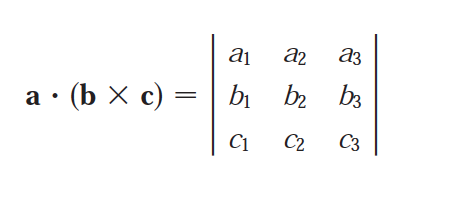
39
New cards
What do you need to make an equation of a 3D line
a point and a vector (since it gives direction)
40
New cards
What is the vector equation of a line
r = r(0) + tv
kind of like y = mx+b
kind of like y = mx+b
41
New cards
What are the parametric equations of a line
x = x0 +at
y= y0 + bt
z = z0 + ct
y= y0 + bt
z = z0 + ct
42
New cards
What are the symmetric equations of a line
(x-x0)/a = (y-y0)/b = (z-z0)/c
(made if you solve for t)
(made if you solve for t)
43
New cards
If a, b, or c equals zero on the symmetric equations of a line what does that mean
the particle is not changing positions in the direction
44
New cards
If you are given a point and a vector, how do you find the vector equation
you use the formula r = r0 +at
r0 is the point
a is the given vector
t is the variable
r0 is the point
a is the given vector
t is the variable
45
New cards
How do you find the parametric equations for a line that passes through points A and B if the points are given
You find the "slope" between the points and essentially find the vector between them. The values in that vector <a,b,c> are the coefficients in the parametric equation
x = point + at
y = point + bt
z = point + ct
x = point + at
y = point + bt
z = point + ct
46
New cards
how do you find when the line intersects the yz-plane when given the two points the line passes through
1) find the parametric equations
2) you set x = 0 since that's where it'll intersect the yz plane and solve for t
3) plug that t value into the other parametric equations and find the other values for y and z
2) you set x = 0 since that's where it'll intersect the yz plane and solve for t
3) plug that t value into the other parametric equations and find the other values for y and z
47
New cards
how do you know if two lines are parallel based off of their parametric equations
you take the coefficient values of the parametric equations and make them a vector. compare the two. if they are scalar multiples, then they are parallel
48
New cards
What are skew lines
Lines that do not intersect and are not coplanar
- they could go through the same point but NOT at the same time
- they could go through the same point but NOT at the same time
49
New cards
how do you determine if two lines are skew lines given the symmetric equations
1) you check that the lines aren't parallel by turning them into parametric, then vectors, then compare them to see if they're multiples
2) check that they don't intersect by setting the parametrics equal to each other (make one variable t and the other c). solve for t and c. If they work out then the lines intersect
2) check that they don't intersect by setting the parametrics equal to each other (make one variable t and the other c). solve for t and c. If they work out then the lines intersect
50
New cards
What do you need to define a plane is space
You need a vector that is perpendicular to the plane since it restricts the direction the plane could possibly be in
- parallel vector would be infinite possibilities
- parallel vector would be infinite possibilities
51
New cards
What is a normal vector
a vector that is orthogonal to every vector in a given plane
52
New cards
how do you prove vectors are orthogonal
if the dot product is zero
53
New cards
what is the formula for the scalar equation of a plane given a point and normal vector <a,b,c>
a(x-x1) +b(y-y1) +c(z-z1) = 0
54
New cards
What is the linear equation of a plane
ax + by + cz + d = 0
55
New cards
How do you find the normal vector from the linear equation of a plane
vector = <a,b,c> based off of the equation ax + by + cz + d = 0
56
New cards
how do you find the equation of a plane that passes through three points
1) make 2 vectors from the points
2) do the cross product of the two vectors to find the orthogonal/normal vector
3) plug the values from the normal vector into the equation of a plane using one of the given points
2) do the cross product of the two vectors to find the orthogonal/normal vector
3) plug the values from the normal vector into the equation of a plane using one of the given points
57
New cards
How do you know if two planes are parallel
Their normal vectors are parallel
58
New cards
How do you know if two planes are perpendicular
the dot product of their normal vectors is zero
59
New cards
If the two planes are not parallel, then how do they intersect and what is the angle
They intersect in a straight line and the angle is called the acute angle between two vectors
60
New cards
How can you find the distance between a point and a plane
You create a vector between two known points, then use that vector to determine how much of that vector is made up by the orthogonal distance to the plane
61
New cards
What is the formula to find the distance between a point and a plane
comp vector (v) along normal vector (n) = (dot product v and n)/||n||
62
New cards
How do you find the distance between two planes
You find a vector between the two known points and use the normal vector of the plane to one of the points to do a comp of the vector onto the normal vector
- it gives you how much of that vector is between the two planes in the direction of the normal vector
- it gives you how much of that vector is between the two planes in the direction of the normal vector
63
New cards
how do you find the distance between two plane given the equation of the parallel planes
1) Find a point on both planes by setting y and z to zero and solving for x
2) Find the vector between the two points
3) comp of that vector along the normal vector
2) Find the vector between the two points
3) comp of that vector along the normal vector
64
New cards
What are cylindrical coordinates
Its like a polar coordinate so its in (r, theta, z)
- z just stays the same
- z just stays the same
65
New cards
What is x equal to in polar
x = r*cos(theta)
66
New cards
What is y equal to in polar
y = r*sin(theta)
67
New cards
What is the x and y identity in polar
r^2 = x^2 + y^2
68
New cards
What is the tan identity in polar
tan(theta) = y/x
69
New cards
What are spherical coordinates
Coordinates in (rho, theta, phi)
70
New cards
What does rho represent
The distance from point p to the origin
- hypotenuse of triangle
- magnitude of vector to point p
- hypotenuse of triangle
- magnitude of vector to point p
71
New cards
What does phi represent
The angle between rho and the z-axis
72
New cards
What is rho equal to in cartesian
distance formula root( x + y + z) but the vars are squared
73
New cards
what does r equal in spherical coordinates
r = rho*sin(phi)