N3 Exam 2
 Call Kai
 Learn
Learn Practice Test
 Spaced Repetition
 Match
Match Flashcards
 Knowt Play
1/290

There's no tags or description
Looks like no tags are added yet.
Name | Mastery | Learn | Test | Matching | Spaced | Call with Kai | Chat |
|---|
No analytics yet
Send a link to your students to track their progress
291 Terms
How many bones are there in the body
206 bones
What are all the types of bones
•Long bones
•Short bones
•Flat bones
•Irregular bones
Osteoblasts
Function in bone formation
Osteocytes
Mature bone cells that function in bone maintenance
Osteoclasts
Multinuclear cells that function in destroying, resorbing, and remodeling bone
Osteophytes (bone spurs)
Protrude into the joint space
Osteogenesis
process of bone formation
Ossification
the process of formation of the bone matrix and deposition of minerals
Regulating factors
Stress and weight bearing
Vitamin D (check)
Parathyroid hormone and calcitonin
Blood supply
Osteoarthritis (OA)
Slowly progressive noninflammatory disorder of the diarthrodial joints
Why are OA numbers expected to increase?
Because the population is aging
Is OA more common in men or women?
More common in women
More common in women (reason not fully established — hormonal factors, especially estrogen decline after menopause, are thought to play a role) (claude ai)
Which types of OA are especially common in women?
Especially hand OA and knee OA (after menopause)
When are most men affected by OA?
Most men affected by 70 to 80 years, except for traumatic arthritis
Which joint is OA more common in overall
Hip OA more common
OA: Etiology & Pathophysiology
Gradual loss of articular cartilage
Formation of osteophytes at joint margins
Not normal part of aging process
Cartilage destruction causes
narrowing of joint space
By what age are most adults affected by OA
Most adults affected by age 40
When do symptoms of OA typically manifest?
manifest after age 50 to 60
Pathologic changes in OA — what happens to the color and texture of cartilage?
Cartilage becomes:
• Dull, yellow, and granular
• Softer and less elastic
Less able to resist wear with heavy use
OA and Osteophytes
are formed resulting in uneven weight distribution; bones rub together leading to increasing pain in later stages
OA: Risk Factors
Older age, female gender, and obesity
Certain occupations (e.g., those requiring laborious tasks)
Engaging in sport activities
History of previous injuries, muscle weakness, genetic predisposition, and certain diseases
Most prominent modifiable risk factor for OA is obesity
Diet and exercise can help minimize symptoms of OA in patients with obesity
Most prominent modifiable risk factor for OA
OA is obesity
Diet and exercise can help minimize symptoms of OA in patients with obesity
OA: S/S
Joint pain = Pain worsens with joint use
Early stages: rest relieves pain
Later stages: pain with rest and trouble sleeping due to increased joint pain
Pain contributes to disability and loss of function as OA progresses
Pain may be referred to groin, buttock, or outside of thigh or knee
Sitting down becomes difficult, as does getting up from a chair when hips are lower than knees
Local pain and stiffness
Crepitation (grating sensation)
OA affects joints asymmetrically
When does joint stiffness occur in OA?
after periods of rest or unchanged position
Early morning stiffness usually resolves within 30 minutes
How does OA morning stiffness compare to rheumatoid arthritis?
rheumatoid arthritis cause Fatigue, fever, and organ involvement which is not present in OA
What effect does overactivity have on OA joints?
Leads to mild joint effusion, temporarily increasing stiffness
Joints most affected by OA
Hips
Knees
Metatarsophalangeal (MTP)
Cervical vertebrae
Lumbar vertebrae
Distal interphalangeal (DIP)
Proximal interphalangeal (PIP)
Metacarpophalangeal (MCP)
OA: S/S Joint Deformity
Specific to joint involved
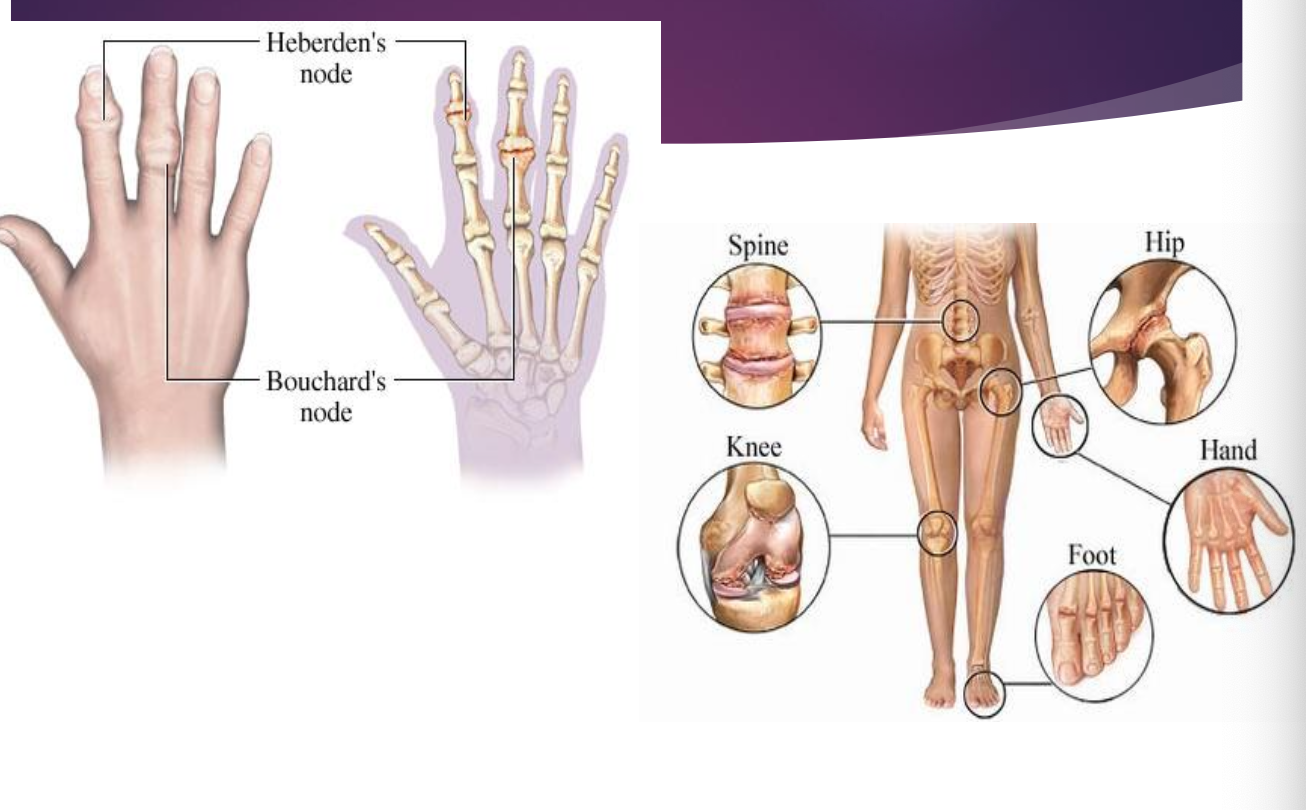
Heberden’s nodes: DIP
Bouchard’s nodes: PIP
Appear red, swollen, and tender
Varus deformity (bowlegged): medial knee
Valgus deformity (knock-kneed): lateral knee
One leg shorter than the other: hip
Thinking Nurse
The nurse is discussing the symptomology of
osteoarthritis (OA) with a patient. The nurse
would describe which common initial symptom
of the disease?
A. A fine red rash on the elbow that is constant.
B. Painful stiffness in the joints of the fingers
C. Popping sensation in the wrist joint when
typing.
D. Knee pain when the leg is at rest.
OA: Diagnostic Studies
Bone scan, CT scan, MRI
X-rays
No specific lab tests or biomarkers
Synovial fluid analysis
OA: Bone scan, CT scan, MRI
Diagnosis of OA; show early joint changes
OA: X-rays
Detect joint space narrowing, increased bone density, and osteophytes
OA: No specific lab tests or biomarkers
Baseline labs may be done before starting treatments or for screening for related conditions
Is there a cure for OA
no cure
what does OA Tx focus on
Managing pain and inflammation
Preventing disability
Maintaining and improving joint function
Nondrug interventions are the basis for OA management = PT
Drug therapy supplements nondrug treatment
OA: Treatment: Non-Pharm
Balance rest and activity
Rest during acute inflammation
Modify activities to decrease joint stress
Avoid prolonged standing, kneeling, or squatting
Assistive device as needed
Heat and Cold Applications
Weight-reduction
Exercise
OA: Rest during acute inflammation
Functional positioning with splints or braces
Avoid increased stiffness by limiting immobility to less than 1 week.
OA Tx: Heat and Cold applications
May help reduce pain and stiffness
Ice for acute inflammation
Heat therapy for stiffness
OA Tx: Wt reduction
critical if over weight
OA Tx: Exercise
Aerobic, Range of motion, & Muscle strengthening
OA Treatment: Surgery — Arthroscopic surgery
For patients with loss of function, unmanaged pain, and decreased independence
Common for patients with knee OA
May provide no additional benefit over PT and medical treatment
OA: Treatment: Pharm based on
severity of patient’s symptoms
OA: Pharm Mild to moderate joint pain
Acetaminophen
Topical agent (e.g., capsaicin cream)
OTC creams containing camphor, eucalyptus oil, and
menthol (e.g., BenGay, ArthriCare)
Topical salicylates (e.g., Aspercreme)
OTC Balm eg. Tiger balm
OA: Treatment: Pharm Moderate to severe joint pain
• Nonsteroidal antiinflammatory drug (NSAID); start low
dose, increase if needed
Ibuprofen 200 mg up to four times per day TAKE WITH FOOD
Misoprostol to decrease GI side effects
Arthrotec (combination of misoprostol and NSAID diclofenac)
Diclofenac gel
Avoid both oral and topical NSAIDs together
• COX-2 inhibitor celecoxib (Celebrex)
Intraarticular corticosteroid injections
Hyaluronic acid injection
DMOADs—disease-modifying OA drugs
OA: Colecoxib (Celebrex)
Take the medication with food or milk
OA: Treatment: Pharm Intraarticular corticosteroid injections
4 or more injections without relief suggest need for additional intervention
Corticosteroids should not be given systemically
OA: Hyaluronic acid injection
knee OA
Viscosupplementation
OA: DMOADs—disease-modifying OA drugs
No drugs approved to modify OA progression
Thinking Nurse
The nurse should include all of the following teaching for
the client with osteoarthritis EXCEPT?
A. Avoid aerobic exercise because it fatigues the joints
B. Take prescribed anti-inflammatory medications with
meals.
C. Alternate hot and cold packs to affected joints.
D. Rest during acute inflammation period for no more
than 1 week to prevent joint stiffness.
OA Nursing Assessment
Joint pain and stiffness
Type, location, severity, frequency, and duration;
aggravating or alleviating factors
Impact on ability to perform ADLs
Pain management practices
Assess affected joints (compare to
unaffected)
Tenderness, swelling
Limitation of movement
Crepitation—What is it?
OA Patient teaching
Nature and treatment of disease
Pain management
Body mechanics
Correct use of assistive devices
Joint protection and energy conservation
See Table 64-4 in the textbook
Nutrition
Weight and stress management
Exercise WHAT TYPE?
The nurse determines that teaching about
management of osteoarthritis of the feet and hands has
been effective when the patient says:
a. “I will be careful to avoid crowds.”
b. “I can use heat to relieve the stiffness when I wake up in
the morning”
c. “I should exercise my hands every day, especially if they
are painful and inflamed.”
d. “I should avoid the use of glucosamine as it does not
have any therapeutic value.”
OA Take Home — What type of disease is OA often described as?
A disease of "wear and tear"
Are there biomarkers or lab abnormalities in OA?
No — there are no biomarkers and no lab abnormalities
What does synovial fluid look like in OA?
Basically normal
what is the range of joint disability seen in OA?
Mild to significant joint disability
In early-stage OA, what relieves pain?
Rest
Distiguishing feature of OA
early morning stiffness
RA: Pathophysiology & Etiology
Chronic, systemic autoimmune disease; inflammation of connective tissue in diarthrodial (synovial) joints
What is the disease course pattern of RA?
Periods of remission and exacerbation = Disabling form of arthritis
What may be needed if RA treatment is inadequate?
Mobility aids or joint reconstruction may be needed
What ethnic groups dfoes RA affect
all ethnic groups
How does RA incidence change with age?
Increases with age, peaks between 20 and 40
How does RA prevalence compare between women and men?
Three times as many women as men
check if we need to know
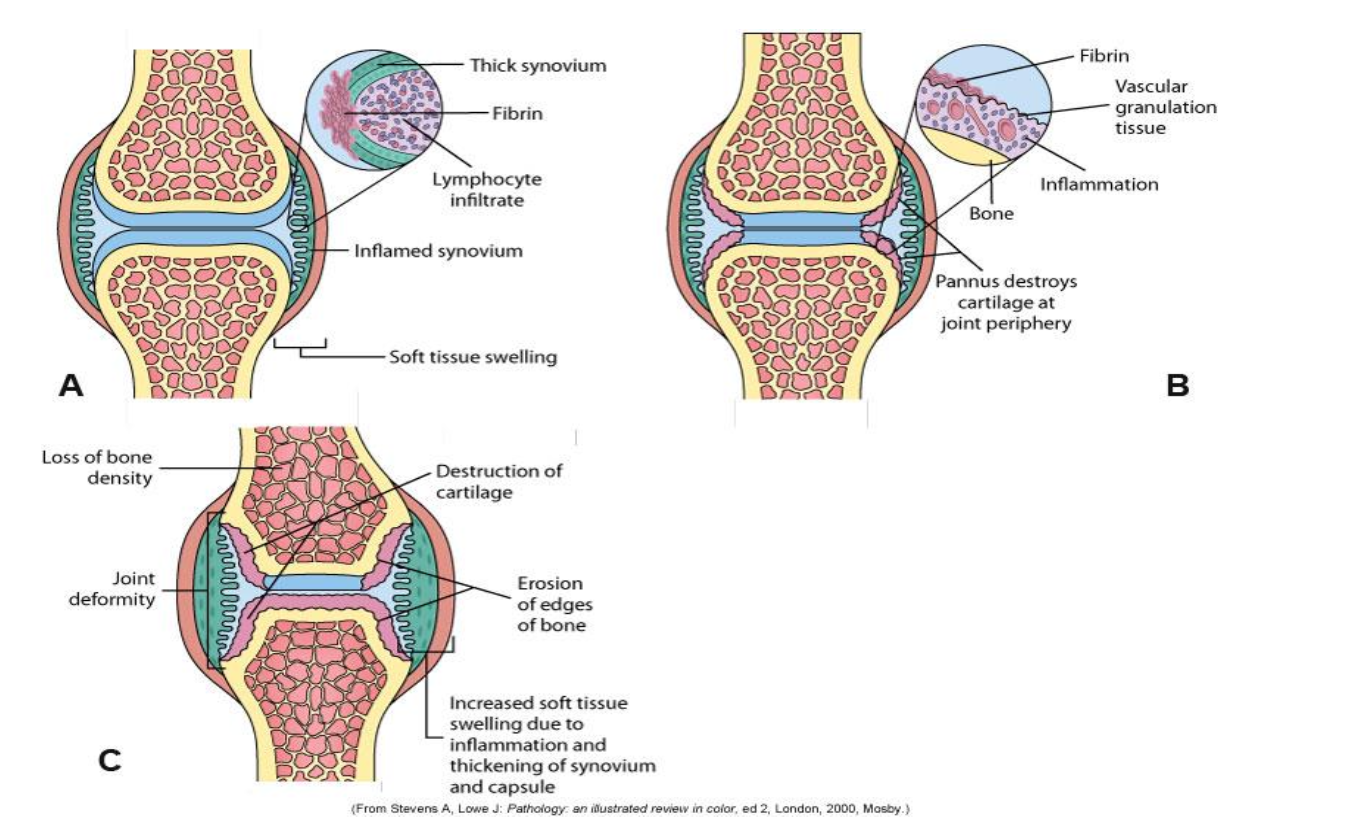
Rheumatoid arthritis. A, Early pathologic change in rheumatoid arthritis is rheumatoid synovitis. The synovium is
inflamed. There is a great increase in lymphocytes and plasma cells.
B, With time, there is articular cartilage destruction; vascular granulation tissue grows across the surface of the cartilage
(pannus) from the edges of the joint, and the articular surface shows loss of cartilage beneath the extending pannus, most
marked at the joint margins.
C, Inflammatory pannus causes focal destruction of bone. At the edges of the joint there is osteolytic destruction of bone,
responsible for erosions seen on x-rays. This phase is associated with joint deformity
cause of RA
Cause unknown, believed autoimmune etiology
Genetic factors: have increased human leukocyte antigen (HLA)
What does the triggering antigen cause in RA?
formation of abnormal immunoglobulin G (IgG)
What develops against the abnormal IgG in RA?
Autoantibodies
Rheumatoid factor (RF)
What increases RA risk when your genetically predisposed
smoking
How much more often does RA occur in women vs. men?
RA occurs 2-3 times more often in women than in men
The nurse is preparing a flyer on rheumatoid arthritis (RA) for
distribution during a community health fair. Which
information should the nurse include? Select all that apply
A. Rheumatoid arthritis typically affects weight-bearing
joints.
B. Onset generally occurs between 20 and 40 years of age
C. Rheumatoid arthritis is the most common form of arthritis.
D. Women are more likely to be affected than men
E. Rheumatoid arthritis appears to have a genetic
component
RA: Diagnostic tests
4 OF THE FOLLOWING MUST BE PRESENT WITH 1 THROUGH 4 PRESENT A MINIMUM OF 6 WEEKS
Moring stiffness equal to or greater than 1 hour
Arthritis of 3 or more of the following joints: right or left PIP, MCP, wrist, elbow, knee, ankle, and iTP joints
Arthritis of wrist, MCP, or PIP joint
Symmetric involvement of joints
Rheumatoid nodules over bony prominences, or extensor surfaces, or in juxtaarticular regions
Positive serum rheumatoid factor
Radiographic changes including erosions or bony decalcification localized in or adjacent to the involved joints
RA: Inflammatory Disease Lab Work
WBC-elevated in stress, infection, inflammation, trauma
C-reactive protein (CRP)-detects inflammation
ANA-antinuclear antibody, suggest possible presence of
autoimmune disease
Rheumatoid factor (RF)- autoantibody, present in RA
Seronegative RA Factor
Can still have RA-antibodies non-existent or too low to detect
Vectra- advanced blood test for adults with rheumatoid
arthritis (RA). Measures 12 markers of disease activity
Reports level of RA activity: High, Moderate or Low
RA: S/S
Onset subtle eg fatigue, anorexia, weight loss, generalized stiffness that becomes localized stiffness with progression
May report history of precipitating stressful event eg Infection, stress, exertion, childbirth, surgery,
Specific joint involvement
Symptoms occur symmetrically
Often affects small joints (PIP, MCP, MTP)
Larger joints & cervical spine may be involved
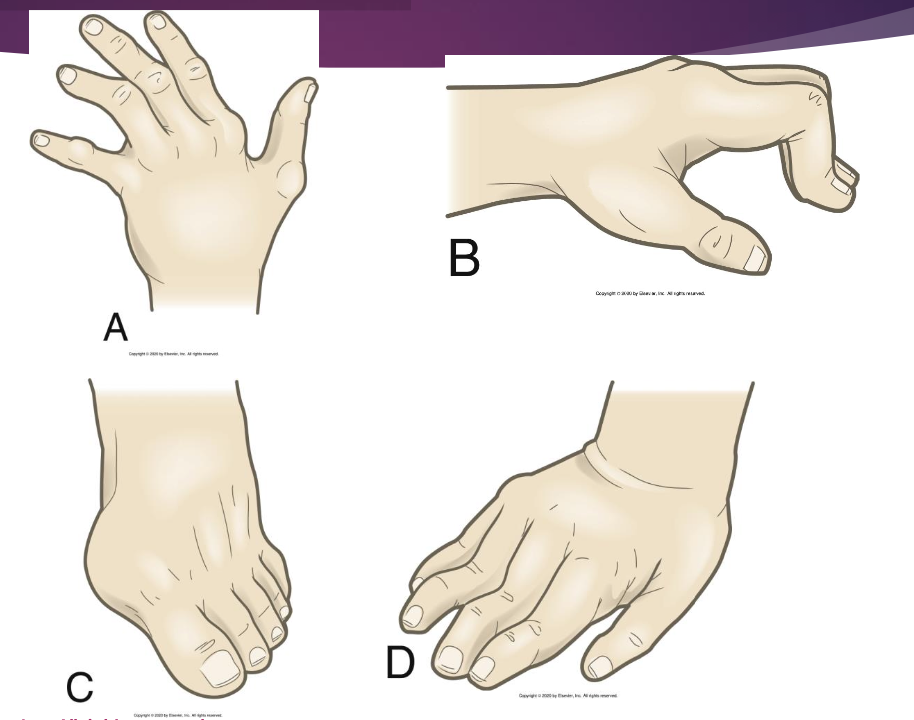
Typical Deformities of
Rheumatoid Arthritis
RA: Affects all body systems
Firm, nontender masses found on bony areas exposed to pressure
Cataracts and vision loss
Nodular myositis
Pleurisy, pleural effusion, pericarditis, pericardial effusion, and cardiomyopathy
Drug Therapy for RA-DMARDS
DMARDS
Methotrexate
RA: DMARDS
Disease modifying ant rheumatic drugs prescribed aggressively
RA: Methotrexate
Drug of first choice
Less expensive
Lower toxicity
Therapeutic effects in 4 to 6 weeks
Methotrexate Side Effects
Sore mouth
Low blood cell counts (bruising/bleeding, swollen lymph nodes)
bone marrow suppression and hepatotoxicity
monitor with CBC, chem panel, and LFT’s
Liver & lung damage (follow with CXR and blood tests)
Risk for Infection is high
DMARDS type
Sulfasalazine and antimalarial drug
Hydroxychloroquine (Plaquenil)
Corticosteroids
Leflunomide (Arava)
Hydroxychloroquine (Plaquenil)
for mild to moderate cases (mechanism of action unknown)
Rapid absorption & Relatively safe
Well tolerated
Need eye exam
Corticosteroids
daily prednisone
Leflunomide (Arava)
*newer, blocks immune cell overproduction
Blocks immune cell overproduction
Not used during pregnancy; teratogenic
Sulfasalazine Side Effects
Changes in blood counts
Nausea/Vomiting
Sensitivity to sunlight
Yellow/Orange color of urine, tears, sweat- stains clothes/contacts
Avoid if allergic to Sulfa drugs
Also used for IBD, Ankylolosing spondylitis (AS)
Hydroxychloroquine (Plaquenil) — What risk comes with high dose over time?
increase risk of damage to the retina-- follow with eye exam Q 6 months
what is Hydroxychloroquine (Plaquenil) taken with
Used with other DMARDS and steroids
Hydroxychloroquine (Plaquenil) uses
Used for early RA and SLE
Hydroxychloroquine (Plaquenil) originally developed for
malaria
Hydroxychloroquine (Plaquenil) side effects
Pt may have hair loss or hair becomes lighter
Tofacitinib (Xeljanz)
JAK (Janus kinase) inhibitor: interferes with enzymes that cause joint inflammation
Moderate to severe active disease
No live vaccines
Janus kinase (JAK) inhibitors
another type of DMARD, are the first in a class of treatments for moderate to severe RA.
XELJANZ, a JAK inhibitor, has been shown to help
reduce pain and swelling in the joints, and to slow the progression of joint damage.
XELJANZ works
alone
XELJANZ proven to reduce
RA pain, swelling, and joint damage without the need for methotrexate.
XELJANZ is also available a
a once-daily pill called XELJANZ XR.
Biologic Response Modifiers (BRMs/"Biologics")
target the underlying disease process, including specific parts of the immune system, to help reduce moderate to severe RA symptoms.
Biologic Response Modifiers (BRMs/"Biologics") have been shown to help
reduce pain, swelling, and stiffness in the joints, and the progression of joint damage
What do biologics block?
TNF