KAP biology unit 1.2 Vocabulary
 Call Kai
 Learn
Learn Practice Test
 Spaced Repetition
 Match
Match Flashcards
 Knowt Play
1/55

There's no tags or description
Looks like no tags are added yet.
Name | Mastery | Learn | Test | Matching | Spaced | Call with Kai | Chat |
|---|
No analytics yet
Send a link to your students to track their progress
56 Terms
Macromolecules
are large, complex molecules essential to life, built by linking smaller chemical units together.
main classes of biological macromolecules
Carbohydrates
Lipids
Proteins
Nucleic Acids
Carbohydates
Energy-rich molecules made of carbon, hydrogen, and oxygen
Primary Functions: provide fast energy
Lipids
A diverse group of hydrophobic (water - fearing) molecules,commonly known as fats and oils
Protein
an essential macronutrient made of amino acid chains that builds and repairs tissues,powers chemical reactions, and supports immune health in the body.
What Protein Does
Building blocks: forms muscles, bones, skin, hair and organs.
Enzymes and hormones: Powers chemical reactions and coordinates biologic processes.
Defense: Creates antibodies to fight infections and protect the body.
Nucleic acids
large biological molecules essential for all known forms of life, serving as the primary information-carrying molecules of the cell. They store, transmit, and express genetic instructions needed to build and operate organisms.
Main Types of Nucleic Acids
DNA and RNA
RNA
Typically single-stranded. It acts as a template and messenger, translating the genetic information stored in DNA into functional proteins.
DNA
Usually double-stranded in a twisted double helix shape. It holds the master genetic blueprint for an organism's traits and functions.
Biomolecule
are chemical substances produced by living organisms that drive essential cellular processes, ranging from structure and growth to energy storage and genetic reproduction.
Monomer
a small, basic molecule that can bind chemically with other identical or similar molecules to form a larger, complex structure called a polymer.
Polymer
a large macromolecule made up of many repeating smaller units (monomers) chemically bonded together in a long chain.
Fatty acids
are organic molecules that serve as key building blocks for lipids (fats and oils). They consist of a long hydrocarbon chain attached to an acidic carboxyl group (-COOH) at one end.
Unsaturated Fat
Contain one or more double bonds between carbon atoms, creating bends or "kinks" in the chain. They are usually liquid at room temperature (e.g., olive oil, vegetable oil).
Saturated Fat
Have only single carbon-carbon bonds, packing tightly together. They are typically solid at room temperature (e.g., butter, lard).
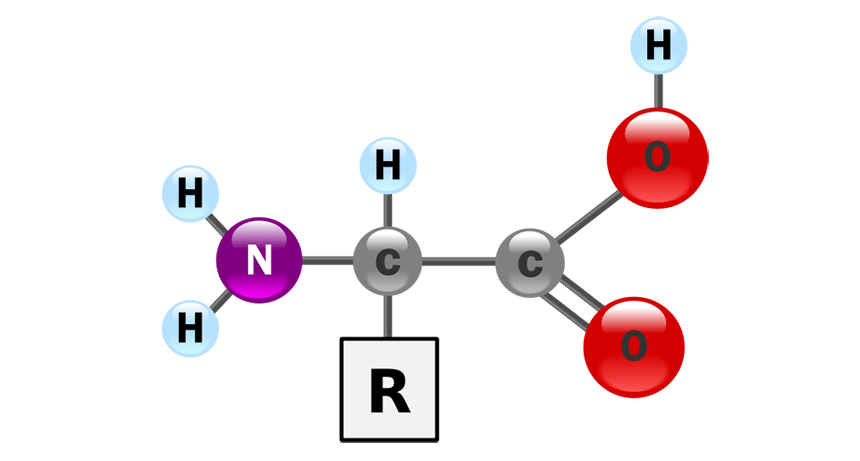
Amino acid
small organic molecules that serve as the building blocks (monomers) of proteins. When linked together by peptide bonds in long chains, they fold into functional 3D proteins.

Enzyme
a specialized protein that acts as a biological catalyst, speeding up chemical reactions in living organisms without being permanently changed or consumed in the process.
Inorganic
matter or chemical compounds that are not derived from living organisms and generally do not contain carbon-hydrogen (C-H) bonds.
DNA
Deoxyribonucleic Acid
RNA
Ribonucleic Acid
Nucleotide
the basic chemical unit (monomer) that links together to form long chains of nucleic acids, such as DNA and RNA.
Dehydration Synthesis
a chemical reaction in which two smaller molecules (monomers) combine to form a larger molecule (polymer), releasing a molecule of water as a byproduct.
Hydrolysis
a chemical reaction in which a molecule of water is used to break down a larger chemical compound (polymer) into smaller units (monomers).
Hydrolysis
direct reverse of dehydration synthesis.
organic
chemical compounds centered around carbon atoms, typically bound to hydrogen (C-H bonds), as well as oxygen, nitrogen, and other life-essential elements.
monosaccharide
the simplest form of carbohydrate, consisting of a single sugar molecule. Because they cannot be broken down into simpler sugars
monosaccharide
serve as the basic monomer building blocks for complex carbohydrates like disaccharides and polysaccharides.
polysaccharide
a complex carbohydrate polymer composed of long chains of simple sugar monomers (monosaccharides) linked together by glycosidic bonds.
phospholipid
a class of lipid molecule that forms the primary structural component of all cell membranes.
Bilayer
a thin, two-layered membrane composed of lipid molecules that forms the fundamental continuous barrier around all living cells and intracellular organelles.
hydrophilic
describes molecules or chemical substances that interact favorably with water and dissolve easily in it
hydrophobic
describes nonpolar molecules or chemical substances that repel water and do not dissolve in it.
Common Biological Examples of hydrophobic
oils and fats
Common Biological Examples of hydrophobic
Waxes: Found on plant leaves and bird feathers to create water-repelling protective barriers.
Common Biological Examples of hydrophilic
Salts and sugars
solution
a uniform mixture made when one substance dissolves completely into another
semipermeable
describes a barrier or membrane that allows certain molecules or ions to pass through while blocking others.
passive transport
the movement of substances across a cell membrane without requiring cellular energy (ATP). Molecules naturally move down their concentration gradient, shifting from an area of higher concentration to an area of lower concentration until equilibrium is reached.
diffusion
the natural movement of particles from an area of higher concentration to an area of lower concentration until they are evenly spread out.
osmosis
the movement of water molecules across a semipermeable membrane from a region of lower solute concentration (higher water concentration) to a region of higher solute concentration (lower water concentration).
concentration gradient
the difference in the concentration of a solute between two adjacent areas or across a cell membrane.
solute
a substance that is dissolved in a fluid (the solvent) to create a uniform mixture called a solution.
isotonic
the same concentration of dissolved solutes as the fluid inside a cell
Hypertonic
has a higher concentration of dissolved solutes (like salt or sugar) compared to the inside of a cell.
Hypotonic
has a lower concentration of dissolved solutes (like salt or sugar) compared to the inside of a cell.
plasmolysis
the process where a plant cell loses water when placed in a hypertonic solution, causing its cell membrane and cytoplasm to shrink and pull away from the rigid cell wall.
lysis
the breaking down or rupture of a cell's outer membrane, leading to the release of its internal contents and the death of the cell.
lysis
from the Greek word for "unbinding" or "loosening"
turgor pressure
the force exerted outward by water inside a plant cell pressing its cell membrane against the rigid outer cell wall.
facilitated diffusion
a type of passive transport that moves molecules across a cell membrane with the help of specialized membrane proteins.
active transport
the movement of molecules or ions across a cell membrane against their concentration gradient (from an area of lower concentration to an area of higher concentration), requiring cellular energy in the form of ATP.
homeostasis
the self-regulating process by which a biological system maintains a stable internal environment despite continuous changes in external conditions.
endocytosis
a cellular process in which a cell engulfs extracellular material by folding its plasma membrane inward to form a membrane-bound vesicle.
exocytosis
a cellular process where a cell expels materials by fusing internal vesicles with the plasma membrane. It is the functional opposite of endocytosis.
polymerization
a chemical process in which small, individual molecules called monomers bond together to form long, repeating chains or three-dimensional networks called polymers.