exam 3 flashcards

0.0(0)
Studied by 0 people
call kaiCall Kai
learnLearn
examPractice Test
spaced repetitionSpaced Repetition
heart puzzleMatch
flashcardsFlashcards
GameKnowt Play
Card Sorting

1/48

encourage image

There's no tags or description

Looks like no tags are added yet.

Last updated 8:54 PM on 3/19/25
Name
Mastery
Learn
Test
Matching
Spaced
Call with Kai

No analytics yet

Send a link to your students to track their progress

49 Terms

1
New cards
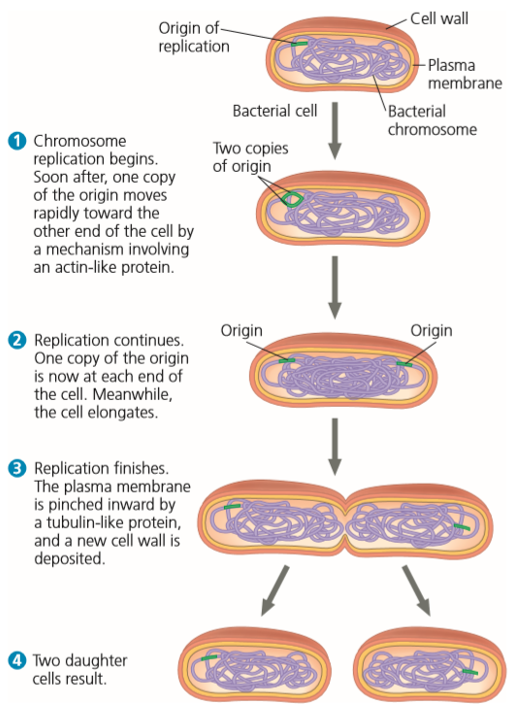
Binary Fission

A method of asexual reproduction occurring in prokaryotes where a single organism replicates its DNA and divides into two identical cells.

  • doesn’t use mitosis

  • takes place in the cytoplasm → doesn’t have a nucleus

  1. Origin replicates (single origin of replication)

  2. Both origins of replication move to opposite ends of cell

  3. Cell elongates and then divides

<p>A method of asexual reproduction <span style="color: red"><strong>occurring in prokaryotes</strong></span> where a single organism replicates its DNA and divides into two identical cells.</p><ul><li><p><span style="color: red"><strong>doesn’t use mitosis</strong></span></p></li><li><p>takes place <span style="color: red"><strong>in the cytoplasm → doesn’t have a nucleus</strong></span></p></li></ul><ol><li><p>Origin replicates (single origin of replication)</p></li><li><p>Both origins of replication move to opposite ends of cell</p></li><li><p>Cell elongates and then divides</p></li></ol><p></p>
2
New cards

Mitosis

A process of cell division in eukaryotic cells that results in two identical daughter cells, involving multiple phases such as prophase, metaphase, anaphase, and telophase.

3
New cards
Prokaryotes

Simple, unicellular organisms that do not have a nucleus or membrane-bound organelles; reproduce mainly by binary fission.

4
New cards
Eukaryotes

Complex organisms whose cells contain a nucleus and membrane-bound organelles; typically reproduce through mitosis.
5
New cards
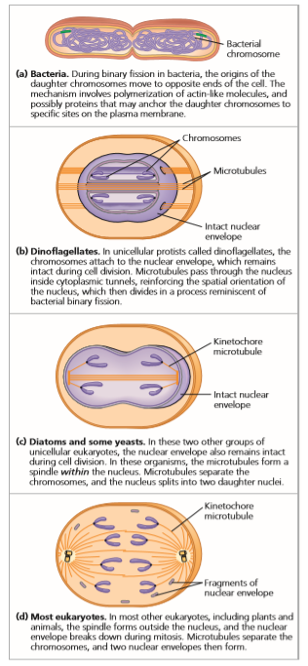
<p>What is happening here?</p>

What is happening here?

A = Binary vision = no nucleus

B = Microtubules go through the nucleus and pulls chromosomes apart

C = Micro form within the nucleus and pull apart

D = Mitosis
<p>A = Binary vision = no nucleus</p><p>B = Microtubules go through the nucleus and pulls chromosomes apart</p><p>C = Micro form within the nucleus and pull apart</p><p>D = Mitosis</p>
6
New cards

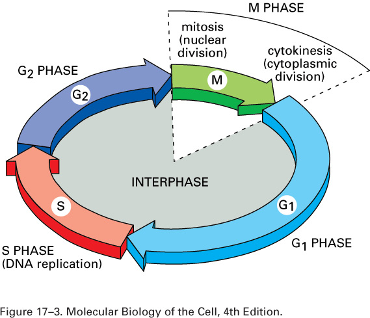
What is the Cell Cycle and what are the phases?
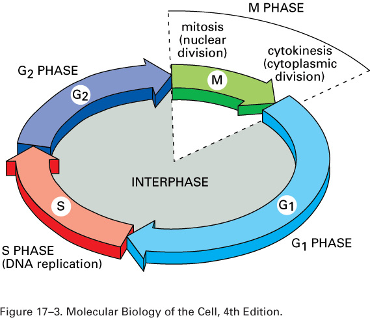
The series of phases that a cell goes through in order to divide and produce daughter cells, consisting of interphase, mitosis, and cytokinesis.
7
New cards

What happens during S Phase?

During S Phase; every time you replicate you’re losing a small amount of DNA specifically in the daughter cells

  • DNA replication occurs, resulting in the duplication of the chromosomes in preparation for cell division.

  • Part of interphase

<p>During S Phase; every time you replicate you’re losing a small amount of DNA specifically in the daughter cells</p><ul><li><p>DNA replication occurs, resulting in the duplication of the chromosomes in preparation for cell division.</p></li><li><p>Part of interphase</p></li></ul><p></p>
8
New cards
Interphase

The phase where the cell spends most of its time, preparing for division by growing and replicating its DNA.
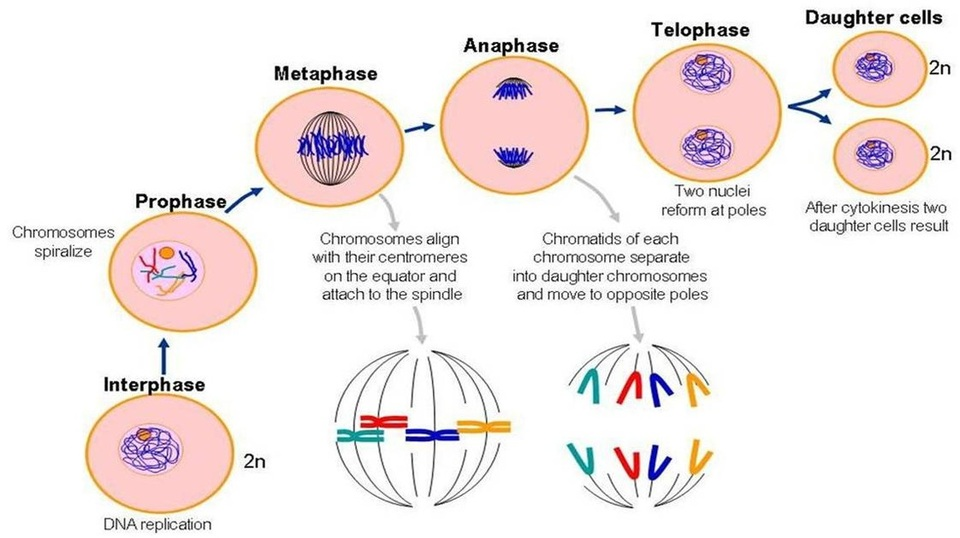
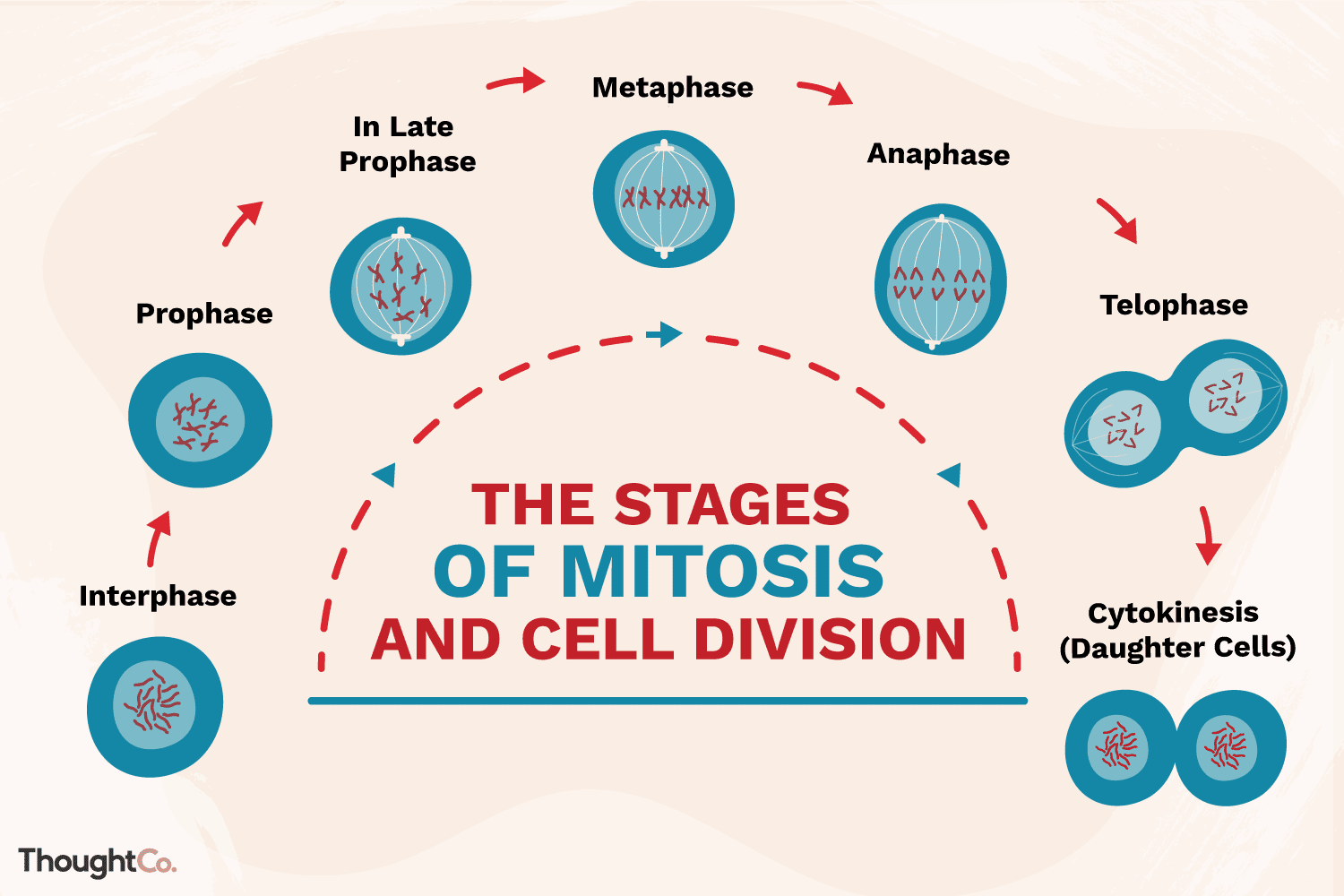
<p>The phase <span style="color: red"><strong>where the cell spends most of its time</strong></span>, preparing for division by growing and replicating its DNA.</p>
9
New cards
Mitosis
The process of cell division in eukaryotic cells where the nucleus divides, resulting in two identical daughter cells.
10
New cards
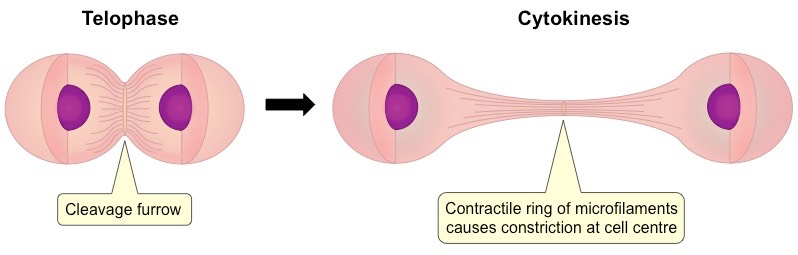
Cytokinesis
The final stage of cell division where the cytoplasm divides, resulting in two separate cells.
11
New cards
Cell Senescence

The process where cells can not keep dividing and growing because of the shortening of telomeres.

  • Cell can no longer divide because you’re losing proteins and DNA needed for cell maintenance

  • Losing DNA at the end of a strand = shortening telomeres (in picture)
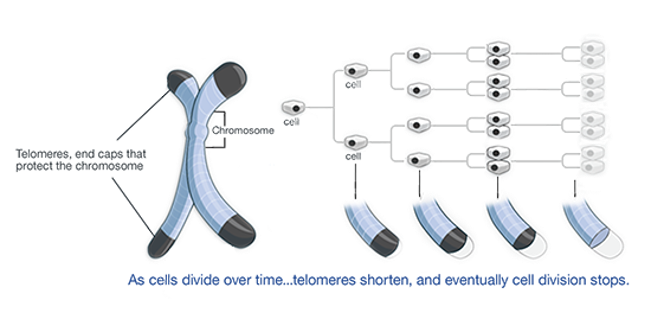
<p>The process where cells can not keep dividing and growing because of the shortening of telomeres.</p><ul><li><p>Cell can no longer divide because you’re losing proteins and DNA needed for cell maintenance</p></li><li><p>Losing DNA at the end of a strand = shortening telomeres (in picture)</p></li></ul><p></p>
12
New cards
Telomeres

The repetitive nucleotide sequences at the ends of chromosomes that protect them from deterioration during cell division.

  • ends of chromosomes have tandem repeats (such as GGGGTT). Telomeres shorten each time the cell divides

  • Loss of telomeres and shortening of chromosomes is thought to be an important reason why cells age and undergo senescence
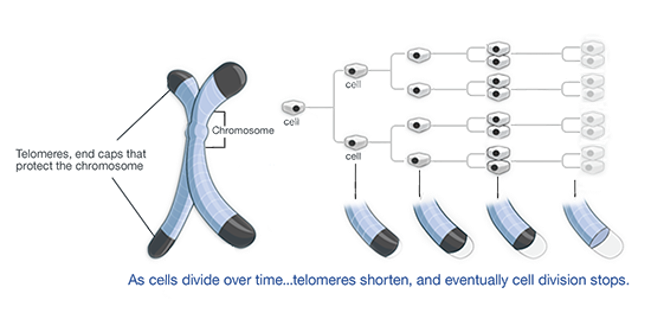
<p>The repetitive nucleotide sequences at the <span style="color: red"><strong>ends of chromosomes</strong></span> that <span style="color: red"><strong>protect</strong></span> them from deterioration during cell division.</p><ul><li><p>ends of chromosomes have tandem repeats (such as GGGGTT). Telomeres shorten each time the cell divides</p></li><li><p>Loss of telomeres and shortening of chromosomes is thought to be an important reason why cells age and undergo <strong>senescence</strong></p></li></ul><p></p>
13
New cards

Who is Henrietta Lacks?

an African American woman whose cancer cells were taken without her knowledge in 1951.

Her cells became the first immortal cell line, known as HeLa cells (immortal HeLa Cell line), which have been crucial for medical research.

14
New cards
Telomerase

An enzyme that extends/ restores telomeres, allowing certain cells (like germ, stem, and cancer cells) to divide indefinitely.

  • The telomerase gene has been cloned. Introduction into human fibroblasts prevents senescence and makes cells immortal.

“the key to immortality”

15
New cards
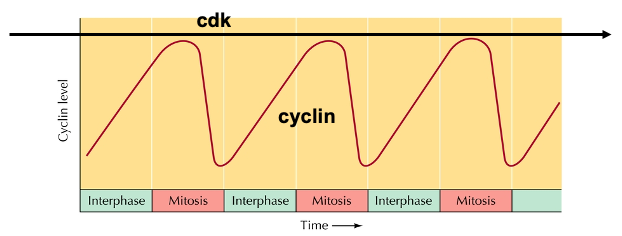
Cyclins

A family of proteins that regulate the cell cycle by activating cyclin-dependent kinases (CDKs) through their abundance during different phases.

  • Cyclin B accumulates during interphase but drops quickly in mitosis. Cyclins control the cell cycle in all eukaryotic cells
<p>A family of proteins that regulate the cell cycle by activating cyclin-dependent kinases (CDKs) through their abundance during different phases.</p><ul><li><p>Cyclin B accumulates during interphase but drops quickly in mitosis. <span style="color: red"><strong>Cyclins control the cell cycle in all eukaryotic cells</strong></span></p></li></ul><p></p>
16
New cards
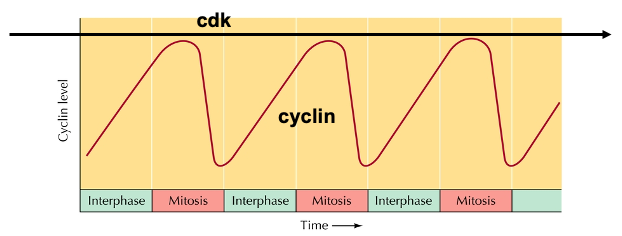
Cyclin-dependent Kinases (CDKs)

Proteins that phosphorylate and cause cells to move to next cell cycle phase. They are always present but they require a cyclin to become an active kinase
<p>Proteins that phosphorylate and cause cells to move to next cell cycle phase. They are always present but they <span style="color: red"><strong>require a cyclin to become an active kinase</strong></span></p>
17
New cards
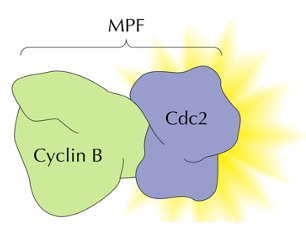
Maturation Promoting Factor (MPF)

A regulatory protein complex composed of cyclin and CDK that promotes the transition from G2 phase to M phase in the cell cycle.

  • first purified complex of cyclin and cdk, promotes maturation of oocytes by completion of meiosis
<p>A regulatory protein complex composed of cyclin and CDK that promotes the transition from G2 phase to M phase in the cell cycle.</p><ul><li><p>first purified complex of cyclin and cdk, <span style="color: red"><strong>promotes maturation of oocytes by completion of meiosis</strong></span></p></li></ul><p></p>
18
New cards

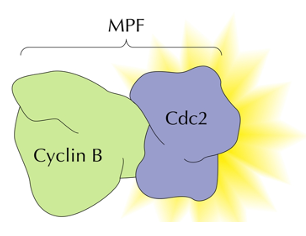
Why is Cyclin B and Cdc2 important?

  • Cyclin B is the regulatory subunit and must be present for function of the Cdc2 (cdk1) kinase

  • Cdc2 (cdk1) phosphorylates nuclear lamins (breaks down nucleus) and proteins that condense chromosomes
<ul><li><p><span style="color: red"><strong>Cyclin B is the regulatory subunit</strong></span> and <mark data-color="red" style="background-color: red; color: inherit">must be present for</mark> function of the <mark data-color="red" style="background-color: red; color: inherit">Cdc2</mark> (cdk1) kinase</p></li><li><p><span style="color: red"><strong>Cdc2 (cdk1)</strong></span> phosphorylates <mark data-color="red" style="background-color: red; color: inherit">nuclear lamins</mark> (<span style="color: red"><strong>breaks down nucleus</strong></span>) and proteins that <span style="color: red"><strong>condense chromosomes</strong></span></p></li></ul><p></p>
19
New cards

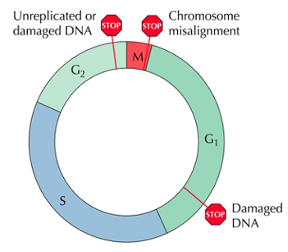
What are checkpoints in the cell cycle?

They prevent the cell from entering the next phase of the cycle before the preceding phase has been completed
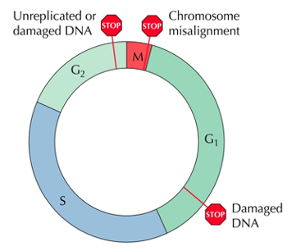
<p>They prevent the cell from entering the next phase of the cycle before the preceding phase has been completed</p>
20
New cards
G1 Checkpoint

A checkpoint that monitors whether the environment is favorable for cell division (growth factors).

  • It also checks for DNA damage.

<p>A checkpoint that monitors whether the environment is favorable for cell division (growth factors).</p><ul><li><p>It also checks for DNA damage.</p></li></ul><p></p>
21
New cards
G2 Checkpoint

A checkpoint that checks if DNA replication is complete.

Also causes cell cycle arrest in response to DNA damage, allowing cells to repair any damaged DNA before division
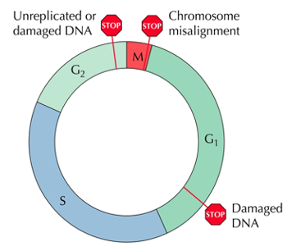
<p>A checkpoint that checks if DNA replication is complete.</p><p>Also causes cell cycle arrest in response to DNA damage, allowing cells to repair any damaged DNA before division</p>
22
New cards
M Checkpoint

A checkpoint that monitors whether chromosomes are intact and lined up properly before the cell proceeds with division.
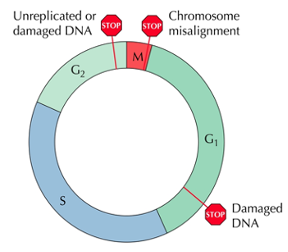
<p>A checkpoint that monitors whether chromosomes are intact and lined up properly before the cell proceeds with division.</p>
23
New cards

What is MPF role in the cell cycle?

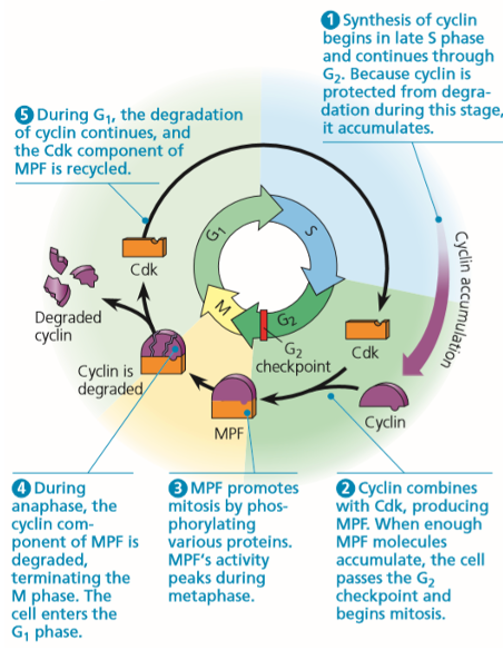
  1. Cyclin B synthesized in S and G2.

  2. Cyclin B binds CDK1 making MPF

  3. MPF phosphorylates proteins during M phase

  4. Cyclin B is degraded in anaphase.

<ol><li><p>Cyclin B synthesized in S and G2.</p></li><li><p>Cyclin B binds CDK1 making MPF</p></li><li><p>MPF phosphorylates proteins during M phase </p></li><li><p>Cyclin B is degraded in anaphase.</p></li></ol><p></p>
24
New cards

Growth Factors

  • A property of normal cells

Normal cells within the body respond to growth factors (example: hormones or cytokines) to function within the cell cycle.

25
New cards
Density-dependent Inhibition
The phenomenon where crowded cells stop dividing due to lack of space or resources.
26
New cards
Anchorage Dependence
The requirement for cells to be attached to a solid surface in order to divide.
27
New cards
Neoplasm

A new abnormal growth of cells / tissue that arises from uncontrolled cell division.

  • can also be a tumor

(neo = new, plasm = growth)

28
New cards

Cancer is a ….

Cancer is a malignant neoplasm (or tumor)

  • Cancer cells leave normal cell cycle

29
New cards
Malignant

When cells invade adjacent tissue they are considered cancer

Malignant = cancer

30
New cards
Benign

Describes non-cancerous tumors that do not invade surrounding tissues.

  • but, can kill if it’s not possible to remove tumor due to location (brain)

31
New cards
Cell Division
The process by which a parent cell splits into two or more daughter cells.
32
New cards
Microtubules
Cytoskeletal structures that pull chromosomes apart during mitosis.
33
New cards
Chromosome
A structure of nucleic acids and proteins that carries genetic information.
34
New cards
Cyclin B
A specific cyclin involved in the regulation of the cell cycle, particularly related to the transition from G2 to M phase.
35
New cards
Cdc2 (cdk1)
A cyclin-dependent kinase that, when activated by cyclin B, plays a key role in promoting the transition from G2 to M phase.
36
New cards
Anaphase
The stage in mitosis where sister chromatids are separated and pulled to opposite poles of the cell.
37
New cards
Cellular Aging
The gradual decline in cell function due to cellular senescence and telomere shortening.
38
New cards
Telomere Shortening
The progressive loss of nucleotide sequences at the ends of chromosomes with each cell division, linked to aging.
39
New cards

Why study cancer?

Cancer is a disease of cells.

Studying cancer cells contributes to our understanding of normal cell biology and the mechanisms of growth and division.

Often using immortal cell lines like HeLa.

40
New cards
41
New cards
42
New cards
43
New cards
44
New cards
45
New cards
46
New cards
47
New cards
48
New cards
49
New cards

Explore top notes

note
developmental psych terms
Updated 112d ago
0.0(0)
note
Algebra 1(Abandoned,Incomplete)
Updated 628d ago
0.0(0)
note
Physiologie cardiaque
Updated 707d ago
0.0(0)
note
Ways of the World
Updated 98d ago
0.0(0)
note
Protein Synthesis 14.1-14.2
Updated 1143d ago
0.0(0)
note
developmental psych terms
Updated 112d ago
0.0(0)
note
Algebra 1(Abandoned,Incomplete)
Updated 628d ago
0.0(0)
note
Physiologie cardiaque
Updated 707d ago
0.0(0)
note
Ways of the World
Updated 98d ago
0.0(0)
note
Protein Synthesis 14.1-14.2
Updated 1143d ago
0.0(0)

Explore top flashcards

flashcards
AP Precalculus Ultimate Guide
64
Updated 414d ago
0.0(0)
flashcards
Abstract Algebra
101
Updated 849d ago
0.0(0)
flashcards
Honors English II - Midterm
78
Updated 1164d ago
0.0(0)
flashcards
I-W A-H 1 SEMESTER TEST
130
Updated 835d ago
0.0(0)
flashcards
Psycology Ch 1-4
50
Updated 930d ago
0.0(0)
flashcards
AP Precalculus Ultimate Guide
64
Updated 414d ago
0.0(0)
flashcards
Abstract Algebra
101
Updated 849d ago
0.0(0)
flashcards
Honors English II - Midterm
78
Updated 1164d ago
0.0(0)
flashcards
I-W A-H 1 SEMESTER TEST
130
Updated 835d ago
0.0(0)
flashcards
Psycology Ch 1-4
50
Updated 930d ago
0.0(0)