6. The Horopter - Eye Movements & Binocular Vision Summer 2026
 Call Kai
 Learn
Learn Practice Test
 Spaced Repetition
 Match
Match Flashcards
 Knowt Play
1/90

There's no tags or description
Looks like no tags are added yet.
Name | Mastery | Learn | Test | Matching | Spaced | Call with Kai | Chat |
|---|
No analytics yet
Send a link to your students to track their progress
91 Terms
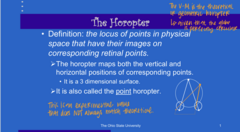
What is the definition of the horopter?
The locus of points in physical space that have their images on corresponding retinal points
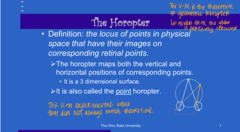
What does the horopter map?
both the vertical and horizontal positions of corresponding points
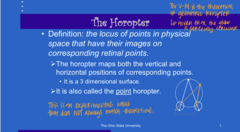
Horopter is a _____ surface
3D
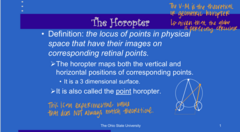
The horopter is also called the ____ horopter
point
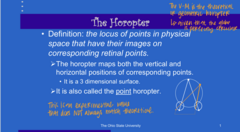
Does the experimental horopter always match the theoretical V-M circle?
No
The validity of retinal disparity calculation will depend on what?
the shape of the horopter
What is the equation for retinal disparity?
βL - βR
What does the horopter indicate?
The position of objects in space where single vision is possible
The horopter is a ____ surface for spatial relationships
reference
On the horopter, there is a surface of points that all have the same ____
depth
True or False:
An abnormal horopter will cause spatial distortions in the distance
true
What is a line horopter?
2D surface showing the LATERAL position of corresponding points
What is the target of the line horopter?
vertical lines (not points)
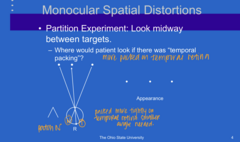
Partition Experiment
Where would a patient look if there was more "temporal" packing of the OD?
-There would need to be a smaller angle on the temporal retina
-Look closer to the nasal dot
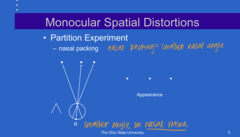
Partition Experiment
Where would a patient look if there was more "nasal" packing of the OD?
-There would need to be a smaller angle on the nasal retina
-Look closer to the temporal dot
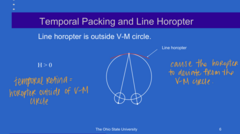
When the line horopter is OUTSIDE the V-M circle, there will be (temporal/nasal) packing?
temporal
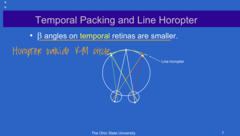
When there is temporal packing, the ____ angles on the temporal retina is smaller
β
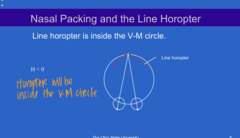
When the line horopter is INSIDE the V-M circle, there will be (temporal/nasal) packing?
nasal
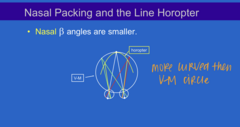
When there is nasal packing, the ____ angles on the nasal retina is smaller
β
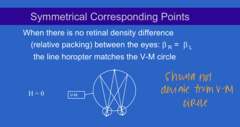
When there is NO RETINAL DENSITY DIFFERENCE (relative packing), between the eyes (βR = βL), the line horopter will match what?
the V-M circle
What are the 4 methods for measuring the horopter?
1) Apparent Frontal Parallel Plane
2) The Nonius Criterion
3) Center of Region of Binocular Single Vision criterion
4) Stereoscopic Sensitivity criterion
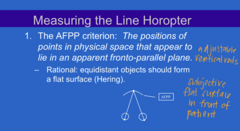
What does the Apparent Frontal Parallel Plane (AFPP) criterion state?
The positions of points in physical space that appear to lie in an apparent front-parallel plane
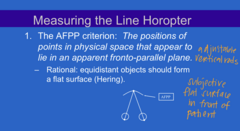
What is the rationale behind the Apparent Frontal Parallel Plane (AFPP) criterion?
Equidistant objects should form a flat surface (Hering)
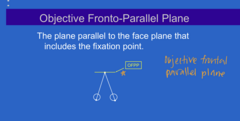
What is the Objective Frontal Parallel Plane?
The plane parallel to the face plane that includes the fixation point
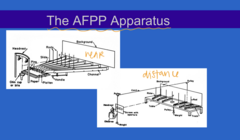
AFPP Apparatus (Pic)
AFPP Apparatus (Pic)
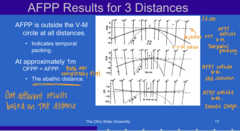
The AFPP will be (inside/outside) the V-M circle AT ALL DISTANCES
outside
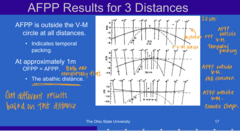
What does the AFPP being outside the V-M circle AT ALL DISTANCES indicate?
temporal packing at all distances
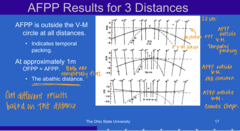
At approx what distance does AFPP = OFPP?
1m
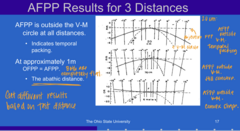
What is the name for the location where AFPP = OFPP?
Abathic distance (1m)
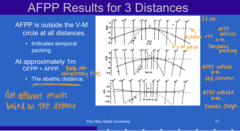
Describe the AFPP at 20cm
-AFPP will be outside V-M circle
-Temporal packing present
-AFPP will be in concave shape
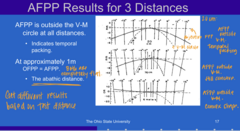
Describe the AFPP at 76cm
-AFPP will be outside V-M circle
-Temporal packing present
-AFPP will be in slightly less concave shape than nearer distance
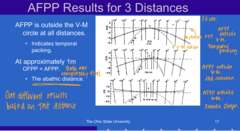
Describe the AFPP at 6m
-AFPP will be outside V-M circle
-Temporal packing present
-AFPP will be in a convex shape
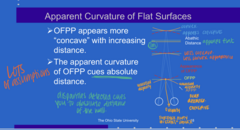
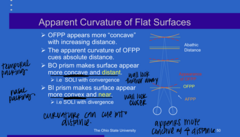
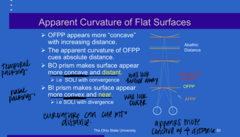
The OFPP will appear more (concave/convex) with increasing distance (coming towards you)
concave
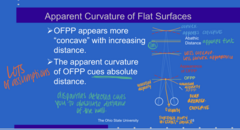
What does the apparent curvature of the OFPP cue?
absolute distance
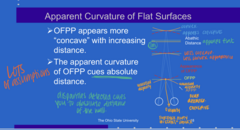
At the Abathic distance (1m), describe both the AFPP and OFPP?
These lines will be parallel lines
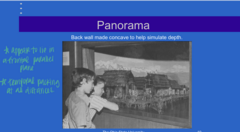
What is Panorama?
back wall made concave in order to help stimulate depth
Describe the Nonius Criterion to measure the line horopter
The positions of points in physical space such that the visual directions of the images formed in the two eyes are identical
What does the Nonius Criterion use?
monocular alignments of multiple nonius lines
What is considered to be the "true" horopter because the fewest assumptions are made for this criterion?
Nonius criterion
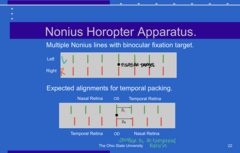
Multiple Lines with Binocular Fixation Target (Pic)
Multiple Lines with Binocular Fixation Target (Pic)
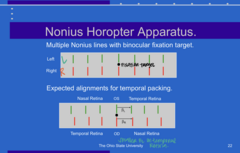
Expected Alignment for Temporal Packing (Pic)
**β angle on the temporal retinas are smaller and thus the lines will appear closer together in these locations
Expected Alignment for Temporal Packing (Pic)
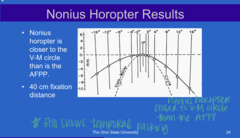
Nonius horopter is closer to the V-M circle than is the _____
AFPP
Describe the Region of Binocular Single Vision criterion for measuring the line horopter
The positions of points in physical space at the center of the region of binocular single vision
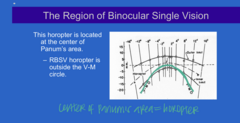
The horopter is located at the center of ______ according to the region of binocular single vision criterion
Panum's area
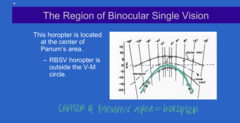
RBSV Horopter is (inside/outside) of the V-M circle
outside
Describe the Stereoscoptic Sensitivity Horopter criterion for measuring the line horopter
The positions of points in physical space such that the stereoscopic sensitivity is maximum
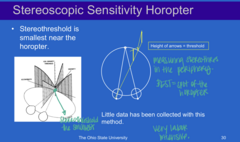
Stereothreshold is smallest near the _____
horopter
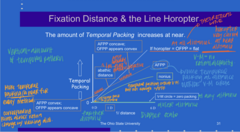
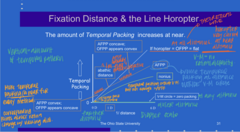
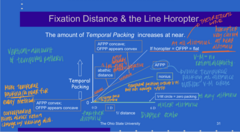
The amount of temporal packing will increase at (distance/near)
near
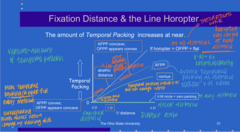
When AFPP = OFPP?
Abathic distance
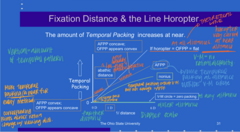
If the horopter = OFPP, then the horopter will be ____
flat
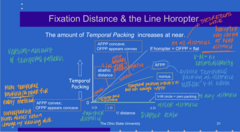
The horopter will be very ___ at near distances
curved
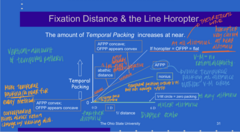
At the V-M circle, describe the retinal packing
zero packing at the V-M circle
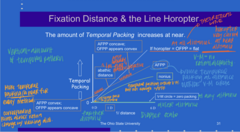
Is there any temporal packing at optical infinity (accom = 0D)?
No
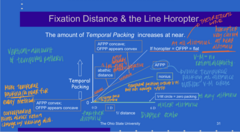
When the AFPP appears concave, the OFPP will appear _____
convex
When the AFPP appears convex, the OFPP will appear _____
concave
Will the Nonius horopter ever be >AFPP?
No
Is the effect of temporal packing increases at near an optical effect?
No
Is temporal packing increasing for near distances an effect of retinal stretching?
No
The effect of temporal packing increasing for near distances in _____ in origin
neural
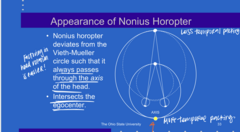
Does the Nonius Horopter deviate from the V-M circle?
YEs -- it will ALWAYS pass through the axis of the head
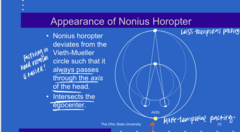
Where does the Nonious Horopter intersect?
at the egocenter of the head
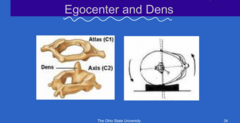
What is the egocenter of the head?
Dens
What is SILO?
As an object moves towards you, the size on the retina gets larger. You assume (from prior experience) the object is NOT getting larger so you perceptually reduce percept in size
What does SILO maintain?
size constancy
What would happen if you perceived an object moving nearer to you, however the image size of the object on your retina remained constant?
Size constancy adjustments would make the percept "appear" smaller
In you judge an object to be nearer to you (IN), then you will perceive the object to be (larger/smaller) according to SILO?
smaller
In you judge an object to be farther from you (OUT), then you will perceive the object to be (larger/smaller) according to SILO?
larger
What is SILO driven by?
-process disparity
-determine distance
-apply size constancy
How to stimulate SILO on tranaglyph?
-Wearing R/G glasses
-Slide green tranaglyph to left, red to the right
-Causes crossed disparity
-distance will be judged as nearer
-perceptually reduces the size of the target
-Small IN
SOLI
processing SIZE instead of disparity (SILO)
If an object is larger, it must be (closer/farther) from experience
closer
If an object is smaller, it must be (closer/farther) from experience
farther
Can SOLI be reported on vectogram?
Yes -- by analytical types of adults
Why is SOLI reported on vectogram by some adults?
-Accommodation and Convergence drive AC micropsia which is a neural process
-Convergence and Convergence Accommodation cause micropsia
-With Micropsia the target will appear smaller
-Smaller is judged as farther away
With prism, image is shifted towards the (apex/base)
apex
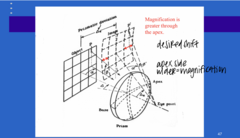
Prism Distortion (Pic)
Prism Distortion (Pic)
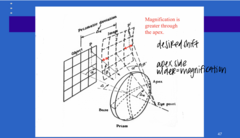
Magnification will be greater through the (apex/base) of the prism
apex
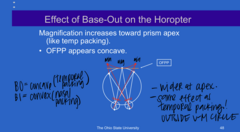
When the magnification increases towards the prism apex with BO prism in place, the OFPP will appear (convex/concave)
concave
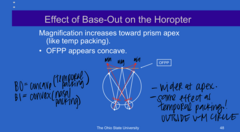
When the magnification increases towards the prism apex with BO prism in place, the AFPP will appear (convex/concave)
convex
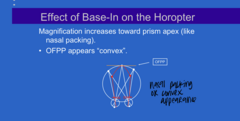
When the magnification increases towards the prism apex with BI prism in place, the OFPP will appear (convex/concave)
convex
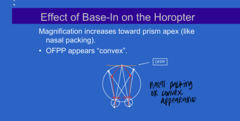
When the magnification increases towards the prism apex with BI prism in place, the AFPP will appear (convex/concave)
concave
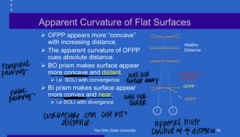
The OFPP will appear more (convex/concave) with increasing distance
concave
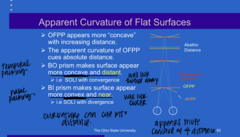
The apparent curvature of the OFPP will cue what?
absolute distance
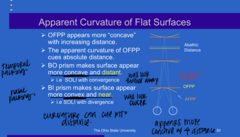
BO prism will make a surface of the OFPP appear (convex/concave)
concave
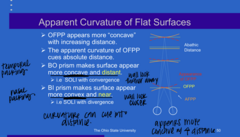
BO prism will make a surface of the OFPP appear (closer/farther away)
arther away
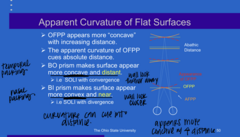
BI prism will make a surface of the OFPP appear (convex/concave)
convex
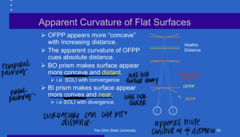
BI prism will make a surface of the OFPP appear (closer/farther away)
closer
BO prism mimics (temoral/nasal) packing
temporal
BI prism mimics (temoral/nasal) packing
nasal
When working with prism to increase convergence or divergence, then the size/distance relationships may be opposite what ____ predicts
SILO
When working with tranaglyphs and vectograms, we WANT our patients to perceive ____
SILO