Endocrine system
 Call Kai
 Learn
Learn Practice Test
 Spaced Repetition
 Match
Match Flashcards
 Knowt Play
1/77

There's no tags or description
Looks like no tags are added yet.
Name | Mastery | Learn | Test | Matching | Spaced | Call with Kai | Chat |
|---|
No analytics yet
Send a link to your students to track their progress
78 Terms
gap junction
A junction between two cells consisting of a pore surrounded by a ring of proteins in the plasma membrane of each cell; allows solutes to diffuse from the cytoplasm of one cell to the next; allow communication
neurotransmitter
A chemical released at the distal end of an axon that stimulates an adjacent cell
paracrine
secreted by one cell, diffuse to nearby cell in the same tissue
hormones
distant. when the chemical messenger enter the blood stream and stmulant the organs and cells.
endocrine system
the gland, tissue, and cell that secrete hormones
endocrine gland
A ductless gland that secretes hormones into the bloodstream; for example, the thyroid and adrenal glands.
blood capillaries
vessele where hormones travel throught
liver is exo or endo?
both! it has exocrine that secrets bile into small intestent. but also endocrine gland that secrets hormones into blood.
pancrease and kidney… exo or endo?
both
neuron vs hormones
neuron- only one organ, limited number of cells. short time.
hormones- secreted into blood and circulate the body to different target organs. takes long time.
neuroendocrine cells
act like neurons but also gland cells. secret staff into blood.
target cell and target organs
where hormones get attached to.
pituitary gland
attached to hypothalamus. carry the chemical to the body by secret hormones into the blood vessels.
anterior pituitary gland (adenohypophysis)
no nerve connection to hypothalamus. but it has complex web like blood vessel called hypophyseal portal system.
hypophyseal portal system
complex blood vessel on anterior pituitary. it consist of primary capillaries.
portal venules
small veins of hypophyseal portal system. it run down to the stalk
stalk (infundibulum)
floor of the hypothalamus, where the pituitary gland hang from. depression sphenoid bone

secoundary capillaries
locate in the anterior pituitary.
steps of the hormone secretion of the hypothalamus
hypothalamus controls the anterior pituitary by secreting hormones
hormones travel down to the primary capillaries, and than venules and diffuse out to secondary capillaries.
posterior pituitary (Neurohypophysis)
stalk is part of the posterior pituitary. it is nervous tissue not true gland. hormones are created by neuroendocrine cells.
hypothalamo - hypophyseal tract
bundle of axon in the posterior pituitary gland
TRH (thyrotropin) releasing hormones
hypothalamic releasing, inhabiting hormones that regulate anterior pituitary gland. it promotes TSH (thyroid stimulation hormones) and PRL (prolactin)
Corticotropin-releasing hormone
hypothalamic releasing, inhabiting hormones that regulate anterior pituitary gland. It tells the anterior pituitary to release adrenocorticotropic hormone, or ACTH. ACTH
hormones produced by hypothalamus
the hormone that produced by hypothalamus stimulates the anterior pituitary to secrets and release hormones
oxytocin OT
hypothalamic hormones secrets by posterior pituitary gland. comes from the paraventricular nuclei of the hypothalamus.
antidiuretic hormones ADH
hypothalamic hormones secrets by posterior pituitary gland. supraoptic nuclei, above the optic chiasm.
gonadotropin
NAD, TRO. they target the ovaries and testes (gonads).
Follicle-stimulating hormones (ap)
target- ovaries, testes
FE- Growth of ovaries follicle and secretion of estrogen
M- sperm production
Luteinizing hormones(ap)
target- ovaries, testes
female- ovulation and maintenance of corpus luteum
tyroid-stimulation hormones(ap)
target- tyroid gland
growth of thyroid, secrets thyroid hormones
Adrenocorticotropic hormones(ap)
target- adrenal cortex
growth of adrenal cortex
secretion of glucocorticoids
Prolactin(ap)
target-mammary gland
milk synthesis
growth hormones (ap)
target-liver, bone, cartilage, muscle, fat
tissue growth
antidiuretic hormones (pp)
target-kidney
water retention
oxytocin-pp
target- uterus, mammary gland
labor contraction, milk release
neuroendocrine reflexes
when brain release hormones by responding to some body condition
Insulin-like growth factor (IGF)
GH only has 6 to 20min life span in contract IGF has 20 hours of life span. it boost the GH’s function.
ghrelin
stimulates hunger and GH
involution
shrinking of tissue. ex) pineal gland
suprachiasmatic nuclei (SCN)
synapse with secound-order neuron in SCN
travels down to SCN-paraventricular nuclei-brainstem and spinal code-preganglion synaptic nerve- sympathetic chain ganglia- superior cervical fiber- postganglionic sympathetic fiber- back into pineal gland
this cycle maintain day cycle of darkness and light
melatonin
at the night pineal gland secrets melatonin. it promote sleep and cardiatic breath.
thymus
function- endocrine, lymphoid and immune
locate- superior of the heart, behinde the sternal
involution
dose maturation for white blood cell
secrets thymopoietin, thymosin, and thymulin

thyroid gland
only endocrine
largest adult gland
locates- adjacent to the trachea, below larynx
directly release hormones into blood stream
isthmus
narrow bridge of tissue that joined the thyroid gland
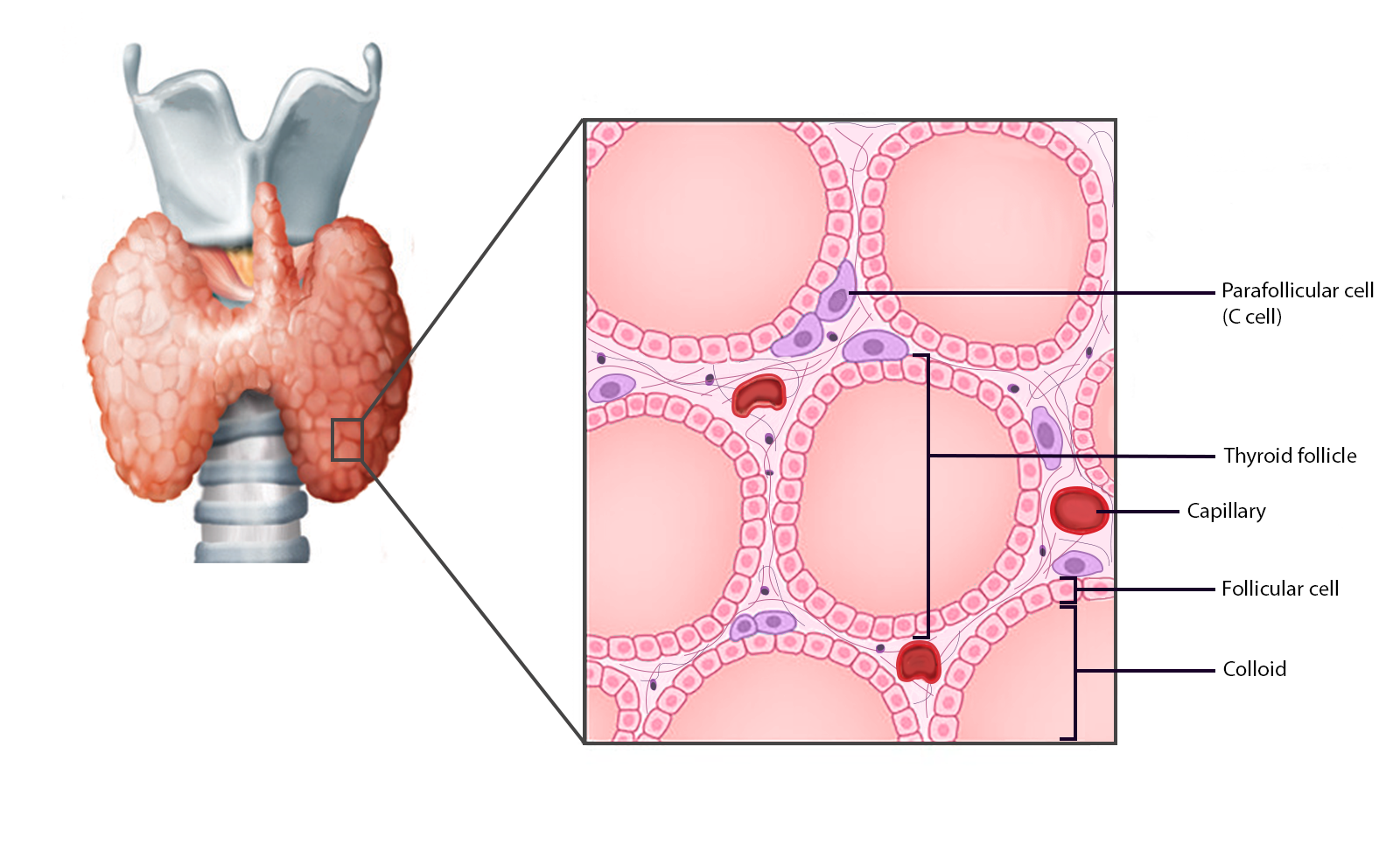
thyroid follicles
sacs that compose the thyroid gland
filled with protein-rich colloid and lined with follicular cells
80um of thyroid hormones (T4,T3) each day
colloid
protein rich substance in the follicle
thyroid hormones
increase metabolic rate. this will result in heat production
increase respiratory rate
increase appetite
accelerate breakdown of food
promote quicker reflexes
parafollicular cells
they respond to rising level of blood calcium and secrets calcitonin.
calcitonin
hormones that stimulates osteoblast activity and antagonizes parathyroid hormones.
parathyroid glands
ovoid gland locate in posterior side of thyroid.
secrets parathyroid hormones(PTH) when the calcium level in the blood is low
not regulated by pituitary gland. it directly monitor blood calcium level.
parathyroid hormones
it stimulates the calcium reabsorption from the bone and reducing calcium loss in urine,
adrenal gland
locates- superior pole of each kidney
has two glands that dose different things like pituitary gland
adrenal medulla and adrenal cortex

adrenal medulla
inner core of adrenla gland. 10 to 20% of the gland.
act as endoctine gland but also ganglion of sympathetic nervous system
has chromaffin cells
chromaffin cells
sympathetic preganglionic nerve fibers penetrate through the cortex to reach chromaffin cells. they are neurons but they don’t have dendrites and directly release staff into blood. so its neuroendocrine cells.
the cell response to stress and fear and secrets neurotransmitters such as epinephrine, norepinephrine, and dopamine. but these chemical work as hormones
these chemical…
increase and prepare for physical activity and alartness
boost glucose level by glycogenolysis and gluconegenesis
epinephrine
epinephrine is also called adrenaline
in brain its neurotransmitter
in adrenal medulla its hormone
has glucose-sparing effect which inhabits insulin
dopamine
it is inhibitory catecholamine neurotransmitter of central nervous system
norepinephrine
in brain its neurotransmitter
in adrenal medulla its hormone
adrenal catecholamines
raise heart rate and blood pressure
inhabuts inessential function of digestion
adrenal cortex
it surrounds the adrenal medulla in adrenal gland.
it produces corticosteroids/ corticoids.
synthesized from cholesterol
5 types (has three categories) that mainly synthesized and other are small amount.
mineralocorticoids
the one of the main steroid categories in adrenal gland
regulate body electrolyte balance
glucocorticoids
the one of the main steroid categories in adrenal gland
regulates metabolism of glucose and other
s3x steroids
the one of the main steroid categories in adrenal gland
developmental and reproduction function
zona glomerulosa
the top layer of adrenal cortex beneath capsule
source of mineralocorticoids

zona fasciculata
middle layer of adrenal cortex
cells are called spongiocytes
secrets glucocorticoids
zona reticularis
the depper layer of the adrenal cortex
secrets glucocorticoids and androgens
aldosterone
most significant mineralocorticoids and it produced only by the zona glomerulosa.
it increase blood pressure by renin-angiotensin-aldosterone system
it stimulates kidney which kidneys to retain sodium.
cortisol
most potent glucocorticoids
secreted by zona fasciculata as response from pituitary gland
it stimulate fat and protein catabolism, glucogenesis, and release fatty acid and glucose into blood.
also anti-inflammatory effect
androgens
primary s3x steroids.
it secreted by zona fasciculata and zona reticularis
pancreas
spongy, retroperitoneal gland
locate: lower stomach and posterier body wall
relate activity with cycle of eating and fasting
has alpha, beta, and delta cells
pancreatic islet
small cluster of endocrine cells in the pancreas that secret insulin
glycemia
blood glucose concentration
alpha cells or glucagon cells
secrets glucagon between meals when blood glucose level is low
glucagon
hormones that exert liver action, glycolysis and glycogenesis
beta cells or insuline cells
it secrets insulin and amylin
insulin
it is secreted during meal or before meal when blood nutrient is rising.
target is liver, skeletal muscle, and adipose tissue.
it stimulates cells to store or metabolize fat, glucose and protein
it also antagonize the glucagon which supress the use of stored fat
amylin
slowing the emptying the stomach and stimulate the sense of satiety
inhabits glucagon secretion
delta or somatostatin cells
secrets soatostatin
somatostatin regulate insulin and glucaagon secretion
PP cell or pancreatic polypeptide
secrets pancreatic polypeptide after a meal
it inhabits the stimulation of pancreas