L1-6 ***Need to look through L1-4 to make sure nothing missed***
 Call Kai
 Learn
Learn Practice Test
 Spaced Repetition
 Match
Match Flashcards
 Knowt Play
1/231

There's no tags or description
Looks like no tags are added yet.
Name | Mastery | Learn | Test | Matching | Spaced | Call with Kai | Chat |
|---|
No analytics yet
Send a link to your students to track their progress
232 Terms
Poison
a substance that is capable of causing illness or death of a living organism when introduced or absorbed
Poisonous
substance causing or capable of causing death or illness if taken into the body
Toxin
a poisonous substance that is a specific product of the metabolic activities of a living organism, is notability toc when introduced into tissues of another organism
What is a toxin capable of inducing?
antibody formation
Toxic
substance containing or being poisonous material especially when capable of causing death or serous debilitation
Toxicant
any toxic substance
Toxicants can be ___
poisonous either synthetic or naturally occuring
Where can different toxicants be found
in air, soil, water, food
Venom
a toxic substance produced by some animals that is injected into prey or an enemy chiefly by biting or stinging and has an injurious or lethal effect broadly
If YOU bite it and die it is _______
poison
If IT bites you and you die its ____
venom
Toxicosis
a pathological condition caused by the action of a poison/toxin
Intoxication
the state of being intoxicated
Should you specify the type of intoxication?
yes
Poisoning
the action of administering poison to a living organism
Toxicity
the quality of being toxic or poisonous
Does "natural", "organic", "non-artificial" tells you anything about safety?
NO
What are the seven most deadly (to humans) chemical substances?
botulinum toxin A, tetanus toxin A, diphtheria toxin, dioxin, muscarine, bufotoxin, sarin
Where does botulinum toxin A come from?
Clostridium botulinum
Where does tetanus toxin A come from?
Clostridium tetani
Where does diphtheria toxin come from
corynebacterium diphtheriae
Where does dioxin come from?
its manufactured
Where does muscarine come from?
mushrooms
Where does bufotoxin come from?
toad, bufo
Where does sarin come from?
manufactured
Hazard
something that has the potential to cause harm
What does hazard include?
element of magnitude
What can a hazard be?
physical trauma, chemical effect, infection, neoplasia
Risk
the likelihood / probability that a hazard will cause harm
What does risk include?
element of probability
What is the calculation for risk?
hazard x probability
Risk assessment
the systematic process of identifying, analyzing and evaluating potential hazards or risks that could cause harm, determining the risk, and what can be done to reduce or eliminate it
Hazard is something that has the ___ to harm you
POTENTIAL
Risk is the _____ of hazard causing harm
LIKELIHOOD
Without context, hazard is ___
meaningless
What are the steps to toxicology analysis?
list toxicological differentials, obtain appropriate samples w/ appropriate extraction technique, determine appropriate analysis, interpret results
What are toxicological differential based on?
signalment, history, clinical signs, other diagnostics
If toxic etiology on the differential list is that ALWAYS the cause?
no
What are many toxicological diagnosis based on?
HISTORY and analysis is confirmatory
What things should you not assume in animal history?
that what you are told is the truth, that the owner will volunteer all info, and the case is cut and dry
What makes up the examination?
physical exam and postmortem exam
What are the things you collect in antemortem sampling
blood (whole and serum), urine, feces, vomit/gastric lavage, hair in topical exposure
Why is serum separation important?
prevents sample degradation and allows better testing
What organs do you collect for postmorem sampling
liver, kidney, brain, heart, skeletal muscle, fat, etc
What fluids should you collect postmortem?
urine, blood from heart, aqueous fluid
What GI contents should you sample postmortem?
stomach or rumen contents, cecal or intestinal contents, feces, crop or gizzard contents
What do you collect if you expect topical exposure
skin and hair
Dog presenting with vomiting, diarrhea, tremors, salivation, fever (107°F). What's the approach of the case?
history, exam, baseline diagnostics, environmental exam, toxicology analysis
What body temp do you start worrying about brain denaturation
108
What diagnostic framework can be used for toxicology differential lists
DAMNIT V
What is the D in DAMNIT V
degenerative, developmental
What is the A in DAMNIT V
anatomic
What is the M in DAMNIT V
metabolic
What is the N in DAMNIT V
neoplastic, nutritional
What is the I in DAMNIT V
infectious, inflammatory, immune-mediated, idiopathic, iatrogenic
What is the T in DAMNIT V
traumatic, toxic
What laboratory methods are used to confirm toxin exposure
gas chromatography, liquid chromatography, mass spectrometry
What are toxicological rule-outs based on
History, Physical or postmortem exam, Baseline diagnostics, Environmental exam, Toxicological analyses
What is the difference between signs and symptoms
Symptoms are how patient describes so our patients have NONE
Who is the grandfather of toxicology
Paracelsus
What makes the posion
the DOSE
Toxicology is to ___
pharmacology
What is a dose response
increase dose can cause toxic effect
Increasing dose past the therapeutic effect can cause
a toxic effect
____ is toxic at the right dose
EVERYTHING
What is NOAEL
no observed adverse effect level
What is LD50 or LC50
lethal dose/concentration that kills 50% of a test population
What it MTD
minimum toxic dose
What is MLD or MLC
minimum lethal dose/concentration
What toxicity parameter is used most clinically
MTD because shows dose where we have problems in our patients
Why does exposure NOT EQUAL intoxication
intoxication requires absorption, sufficient dose and affect on body systems
What are the 4 steps of toxicokinetics
ADME
What does ADME stand for
absorption, distribution, metabolism, excretion
What are the ways toxins are absorbed
oral/ingestion, dermal exposure, injection, inhalation
How can we minimize absorption
decontamination
What things influence distribution
fat solubility vs water solubility, protein binding, pH of tissues and compartments
Where does metabolism normally occur
in the liver but can be in other organs
What happens in metabolism
biotransformation to a more water-soluable product
What happens in metbaolism
coverting into a more water soluble product
What are the primary routes of excretion
urinary, biliary/fecal (milk, sweat, saliva)
Why are species differences important in metabolism
Some species produce less toxic metabolites, others produce more toxic ones
Describe acute
generally 24 hours or less (hours)
Describe subacute
less than 24 hrs but less than a month (days to weeks)
Describe subchronic
several months, less than a year (months)
Describe chronic
signifcant portion of life (years)
Describe dose response curve
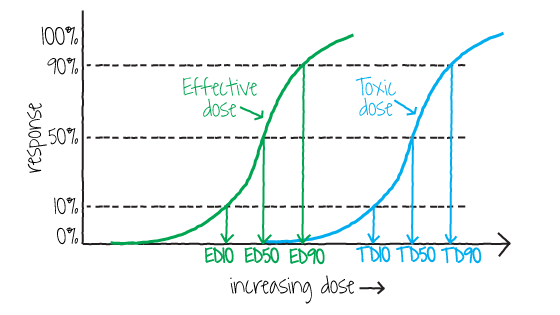
What are exceptions to dose response curves
essential nutrients, hormesis
Describe essential nutrients in dose response curves
toxic at high doses, deficiency at low doses
Describe hormesis in dose response curves
small exposures are protective, large are dangerous
What is therapeutic index?
the ratio of the dose of the drug that produces toxic effect to therapeutic effect in 50% of patients (TI = TD50 / ED50)
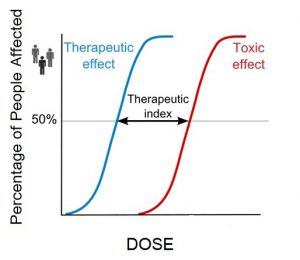
How do you calculate therapeutic index TI
TD50 / ED50
How do you calculate safety margin
TD1 / ED99
What does a small TI mean
narrow safety margin
What does a large TI mean
large safety margin
What are the factors influence toxicity
characteristic of animals exposed, route of exposure, frequency of exposure, characteristics of the toxicant, environmental conditions
List animal characteristics that influence toxicity
species, genetic differences, age, sex, concurrent disease, nutritional status, concurrent exposure to other drugs
What are the toxicant-related factors that influence toxicity.
formulation, vehicle, valence of metals, ionization, decomposition, impurities, strain
What are the frequency of exposure factors that influence toxicity.
one time exposure, repeated exposure, cumulative effects
What are the enviornmental condition that influence toxicity.
drought, time of year, growth stage, temperature, photo period, winds
Why do you calculate dose of exposure
to determine if the dose is toxic or lethal and help with treatment