G11) 1.2 Organic compounds
 Call Kai
 Learn
Learn Practice Test
 Spaced Repetition
 Match
Match Flashcards
 Knowt Play
1/13

There's no tags or description
Looks like no tags are added yet.
Name | Mastery | Learn | Test | Matching | Spaced | Call with Kai | Chat |
|---|
No analytics yet
Send a link to your students to track their progress
14 Terms
What is an organic compound?
A compound that contains carbon and is found in living things.
* What are carbons that are exceptions to being organic compounds?
Carbonates, oxides of carbons, and cyanide
Carbon forms the basis of all organic compounds due to its...
ability to form large and complex molecules via covalent bonding.
Carbon atoms can form __ covalent bonds. This allows it to....
4. This allows it to form a variety of organic molecules (branched and unbranched).
Types of carbon compounds
carbohydrates, lipids, proteins, nucleic acids
carbohydrates
sub-unit: monosaccharide (eg: glucose)
Polysaccharides are made up of many monosaccharides. (eg: cellulose, starch (in plants), glycogen (in humans).
Carbs function as a source of storage of energy and energy in general.
Lipids
sub-unit: (dont have a concrete subunit but you can technically say fatty acids although many acids do not chain to perfectly form lipids).
Lipids or triglycerides are non-polar, hydrophobic molecules. They can be unbranched (fatty acids) or ringed (steroids).
Function: component of cell membrane, energy storage, insulate for thermal conductivity.
Proteins
sub unit: chains of amino acids (20,22)
polypeptide (protein)
function: structure, cell signaling, enzymatic activity, transport, movement.
Nucleic acids
sub-unit: nucleotides (made up of phosphate, ribosugar and a nitrogenous base)
DNA and RNA
function: contains the genetic instructions of a cell
whats a monomer
since organic compounds are typically composed of recurring subunits, we call those monomers.
Monomers join together to form polymers.
How can polymers be formed
condensation reactions
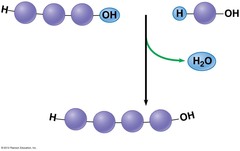
condensation reaction
A hydroxyl group (OH) on one monomer is combined to a hydrogen atom (H) on another monomer.
The two monomers become covalently bonded and a water molecule is produced as a byproduct.
How can polymers break down to monomers
hydrolysis reactions
hydrolysis reactions
A water molecule is used to provide the H and OH groups required to break the covalent bond between two monomers
