KIN 3513 PPT LSU Final Chris Hill (Sec. 6,7,8,9, & 10) (JUST PPT, NOT QUIZZES)
 Call Kai
 Learn
Learn Practice Test
 Spaced Repetition
 Match
Match Flashcards
 Knowt Play
1/194

There's no tags or description
Looks like no tags are added yet.
Name | Mastery | Learn | Test | Matching | Spaced | Call with Kai | Chat |
|---|
No analytics yet
Send a link to your students to track their progress
195 Terms
What is the primary purpose of the flashcard deck for the final exam?
To review and reinforce key concepts and information covered in the course.
How should images be used in the flashcard deck?
Images should complement the text and aid in visual learning, helping to illustrate concepts.
What is an effective study strategy when using flashcards?
Active recall, where students attempt to remember the answer before flipping the card.
Why is it important to include a variety of question types in flashcards?
To engage different cognitive processes and enhance understanding of the material.
What should be avoided when creating flashcards for effective studying?
Including too much information on a single card, which can overwhelm and confuse the learner.
What is a theory in the context of motor learning?
A theory accurately describes a large class of observations and makes definite predictions about results of future observations.
What do motor learning and control theories explain?
They explain human movement behavior and provide insights into why people perform skills as they do.
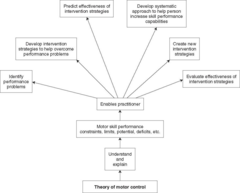
Why is theory relevant to professional practice in motor learning?
It provides the foundational basis for what practitioners do.
What does motor control theory describe?
It describes and explains how the nervous system produces coordinated movement during motor skill performance in various environments.
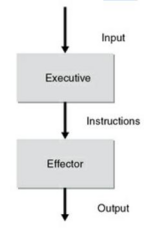
What are the two general types of control systems in motor control?
Open-Loop Control and Closed-Loop Control.
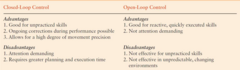
What is the main characteristic of an open-loop control system?
It does not use feedback; the control center provides sufficient information for effectors to carry out movement.
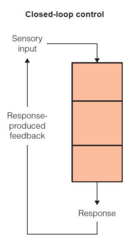
What is a key feature of closed-loop control systems?
They use feedback to continue and terminate movement.
What is Fitts' Law in relation to motor control?
It predicts movement time for speed-accuracy skills, indicating that movement time increases with larger movement amplitude or decreased target width.
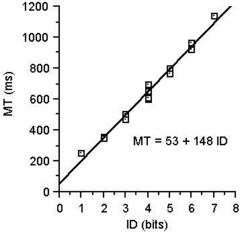
What happens to speed and accuracy in the speed-accuracy tradeoff?
When speed is emphasized, accuracy is reduced, and vice versa.
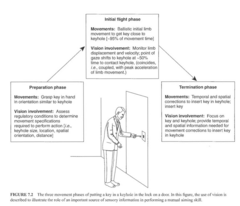
What are the two phases involved in speed-accuracy skills according to Fitts' Law?
Open-loop control during movement initiation and closed-loop control during movement termination.
What is the Motor Program-Based Theory?
It is a cognitive-based mechanism that controls coordinated movement through generalized motor programs (GMP).
What does a Generalized Motor Program (GMP) control?
It controls a class of actions identified by common invariant characteristics.
What are invariant features in the context of GMP?
Characteristics that do not vary across performances of a skill within a class of actions.
What are parameters in the Motor Program-Based Theory?
Specific movement features added to invariant features to adapt to a specific situation.
What does relative timing refer to in motor skills?
The proportion or percentage of the total amount of time required by each component of a skill during its performance.
How does the analogy of music and dance relate to invariant features and parameters?
Relative time is like rhythm (the beat), while overall time is like tempo (the speed), where rhythm remains constant regardless of tempo.
What is Schema Theory by Schmidt?
It is a set of rules or a framework of relationships that provides the basis for decision-making in motor learning.
How is Schema Theory developed?
By abstracting important pieces of information from related experiences and combining them into a type of rule.
What role does feedback play in closed-loop control?
Feedback is necessary to terminate the movement and ensure accuracy.
What are the applications of open and closed-loop control systems?
They are applied in various skills, with feedback being crucial for learning and performance in high attentional demands.
What is the significance of the term 'ballistic' in motor control?
It refers to the initial limb movement that occurs rapidly and is primarily controlled by open-loop mechanisms.
What is the first control component in motor control?
Generalized Motor Program (GMP)
What does the second control component in motor control provide?
Motor response schema, which includes specific rules governing the performance of a skill.
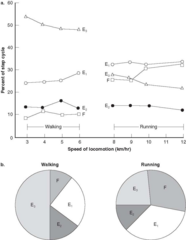
What did Shapiro et al. (1981) test regarding walking and running?
They tested the prediction of relative time invariance for a class of actions controlled by a GMP.
What was the main finding regarding relative time in Shapiro et al.'s study?
Relative time was similar within speeds when walking but different from speeds when running.
What does Dynamical Systems Theory (DST) emphasize in motor control?
The role of environmental information and the dynamic properties of the body/limbs.
When did DST begin to influence views about motor control?
In the early 1980s.
What are the two problems associated with cognitive-based theories that DST attempts to resolve?
Context-Conditioned Variability Problem and Degrees of Freedom Problem.
What is the Context-Conditioned Variability Problem?
It questions whether the same commands will result in the same outcomes if the context changes.
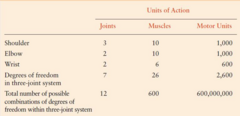
What does the Degrees of Freedom Problem refer to?
The number of ways in which a system can vary independently.
What is one solution to the Degrees of Freedom Problem?
Muscle synergies, which are groups of muscles constrained to act as functional units.
What does self-organization in motor control refer to?
A process where the organization of a system becomes more stable due to inherent properties.
What is an attractor in the context of motor control?
A stable state of the motor control system that represents preferred patterns of coordination.
What are control parameters?
Variables that influence the stability and character of order parameters.
What is the significance of the order parameter in motor control?
It defines the overall behavior of the system and distinguishes coordinated movement patterns.
What are the three types of constraints in motor performance?
Organismic, environmental, and task constraints.
What do organismic constraints refer to?
Characteristics of the individual, including structural and fundamental characteristics.
How do environmental constraints arise?
From both the physical and social environments of individuals.
What do task constraints include?
Constraints imposed by task goals, equipment used, and mandated rules and procedures.
What is the current state of the control theory issue in motor control?
Both motor program-based theory and dynamical systems theory are predominant, with speculation about a hybrid theory.
What is the Optimal Theory of Motor Learning?
A new theory focusing on conditions that enhance performance expectancies, learner autonomy, and external focus of attention.
What are the three issues that the Optimal Theory of Motor Learning focuses on?
1. Conditions that enhance expectancies for future performance. 2. Variables that influence learners' autonomy. 3. External focus of attention on the intended movement effect.
What is the definition of learning?
A change in behavior due to experience.
What is an example of learning?
Stopping smoking or learning to play tennis.
What does behavior refer to in the context of learning?
Anything an organism does that can be observed.
What is motor learning?
A change in the capability of a person to perform a skill that must be inferred from a relatively permanent improvement in performance due to practice or experience.
What are the general performance characteristics of skill learning?
Improvement, consistency, stability, persistence, adaptability, and reduced attention demands.
How does performance differ from learning?
Performance is observable behavior at a specific time and location, while learning is not directly observable and is inferred from performance.
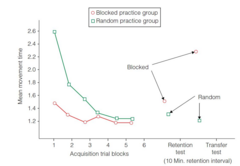
What are some techniques for assessing learning?
Observing practice performance, retention tests, and transfer tests.
What is a performance curve?
A line graph that plots performance measures across practice trials or periods of time.
What are the four general trends in performance curves?
Linear, negatively accelerated, positively accelerated, and S-shaped (ogive).
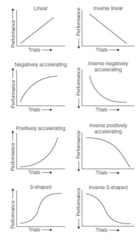
What does a linear performance curve indicate?
Proportional increases in performance over trials or time.
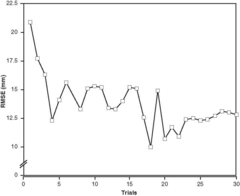
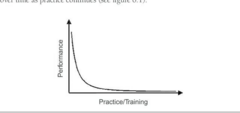
What characterizes a negatively accelerated performance curve?
Early improvement that slows during later practice.
What does a positively accelerated performance curve show?
Slight improvement early but substantial improvement during later practice.
What is an S-shaped or ogive performance curve?
A combination of linear, negatively accelerated, and positively accelerated curves.
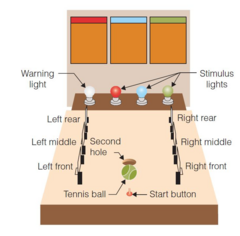
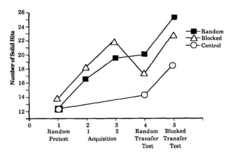
What does a U-shaped performance curve represent?
Rapid increases in performance followed by larger decreases.
What are kinematic measures?
Measures that assess movement characteristics over time within a trial.
Why can performance curves misrepresent learning?
Because performance may be influenced by performance variables that inflate or depress performance.
What is the Law of Practice?
Performance continues as long as practice continues, but the rate of improvement gradually decreases over time or number of practice trials.
What is the significance of feedback in practice?
Feedback can influence performance and may lead to misrepresentations of learning.
What are flooring and ceiling effects in performance assessment?
Performance variables that limit the observable range of performance, affecting the assessment of learning.
What is the role of practice in motor learning?
Practice is essential for improvement in performance and the development of motor skills.
What is retention testing?
Testing the consistency of performance after a period without practice.
What is transfer testing?
Assessing the ability to apply learned skills to different contexts or tasks.
What is the importance of observing practice performance?
It provides insights into the learning process and the effectiveness of practice.
What does the term 'adaptability' refer to in skill learning?
The ability to adjust performance based on changing conditions or demands.
What is the theory asymptote in the context of motor learning?
Theoretical upper limit to learning that is progressively approached with practice but that is never reached.
Who proposed the Power Law of Practice?
Crossman (1959)
What are the two types of practice in motor learning?
Part practice and whole performance.
What is the purpose of part practice?
To break down complex skills into meaningful units for separate practice before combining them into the whole skill.
For what type of tasks is part practice most efficient?
For very complex, serial tasks with no component interaction.
What can happen when practicing brief, programmed actions in isolation?
It can be detrimental to learning.
How does component interaction affect the effectiveness of part practice?
The more the components of a task interact with each other, the less effective part practice becomes.
What are the three stages of motor skill learning according to Fitts and Posner?
Cognitive stage, associative stage, and autonomous stage.
What characterizes the cognitive stage of learning?
Beginners focus on solving cognitively-oriented problems, with performance showing large variability and errors.
What happens during the associative stage of learning?
Learners associate information with required movements and work to refine performance, decreasing variability and errors.
What defines the autonomous stage of motor learning?
Performance of the skill becomes automatic, requiring minimal attention, with reduced variability and self-correction of errors.
What is the goal of the initial stage in Gentile's Two Stage Model?
To get the idea of the movement and organize a movement pattern to achieve some degree of success.
What are the goals of the later stages in Gentile's Two Stage Model?
Fixation or diversification, adapting movement patterns to performance demands, increasing consistency, and performing with economy of effort.
What are fixation skills in Gentile's model?
Skills that require the development of an optimal movement pattern for consistent action goal achievement.
What are diversification skills in Gentile's model?
Skills that require the development of a flexible movement pattern that can adapt to changing environmental conditions.
What does Bernstein describe as appropriate practice?
A form of 'freeing without freezing' degrees of repetition.
What is the initial problem in Bernstein's Stage 1: Freeze Degrees of Freedom?
Determining what to do with all possible degrees of freedom of movement available for the body.
What is the solution in Bernstein's Stage 1?
Reduce the movement of nonessential or redundant body parts by freezing degrees of freedom.
What occurs in Bernstein's Stage 2: Freeing Degrees of Freedom?
Learners improve performance by releasing some of the degrees of freedom that had initially been frozen.
What is the focus of Bernstein's Stage 3: Exploit Degrees of Freedom?
The performer learns to exploit the passive dynamics of the body for maximally skilled movement.
What are the two key outcomes of achieving efficiency in movement?
Achieving results with maximum assuredness and minimum outlay of energy.
What is memory?
Memory is the capacity to retain experiences and benefit from past information.
What is encoding in memory?
Encoding is the process of registering information from the environment into memory.
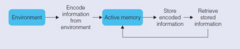
What is storage in memory?
Storage is the capacity to retain encoded information in both active and nonactive forms until needed.
What is retrieval in memory?
Retrieval is the ability to locate and recall information stored within memory systems.
What is declarative knowledge?
Declarative knowledge is knowledge that can be verbally described, such as 'what to do' to perform a skill.
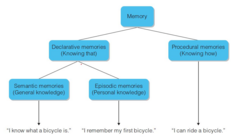
What is procedural knowledge?
Procedural knowledge is knowledge that enables a person to perform a skill, typically difficult to verbalize.
What is sensory memory?
Sensory memory is the stage of memory that takes in virtually everything registered by sensory receptors and holds it briefly for organization and encoding.
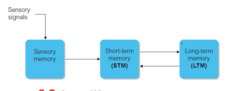
What are the two functional systems of memory?
The two functional systems of memory are working memory and long-term memory.