Chapter 2 - Water & Carbon: The Chemical Basis of Life
 Call Kai
 Learn
Learn Practice Test
 Spaced Repetition
 Match
Match Flashcards
 Knowt Play
1/63

There's no tags or description
Looks like no tags are added yet.
Name | Mastery | Learn | Test | Matching | Spaced | Call with Kai | Chat |
|---|
No analytics yet
Send a link to your students to track their progress
64 Terms
What is the theory of chemical evolution?
It states that life started by the formation of increasing complex carbon-containing substances which could then replicate itself.
What are the ____ major atoms that make up life today? Also, what ___ make up 96%?
5; Think CHNOPS!
Carbon, Hydrogen, Nitrogen, Oxygen, Phosphorus, Sulfur.
Only CHNO make up 96% of life—the other two make up 3%.
What denotes the atomic number of an element?
The number of protons!

Label the image from top to bottom!
Mass number (number of protons + neutrons)
Atomic number (number of protons)
What is the unit that we use to measure the weight of protons, neutrons, and electrons?
Dalton (da)
What is an isotope?
This is when an element changes the number of neutrons it has! PROTONS STAY THE SAME!
Why might the atomic weight of carbon be like 12.01 instead of 12? It has 6 protons and neutrons right?
It’s different because atomic weight is an AVERAGE of all of the naturally occurring isotopes. There’s carbon 6, 7, 8 and therefore the dalton—weight—is really 12, 13, 14 for naturally occurring carbons.
What is a radioactive isotope? What happens in these cases?
This is an unstable version of an element. It’s nucleus will decay and release energy (radiation), causing a neutron to change into a proton or vice versa.
What contributes to an atom’s electronegativity? (hint: two things)
It’s the number of protons in the nucleus and the distance between nucleus and the valence shell.

What element would have the most electronegativity? Look at the periodic table in the image :)
Fluorine; this is because it has the lowest amount of shell and the most amount of protons. It’s GREAT at taking in electrons from other atoms.
What’s the difference between nonpolar covalent bonds and polar covalent bonds?
Nonpolar covalent bonds have equally shared electrons, while polar covalent bonds have an uneven sharing of electrons (the more negative atom hogs them like in water).
What is an ion, cation, and anion?
An ion is simply an atom/molecule that carries a full charge.
A cation is a positively charged ion that LOST an electron.
An anion is a negatively charged ion that GAINED an electron.
Why do most polar covalent bonds involve nitrogen or oxygen?
Oxygen and nitrogen both have high electronegativities. Therefore, they share elcetrons more tightly than many other items which results in polar bonds.
What is formed when carbon bonds with the max hydrogen atoms? What about nitrogen? What about oxygen?
It forms CH4 (methane); it forms NH3 (ammonia); it forms H2O (water)
Look at image

Recall the geometry of like H2, CH4. Why might it form? What is the degree for the Methane?
The dihydrogen molecule is linear because there’s only two of them. Methane is tetrahedral because the repulsive forces between the electrons push the four C—H bonds apart. 109.5
There are four different ways to represent molecules in models. What is each model? (dont describe each one)
There’s the molecular formula, structural formula, ball-and-stick model, and the space-filling model.
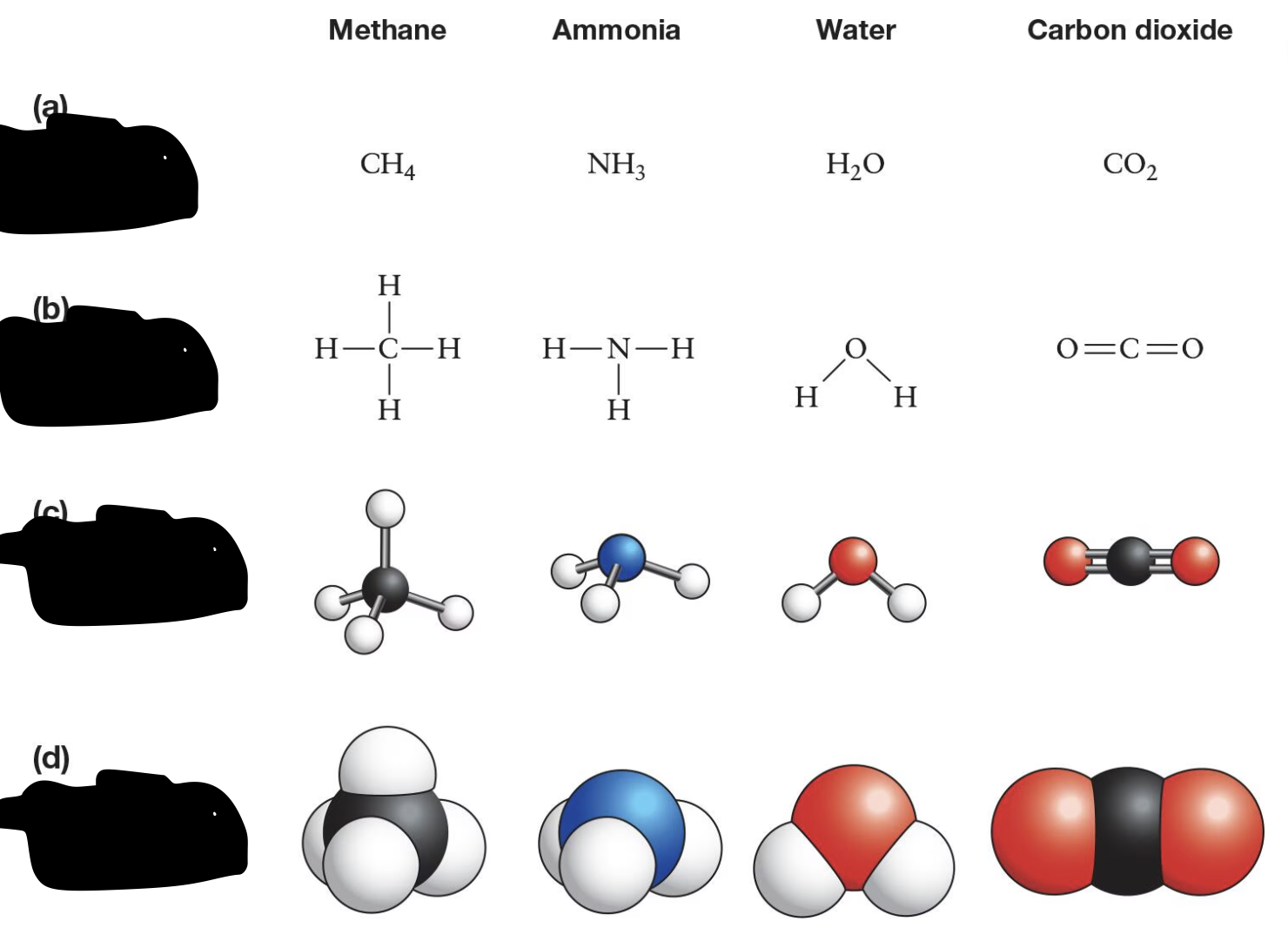
Label each model from top to bottom!
Molecular Formula
Structural Formula
Ball-and-Stick Model
Space-Filling Model
In a space-filling model, what does the ball ball ALWAYS represent?
Carbon
Why is it that nonpolar molecules DO NOT dissolve in water? What kind of interaction is this when the nonpolar molecule is pushed away?
It is because nonpolar substances cannot form hydrogen bonds or strong attractions with the polar water molecules. It will repel the nonpolar molecules.
The interaction is called a hydrophobic interaction.
What happens when hydrophobic molecules are close to one another association wise?
HOW do these occur?
These molecules form van der Waals interactions, which are similar to LDFs.
These interactions occur because electrons are constantly flowing around each molecule, which end up creating a tiny charge that changes over times to reel in surrounding hydrophobic molecules (and then repel them).
What is cohesion, adhesion, and surface tension?
Cohesion is the attraction between ITS OWN molecules. (EX: water will stay together with itself)
Adhesion is the attraction between different molecules (EX: water and glass since they kinda stick together)
Surface Tension is the cohesiveness caused by the molecules at the surface of a liquid.
For adhesion to work with water, they must be…
polar and charged molecules.
Why does water have such a high surface tension?
It’s because of hydrogen bonding!
Why is water more dense as a liquid than a solid?
When water is in a liquid state, there is no sort of crystal lattice that forms. In a solid, water molecules form a crystal lattice.
Look at the image
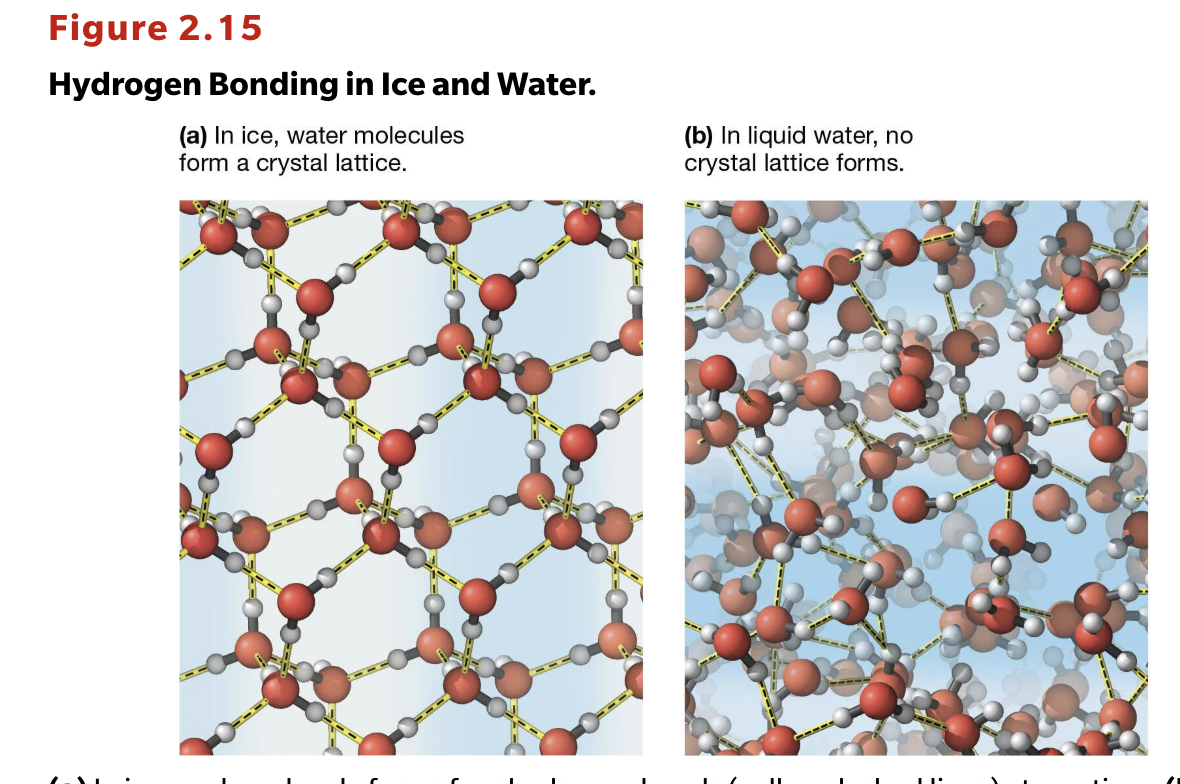
What actually causes the lattice structure in solid water? (WHY hydrogen bonds)
It’s hydrogen bonds, which end up causing the water to orient themselves in such a structure. It makes a ton of space between the molecules (since there’s only four hydrogen bonds: 2 as a donor and 2 as an acceptor).
Why does water have such a high specific heat?
This is mainly because when a source of energy hits it (e.g., heat), hydrogen bonds must be broken before heat can be transferred, causing the water molecules to move faster.
know that the higher the polarity (and IMFs), the higher the specific heat.
Why is water’s ability to absorb energy so critical to the theory of chemical evolution? (think like 2 billion years ago)
It’s because molecules formed in the ocean were well protected from excessive heat or sources of energy that would otherwise break them apart.
Write a dissociation reaction of water without being balanced, then write it balanced and explain your answer to the balanced:
H2O ⇄ H+ + OH-
2H2O ⇄ H3O+ + OH-
The balanced one results in a hydronium because on paper, protons cannot exist by themselves.
Substances that give up protons and raise the hydronium concentration in water are called ___. Molecules or ions that acquire protons during chemical reactions and lower the concentration of hydronium are called ___.
acids; bases
Strong bases will readily (acquire/dequire) protons when they react with water.
aquire
EX: NaOH dissociates completely in water to form Na+ and OH-.
What happens when NaOH dissociates completely in water, specifically with the OH-?
The OH- will end up accepting a proton from a hydronium ion in the water to form water.
Adding an acid to a solution will (increase/decrease) the concentration of protons. Why?
increase
This is because acids DONATE protons (H+) when dissolved in water. The H+ concentration (aka proton) will therefore increase in the solution
What is molecular weight? For example, how would you get the molecular weight of water?
It is the sum of the atomic weights of all the atoms in the molecule.
To get the molecular weight of water, you would add the atomic weights of two atoms of hydrogen and one atom of oxygen. For water, it would be 1 + 1 + 16 = 18.
Note: if you were to weigh a sample of 18 grams of water, it would contain around 6.022 × 10²³ water molecules, or 1 mole of water molecules.
What is molarity?
This is a measure of the concentration of moles of the solute present per liter of a solution.
EX: a 1M solution of hydrogen ions means that 1 mole of protons is contained in 1 liter of solution.
How do you find the pH of a solution given the concentration of H+ ions?
take the -log[H+]
If you were given the pH of a substance and wanted to know the concentration of H+ ions, what would you do?
Take the antilog (aka 10-pH)
Remember how drastic a pH change may be. A pH change from 7 to 5 means the new sample contains ___ times more protons and has become ___ times more acidic.
100; 100
What is a buffer? What do they help to maintain within organisms?
This is a compound that will minimize changes in pH. They help to maintain homeostasis!
What are most buffers? strong? weak? What exactly does that mean?
Most buffers are weak acids, meaning they are somewhat likely to give up a proton in a solution.
NOTE: If they give up protons in a solution, the proton concentration rises (H+), which then regenerates the acid (since H+ is acid!)

Think about what happens if the proton concentration increases. What happens?
The reaction will shift to the left to form more carbonic acid (which is a buffer, making the pH stay the same).
A system is…
an enviroment where you only focus on what’s inside. You ignore everything else (literally just system vs surrounding)
What is an open system, closed system, and isolated system?
An open system can exchange energy AND matter with the enviroment.
A closed system can exchange energy but NOT matter with the enviroment.
An isolated system cannot exchange energy and matter with the environment.
look at screenshot

How might equilibrium be affected by temperature?
If a temperature to increase or decrease, the molecules on one side of the equation will undergo physical changes (like a liquid to gas). Then, the reaction may struggle to proceed to the left or right.
This should be the easiest flashcard: describe endothermic and exothermic.
Endothermic is when a reaction takes in energy from the surroundings.
Exothermic is when a reaction gives off energy into the surroundings.
What two factors determine if a reaction is spontaneous (able to happen completely alone)?
A reaction will be spontaneous if the products have lower potential energy than the reactants.
AKA when the shared electrons in the products are held more tightly than in those reactants.
Reactions will be spontaneous when the product molecules are less ordered than the reactant molecules.
EX: glucose is a single, highly ordered molecule. When it burns in air, it breaks up into CO2 and H2O which are less ordered.
Look at image for 1! Read it!
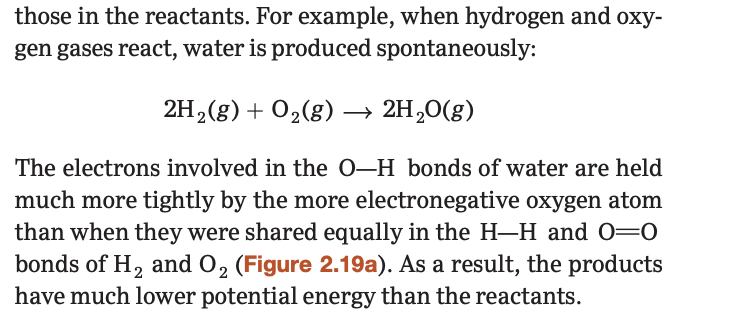
What is entropy and when would it increase?
Entropy is the amount of disorder in a system. It will increase when the products are less ordered than the reactants.
What is the difference between temperature and heat?
Temperature is the measure of how much thermal energy its molecules have.
Heat is the transfer of thermal energy between multiple (2+) objects.
What is the first and second law of thermodynamics?
First law - Energy cannot be created or destroyed. It is always conserved.
Second law - All spontaneous reactions will increease the total entropy of a SYSTEM and its SURROUNDINGS.

In the screenshot explain why potential energy in the products decreases…
This because the electrons were all around their counterparts (Hydrogen and Oxygen) in the reactants. They were at the top of that imaginary roller coaster and then the reaction happened. They are way less favorable (low potential energy) to follow through another reaction.
At the very core, what do organic compounds contain?
Carbon!
Why are all organic compounds made from carbon? What’s so special about it?
Carbon has the ability to make four covalent bonds because of its four valence electrons.
What are functional groups?
These are atoms bonded together in a precise configuration which allow them to show unique chemical properties.
There are ____ functional groups (most common). What are they?
Amino Group
Carboxyl Group
Carbonyl Group
Hydroxyl Group
Phosphate Group
Sulfhydryl Group
What two functional groups are usually grouped together? Why?
It’s the amion group and carboxyl group. They are grouped together because one attracts a hydrogen ion (amino group) while one releases a hydrogen ion (carboxyl group).
These are really important because they are contained within amino acids, which can be linked together by covalent bonds through these two functional groups.
What are the properties of the six functional groups? (hint: hydroxyl and phosphate have two!)
Carboxyl Group - Acts as an acid, which means it tends to lose a proton in a solution.
Amino Group - Acts as a base, meaning it tends to attract a proton.
Hydroxyl Group - Very polar which makes compounds way more soluble through hydrogen bonding with water. It can ALSO act as a weak acid and drop a proton.
Carbonyl Group - Contains molecules (especially aldehydes) that react with compounds to produce larger molecules
Phosphate Group - This group carries negative charges on each oxygen atom, making any new molecule it bonds with change its structure. It can also store large amounts of chemical energy because of the four oxygens!
Sulfhydryl Group - When present in proteins, this group can link to other Sulfhydryl Groups using disulfide S-S bonds.

Label all of these functional groups from top to bottom AND their family of molecules (top to bottom):
Amino
Carboxyl
Carbonyl
Amines
Carboxylic Acids
Aldehydes
Ketones
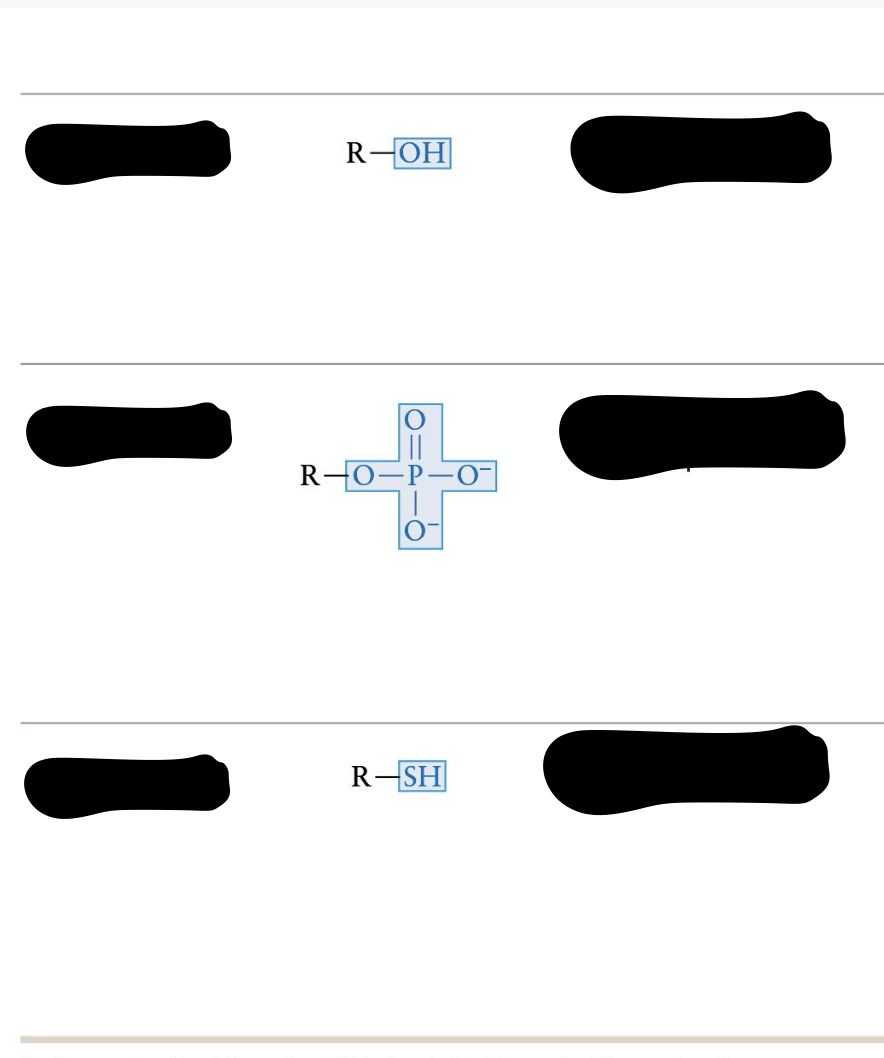
Label the following functional groups AND their families (start top to bototm on left side, then top to bottom on right side):
Hydroxyl Group
Phosphate Group
Sulfhydryl Group
Alcohols
Organic Phosphates
Thiols

Label all of the functional groups. Start with the top half and label left to right. Then the bototm half left to right:
Phosphate Group, Carbonyl Group, Sulfhydryl Group, Amino Group, Carbonyl Group, Hydroxyl Group, Carboxyl Group
What is the singular of a macromolecule? The plural of many ____ (dont fill in)?
monomer; polymer
What is the process of linking monomers together called?
polymerization. Look at image

Why does polymerization even happen? The second law of thermodynamics should stop this, right?
It happens beacuse polymerization organizes the SIMILAR monomers into larger, more complex structures. Polymerization DECREASES the disorder (entropy) of the molecules involved.
What is necessary for monomers to be linked together? Explain…
It is through dehydration reactions (or condensation reactions)!
Dehydration reactoins happen when two monomers bond, resulting in the release of water.
Look at image

What needs to happen for reverse polymerization (breaking of a polymer)? Explain…
The compound ends up taking in water to split the monomer away from the polymer.
Look at image


Based on the image, polymerization would only occur if…
there ere a very high concentration of monomers to push the reaction toward dehydration. Think equilibrium here!