Anatomy Unit One terms
 Call Kai
 Learn
Learn Practice Test
 Spaced Repetition
 Match
Match Flashcards
 Knowt Play
1/26

Earn XP
Description and Tags
Dr. Lawson Bio 290 JMU
Name | Mastery | Learn | Test | Matching | Spaced | Call with Kai | Chat |
|---|
No analytics yet
Send a link to your students to track their progress
27 Terms
study of the body, specifically external and internal anatomical features that can be seen by the naked eye.
gross, macroscopic anatomy
study of the constituents that make up the body such as tissues and cells which are invisible to the naked eye
microscopic anatomy
study of the structural changes throughout the life span with a special focus on embryology
developmental anatomy
study of the anatomical variation between structures
comparative anatomy
pharyngeal slits
tissue folds in pharynx give rise to multiple head and neck structures
segmentation
serial repeats of structures along longitudinal axis of body, example ribs
superior position
towards the head
inferior position
away from the head
medial position
midline of the body
lateral position
left or right away from the midline
anterior/ventral position
towards the belly
posterior/dorsal position
towards the back
proximal position
closer to the origin
distal position
away from origin of structure or torso
sagittal plane
vertical plane dividing body into right and left half
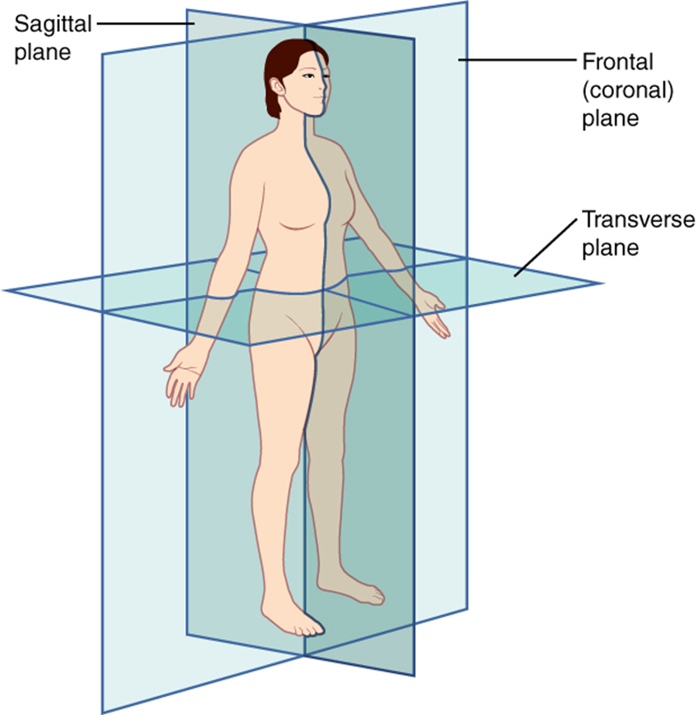
midsaggital plane
exactly middle
parasagittal plane
to each side of the midsag plane
frontal or coronal plane
vertical plane dividing structure into anterior and posterior
transverse plane
horizontal plane dividing body into superior and inferior sections
oblique plane
any diagonal plane
axial skeleton components
skull, vertebral column, ribs, sternum
appendicular skeleton components
pectoral, upper extremity, pelvic, lower extremity
process
a bony projection, often for attachment
foramen
an opening in a bone usually for a nerve or blood vessel
facet
smooth, flat, articular surface
notch
an indentation in a bone
tubercle
small rounded projection