BIOL 371 - Animal Reproduction and Development
 Call Kai
 Learn
Learn Practice Test
 Spaced Repetition
 Match
Match Flashcards
 Knowt Play
1/90

There's no tags or description
Looks like no tags are added yet.
Name | Mastery | Learn | Test | Matching | Spaced | Call with Kai | Chat |
|---|
No analytics yet
Send a link to your students to track their progress
91 Terms
How are new individuals primarily produced in animal reproduction?
sexual reproduction
What is animal reproduction generally the dominant stage and what happens?
dominant diploid stage producing haploid gametes which fuse to produce new diploid offspring
What must the zygote undergo after its fusion?
mitosis and gastrulation
What happens to cells that give rise to gametes?
they are isolated early on in development
What are the different kinds of asexual reproduction?
fission
budding
fragmentation
parthenogenesis
What is fission?
genetically-controlled, two identical individuals result
What is budding?
smaller offspring arises from parent
What is fragmentation?
Each fragment gives rise to a new organism
What is parthenogensis?
new individual develops from unfertilized egg
What are the pros and cons of asexual reproduction compared to mitosis?
Pros
don’t need males
rapid reproduction
saves energy
Cons
lack of genetic variability
What is sexual reproduction?
genes from two parents
→ eggs (oogenesis) and sperm (spermatogenesis) - the gametes that are produced by meiosis
→ ALWAYS involves fertilization and development
What are dioecious reproduction? (gonochoristic)
involving of two seperate sexes
What is monoecious/hermaphroditic reproduction?
an individual has both male and female reproductive organs either simultaneously or at different stages
What are the pros and cons of sexual reproduction?
Pros
generates genetic variation
Cons
fertilization is necessary which can be complicated
development must proceed form the zygote
costs of egg and sperm
males (half the population) can’t produce offspring
What are gametes?
cells that give rise to gametes (germ cells) developing separately from somatic cells
Is there a relationship between somatic and germ cells?
no, differentiation and development of somatic cells do not affect germ cells and experiences of an organism do not affect genetics of sex cells
Where does gametogenesis take place?
in primary reproductive organs or gonads
What is the haploid stage of an animal’s cycle?
Gametes are the only haploid stage of an animals life cycle
What does gametogenesis consist of?
mitosis, meiosis, and cell differentiation to produce gametes - haploid sex cells which must combine to give rise to zygote - new diploid individual
What produces sperm cells and what is the metabolic characteristic of sperm?
spermatogenesis produces sperm cells
sperm are highly metabolically active
Where do sperm get the energy for movement?
Mitochondria provide ATP for flagellum
What does the head of a sperm consist of?
acrosome
nucleus
centrioles
few or no stored nutrients
What is the male strategy of sperm production?
to produce abundant small, motel, cheap gametes
What is the structure of sperm?
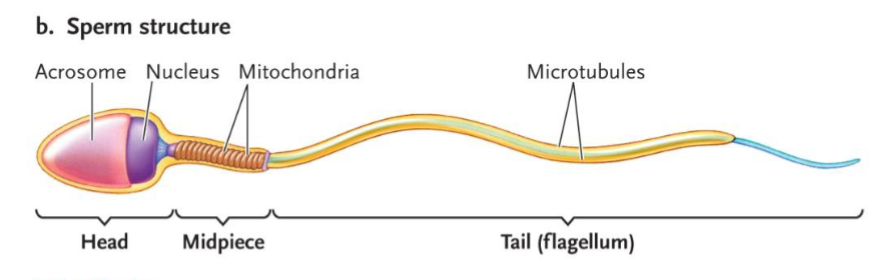
What are eggs produces by and what is their main characteristic?
produced by oogenesis
eggs contain large amounts of protective components and nutritive contents (yolk)
What is the structure of eggs?
contained with vitelline membranes (zone pellucid) - carries receptors for sperm
may be wrapped within jelly layer
hard shell
What is the female strategy of egg production?
produce few large, non-motile, well-provisioned gametes
(reciprocal of male)
Male reproductive system parts
testes produce sperm
urethra/ducts carry sperm genital opening
Female reproductive system parts
ovaries produce eggs
oviducts carry them to genital opening
What determines external reproductive structures?
Whether fertilization is external or internal
What is hermaphroditism?
an adult organism possessing functional reproductive systems of both sexes, either simultaneously or sequentially
monoecious
Who is hermaphroditism common in?
taxa like annelids, gastropods and nematodes
How is sex determined in placental mammals?
two sex chromosomes, X and Y
Y chromosomes carries few genes, carrying SRY gene which controls development of new individual into a male
Y carried only on males
without the Y and SRY, the new individual develops into a female
How is sex determined in bird, some reptiles, some fish and butterflies?
two sex chromosomes, Z and W
female determined
ZW - female
ZZ - males
How is sex determined in some insects?
by aneuploidy (monosomy) in males
males X
females XX
How is sex determined in Hymenoptera?
ploidy dictates sex
females - diploid
males - haploid (parthenogenesis)
basis for sociality in wasps, ants and bees
What organisms does external fertilization occur in?
only aquatic animals
External fertilization
Gametes generally small (egg still larger)
Frequently high egg mortality
Number of eggs released varies greatly among species
Release of gametes by both sexes into environment requires coordination of gametogenesis in response to seasonal environmental cues
Coordinated gamete release may be due to stimulus through courtship movements, calls, or pheromone release
What organisms is internal fertilization found in?
found in ALL terrestrial and in some aquatic animals
Internal fertilization?
Large differences in gamete size
Number of eggs relatively few compared to sperm
What are some challenges that go along with all fertilization?
making sure that the right sperm encounters the egg, and that only 1 sperm fertilizes it
What are some challenges that go along with external fertilization?
the possibility of interspecific sperm-egg encounters
timing of breeding
molecular mechanisms of identifying appropriate sperm
What are some challenges that go along with internal fertilization?
pre and post zygotic reproductive isolating mechanisms
behavioural
physical constraints
genetic incompatibility
What two ways does fertilization prevent polyspermy?
acrosomal reaction (fast block)
cortical reaction (slow block)
What is the acrosomal reaction (fast block)?
sperm cell membrane fuses with egg cell membrane initiating a wave of depolarization - subsequent sperm unable to fuse with egg
What is the cortical reaction (slow block)?
cortical granules fuse with egg membrane, vitelline coat becomes impenetrable to sperm - external and internal fertilization
How are species prevented from interbreeding and producing hybrids?
pre-zygotic barriers: eggs and sperm never encounter one another, or if they do fertilization does not take place
post-zygotic barriers - fertilization can take place, but hybrids unlikely to reproduce in turn
How does internal fertilization protect the developing embryo?
Internal fertilization allows for different ways of protecting the developing embryo
What do all amniotic vertebrates have?
the amanita
What are the parts of the amniotic egg?
variation in all amniotic vertebrates
allantois and chorion - carry out life support functions for embryo
shell - protects internal environment
What type of fertilization do all organisms containing an amnion use?
internal fertilization
Oviparous meaning
fertilized eggs are laid and hatch outside the body (e.g. most birds, reptiles and monotremes)
What is viviparity?
a form of reproduction where embryo develops inside the parent's body and the parent gives birth to live young
nutrients, gases and metabolic wastes are exchanged between the mother and embryo requiring some form of a placenta
What is the placenta derived from?
extraembryonic membranes - The placenta develops from tissues associated with the embryo but outside the embryo itself.
When does the parent invest more in viviparity?
The parent has to provide a lot of resources while the embryo is developing inside them.
Giving birth to a live offspring doesn't automatically mean the parent invests heavily afterward. Different species vary in how much parental care they provide.
What are types of animals are placentalia?
placental mammals - some fish, amphibians and reptiles (rare)
What is ovoviviparity?
a reproductive strategy where the embryos develop inside eggs that are retained within the parent's body until they hatch.
retention of the fertilized eggs within the mother’s body, with varying degrees of exchange of gases, nutrients or wastes between mother and developing embryo
principle reproductive effort tends to be before birth
Describe the continuum of reproduction
Reproductive strategies can be viewed as a continuum based on where the embryo develops and how much nutritional support the parent provides:
Oviparity → Ovoviviparity → Viviparity
Difference between Oviparity, Ovoviviparity and Viviparity?
Oviparity: Eggs are laid outside the parent; embryo is nourished primarily by yolk.
Ovoviviparity: Eggs are retained inside the parent; embryo is still nourished primarily by yolk and young are born/released alive.
Viviparity: Embryo develops inside the parent and receives substantial nutritional support directly from the parent, often through a placenta.
Reproductive strategy | Where does the embryo develop? | Main source of nutrients | What happens? |
|---|---|---|---|
Oviparity 🥚 | Outside the parent's body | Yolk | Parent lays eggs → embryo develops in egg → hatches |
Ovoviviparity🥚 | Inside the parent's body, within an egg | Yolk | Eggs are retained inside parent → embryo develops → young are released/born |
Viviparity 👶 | Inside the parent's body | Parent | Embryo develops inside parent and receives nutrients from parent → live birth |
What is the intermediate step between oviparity and viviparity?
ovoviviparity
What are the animal and vegetal poles of an egg?
The animal pole contains the egg nucleus and less yolk, so cleavage is faster and produces smaller cells. The vegetal pole contains more yolk, so cleavage is slower and produces larger cells.
Where is developmental information stored?
the nucleus
the cytoplasm
contains maternal cytoplasmic determinants which are mRNA and proteins from the mother’s genome that contain molecules that help direct development and differentiation in embryo
What is Ontogeny?
he development of an individual organism throughout its life.
What is blastulation?
cleavage the zygote undergoes immediately following fertilization
mitotic division with no increase in mass, using egg’s resources
What are the different types of blastulation?
radial and spiral
What are the stages of the zygote following gastrulation?
process results in the morula - solid ball of cells
gives rise to blastula -hollow ball of cells (blasters)
Does the blastula contain animal and vegetal poles?
Yes
What are cytoplasmic determinants?
Maternal mRNAs and proteins placed in the egg cytoplasm before fertilization that help direct cell differentiation and embryonic development.
How does cytoplasmic differentiation alter the way embryos develop?
cleavage divides cytoplasmic determinants up - different blastomeres have different combinations and amounts of cytoplasmic determinants
blastomeres undergo differentiation - become different types of cells depending on position
Cytoplasmic differentiation in relation to snail shells?
spatial distribution of cytoplasmic determinants determines direction of cleavage spiral in snails
What is morphogenesis?
the process by which an embryo develops its shape and organization.
What 7 cellular processes are important in morphogenesis?
mitosis
cell movement
selective cell adhesion
apoptosis
indiction
determination
differentiation
Why are mitosis, cell movement, selective cell adhesion, apoptosis important for morphogenesis?
1. Mitosis
Cells divide to increase the number of cells in the embryo.
→ One cell → two cells → four → eight → etc.
2. Cell movement
Cells move to different locations in the developing embryo.
This is important because cells need to end up in the correct place to form the appropriate structures.
3. Selective cell adhesion
Cells stick to some cells more strongly than others.
This helps cells sort themselves into appropriate groups and tissues.
4. Apoptosis
Programmed cell death.
Some cells are intentionally eliminated to help shape structures during development.
For example, removing certain cells can help separate developing structures.
What is apoptosis?
programmed cell deathHW
What is induction?
one group of cells affects developmental path taken by another group of cells, through signal molecules or direct contact
“Cell group A tells cell group B how to develop.”
What is determination?
A cell becomes committed to a particular developmental pathway.
switching of most of the genes of the cell, only allowing certain developmental pathways to be followed
What is differentiation?
After determination, the cell actually develops the specialized characteristics of its particular cell type.
After determination, cells follow specific developmental pathways
Easy way to think about induction, determination and differentiation
Induction: “You should become X.”
↓
Determination: “I'm committed to becoming X.”
↓
Differentiation: “I now develop the features of X.”
What does gastrulation establish (very early on)?
process by which blastula forms 2 or 3 germ layers (embryonic tissues) - ecto-/meso-/endoderm giving rise to gut, mouth/anus
initial establishment of body axes
What do the 3 germ layers develop into?
endoderm - lining of gut and associated organs
mesoderm - muscle, other internal organs, connective tissue and skeleton
endoderm - outer surface, nervous system
What do the three embryonic tissue layers determine?
three embryonic tissue layers broadly determined fates in developing embryo
How do organisms, like drosophila develop?
Fertilized egg
↓ repeated nuclear divisions without cytokinesis
Syncytium (many nuclei, one cell)
↓ cytokinesis
Blastula
↓ gastrulation + cell movements
Segmented embryo
What is the key idea to how development of the embryo occurs?
The nuclei contain the genetic information, but maternal determinants and signaling establish which genes are expressed where, helping determine the embryo's development. The nuclei aren’t exclusive. The nuclei themselves don't determine the embryo's development by themselves.
When are body axes information present?
Even before fertilization takes place - body axes are established early, during the syncytial blastoderm stage, largely through maternal cytoplasmic determinants, before gastrulation.
Why is Drosophila useful as a developmental model organism?
Its larval segments have a one-to-one correspondence with regions of the adult, allowing researchers to easily track developmental changes from embryo/larva to adult.
What is the relevance of the bicoid gene to maternal-effect inheritance?
Mother makes bicoid mRNA → puts it in egg → Bicoid protein gradient → establishes anterior development.
So even though the embryo eventually has its own bicoid gene, the crucial early bicoid information was provided by the mother before fertilization.
How does the maternal bicoid gene establish the anterior-posterior axis in a Drosophila embryo?
Maternal bicoid mRNA is concentrated at the anterior end of the egg. After fertilization, it is translated into Bicoid protein, which diffuses toward the posterior to form a concentration gradient. Different Bicoid concentrations provide positional information that helps determine anterior vs. posterior development.
What do Hox genes do in Drosophila?
Hox genes are a group of genes arranged in a particular linear order on the chromosome.
They produce transcription factors—proteins that regulate which other genes are turned on or off.
These transcription factors give cells positional information along the embryo's body axis.
Different regions of the embryo express different Hox genes, causing them to develop different segment-specific structures.
What is direct development?
non-metamorphic - new individual similar to adult
What is indirect development?
metamorphic - new individual dissimilar from adult undergoes metamorphosis
Do animals observe allometric or isometric growth?
Both direct and indirect may display allometric
Isometric growth is uncommon