Water Balance and Kidney Function in Human Homeostasis: Biology Quizlet
 Call Kai
 Learn
Learn Practice Test
 Spaced Repetition
 Match
Match Flashcards
 Knowt Play
1/64

There's no tags or description
Looks like no tags are added yet.
Name | Mastery | Learn | Test | Matching | Spaced | Call with Kai | Chat |
|---|
No analytics yet
Send a link to your students to track their progress
65 Terms
What is osmoregulation?
The process by which living organisms maintain a balance of water and solutes to keep their cells functioning properly.
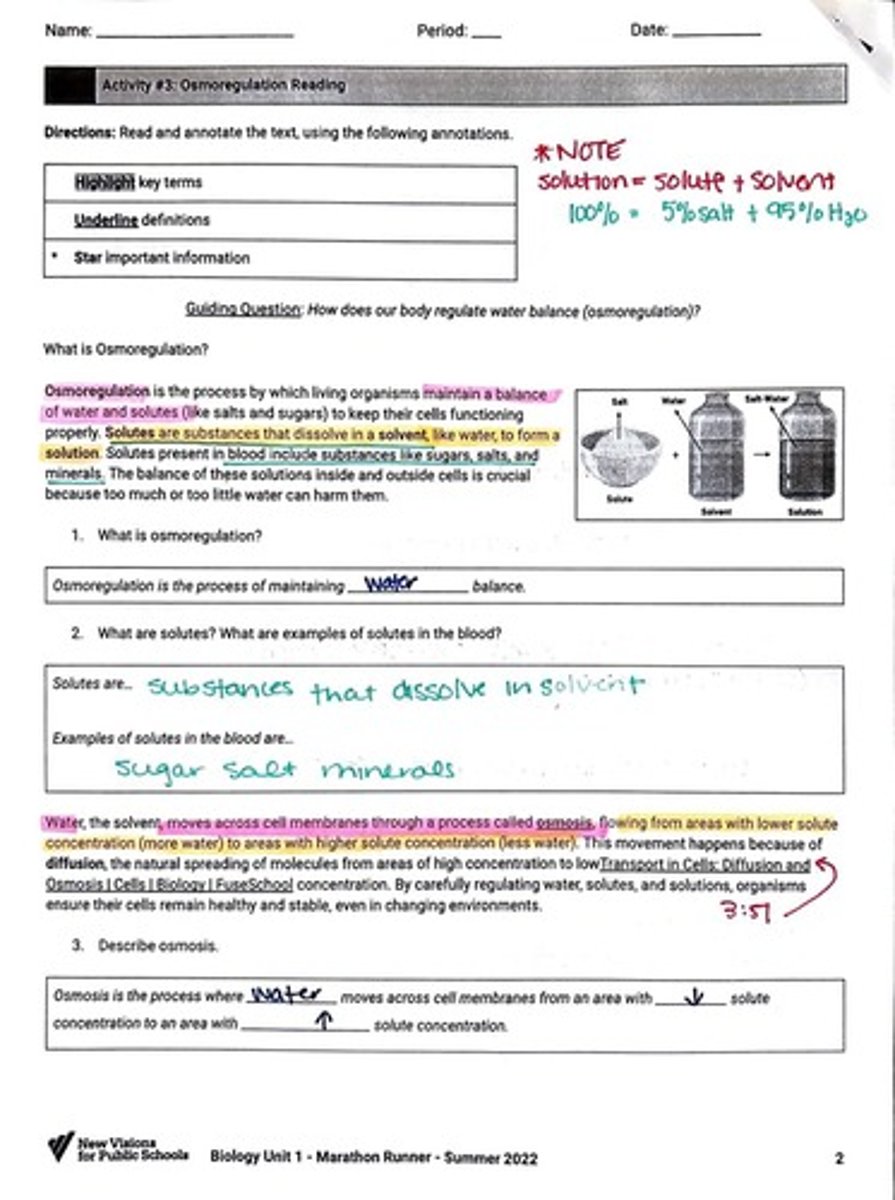
What are solutes?
Substances that dissolve in a solvent, like water, to form a solution.
What are examples of solutes in the blood?
Sugars, salts, and minerals.
What is the role of water in osmoregulation?
Water moves across cell membranes to balance solute concentrations inside and outside of cells.
What is osmosis?
The process where water moves across cell membranes from an area of lower solute concentration to an area of higher solute concentration.
What happens to cells in a hypertonic solution?
Water moves out of the cell, causing it to shrink.
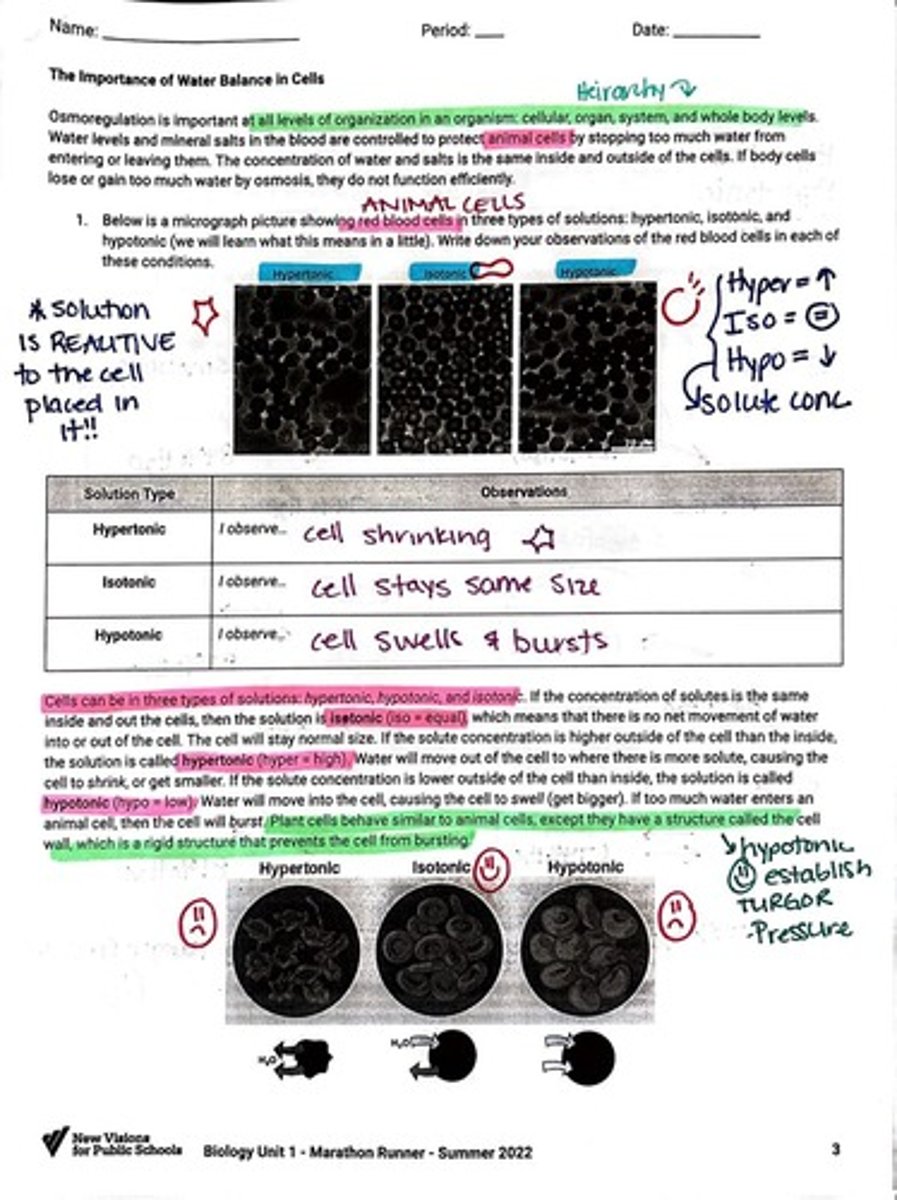
What happens to cells in a hypotonic solution?
Water moves into the cell, causing it to swell and potentially burst.
What happens to cells in an isotonic solution?
There is no net movement of water; the cell remains the same size.
Why is water balance important for cells?
Too much or too little water can harm cells and affect their function.
What is a solvent?
A substance that dissolves solutes to form a solution, commonly water.
What is a solution?
A homogeneous mixture formed when a solute is dissolved in a solvent.
What is the significance of maintaining water balance in the body?
It protects cells from damage due to excessive water loss or gain.
How do cells respond to hypertonic solutions?
Cells lose water and shrink as water moves out to balance solute concentrations.
How do cells respond to hypotonic solutions?
Cells gain water and may burst as water moves in to balance solute concentrations.
What is the effect of osmosis on red blood cells in a hypertonic solution?
Red blood cells shrink due to water loss.
What is the effect of osmosis on red blood cells in a hypotonic solution?
Red blood cells swell and may burst due to water influx.
What is the effect of osmosis on red blood cells in an isotonic solution?
Red blood cells maintain their normal size with no net water movement.
What is the guiding question for understanding water balance?
How does our body regulate water balance (osmoregulation)?
What can happen if body cells lose or gain too much water?
They do not function efficiently.
What is the importance of regulating solute concentrations?
It ensures cells remain healthy and stable in changing environments.
What is the relationship between solute concentration and water movement?
Water moves from areas of lower solute concentration to areas of higher solute concentration.
What are the three types of solutions that affect cell behavior?
Hypertonic, hypotonic, and isotonic.
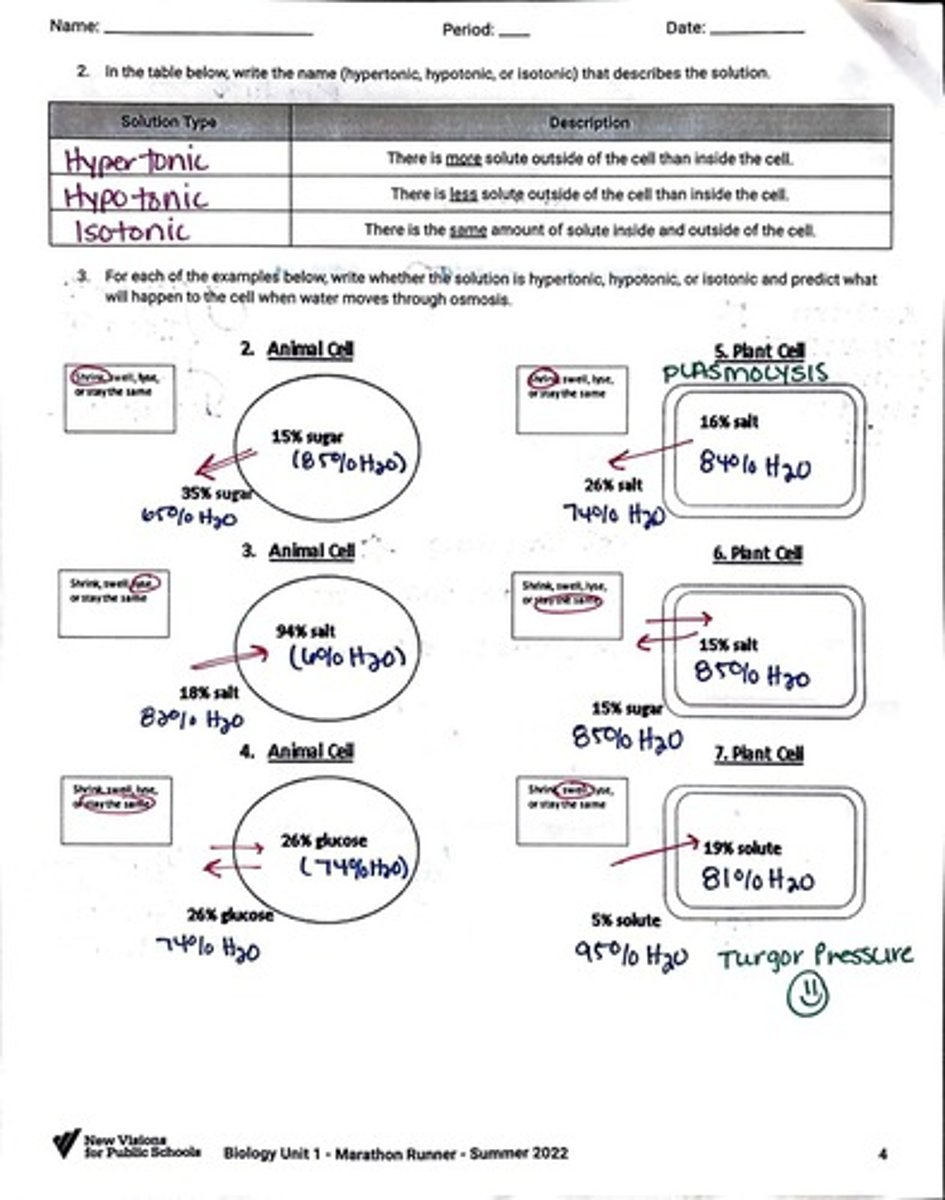
What does it mean if a solution is hypertonic?
The solute concentration is higher outside the cell than inside.
What does it mean if a solution is hypotonic?
The solute concentration is lower outside the cell than inside.
What does it mean if a solution is isotonic?
The solute concentration is equal inside and outside the cell.
What is the role of the cell wall in plant cells regarding osmosis?
It prevents the cell from bursting when too much water enters.
What is the primary organ involved in maintaining water balance?
The kidney
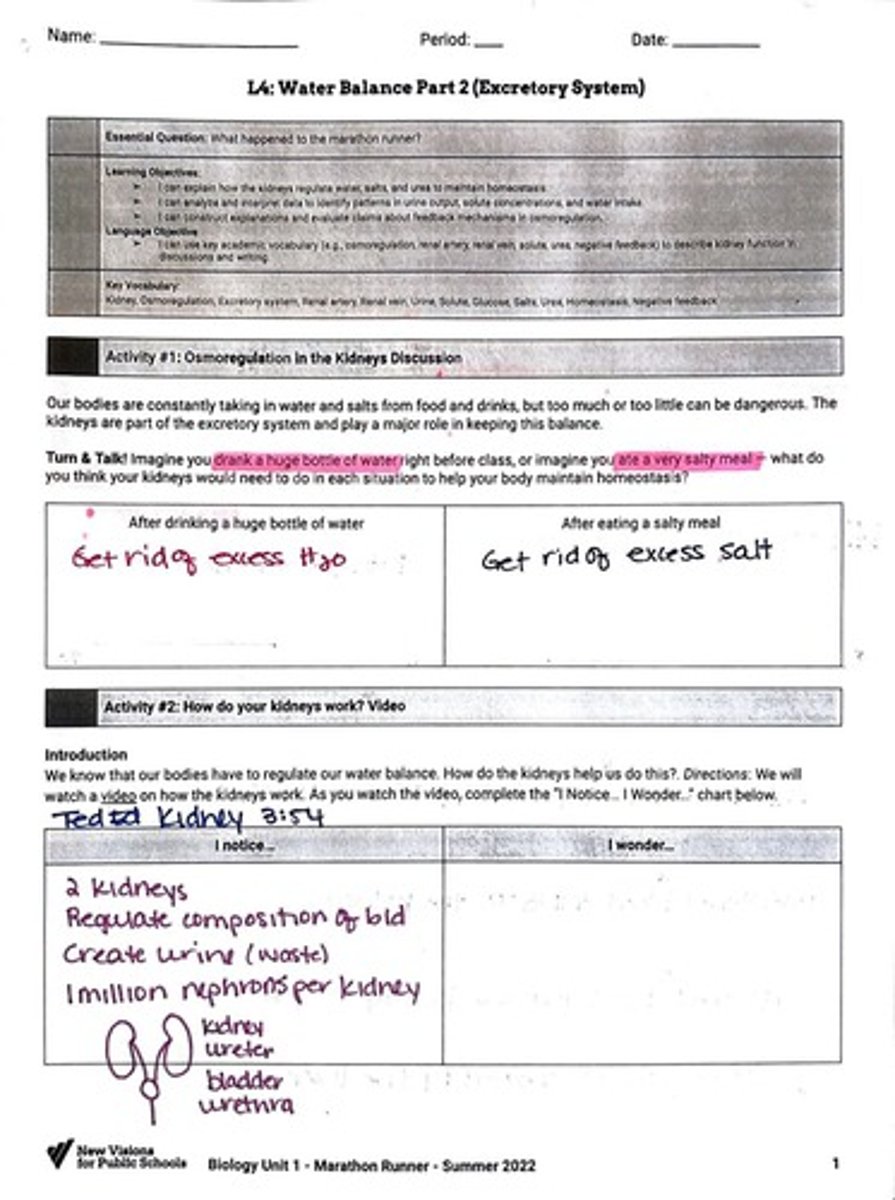
What happens to urine output after drinking a large amount of water?
Urine output increases and may be lighter in color.
What is the function of the renal artery?
It carries oxygenated blood to the kidneys.
What type of blood does the renal vein contain?
Deoxygenated blood that has been filtered by the kidneys.
What is urea?
A waste product created by the liver that is excreted in urine.
What is the role of the kidneys in the excretory system?
To filter waste products from the blood and produce urine.
What occurs to solute concentrations in the blood during exercise?
They can change based on water intake and exercise intensity.
What happens to urine concentration after consuming a salty meal?
Urine concentration increases, and urine output may decrease.
What is the significance of maintaining homeostasis in the body?
It ensures that the internal environment remains stable despite external changes.
What is the average percentage of water in the human body?
About 60%.
What is the relationship between water intake and kidney function?
The kidneys adjust urine production based on water intake to maintain balance.
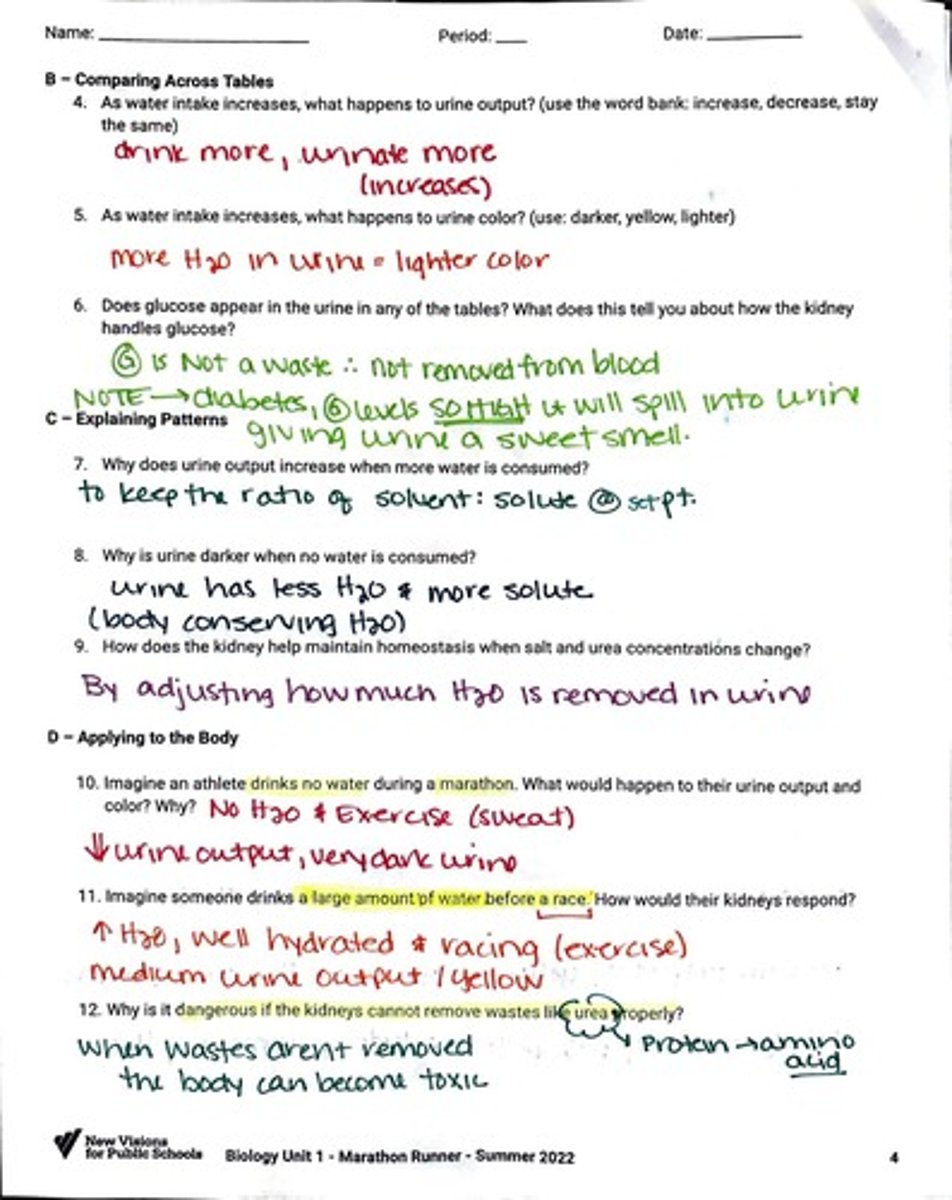
What is the effect of dehydration on urine output?
Urine output decreases, and urine becomes darker in color.
What role do kidneys play in excreting waste products?
They filter waste products from the blood and excrete them in urine.
How do kidneys help regulate blood pressure?
By adjusting the volume of blood through water retention or excretion.
What happens to glucose levels in urine when the kidneys are functioning properly?
Glucose should not be present in urine; it is reabsorbed into the blood.
What is the function of renal pyramids?
They are involved in the concentration of urine and the transport of urine to the renal pelvis.
What is the role of the urinary bladder?
To store urine before it is excreted from the body.
What is negative feedback in the context of kidney function?
A mechanism that helps regulate water balance by adjusting kidney function based on body needs.
What happens to urine output when water intake increases?
Urine output increases.
How does urine color change with increased water intake?
Urine color becomes lighter.
What is the urine output and color when water intake is low?
Urine output is low and color is dark yellow.
What is the concentration of salts in the renal artery?
140 mmol/L.
What is the concentration of glucose in urine with low water intake?
0 mg/dL.
What does the presence of glucose in urine indicate about kidney function?
The kidneys actively reabsorb glucose back into the blood.
What is the concentration of urea in urine with high water intake?
20 mg/dL.
What happens to urine output and color when an athlete drinks no water during a marathon?
Urine output decreases and color becomes darker.
How do kidneys help maintain homeostasis when salt concentrations change?
They adjust urine output and solute concentration.
What is the effect of consuming a very salty meal on urine output?
Urine output increases to excrete excess salt.
What happens to urine output when a large amount of water is consumed before a race?
Urine output increases significantly.
Why does urine become darker when water intake is low?
Less water leads to higher concentration of solutes in urine.
What is the glucose concentration in urine with medium water intake?
0 mg/dL.
What does a urine output that is medium and yellow indicate?
It indicates a moderate level of hydration.
What is the concentration of salts in urine with high water intake?
0.1 mmol/L.
What is the concentration of urea in the renal vein?
1 mg/dL.
How does the kidney respond to high water intake?
It increases urine output and dilutes urine.
What is the primary function of the kidneys in relation to urine?
To regulate water and solute balance in the body.
What is the role of negative feedback in osmoregulation?
It helps maintain homeostasis by adjusting kidney function based on hydration levels.
What is the concentration of glucose in the renal artery?
102 mg/dL.
What happens to urine output and color when water intake is medium?
Urine output is medium and color is light yellow.