bisc 225 exam 1 study guide
 Call Kai
 Learn
Learn Practice Test
 Spaced Repetition
 Match
Match Flashcards
 Knowt Play
1/160

There's no tags or description
Looks like no tags are added yet.
Name | Mastery | Learn | Test | Matching | Spaced | Call with Kai | Chat |
|---|
No analytics yet
Send a link to your students to track their progress
161 Terms
Anatomy
Derived from the Greek word for
'cutting up'; the field of study examining body structures.
Physiology
Derived from the Greek word for
'relationship to nature'; the field of study examining the functions of body parts.
What are the major elements of the human body
The major elements of the human body include oxygen, carbon, hydrogen, nitrogen, calcium, and phosphorus.
Levels of organization in order from simplest to most complex
Atom
Molecule
Macromolecule
Cell
Tissue
Organ
Organ system
Organism
Subatomic particles
protons, neutrons, and electrons that make up cells
Atom
tiny particles that make up chemicals (hydrogen, carbon)
Molecule
particles consisting of atoms joined together (water, glucose)
Macromolecule
large particles consisting of molecules (DNA, protein)
Organelle
functional part of a cell (mitochondrion, lysosome)
Cell
basic unit of structure and functions (muscle, nerve, or blood cell)
Tissue
layer or mass of cells with specific function (adipose or epithelial tissue)
Organ
group of different tissues with a function (heart, kidney, stomach)
Organ system
group of organs with common function (digestive system)
Organism
individual living entity made up of one or more systems that function together to sustain life</span>
What are the processes of the characteristics of life
Growth-
Increase in cell number and size and increase in body size |
Reproduction-
Production of new cells and organisms |
Responsiveness-
Reaction to a change inside or outside of the body |
Movement-
Change in body position or location; motion of internal organs |
Metabolism- The sum of all chemical reactions in a living system: Energy and nutrient cycling
What are the 4 processes listed under metabolism?
Respiration
Digestion
Circulation
Excretion
Respiration
Acquiring energy. Most organisms do it by taking in oxygen and giving off carbon dioxide
Digestion
Breaking down food into usable nutrients for absorption into the blood
Circulation
Moving chemicals and cells through the body fluids
move blood, oxygen, nutrients, and waste products throughout the body
Excretion
Removing waste products
What are the three requirements for life
Chemicals-substances needed for body processes
Heat-necessary for chemical reactions
Pressure-needed for processes such as breathing and circulation
What are the four chemical requirements for life under CHEMICALS
Water
Oxygen
Carbon Dioxide
Food
What is carbon dioxide
A waste product of food breakdown
What does food supply
Nutrients needed to supply energy
What is heat?
A form of energy.
How does temperature affect the body?
It controls the rate of chemical reactions.
What is pressure?
A force applied to something
Why are atmospheric and hydrostatic pressure important?
Atmospheric: breathing
Hydrostatic: keeps blood flowing
What is homeostasis?
Maintenance of a stable internal environment
-All cells contribute to homeostasis in one way or another
How many components do homeostatic mechanisms have and what are they?
3
Receptor(sensor)
Control center
Effectors
What do receptors do?
Detects changes or deviations in a physiological variable (the internal or external environment).
What does the control center do?
Receives and processes information from the receptor and compares it to the normal set point.
What does the effector do?
Acts on the command of the control center to oppose or reverse the deviation, bringing the value back to normal.
Negative feedback loops
A homeostatic mechanism where a deviation from a set point is detected and corrected by effectors, reducing effector activity as conditions return to normal.
-Reverses a change and brings the body back toward its normal range
Positive feedback loops
A mechanism in which a deviation from the set point drives conditions farther away from normal, producing short-lived unstable conditions.
-Amplifies of increases a change until a specific event is completed.
Serous membranes consists of what 2 layers?
Visceral layer
Parietal layer
What is the difference between visceral and parietal membranes?
Visceral layer: inner layer, which covers an organ
Parietal layer: outer layer, which lines the wall of the cavity
What are the organs systems?
integumentary
skeletal
muscular
nervous
endocrine
cardiovascular
lymphatic
respiratory
digestive
urinary
reproductive
integumentary system’s function
protects tissues, regulates body temperatures, supports sensory receptors
skeletal system’s functions
provides framework, protects soft tissues, provides attachments for muscles, produces blood cells, stores inorganic salts
muscular system’s function
causes movements, maintains posture, produces body heat
nervous system’s function
detects changes, receives and interprets sensory information, stimulates muscles and glands
Endocrine system’s functions
control metabolic activities of body structures
Cardiovascular system’s function
Moves blood through blood vessels and transports substances throughout body
Lymphatic system’s function
return tissue fluid to the blood, carry certain absorbed food molecules, defend the body against infection
Digestive system’s function
Receive, break down, and absorb food; eliminate unabsorbed material
Respiratory system’s function
intake and output of air, exchange of gases between air and blood
Urinary system’s functions
Remove wastes from blood, maintain water and electrolyte balance, store and eliminate urine
Reproductive system’s function
-Produce and maintain sperm cells; transfer sperm cells into the female reproductive tract
-Produce and maintain oocytes, receive sperm cells, support development of an embryo, and function in the birth process
Major Organs of Integumentary
Skin, hair, nails, sweat glands, sebaceous glands
Major Organs of Skeletal
Bones, ligaments, cartilages
Major Organs of Muscular
Muscles
Major OrgansNervous
Brain, spinal cord, nerves, sense organs
Major Organs of Endocrine
Glands that secrete hormones (pituitary gland, thyroid gland, parathyroid glands, adrenal glands, pancreas, ovaries, testes, pineal gland, and thymus)
Major Organs of Cardiovascular
Heart, arteries, capillaries, veins
Major Organs of Lymphatic
Lymphatic vessels, lymph nodes, thymus, spleen
Major Organs of Digestive
Mouth, tongue, teeth, salivary glands, pharynx, esophagus, stomach, liver, gallbladder, pancreas, small and large intestines
Major Organs of Respiratory
Nasal cavity, pharynx, larynx, trachea, bronchi, lungs
Major Organs of Urinary
Kidneys, ureters, urinary bladder, urethra
Major Organs of Reproductive
Male: scrotum, testes, epididymites, ducts differentia ,seminal vesicles, prostate glands, bulbourethral glands, urethra, penis
Female: ovaries, uterine tubes, uterus, vagina, clitoris, vulva.
Anatomical Position
• Standing erect
• Face forward
• Upper limbs at the side
• Palms forward
Anatomical Position Definition
The standard reference posture used by medical and scientific professionals to consistently describe the human body, regardless of how the patient is actually positioned.
Relative Directional/ Position Terms
Superior- Above another part
Inferior- Below another part
Anterior- Toward the front
Posterior- Toward the back
Medial- Closer to the midline
Lateral-Away from the midline
Bilateral- Paired structures, one on each side of the midline
Ipsilateral- Structures on the same side
Contralateral- Structures on opposite sides
Proximal- A part closer to a point of attachment to the trunk than another body part.
Distal- Farther from a point of attachment to the trunk
Superficial- Near the surface
Deep- More internal parts
Sagittal section
A vertical plane that runs front-to-back and divides the body into left and right sections.
Transverse Section
A horizontal plane parallel to the ground that divides the body into upper (superior) and lower (inferior) sections.
Coronal Sections
A vertical plane that runs side-to-side and divides the body into front (anterior) and back (posterior) sections.
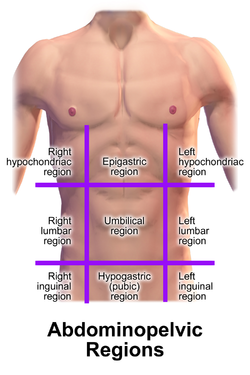
What are the 9 abdominal regions
Epigastric-Upper middle portions
Right and left hypochondriac- Right/left side of the epigastric region
Umbilical- Central portion
Right and left lateral (lumbar) regions- Right/left side of the umbilical region
Pubic (hypogastric) region-Lower middle portion
Right and left inguinal region- right and left side of
the pubic region
Difference between atoms, molecules, elements, and compounds.
Atom: smallest particles of an element that have the properties of that element
Element: A pure substance made of only one type of atom. There are 92 naturally occurring elements.
Molecule: Two or more atoms chemically bonded together. The atoms may be the same or different element (O2 and H2O)
Compounds: A substance made of atoms from two or more different elements chemically bonded together. (H2O, CO2 , C6H12O6 , and NaCl)
What are the major elements that make up most of our body weight.
Oxygen
Carbon
Hydrogen
Nitrogen
(O-C-N-H)
Protons, neutrons, and electrons.
Protons- Large particles; carry a single positive charge
Neutrons- Large particles; carry no electrical charge
Electrons- Small particles; carry a single negative charge
Why are atoms electrically neutral?
They have a equal number of protons and electrons, balancing the overall charge.
Number of protons=number of electrons
Atomic Number vs. Mass number
Atomic Number =Number of protons in a single atom (Each element has a unique atomic number.)
Mass number= The number of protons + the number of neutrons in one atom (Electrons do not contribute to the mass of the atom because they are so light.)
How do you tell the number of protons, neutrons, and electrons based on atomic number or mass?
Protons= atomic #
Neutrons= atomic # (if the atom is neutral)
Electrons= mass #- Atomic #
Example: Carbon-12
Carbon has:
-Atomic Number=6
-Mass number=12
Therefore:
Protons=6, Electrons=6, Neutrons= 12-6=6
Isotope
An atom of a certain element have the same atomic number (same number of protons), but can have a different atomic mass (vary in number of neutrons).
Number of elements in a Formula
Ex: H2O, and C6H12O6
: H, O = 2 different elements
:C6H12O6 = 3 different elements
Electron occupy energy levels/shells.
1st shell= 2 electrons
2nd shell= 8 electrons
3rd shell= 8 electrons( commonly represented as up to 8 for the octet rule)
Octet Rule
Atoms tend to gain, lose, or share electrons to have 8 electrons in their outer shell.
(Outer shell electrons are called valance electrons)
Ionic Bond
Strong chemical bonds formed when ions of opposite charge attract.
Covalent Bonds
Strong chemical bonds, formed between atoms that share electrons
Polar covalent bonds
a type of chemical bond where two atoms share electrons unequally because one atom has a stronger pull than the other
Non-polar covalent bonds
a type of chemical bond that is formed when electrons are shared equally between two atoms.
Hydrogen Bonds
Relatively weak attraction of a slightly positive (H) end of one polar molecule to a slightly negative (N or O) end of a nearby polar molecule.
Synthesis Reaction
more complex chemical structure is formed, 2 or more reactants (growth or repair); require energy; i.e. protein synthesis
A+B= AB
Decomposition Reaction
chemical bonds are broken to form a simpler chemical structure (digestion); release energy
AB= A+B
Exchange Reactions
chemical bonds are broken, and new bonds are formed (stomach acid is neutralized)
AB + CD to AD + CB
Reversible Reaction
the products can change back to the reactants (oxygen binds to hemoglobin)
A+B to AB and vise versa
Catalyst
influence the rate of reactions (enzymes)
Acid
Electrolytes that dissociate to release hydrogen ions in water (increase hydrogen
concentration).
Base
Substances that release hydroxide ions that can combine with hydrogen ions (decrease
hydrogen concentration)
Salts
Electrolytes formed by the reaction between an acid and a base.
Ionic compound that can dissociate into ions in water.
What is being released into water?
Dissociation of sodium and water of chloride ions in water
What are the pH range for acid and bases?
pH greater than 7=base
pH less than 7=acid
The pH scale generally ranges from 0-14
What is the 10-fold difference
10-fold change from one pH to the next pH of 6 has ten times the hydrogen ion concentration as a solution with pH of 7
What is the difference between organic and inorganic chemical constituents in the cell
Organic: have carbon and hydrogen atoms
Inorganic: chemical substances that do not include both carbon and hydrogen atoms
Four Organic Constituents types are:
Carbohydrates- C,H,O =quick energy
Lipids- C,H,O=long-term energy storage
Proteins- C,H,O,N =structure and function
Nucleic Acids- C,H,O,N,P =genetic information
Monosaccharides, disaccharides, and polysaccharides.
(Mono)saccharides
-single sugar units
ex:glucose
(Di)saccharides
-two sugar units
ex: sucrose
(Poly)saccharides
-many sugar units
ex: glycogen, starch
Lipids
are organic compounds made primarily of carbon, hydrogen, and oxygen that serve as long-term energy storage and structural components in cell membranes.
Saturated Fats
• Have only single carbon-carbon bonds
• Binds as many hydrogens as possible saturated with hydrogen
• Most are solid at room temperature
• Most are of animal origin
Unsaturated Fats
• Have one or more carbon-carbon double bonds
• Most are liquid at room temperature
• Most are of plant origin
• Monounsaturated one double bond
• Polyunsaturated two or more double bonds
What are the components that make up a phospholipid?
Glycerol
phosphate group- polar/hydrophilic
2 fatty acid tails- nonpolar/hydrophobic