Cognitive Psychology: Memory Systems, Encoding, and Retrieval
 Call Kai
 Learn
Learn Practice Test
 Spaced Repetition
 Match
Match Flashcards
 Knowt Play
1/38

Earn XP
Description and Tags
Vocabulary flashcards covering sensory memory, short-term and working memory, factors enhancing long-term retention, levels of processing, transfer-appropriate processing, and context-dependent memory based on lecture transcript sources.
Name | Mastery | Learn | Test | Matching | Spaced | Call with Kai | Chat |
|---|
No analytics yet
Send a link to your students to track their progress
39 Terms
Encoding
The memory process of transforming what we perceive, think, or feel into an enduring memory representation.
Storage
The memory process of maintaining and organizing information over time.
Retrieval
The memory process of bringing to mind information that was previously encoded and stored.
Iconic Memory
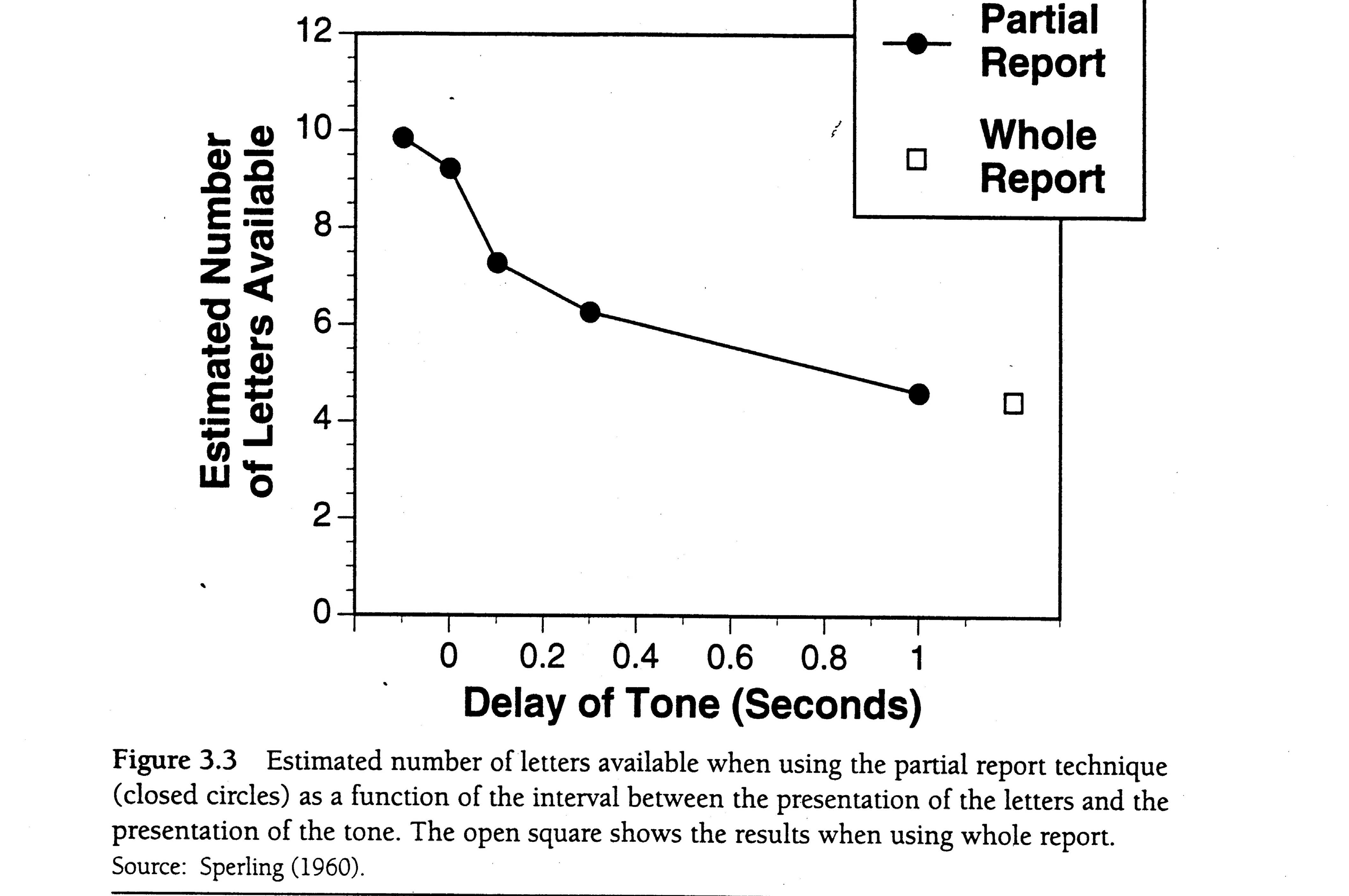
A fast-decaying store of visual sensory information that retains a complete and accurate copy of visual input for approximately 400ms.
Echoic Memory
A brief store of auditory sensory information that retains a copy of sound input for approximately 3seconds.
Partial Report Technique
An experimental procedure developed by Sperling where a high, medium, or low pitch tone cue signals participants immediately after a grid disappears to recall only a single designated row, demonstrating that iconic memory holds a nearly full capacity visual record before fading.
Brown-Peterson Paradigm
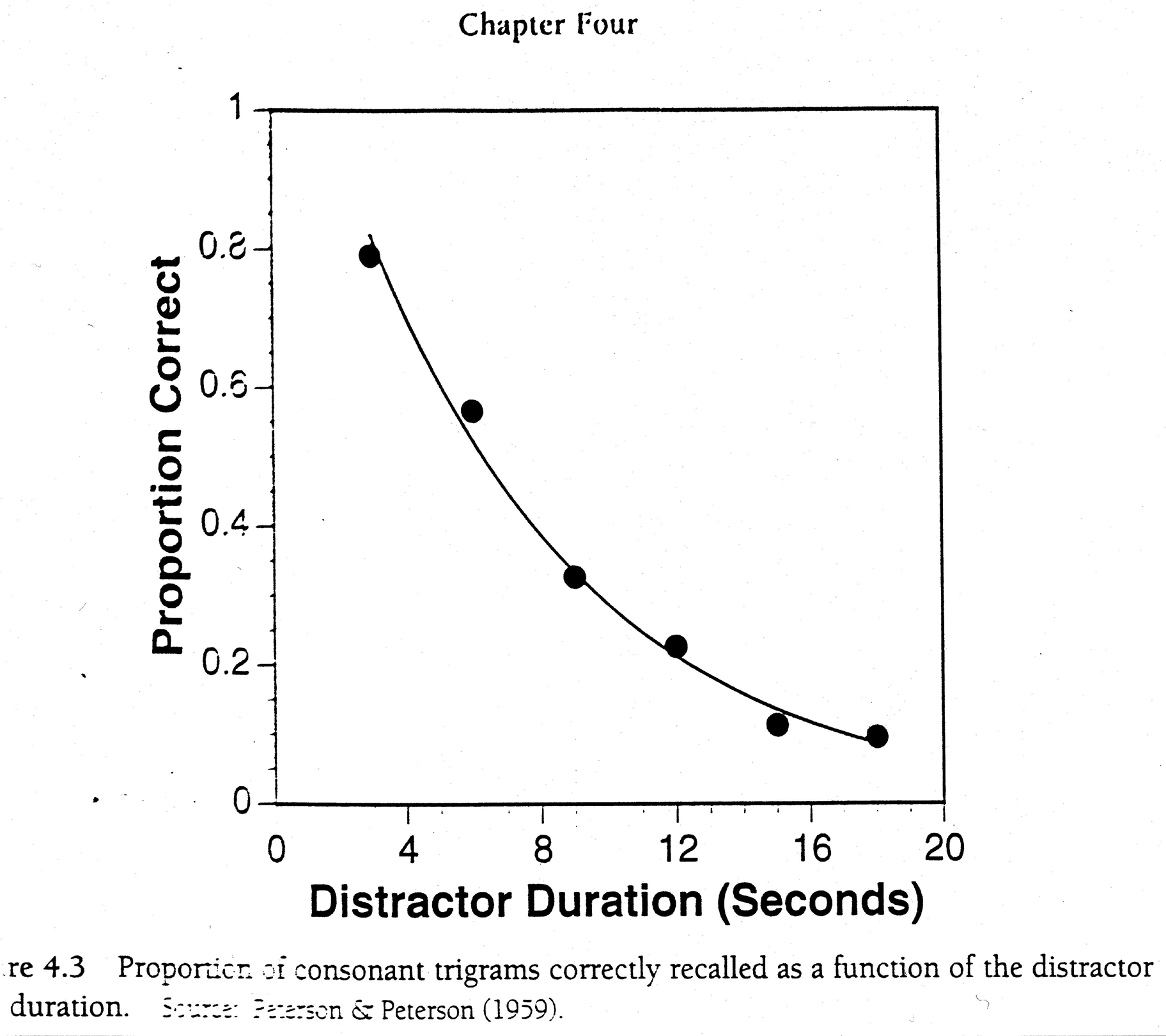
An experimental task measuring short-term memory duration in which subjects study brief items and perform a counting-backward distractor task, showing that unrehearsed information decays within 15 to 30seconds.
Primacy Effect
The enhanced recall of items presented at the beginning of a list, attributed to greater opportunity for rehearsal and transfer into long-term memory.
Recency Effect
The enhanced recall of items presented at the end of a list, attributed to items still being actively held in short-term memory.
Patient K.F.
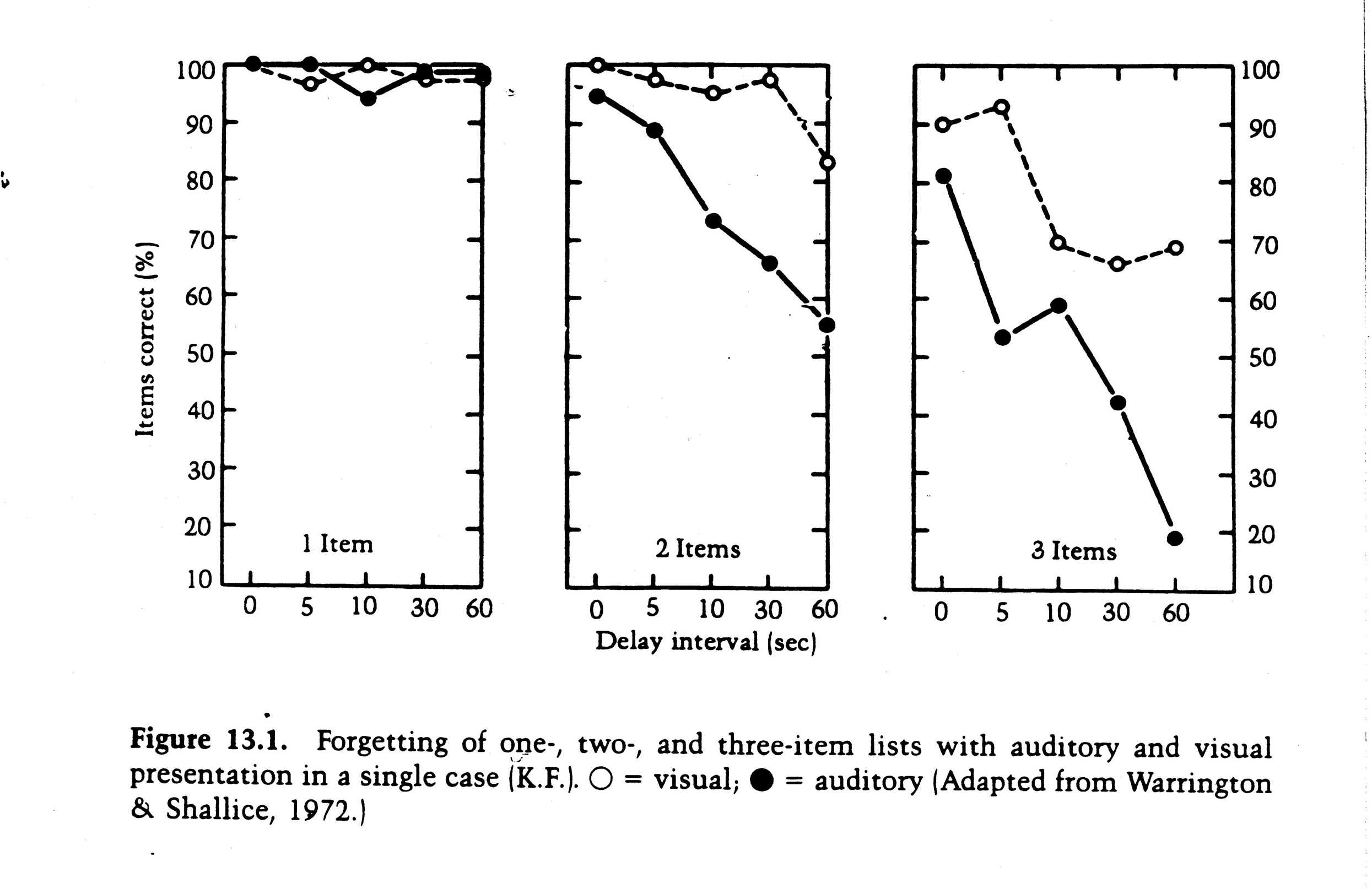
A brain-damaged patient studied by Warrington and Shallice who exhibited severe short-term memory impairment (especially for auditory material) alongside normal long-term memory, challenging the gateway hypothesis of the modal model.
Working Memory
A cognitive system responsible for the active maintenance, temporary storage, and simultaneous processing or manipulation of information during complex cognitive tasks.
Phonological Loop
A component of Baddeley's working memory model that temporarily holds verbal and auditory information in a sound-based or speech-based code.
Visuospatial Scratchpad
A component of Baddeley's working memory model responsible for storing and manipulating visual images and spatial information.
Episodic Buffer
A component of Baddeley's working memory model that temporarily integrates visual, spatial, and verbal information with long-term memory representations, holding current goals and plans.
Central Executive
The attentional control component of Baddeley's working memory model that sets plans, allocates attentional resources, monitors performance, and coordinates the three storage subsystems.
Articulatory Suppression
A procedure that disrupts the operation of the phonological loop by requiring a person to continuously repeat an irrelevant sound or word aloud while encoding information.
Reading Span Test
A complex working memory task developed by Daneman and Carpenter requiring subjects to read sentences aloud while holding the final word of each sentence in memory for subsequent recall.
Near Transfer
Improvement following cognitive training on tasks that are structurally very similar to the trained task.
Far Transfer
Improvement following cognitive training on tasks that are structurally different from the trained task but thought to rely on the same underlying cognitive construct.
Learning to Criterion
An experimental metric introduced by Herman Ebbinghaus defined by the number of study repetitions or relearning time required to achieve a designated level of accuracy, such as 100% recall.
Distributed Practice
The practice of spacing study sessions over multiple time intervals, which produces superior long-term retention compared to massed practice.
Overlearning
The practice of continuing to study or rehearse material past the point of initial 100% mastery or criterion performance.
Generation Effect
The memory enhancement resulting from actively retrieving or producing information from a prompt or hint rather than passively reading it.
Testing Effect
The phenomenon in which practicing retrieval by taking a test yields superior long-term retention compared to spending equal time re-studying material.
Von Restorff Effect
The memory phenomenon where an item that is perceptually or conceptually distinct from surrounding items in a list is more likely to be remembered.
Episodic Memory
A category of declarative long-term memory involving personal experiences and specific events tied to a particular time and place.
Semantic Memory
A category of declarative long-term memory comprising general knowledge, facts, and conceptual understanding detached from specific temporal or spatial learning contexts.
Dual Coding Theory
The framework proposing that concrete words are remembered better than abstract words because concrete concepts can be encoded via both semantic verbal codes and sensory image codes.
Gist Memory
Memory for the general meaning or conceptual content of an event or stimulus, which degrades more slowly over time than verbatim details.
Intentional Study
A study condition where subjects are informed prior to learning that their memory for the material will subsequently be tested.
Incidental Study
A study condition where subjects process material without prior knowledge that a memory test will follow.
Levels of Processing (LOP) Theory
A framework proposed by Craik and Lockhart asserting that memory retention is a function of the depth of mental processing, with deep semantic processing creating stronger memory traces than shallow physical processing.
Transfer-Appropriate Processing (TAP)
The principle stating that memory performance is optimal when the cognitive operations performed during retrieval match the cognitive operations performed during encoding.
Encoding Specificity
The rule that retrieval is most successful when the cues and context present during retrieval match the internal and external cues present during initial encoding.
Alpha Context
A type of context-dependent memory situation where the background context is environmental or incidental and unrelated to the target stimulus.
Beta Context
A type of context-dependent memory situation where the surrounding context directly modifies or alters the semantic interpretation of the target stimulus.
State-Dependent Memory
The phenomenon where memory retrieval is most effective when an individual's physiological or pharmacological state (e.g., sober or intoxicated) during test matches their state during encoding.
Mood-Congruent Memory
The tendency to retrieve material whose emotional tone matches the individual's current emotional state.
Mood-Dependent Memory
The enhancement of retrieval performance that occurs when an individual's emotional state at test matches their emotional state during encoding.