Lecture 1 - Cell
0.0(0)
Studied by 9 people Call Kai
 Learn
Learn Practice Test
 Spaced Repetition
 Match
Match Flashcards
 Knowt Play
Card Sorting
1/38

Last updated 7:31 PM on 12/12/22
Name | Mastery | Learn | Test | Matching | Spaced | Call with Kai | Chat |
|---|
No analytics yet
Send a link to your students to track their progress
39 Terms
1
New cards
Define cell
Basic living structural and functional unit of the body, primarily formed from carbon, oxygen, hydrogen and nitrogen.
2
New cards
What are the levels of structural organisation?
- Chemical
- Cellular
- Tissue
- Organ
- Organ system
- Cellular
- Tissue
- Organ
- Organ system
3
New cards
What are the three functions of cells?
1. Protection and support
2. Communication
3. Energy production
4. Movement
5. Inheritance
6. Transport
2. Communication
3. Energy production
4. Movement
5. Inheritance
6. Transport
4
New cards
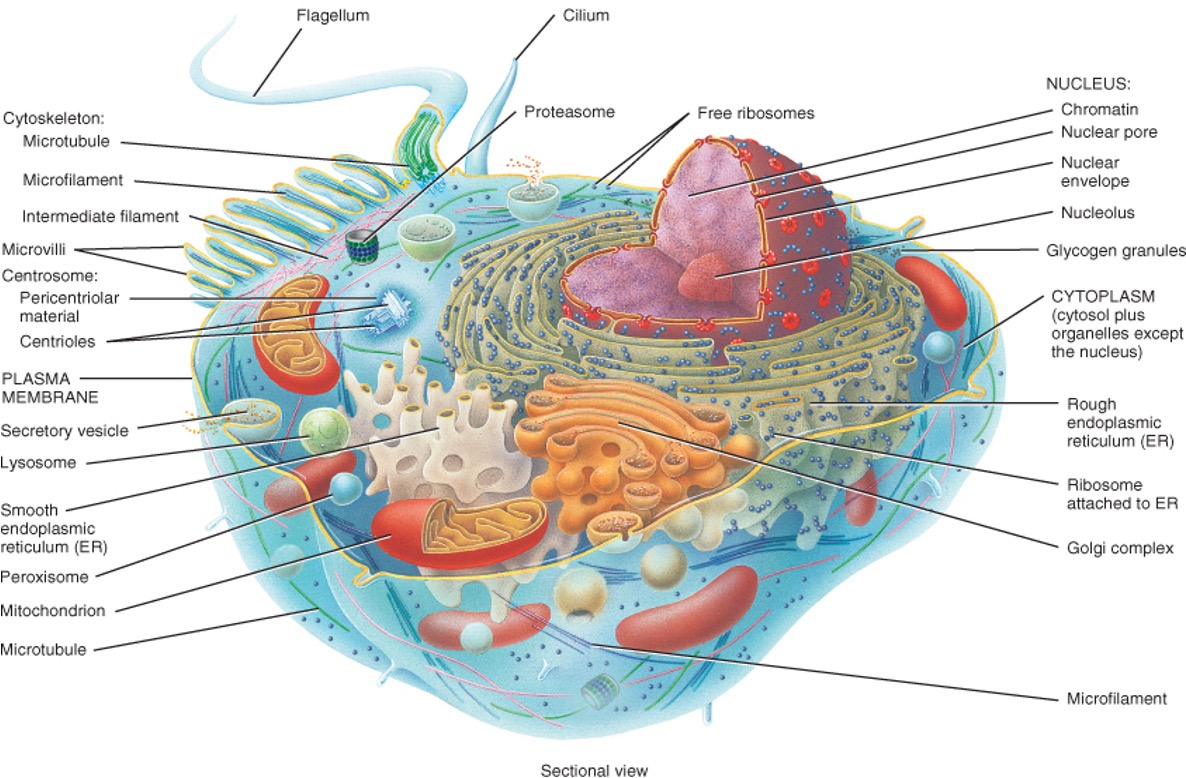
Describe the three main organised components of the cell
1. Plasma membrane
2. Cytoplasm
3. Nucleus
2. Cytoplasm
3. Nucleus
5
New cards
Define what the function of plasma membrane is
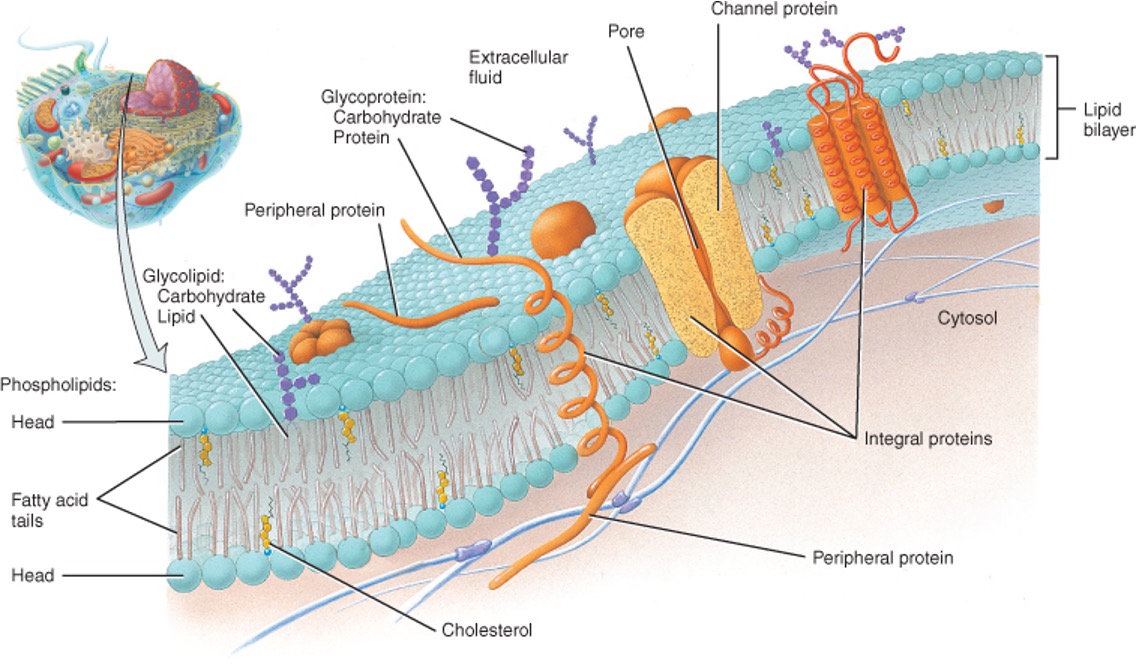
A flexible film that surrounds all cells, forming a barrier between intracellular fluid and extracellular fluid
6
New cards
Describe the structural framework of the plasma membrane
Lipid bilayer - two layers of phospholipids with a embedded cholesterol, glycolipids & integral proteins
7
New cards
What is the difference between passive and active membrane transport?
- Passive membrane transport - a molecule moves down its concentration gradient across the membrane using its own kinetic energy of motion
- Active membrane transport - ATP used to drive the substance against its concentration gradient
- Active membrane transport - ATP used to drive the substance against its concentration gradient
8
New cards
Define simple diffusion
Net movement of molecules from a region of higher to lower concentration
9
New cards
Define facilitated diffusion
Net movement of molecules from a region of higher to lower concentration via ion channels or carrier proteins
10
New cards
Define osmosis
Net movement of water through a selectively permeable membrane from a high concentration of water to a low concentration of water
11
New cards
Define isotonic solution and its osmotic effect
Same total solute and water concentration as the cells
No osmotic effect
No osmotic effect
12
New cards
Define hypertonic solution
Where there is more solute and less water in cells
Cell shrinkage
Cell shrinkage
13
New cards
Define hypotonic solution
Where there is less solute and more water in the cell
Cell-lysis
Cell-lysis
14
New cards
Define active transport
uses cellular energy to drive the movement of solutes against electrochemical gradients across plasma membrane
15
New cards
Name and explain the three types of active transport
- Primary active transport
Direct ATP use
- Secondary active transport
Downward gradient of another solute used to power uphill transport
- Bulk transport
Where ATP is required to move larger packets of substances into and out of the cell
> Exocytosis - ejection of substances - vesicles merge with the plasma membrane to move material out of a cell
> Endocytosis - vesicles detach from the plasma membrane to move materials into a cell
Direct ATP use
- Secondary active transport
Downward gradient of another solute used to power uphill transport
- Bulk transport
Where ATP is required to move larger packets of substances into and out of the cell
> Exocytosis - ejection of substances - vesicles merge with the plasma membrane to move material out of a cell
> Endocytosis - vesicles detach from the plasma membrane to move materials into a cell
16
New cards
Define cytoplasm
All the cellular contents within the plasma membrane except the nucleus
17
New cards
What is cytosol?
- Fluid portion of the cytoplasm > contains 75-90% water as solvent with dissolved nutrients, ions, proteins and waste products
- Has a high concentration of K+ ions and suspended proteins in comparison to extracellular fluid
- Site of many chemical reactions that maintain cell structures
- Allows for cellular growth
- Has a high concentration of K+ ions and suspended proteins in comparison to extracellular fluid
- Site of many chemical reactions that maintain cell structures
- Allows for cellular growth
18
New cards
Define cell organelle
Specialised structures suspended within the cytosol that perform specific functions within the cell
19
New cards
Name three membrane bounded organelles
- Mitochondria
- Endoplasmic Reticulum
- Golgi Apparatus
- Lysosomes
- Peroxisomes
- Ribosomes
- Centrioles
- Proteasomes
- Endoplasmic Reticulum
- Golgi Apparatus
- Lysosomes
- Peroxisomes
- Ribosomes
- Centrioles
- Proteasomes
20
New cards
Define and state the function of the cytoskeleton
- Proteins organised in fine filaments or slender tubes extending throughout the cytosol
- Provides cell strength + supports the organelle + permits movement of cellular structures + determines cell shape
- Provides cell strength + supports the organelle + permits movement of cellular structures + determines cell shape
21
New cards
Define centrosome
Region near the nucleus from which microtubules form
Contains a pair of centrioles at right angles
Contains a pair of centrioles at right angles
22
New cards
Define centrioles
Rod shaped bodies that are made up of fine microtubules
23
New cards
Define and state the function of cilia
- Short hair like projections from the cell surface
- Moves materials and fluids over cell surface
- Moves materials and fluids over cell surface
24
New cards
Define and state the function of flagella
- Longer than cilia and constitutes the sperm cell's tail
- Moves the entire cell directionally
- Moves the entire cell directionally
25
New cards
Define and state the function of microvilli
- Membrane extensions
- Increase cell surface area to facilitate absorption of extracellular solute
- Increase cell surface area to facilitate absorption of extracellular solute
26
New cards
Define and state the function of ribosomes
- Structures made up of RNA and proteins
- Site of protein synthesis
- Site of protein synthesis
27
New cards
Define and state the function of endoplasmic reticulum
- Network of membranous flattened sacs or tubules
> Rough ER - has ribosomes bound to the membranes that store, transport and package newly synthesised proteins
> Smooth ER - lack attached ribosomes that aid in the synthesis of lipids and steroids + detoxification of drugs
> Rough ER - has ribosomes bound to the membranes that store, transport and package newly synthesised proteins
> Smooth ER - lack attached ribosomes that aid in the synthesis of lipids and steroids + detoxification of drugs
28
New cards
Define and state the function of Golgi Apparatus
- Flattened membranes called cisternae
- Storage, further modification and sorting/packaging of proteins, secretory products and lysosomal enzymes
- Storage, further modification and sorting/packaging of proteins, secretory products and lysosomal enzymes
29
New cards
Define and state the function of lysosomes
- Vesicles that bud off from Golgi complex, containing powerful digestive enzymes
- Intracellular removal of worn out organelles and pathogens
- Intracellular removal of worn out organelles and pathogens
30
New cards
Define and state the function of peroxisomes
- Smaller than lysosomes but similar
- Undertake oxidation of amino acids and fatty acids and neutralisation of toxic compounds
- Undertake oxidation of amino acids and fatty acids and neutralisation of toxic compounds
31
New cards
Define and state the function proteasomes
- Protein complexes
- Degrade damaged proteins by proteolysis
- Degrade damaged proteins by proteolysis
32
New cards
Define and state the function of mitochondria
- comprise of mitochondrial cristae and have the mitochondrial matrix enclosing important metabolic enzymes
- produces ATP
- produces ATP
33
New cards
Define and state the function of nucleus
- Consists of a double nuclear envelope, nuclear pore and nucleolus
- Serves as control centre for cellular operations
> Nuclear pores - Control the movement of substances between nucleus and cytoplasm
> Nucleolus - Produces ribosomes and the gens arranged on chromosomes
- Serves as control centre for cellular operations
> Nuclear pores - Control the movement of substances between nucleus and cytoplasm
> Nucleolus - Produces ribosomes and the gens arranged on chromosomes
34
New cards
Define tissue and name the four basic types
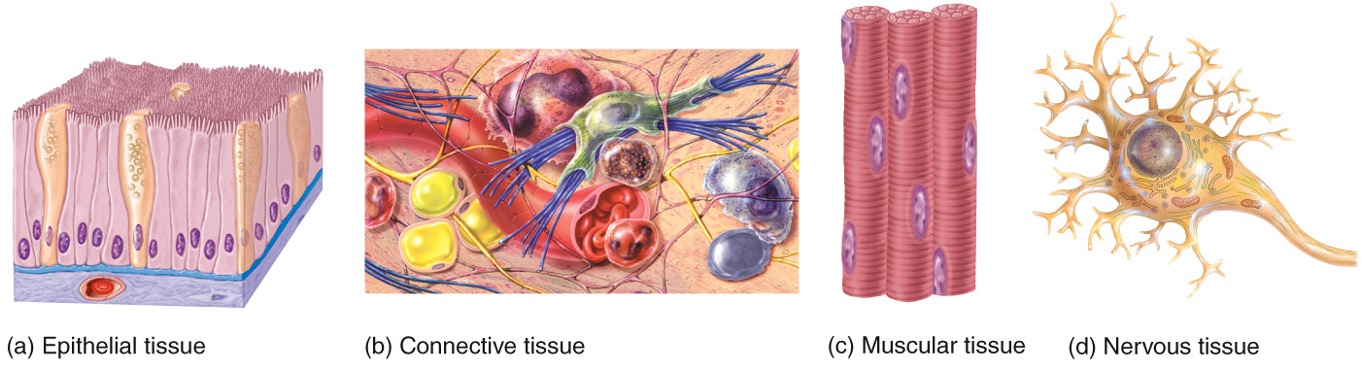
- Group of cells that functions together to perform one or more specialised activities
- Epithelial, connective, muscular and nervous
- Epithelial, connective, muscular and nervous
35
New cards
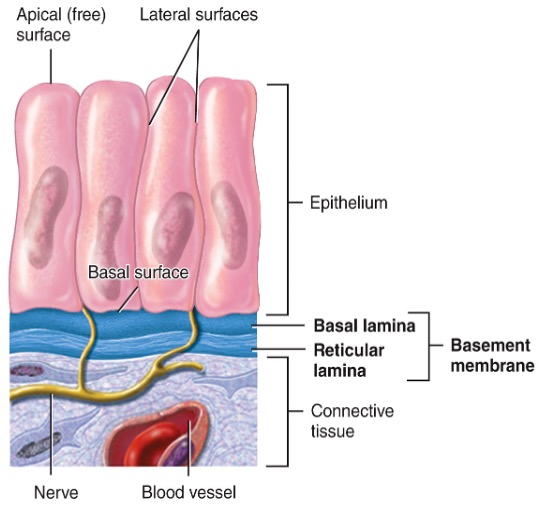
What are the general features of epithelial tissue?
- Cells are arranged in sheets and densely packed
- Cells are supported by a basement membranes
- Epithelial tissue is avascular but has a nerve supply
- Cells are supported by a basement membranes
- Epithelial tissue is avascular but has a nerve supply
36
New cards
What are the three functions of epithelial tissue?
1. Absorption (small intestine)
2. Secretion and Excretion
3. Solute transport (kidney tubules)
4. Protection (skin)
5. Sensory reception (taste buds)
2. Secretion and Excretion
3. Solute transport (kidney tubules)
4. Protection (skin)
5. Sensory reception (taste buds)
37
New cards
What are the general features of connective tissue?
1. Most abundant tissue
2. Contains cells and extracellular matrix
2. Contains cells and extracellular matrix
38
New cards
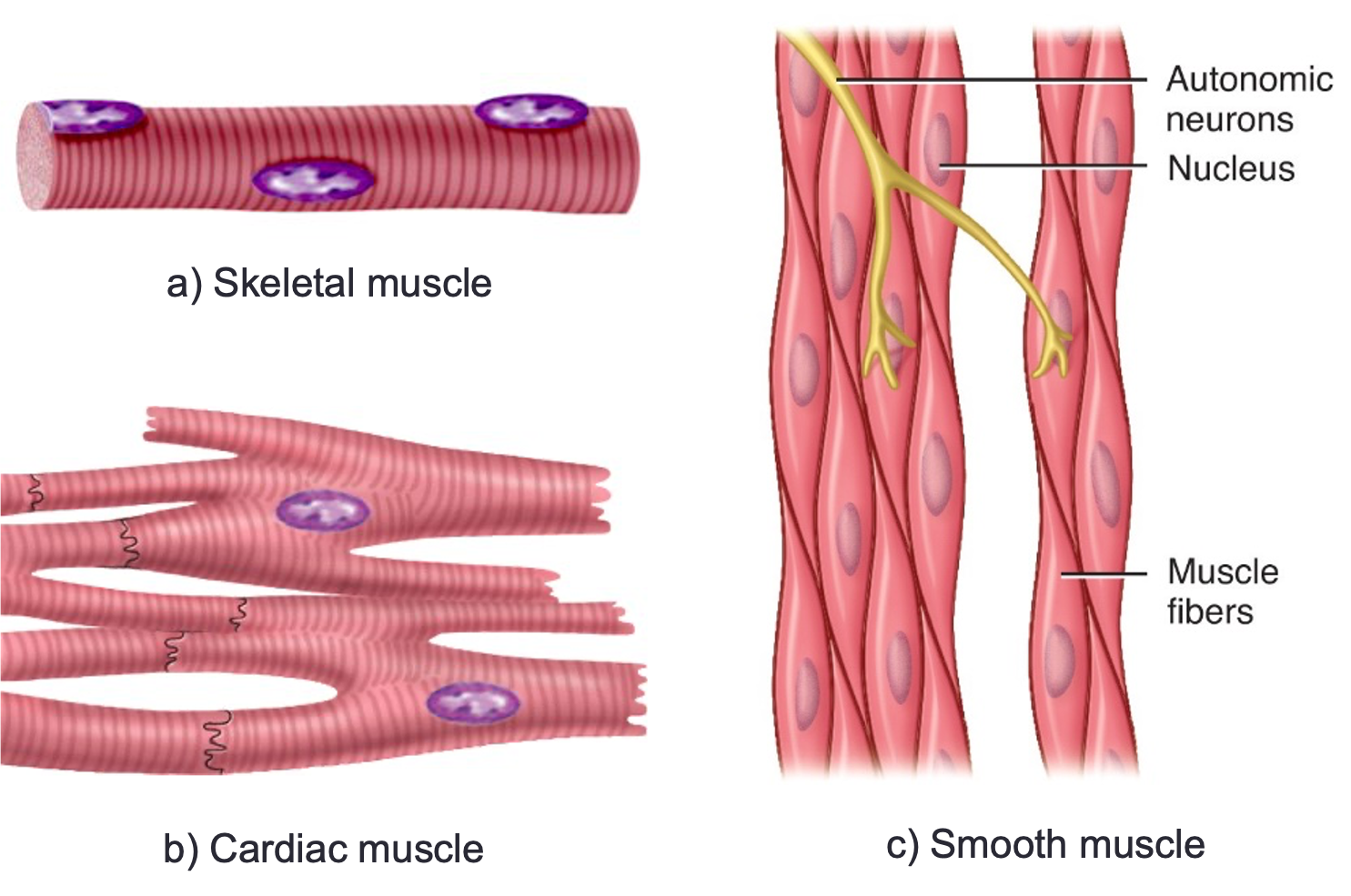
What are the general features of muscular tissue?
- Consists of fibres that provide motion, maintain posture and produce heat
- 3 types - skeletal, cardiac and smooth
- 3 types - skeletal, cardiac and smooth
39
New cards
What are the two types of nervous tissue? Describe the functions
- Two types of cells - neurons and neuroglia
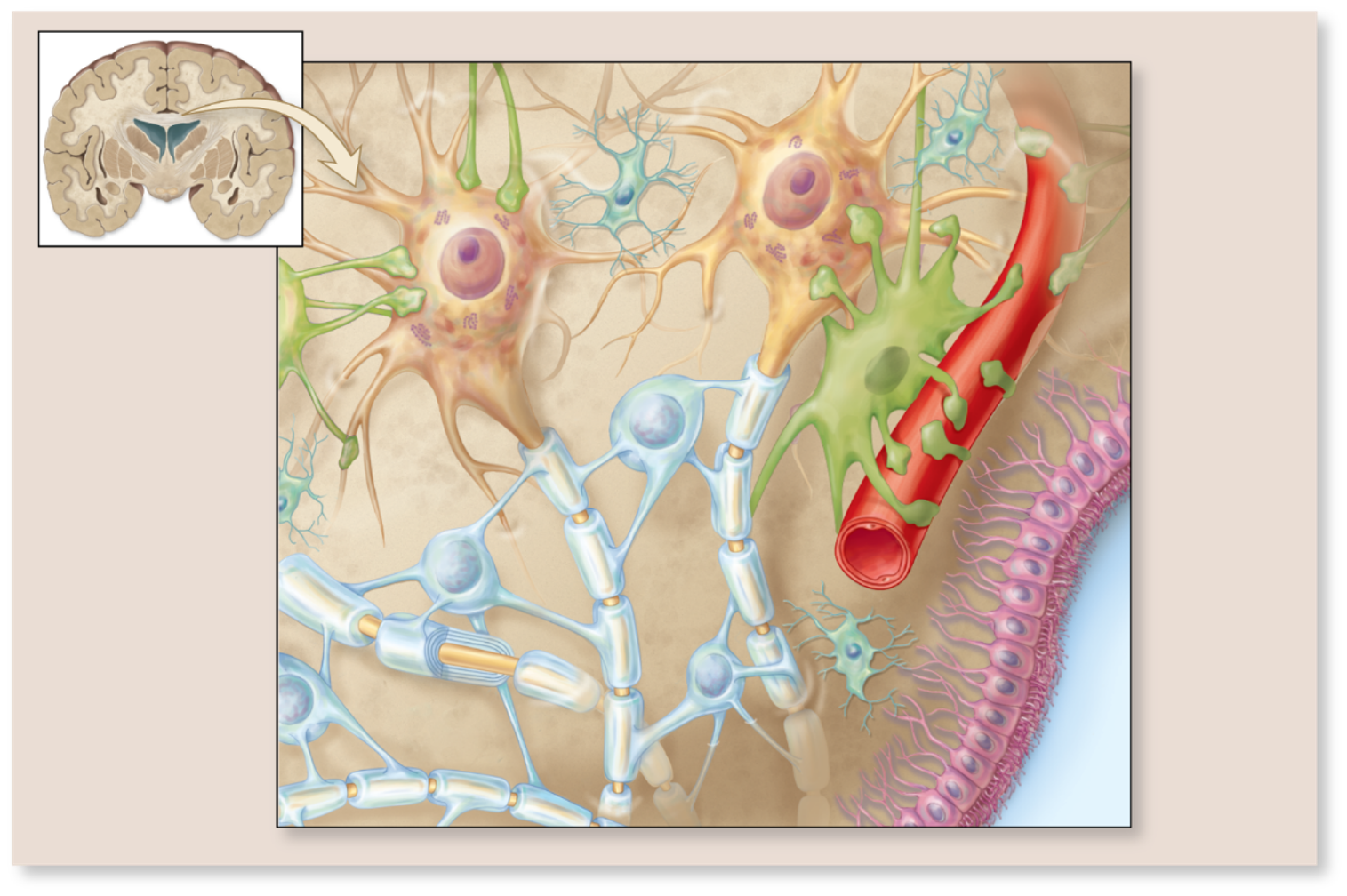
- Neurons provide the ability of sensing, thinking, remembering, controlling muscle activity, and regulating glandular secretions.
- Neuroglia support, feed, and protect neurons, and maintain the interstitial fluid that bathes them.
- Neurons provide the ability of sensing, thinking, remembering, controlling muscle activity, and regulating glandular secretions.
- Neuroglia support, feed, and protect neurons, and maintain the interstitial fluid that bathes them.