Data Monetization Pt.1
 Call Kai
 Learn
Learn Practice Test
 Spaced Repetition
 Match
Match Flashcards
 Knowt Play
1/43

There's no tags or description
Looks like no tags are added yet.
Name | Mastery | Learn | Test | Matching | Spaced | Call with Kai | Chat |
|---|
No analytics yet
Send a link to your students to track their progress
44 Terms
Analytics - Netflix
Netflix uses analytics to gain a competitive advantage
It knows what is being watched by all consumers
When someone pauses, rewinds, fast-forwards
What is being searched
What device is being used
When the viewer leaves content
Netflix’s “data-driven” culture
decisions about original content
what films to license
what shows to recommend to viewers
what colors and images to use on its website
Caesars Entertainment
Caeser’s entertainment is the worlds largest gaming company more than double revenues by collecting and analyzing customer data
They cater to all their wants and needs → customers will spend more money → increase in revenue per customer
Capital One - how did they succeed?
Became one of the industry’s (financial services) big players by using analytics
Created new products/services that appeal to new customers and strengthen their relationship with existing customers
Addressed “niche markets” which might not be attractive to big players because of a small number of potential customers
Why use Analytics?
The use of analytics to gain competitive advantage is that many industries offer similar products and use similar technologies
Analytics helps companies differentiate themselves!
Analytics enables…
fact-based decision-making
reduce bias
increase accuracy
make decisions easier to judge
Business Analytics Definition
Using tools and techniques to turn data into meaningful business insights
data → tools and techniques → business insight
Descriptive Analytics
summarize raw data and make it easy to interpret for humans
used to understand at an aggregate klevel what is going on in the company
historical insights
Predictive Analytics
Provide estimates about the likelihood of a future outcome
Forecasting customer behavior and purchasing power
Prescriptive Analytics
Attempt to quantify the effect of future decisions before they are made
Using prescriptive analytics to optimize production, scheduling, and inventory in a supply chain
Analytics - Categories
What should we do?
What might happen?
What is happening?
Data and the importance
Data is the “oil gig of the digital economy”
Data has economic properties that enable it to be leveraged in ways other assets cannot
when you consume data it does not get used up
when you use it, it often generates more data
it has low inventory and transit costs (compared to other assets)
How is the role of data shifting?
From serving as a secondary asset that supports decisions to being a primary asset that businesses can productize(make into a product) and sell
Data challenges
Data buyers brush off the potential value of data
data cannot be fully disclosed prior to purchase
data needs to be analyzed to discover the FULL VALUE
data buyers don’t know the creation, processing, storing, and distribution of high-quality data is a large cost for the data provider
lack of trust and security concerns
Data sharing 1.0
Companies share minimal data, only when it is REQUIRED, to proceed with transactions, and solve large problems, and follow regulations
Data sharing 2.0
Sharing COMPLEMENTARY data assets and capabilities to create new value propositions
Data monetization
When companies convert data and analytics into financial returns
What is data monetization?
Process of using data to obtain quantifiable economic benefit
Internal or indirect methods include using data to make measurable business performance improvements and inform decisions
External or direct methods: data sharing to gain beneficial terms of conditions from business partners, information bartering, selling data, or offering products and services
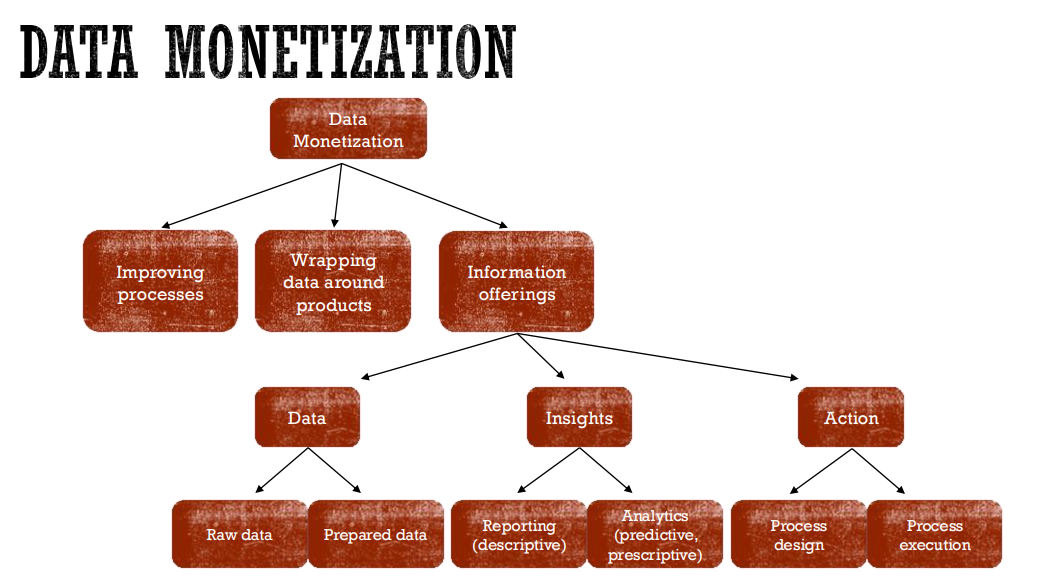
3 main data monetization approaches
Improving processes with data (to create returns through operational efficiencies)
Wrapping core offerings with analytics features (to increase a product’s price, wallet share, market share, or customer loyalty)
Selling information solutions
What is market share and wallet share?
Market share: a company’s portion of total industry sales
Wallet share: how much an individual customer spends on one brand
How can you improve processes?
The most immediate way to monetize data
Financial returns can be generated by using data to create operational efficiencies
Putting data and analytics in the hands of employees who make important decisions
If you cannot measure the impact of indirect data monetization….
It is hard to claim that it is “monetization”
Direct data monetization:
data → revenue
Indirect data monetization:
data → improved business performance → economic value
Can improvement in the hiring process be measured?
Organizations needs evidence that the “data-driven” intervention caused at least part of the improvement
E.g. Changes can be caused by new recruiters, better software, changes in software, etc…
Wrapping
Enriching products/services using data analytics (dashboards, reports, alters, suggested next step, or automated action)
Differentiate product/services; enhance value proposition
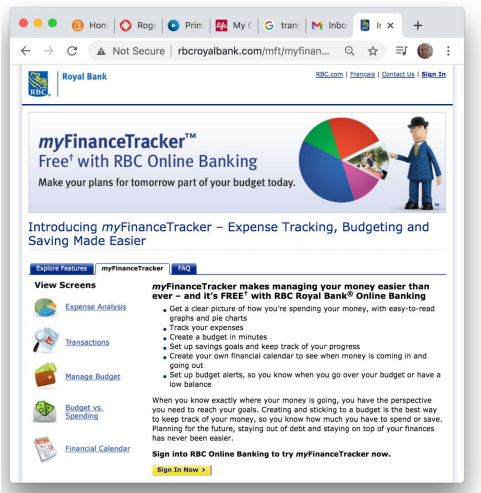
Banks have been wrapping their products/services with analytics
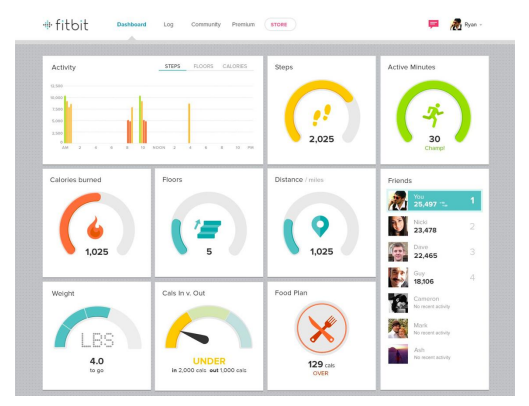
Fitness wrist bands such as Fitbit offer basic analytics for free and premium analytics for a fee

OneTouch Glucometer offers an app rich with analytics

4 design characteristics for data wrapping
Wrapping (4 A’s)
Anticipate
Advice
Adapt
Act
Anticipate
The wrap understands in advance the customer’s need
Advice
The wrap supports evidence based decision-making
Adapt
The wrap meets the customers need in a tailored manner
Act
The wrap performs an action that benefits the customer
Information Offerings
Represent the hardest way to monetize data because they requires a unique business model (e.g. becoming an information business)
Information Offerings 3 phases
1) Data
2) Insights
3) Actions

Information Offerings Consumption Path (9)
Data Offerings
Represent the foundation for the information offerings consumption path
Requires data acquisition platforms
Requires mechanisms to understand the data after it is sold because the buyer is alone in analyzing it and using its insights
2 categories of data offerings
Raw data: data with no cleaning, transformations, or enhancements
Prepared data: data that has been transformed, enhanced, cleansed, etc.
Usually prepared to be used for specific purposes
Insight Offerings
Reports and analytics that directly support processes and decisions
Reports and analytics must be useful and easy to use
2 categories of insight offerings
1) Reporting (descriptive): dashboards, visualization tools
2) Analytics(prescriptive and predictive): tools that use algorithms, stat modeling, and machine learning to discover new insights about the data
Action Offerings
Help customers act on insights
2 categories
Process design: consulting services and on-site support
Process execution: process automation and outsourced solutions that execute tasks on behalf of the client based on insights
Indirect data monetization
Using data internally to improve processes
Employee referrals are hired faster and tend to stay longer
Direct data monetization
Selling data, insights, or actions
selling anonymized data to a labour-market research company
selling reports explaining which recruitment channels produce the best employees
Selling action: advise companies on how to improve their hiring processes using hiring data and analytics
Data monetization