AZ 900 Practice Test 1
 Studied by 0 people
 Call Kai
 Learn
Learn Practice Test
 Spaced Repetition
 Match
Match Flashcards
 Knowt Play
1/22

There's no tags or description
Looks like no tags are added yet.
Name | Mastery | Learn | Test | Matching | Spaced |
|---|
No study sessions yet.
23 Terms
Which cloud computing features allow a company to provide services worldwide during a power outage? (Choose two).
Global scalability, Data Replication
A company hosting its offerings on a cloud can offer its services worldwide through global scalability, where server resources such as computing power, bandwidth, and storage are increased per the demand. The reliable cloud infrastructure has redundant sites that can be fully operational within hours of any event that causes service disruption, such as a power outage or a natural disaster that affects the primary site hosting the cloud’s resources. Regularly replicating data across multiple data centers ensures that data remains available even if one location goes offline.
Contoso Construction Inc. wants to move its services to the cloud but needs a private on-premises network that is connected securely to the public cloud network. Which Microsoft Azure services can offer a secure hybrid cloud model with the required security features? (Choose three.)
Virtual networks, Express Routes, Hybrid connections
The Azure Hybrid Cloud feature enables on-premises networks to establish secure connectivity with Azure Cloud. Virtual Network and Express Routes are the service which are being used to set up Hybrid Connection.
Service Bus is a message service which is used to send messages from one application to another application. External Database and custom connectors are used for application integration. Azure Auto-Scale scales up the resources when traffic increases for hosted applications.
Which packaged offering includes software and hardware, allowing a customer to run Azure services on-premises, making it easier to transfer applications to the cloud with minimal amount of work?
Azure Stack
Microsoft provides Azure Stack to make hybrid cloud deployment easier for its customers. Azure Stack is sold as a package that includes software and validated hardware to run it. It runs Azure services on-premises, making it easy to transfer applications to the cloud with minimal work. Because the hardware is part of Azure Stack and has been validated by Microsoft, you don’t have to determine the hardware needed to deploy Azure Stack. However, you do have to manage the on-premises hardware.
Governance
Policies that prevent users from creating resources that carry high costs
deals with the policy definition and implementation for an organization. The decision to not allow to create resources with higher costs comes under cloud governance.
Reliability
Ensuring all related VMs are allocated in the same infrastructure using fault tolerance
ensures that all the services are placed logically and that the customer’s application has a reliable infrastructure that can provide guaranteed resources even during peak traffic hours.
High Availability
Garuntees network, power, and system uptime close to 100%
guarantees network, system, and power uptime by managing outages and having redundant systems in place, providing uninterrupted services 24/7.
Manageability
Monitering cloud resources using application insights and alerts
a way to manage the resources by configuring alerts and application insights. Alerts are the way to know about the performance of the resources while application insights provide the detail about application performance.
Identify a scenario that shows a need for cloud elasticity.
John is hosting an image processing application on the Azure cloud. His application sees a 67% surge in traffic during weekends. The application gets less than 30% of the traffic during weekdays. He wants the VMs hosting his application to handle the traffic as it surges during the weekend without subscribing to an expensive plan that provides dedicated resources.
Embracing the path of scaling up ensures you can reap the rewards of heightened CPU power, expanded memory capacity, and an array of additional features that come hand-in-hand with such amplified prowess. You unlock many possibilities by elevating your application to a higher tier. For instance, scaling up might grant you access to solid-state disk drives or unveil an assortment of exclusive features that were previously out of reach at lower tiers. This augmentation not only bolsters the performance and capabilities of your application but also presents new avenues for innovation and efficiency.
Cloud providers excel in simplifying the scaling process, ensuring that your application’s growth aligns seamlessly with your requirements. They offer the invaluable capability of automatic scaling, adapting dynamically to the usage patterns specific to your application. You have the flexibility to scale automatically based on essential metrics, such as CPU and memory usage, as well as other parameters tailored to the unique characteristics of your application. This remarkable attribute of automated scaling is called elasticity, allowing your system to expand or contract effortlessly in response to evolving demands. With this elastic nature, your application can gracefully navigate fluctuating workloads and sustain optimal performance efficiently.
The first scenario presented requires elasticity. The second scenario refers to reliability, and the third one refers to security. Similarly, the last option is a requirement scenario for governance where policies are enacted to secure the integrity of the services.
Which cloud model gives the user access to a group of organizations for its services, providing a sharing mechanism with security higher than a public cloud and lower than a private cloud?
Hybrid cloud
Hybrid Cloud: Security can be higher than a public cloud because sensitive data and critical applications can be kept in the private cloud component. However, it is generally considered less secure than a private cloud because it still relies on the public cloud for some operations.
A network administrator plans to run a web application that uses a PHP framework to connect to a database system on the cloud. Which cloud model allows the network administrator to deploy and run the web application instantly?
PAAS
To use IAAS for your web application, you must first install and configure PHP on your VM. Then, you must install and configure the software necessary to connect to your back-end database. In a PaaS scenario, you simply deploy your web application on the cloud, and everything else is done for you. SaaS offers a web application that is ready to be run. It is ready-to-use software on the cloud. XaaS is anything-as-a-service, and it is just another name for bare-bone servers that require all the installation and configurations to deploy the web application.
Which of the following statements correctly describes cloud agility?
It is the ability to quickly develop, test and launch applications
Cloud agility provides the ability to quickly develop, test, and launch applications in cloud based environment. Agility is a key feature which enables organizations to respond to environmental changes and meet customer demands.
SaaS allows the user to customize the application and have control over its configuration.
False
SaaS services significantly differ from IaaS or PaaS services because they are completely managed and maintained by the cloud provider. You cannot install any of your software within a SaaS service, so the deciding factor is whether the provided software meets your needs. The benefit of a SaaS service is that it essentially removes the IT burden from your company and enables everyone in your company to access the software on multiple devices from anywhere, as long as internet access is available. You also benefit from data backup that the cloud provider includes in their infrastructure. However, if you need to customize the application or have any control over its configuration, SaaS might not be a good choice.
What is the difference between vertical and horizontal scaling when dealing with cloud resources in Azure? (Choose two.)
Horizontal scaling provides additional VMs to handle the application load. The VMs are identical, providing additional resources to handle the increasing workload.
Vertical scaling allows the application to be moved to a new, more resourceful VM with more CPU or RAM power. It gives additional power to the application to run faster and handle a more task-intensive workload.
In the ever-changing landscape of computing needs, there are times when you may find it necessary to augment your computing resources. The demand might require a swift response on specific days or certain periods. When a company unexpectedly garners attention from the media or experiences a sudden surge in users, scaling comes to the rescue. It provides additional resources or increased power to your application. Scaling manifests in two distinct forms: horizontal scaling, also known as scaling out, and vertical scaling, often called scaling up.
Scaling out entails the incorporation of additional virtual machines (VMs) into your application infrastructure. Each newly added VM possesses an identical configuration to the others, collectively shouldering the responsibility of handling the increased workload. This form of scaling grants your application the necessary resources to accommodate the mounting demand.
On the other hand, scaling up involves migrating your application to a more robust VM that offers enhanced capabilities. It may necessitate a more powerful CPU and increased memory capacity. By embracing vertical scaling, you effectively elevate your application to a higher echelon, empowering it to thrive in the face of intensified computational demands. The flexibility of scaling enables you to adapt swiftly, ensuring your system remains agile and responsive to ever-evolving requirements.
Which service organizes subscriptions and provides a level of scope in the Azure cloud?
Management groups
If a company has multiple subscriptions, it needs a way to keep track of access, regulations, and compliance for all of them. Azure management groups provide a level of scope. Subscriptions are organized into containers called management groups, and the management groups are subject to the governance rules. All subscribers within a management group automatically inherit the management group’s conditions.
Which service entity adds order and organization to the Azure resources by grouping similar usage, type, and location resources?
Resource groups
Resource Groups contain all the resources which shares the same lifecycle. They should be deployed, updated, and deleted together. A resource can only exist in one resources group. It organizes the resources which makes them easy to maintain.
In order to provide uninterrupted services, Microsoft Azure has created geographical boundaries to host its data centers. Within each geography, there are logical boundaries called regional pairs. How does Microsoft update the regional pairs without impacting the availability of the services?
It performs updates on one region in the regional pair. Once those updates are complete, it moves to the next region in the pair.
In order to establish additional layers of organization and management, Microsoft has implemented a concept known as a regional pair within each geography. A regional pair consists of two distinct regions within the same geography. When updates and modifications to the Azure platform become necessary, Microsoft meticulously carries out these updates on one region within the regional pair. Upon completion, the focus shifts to the subsequent region in the pair. This meticulous approach guarantees that the availability of customer services operating within a regional pair remains unaffected during the update process. By carefully managing the sequence of updates, Microsoft ensures a seamless customer experience, minimizing potential disruptions.
In which events are Azure availability zones unable to provide high availability and fault tolerance to the regional resources? (Choose two.)
High-intensity earthquakes, Tornadoes
Azure Availability Zones are designed to provide high availability and fault tolerance by isolating resources across physically separate datacenters within a region. However, they may not be effective in protecting against large-scale regional disasters that can impact all zones simultaneously. Events such as high-intensity earthquakes and tornadoes can cause widespread destruction across an entire region, potentially affecting multiple availability zones at once.
In contrast, localized issues like datacenter fires, cyclonic storms, or low-intensity earthquakes are typically within the scope of what Availability Zones are designed to withstand.
What is the main difference between the availability sets and availability zones within the Azure Cloud services?
Availability sets are two or more virtual machines in different physical server racks in a data center, whereas availability zones are two or more distant data centers (physical buildings) within a region.
It is important to distinguish availability zones from availability sets. Availability sets allow you to create two or more virtual machines in different physical server racks in an Azure data center.
An availability zone allows you to deploy to two or more distinct data centers (physical buildings) within a region, not a regional pair.
To use availability zones with zone-redundant storage, an administrator should create the service and specify which of the following options to make the service zone redundant?
Zone-redundant storage (ZRS)
Zone-redundant services offer enhanced reliability through zone-redundant storage and SQL databases. You can create redundant zone services across different availability zones to implement availability. In the case of storage, a feature called ZRS (zone-redundant storage) is used, while SQL databases provide an option for zone redundancy, too. By selecting this option, Azure automatically manages the replication process, ensuring your data is replicated across multiple availability zones. This seamless replication mechanism simplifies the process for you and improves the overall resilience of your services.
To ensure applications hosted in Azure cloud perform as quickly and efficiently as possible, Microsoft guarantees round-trip network performance of ___________ or less between the regions.
2 milliseconds
To safeguard Azure data against potential disasters or failures in a specific region, it is highly recommended for customers to replicate their data across multiple regions. Let’s consider a scenario where the South Central US region experiences a severe tornado (not uncommon in Texas). In such an event, data replicated to the North-Central US region in Illinois remains secure and accessible. Microsoft assures a speedy round-trip network performance of a mere 2-millisecond delay. This enables efficient data replication and retrieval processes, enhancing data safety measures.
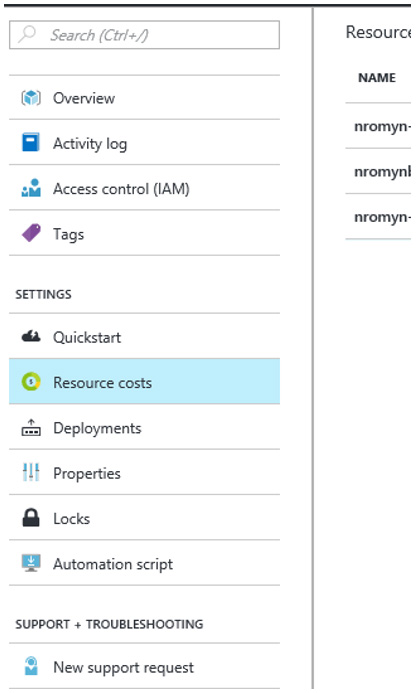
In an enterprise organization, an administrator wants to create resource groups for each department rather than creating resource groups for applications. Which Azure service allows the administrator to see the cost of all the resources in a resource group?
Resource costs
By selecting “resource costs,” you can access the comprehensive breakdown of expenses associated with all resources within a resource group. This convenient feature proves particularly beneficial when you aim to accurately allocate costs to specific departments within your organization. Instead of creating resource groups based on applications, certain companies opt to establish department-specific resource groups. For example, having distinct resource groups such as Sales and Marketing or IT Support can greatly assist in cost management and reporting efforts.
What are the maximum limits of services with an Azure Subscription? (Choose three.)
250 Azure storage accounts per region
980 resource groups per subscription across all regions
25,000 virtual machines per region
Azure subscriptions come with specific limits, also known as quotas. These limits define the maximum allowances for various resources within each subscription. For instance, with a single subscription, you can have a maximum of 250 Azure storage accounts per region, 25,000 virtual machines per region, and 980 resource groups across all regions. These limits ensure efficient resource management and allocation within your Azure environment.
Contoso Construction Inc. wants to move its services to the cloud but needs a private on-premises network that is connected securely to the public cloud network. Which Microsoft Azure services can offer a secure hybrid cloud model with the required security features? (Choose three.)
Virtual networks, Express Routes, Hybrid connections