Humerus
 Call Kai
 Learn
Learn Practice Test
 Spaced Repetition
 Match
Match Flashcards
 Knowt Play
1/38

There's no tags or description
Looks like no tags are added yet.
Name | Mastery | Learn | Test | Matching | Spaced | Call with Kai | Chat |
|---|
No analytics yet
Send a link to your students to track their progress
39 Terms
What is the humerus?
The largest bone of the upper limb.
Which bones does the humerus articulate with?
Scapula (proximally)
Radius (distally)
Ulna (distally)
Which joints does the humerus participate in?
Glenohumeral (shoulder) joint
Elbow joint
Which part of the humerus articulates with the scapula?
The head of the humerus.
Which part of the scapula articulates with the humeral head?
The glenoid cavity.
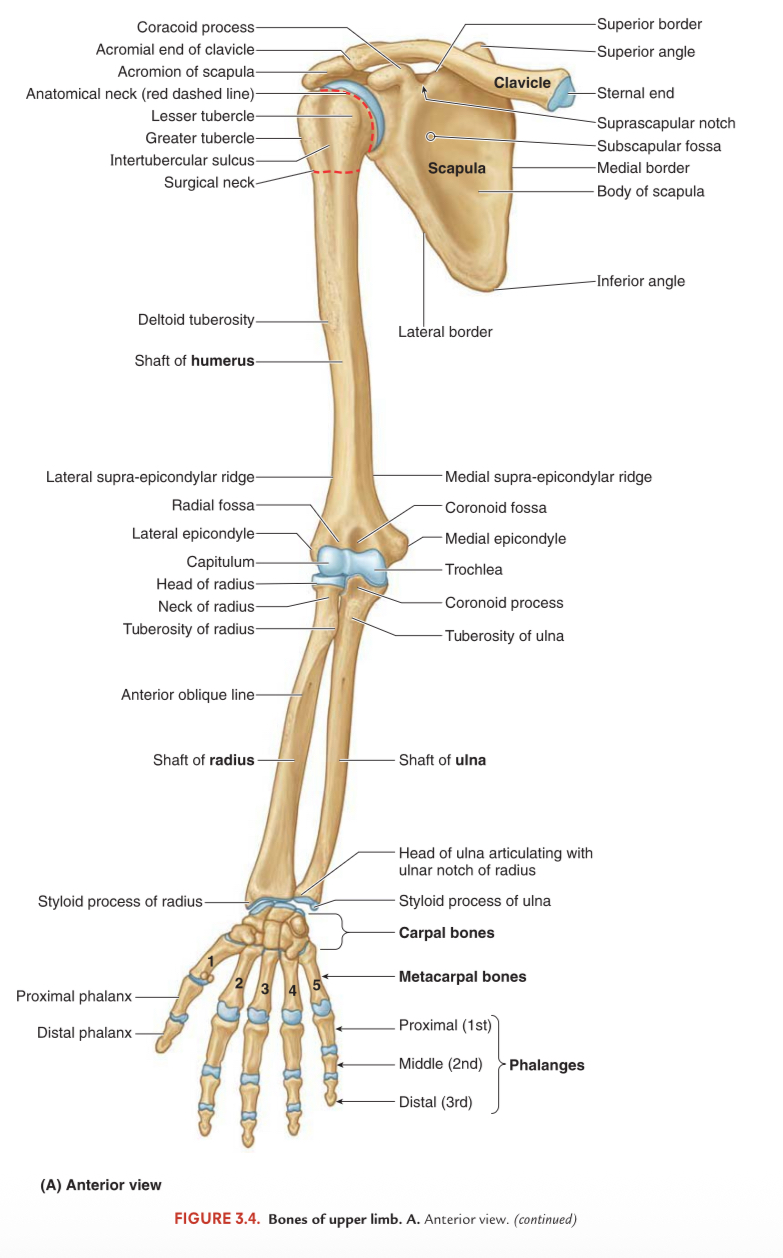
What is the anatomical neck of the humerus?
The groove immediately surrounding the head that separates it from the tubercles.
What is the surgical neck of the humerus?
The narrowed region just distal to the greater and lesser tubercles.
It is a common fracture site.
Which tubercles are found on the proximal humerus?
Greater tubercle
Lesser tubercle
What separates the greater and lesser tubercles?
The intertubercular sulcus
What is another name for the intertubercular sulcus?
The bicipital groove.
Name the two prominent landmarks on the shaft of the humerus.
Deltoid tuberosity
Radial groove
What attaches to the deltoid tuberosity?
The deltoid muscle.
What structures pass through the radial groove?
Radial nerve
Profunda brachii artery
Where is the radial groove located?
On the posterior aspect of the humeral shaft.
What is the condyle of the humerus?
The distal articular part of the humerus consisting of:
Capitulum
Trochlea
Associated fossae
What are the two articular surfaces of the distal humerus?
Capitulum
Trochlea
Which forearm bone articulates with the capitulum?
The radius.
Which forearm bone articulates with the trochlea?
The ulna.
Capitulum vs trochlea
Capitulum
→ Radius
Trochlea
→ Ulna
Which prominent projections are found at the distal humerus?
Medial epicondyle
Lateral epicondyle
What are the supracondylar (supra-epicondylar) ridges?
Sharp ridges proximal to the medial and lateral epicondyles.
Where is the coronoid fossa located?
Anteriorly, above the trochlea.
What enters the coronoid fossa during elbow flexion?
The coronoid process of the ulna.
Where is the radial fossa located?
Anteriorly, above the capitulum.
What enters the radial fossa during elbow flexion?
The head of the radius.
Where is the olecranon fossa located?
Posteriorly, above the trochlea.
What enters the olecranon fossa during elbow extension?
The olecranon of the ulna.
Match each fossa with the structure it receives:
Coronoid
Radial
Olecranon
Fossa | Receives |
Coronoid | Coronoid process |
Radial | Head of radius |
Olecranon | Olecranon |
Which nerve is commonly injured in fractures of the surgical neck?
The axillary nerve.
Which artery accompanies the axillary nerve around the surgical neck?
The anterior and posterior circumflex humeral arteries.
Which nerve is commonly injured in fractures involving the radial groove?
The radial nerve.
Which artery accompanies the radial nerve in the radial groove?
The profunda brachii artery.
Which nerve is commonly injured in supracondylar fractures?
The median nerve.
Which nerve is at risk in fractures of the medial epicondyle?
The ulnar nerve.
Match each fracture site with the nerve most at risk:
Surgical neck
Radial groove
Supracondylar
Medial epicondyle
Fracture | Nerve |
Surgical neck | Axillary |
Radial groove | Radial |
Supracondylar | Median |
Medial epicondyle | Ulnar |
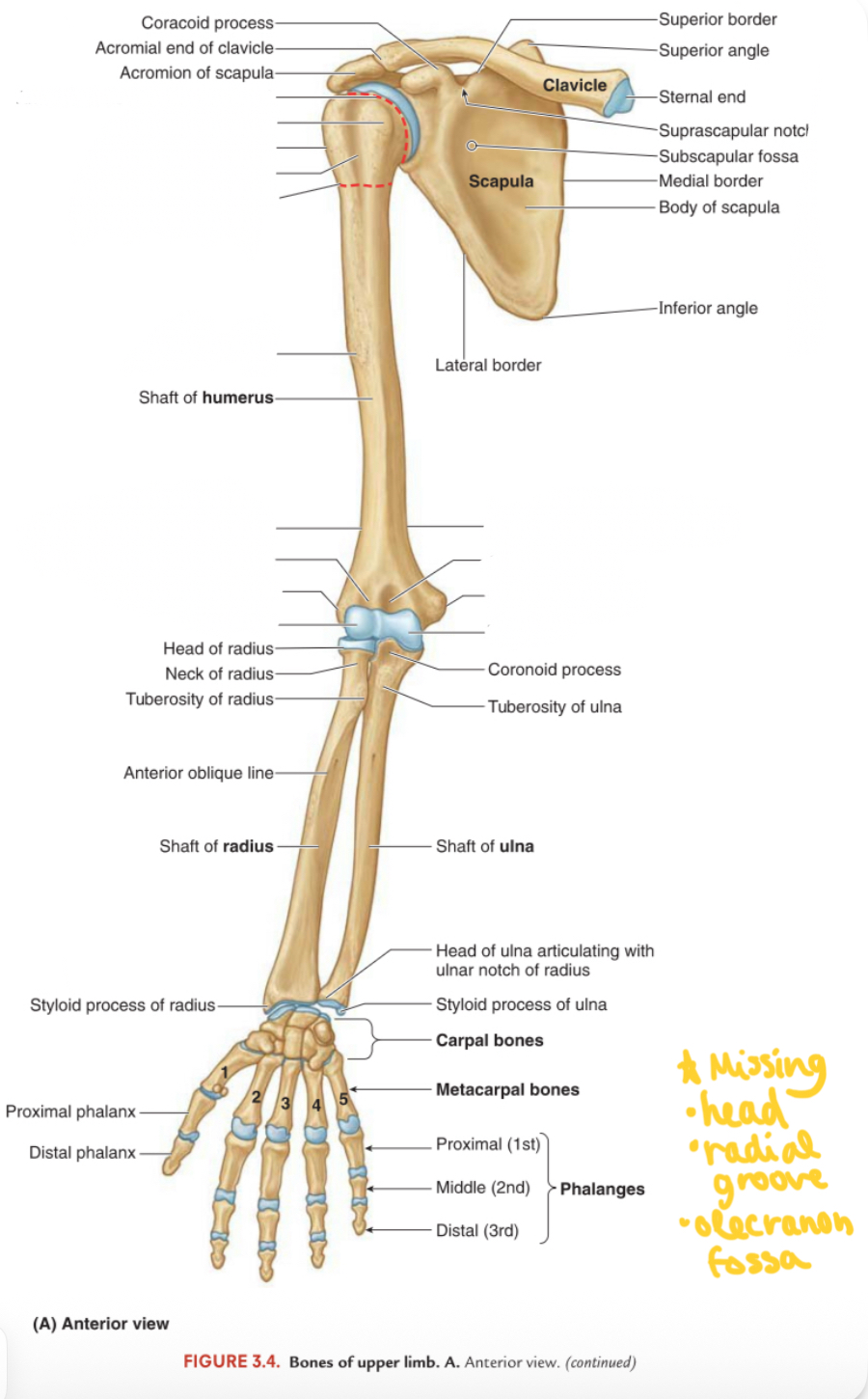
Label

Label the nerves

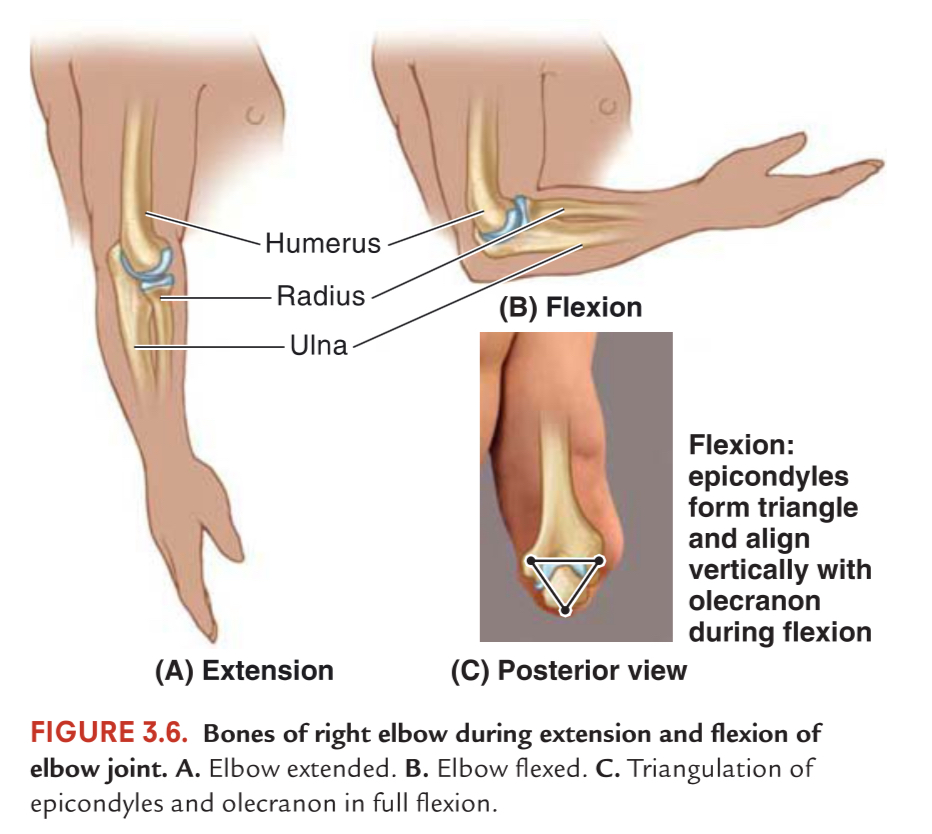
What is the relationship between the olecranon and epicondyles in different elbow positions?
Extension: Olecranon and epicondyles lie in a straight line.
Flexion: Olecranon forms the apex of a triangle with the medial and lateral epicondyles.
Match each humeral landmark with its function or articulation:
Head
Greater & lesser tubercles
Intertubercular sulcus
Deltoid tuberosity
Radial groove
Capitulum
Trochlea
Coronoid fossa
Radial fossa
Olecranon fossa
Landmark | Function / Articulation |
Head | Articulates with glenoid cavity |
Greater & lesser tubercles | Muscle attachment sites |
Intertubercular sulcus | Passage of the tendon of the long head of biceps brachii |
Deltoid tuberosity | Deltoid muscle attachment |
Radial groove | Radial nerve & profunda brachii artery |
Capitulum | Articulates with radius |
Trochlea | Articulates with ulna |
Coronoid fossa | Receives coronoid process |
Radial fossa | Receives head of radius |
Olecranon fossa | Receives olecranon |