Bis 2B Lecture 4 Week 1
 Call Kai
 Learn
Learn Practice Test
 Spaced Repetition
 Match
Match Flashcards
 Knowt Play
1/23

There's no tags or description
Looks like no tags are added yet.
Name | Mastery | Learn | Test | Matching | Spaced | Call with Kai |
|---|
No analytics yet
Send a link to your students to track their progress
24 Terms
What is the fundamental premise of the principle of allocation?
All life functions cannot be simultaneously maximized. Energy and resources allocated to one function are unavailable to other functions.
Optimal Foraging
Predators will choose food items that maximize the ration of energy reards to operational costs.
What is the reward and cost of foraging choices?
Rewards: Total energy/caloric content of the prey.
Costs: handling time
What physiological trade-off is illustrated in this week’s lecture?
The cheetah is super fast but cannot maintain that speed for too long, only for a minute. It needs 15 minutes to recover.
Why do aquatic organisms like algae rely heavily on water flow for nutrient uptake?
Algae lack roots, relying on water flow to continuously replenish depleted nutrients along their cellular surfaces.
What is the morphological trade-off found in the sea palm?
It has broad blades flap in currens to increase nutrient delivery, but a stream-lined blade experiences 4x less nutrient uptake. However, broad blades dramatically increase the risk of being dislodged by waves.
What is an ecological trade-off?
The relationship between the benefits of a trait in one context and its operational costs in another context.
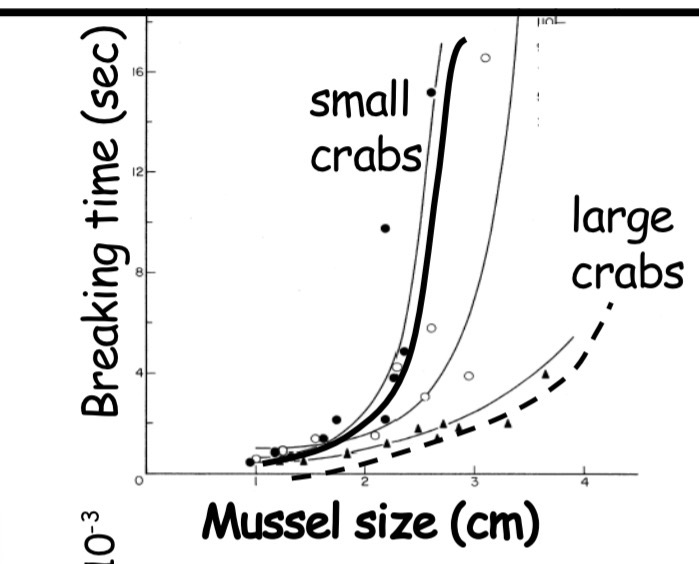
What does this graph read as:
The smaller crabs go for the smaller mussels, breaking time in less time. While large crabs go for bigger muscles, breaking in more time.
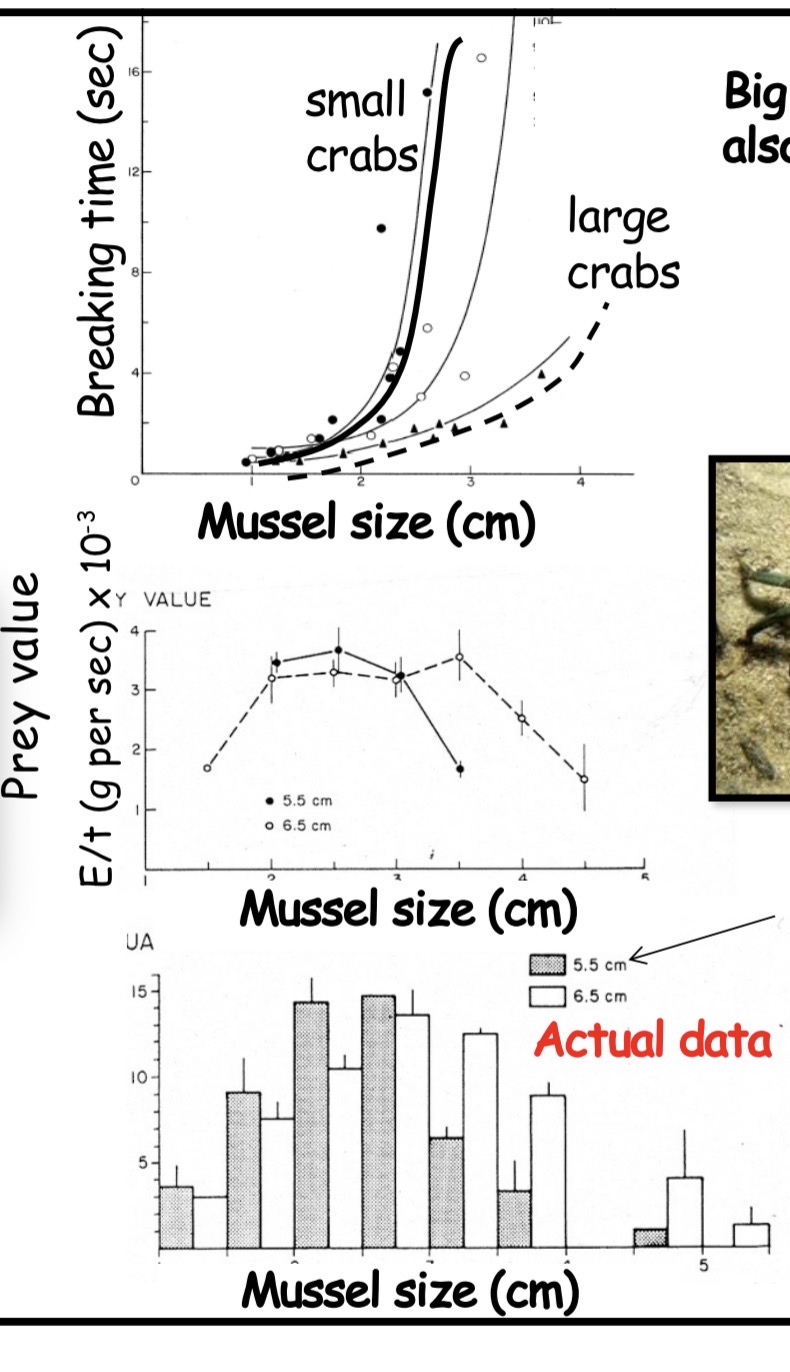
What can we take away?
1) Intermediate sized mussels are preferred by crabs
2) Larger crabs prefer larger mussels.
Physiological stress in an ecological context
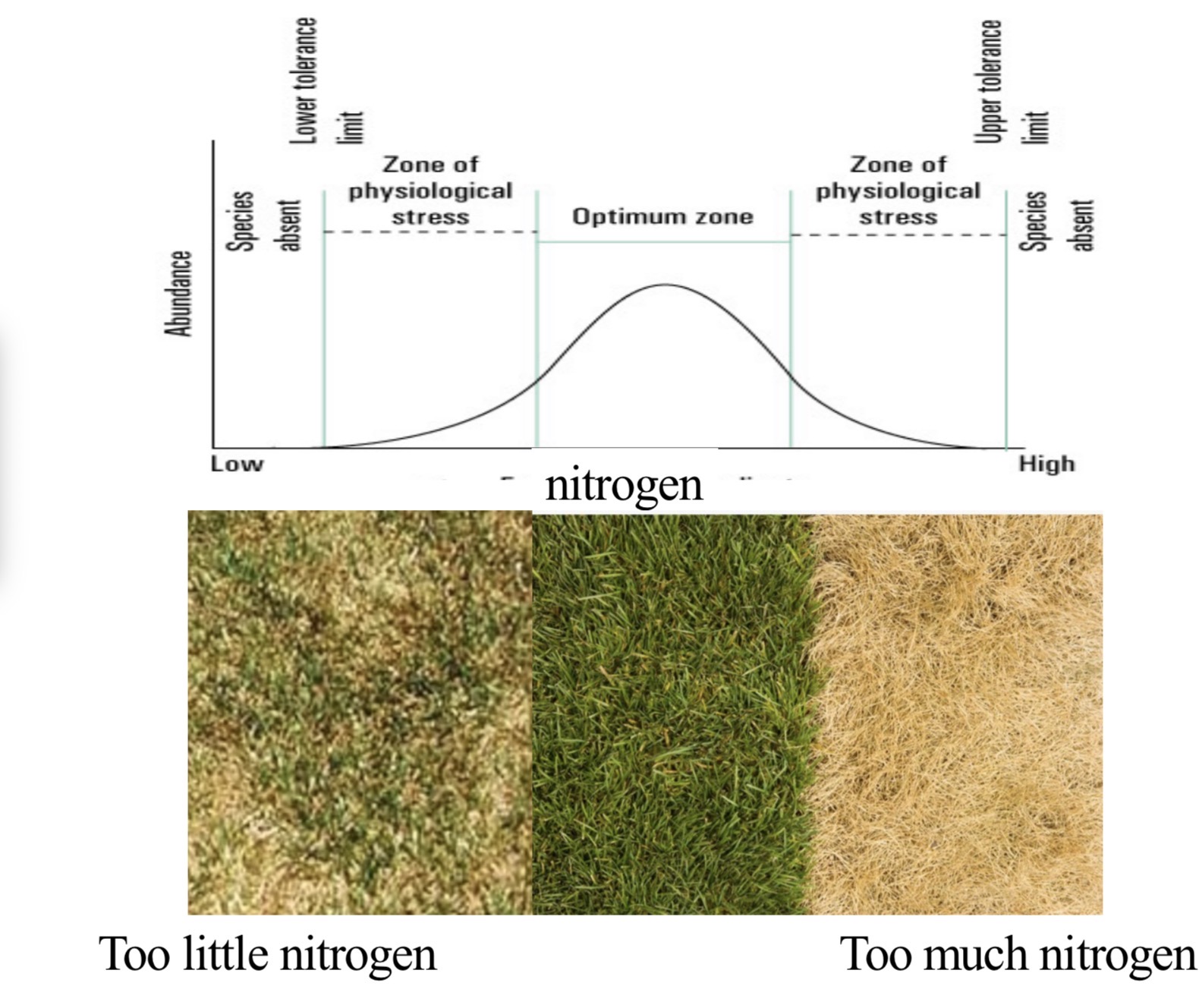
Environmental conditions that fall outside of an organism’s normal “optimum zone”, reducing its performance or abundance.
List 5 common examples of environmental stress vectors:
1) Temperature
2) Water availability
3) Water salinity
4) pH
5) Nutrient levels
What is the layout of a classic tolerance curve along an environmental gradient
What is an endotherm?
Generate body heat as an internal by-product of metabolic activity.
What is an ectotherm
Body heat is determined primarily by te temperature of the surrounding environment.
What is acclimation
A reversible phenotypic change within a single individual’s lifespan, allowing it to perform better under shifting environmental conditions.
What is adaptation?
An evolutionary, genetic change in a population’s genotype that maximizes performance across several generations.
acclimation or adaptation: progressive weightlifting puts stress on muscle fibers, causing them to undergo hypertrophy (enlargement).
Acclimation
acclimation or adaptation: after years of hawks hunting on brown mice, colors of mice began to change to blend into their surroundings
adaptation
acclimation or adaptation: plants wilting to lower total exposed leaf surface area to minimize solar heat gain, closing their stoma to temporary water stress
acclimation
What is a fundamental niche of an organism
the entire set of environmental conditions under which a species can successfully survive, grow, and reproduce in the absence of negative species interactions
Probability of predation =
detection x capture x consumption
What is detection?
The sensory process where a predator identifies the presence of prey using sigh, sound, or smell.
What is capture?
The physical act of pursuing, subduing, and securing the prey.
What is consumption?
The final step of eating and digesting the captured prey for energy.