A) LECTURE CH1 CARDS
 Call Kai
 Learn
Learn Practice Test
 Spaced Repetition
 Match
Match Flashcards
 Knowt Play
1/172

There's no tags or description
Looks like no tags are added yet.
Name | Mastery | Learn | Test | Matching | Spaced | Call with Kai | Chat |
|---|
No analytics yet
Send a link to your students to track their progress
173 Terms
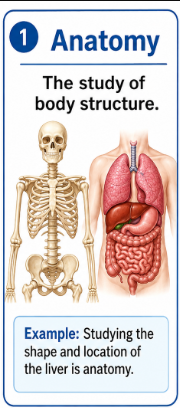
Anatomy
The study of body structure and what body parts look like or where they are located.
Example: Studying the shape and location of the liver is anatomy.
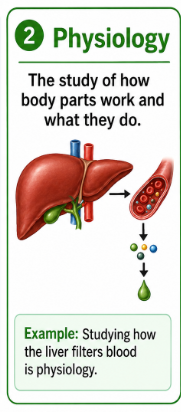
Physiology
The study of how body parts work and what they do.
Example: Studying how the liver filters blood is physiology.
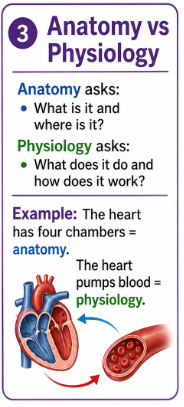
Anatomy vs Physiology
Anatomy asks: What is it and where is it?
Physiology asks: What does it do and how does it work?
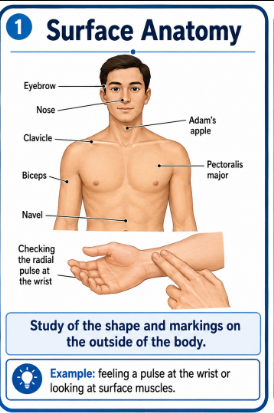
Surface Anatomy
Study of the shape and marks on the outside of the body.
Example: Looking at the muscles you can see under the skin or feeling a pulse at the wrist.
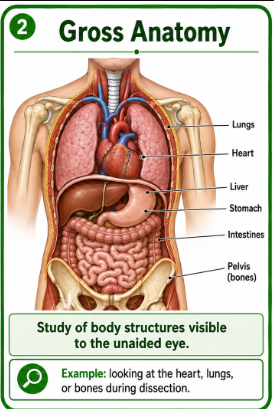
Gross Anatomy
Study of body parts that you can see without a microscope.
Example: Looking at the heart, lungs, or bones during a body dissection.
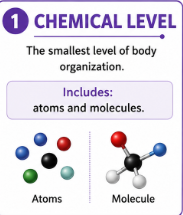
Chemical Level
The smallest level of body organization. It includes atoms and molecules.
Example: Carbon atoms and water molecules are part of the chemical level.
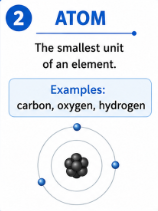
Atom
The smallest unit of an element.
Example: Carbon, oxygen, and hydrogen are atoms found in the body.
Molecule
Two or more atoms joined together.
Example: Water, H₂O, is a molecule.

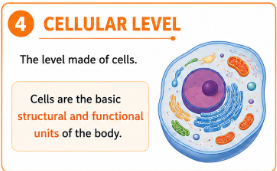
Cellular Level
The level made of cells. Cells are the basic structural and functional units of the body.
Example: A muscle cell is part of the cellular level.
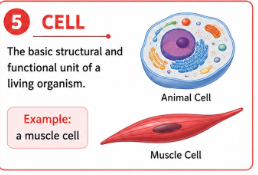
Cell
The basic structural and functional unit of a living organism.
Example: Muscle cells can contract to help create movement.
Tissue Level
A group of similar cells working together to do a job.
Example: Muscle tissue is made of muscle cells working together.

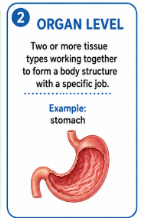
Organ Level
Two or more tissue types working together to form a body structure with a specific job.
Example: The stomach is an organ made of several types of tissue.
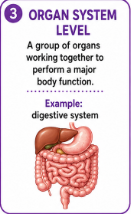
Organ System Level
A group of organs working together to perform a major body function.
Example: The stomach and intestines work together in the digestive system.
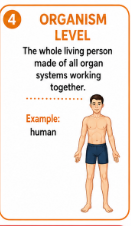
Organism Level
The whole living person made of all the organ systems working together.
Example: The entire human body is an organism.
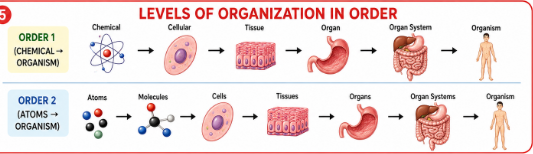
Levels of Organization: Smallest to Largest
Chemical → Cellular → Tissue → Organ → Organ System → Organism
Tissue
A group of similar cells that work together to do a job.
Example: Muscle cells work together to form muscle tissue.
Organ
A body part made of two or more types of tissue that work together for a certain job.
Example: The stomach is an organ made of several types of tissue.
Organ System
A group of organs that work together to do a major body job.
Example: The stomach and intestines work together in the digestive system.
Organism
A whole living thing made of all the organ systems working together.
Example: A human is an organism
Digestive System
Breaks down food, takes in nutrients, and gets rid of solid waste.
Example: The stomach and intestines are part of the digestive system.
Cardiovascular System
Moves blood, oxygen, nutrients, and wastes around the body.
Example: The heart pumps blood through blood vessels.
Respiratory System
Brings oxygen into the body and removes carbon dioxide.
Example: The lungs take in oxygen and remove carbon dioxide.
Urinary System
Removes wastes and extra water and ions from the blood.
Example: The kidneys make urine.
Integumentary System
Protects the body from the outside environment.
Example: The skin helps protect the inside of the body.
Homeostasis
Keeping the inside of the body within a stable range.
Example: The body keeps its temperature near a normal level.
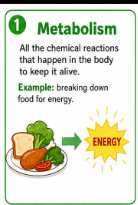
Metabolism
All the chemical reactions that happen in the body to keep it alive.
Example: Breaking down food for energy is part of metabolism
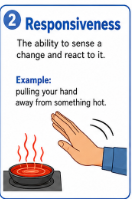
Responsiveness
The ability to sense a change and react to it.
Example: Pulling your hand away from something hot is responsiveness.
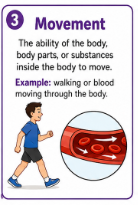
Movement
The ability of the body, body parts, or substances inside the body to move.
Example: Walking is body movement, while the heart moves blood through the body.
Growth
An increase in the size of the body or one of its parts.
Example: Bones and muscles get larger as a child grows.

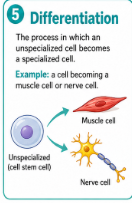
Differentiation
The process in which an unspecialized cell changes into a specialized cell with a certain job.
Example: A developing cell can become a muscle cell or nerve cell.
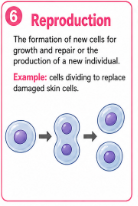
Reproduction
The formation of new cells for growth and repair or the production of a new individual.
Example: Cells divide to replace damaged skin cells.
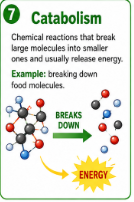
Catabolism
Chemical reactions that break large molecules into smaller ones and usually release energy.
Example: Breaking down food molecules to get energy is catabolism.
Anabolism
Chemical reactions that join smaller molecules to build larger ones and require energy.
Example: Building proteins from amino acids is anabolism.
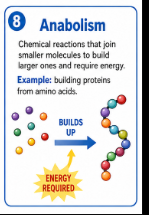
Catabolism vs Anabolism
Catabolism breaks things down and usually releases energy.
Anabolism builds things up and requires energy.
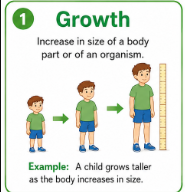
Growth
An increase in the size of the whole body or one of its parts.
Example: Bones and muscles get larger as a child grows.
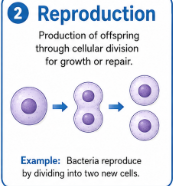
Reproduction
The production of new cells for growth and repair, or the production of a new individual.
Example: Skin cells divide to replace damaged cells.
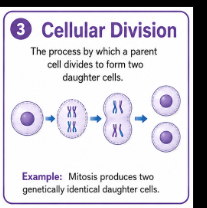
Cellular Division
The process where one cell divides to form new cells.
Example: Cell division helps the body grow and repair damaged tissue.
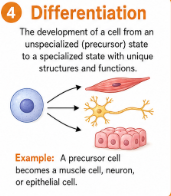
Differentiation
The process where an unspecialized cell develops into a specialized cell with a certain structure and job.
Example: An unspecialized cell can become a muscle cell or nerve cell.
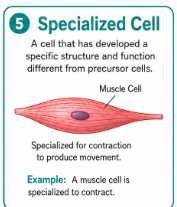
Specialized Cell
A cell that has developed a certain structure so it can perform a certain job.
Example: A muscle cell is specialized to contract.
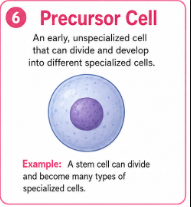
Precursor Cell
An early cell that can develop into a more specialized type of cell.
Example: A precursor cell may later become a muscle or nerve cell.
Human survival needs
The basic things the human body needs to stay alive.
They include nutrients, oxygen, water, normal body temperature, and proper atmospheric pressure.

Nutrients
Chemicals the body needs for energy, growth, repair, and building cells.
Example: Carbohydrates, fats, proteins, vitamins, and minerals are nutrients.

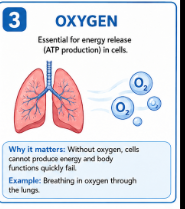
Oxygen
A gas needed by cells to release energy from food and make ATP.
Example: Oxygen from the lungs is carried by the blood to body cells.
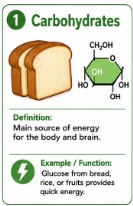
Carbohydrates
Nutrients that are an important source of energy for the body.
Example: The body can break down glucose from carbohydrates for energy.
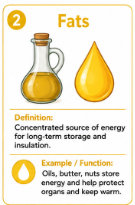
Fats
Nutrients that store energy and help build parts of cells.
Example: The body can store fat as an energy reserve.
Proteins
Nutrients used to build and repair body structures and make many important molecules.
Example: Muscles contain large amounts of protein.

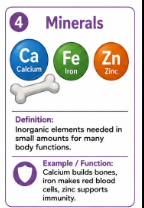
Minerals
Inorganic nutrients needed for many body functions and structures.
Example: Calcium helps build bones.
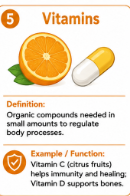
Vitamins
Organic nutrients needed in small amounts to help normal body processes work.
Example: Vitamin D helps the body use calcium.
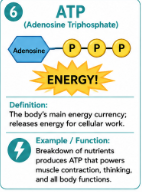
ATP
The main form of usable energy for cells.
Example: Cells use oxygen and nutrients to help make ATP.
Water
The most abundant chemical in the body and the place where many chemical reactions occur.
Example: Water is found inside cells and in body fluids.

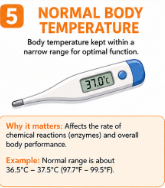
Normal Body Temperature
A body temperature range that allows chemical reactions and enzymes to work properly.
Example: A large change in body temperature can change the speed of chemical reactions.
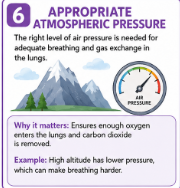
Appropriate Atmospheric Pressure
Enough air pressure for normal breathing and gas exchange in the lungs.
Example: Very low air pressure at high altitude can make it harder for the body to get oxygen.
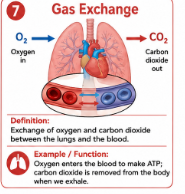
Gas Exchange
The movement of oxygen into the blood and carbon dioxide out of the blood.
Example: Gas exchange happens in the lungs.
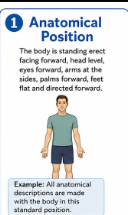
Anatomical Position
The standard body position used when describing anatomy. The person stands upright, faces forward, keeps the head and eyes forward, feet flat and pointing forward, arms at the sides, and palms facing forward.
Example: Anatomical directions are always based on this position.
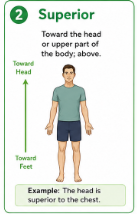
Superior
Toward the head or above another body part.
Example: The chest is superior to the stomach.
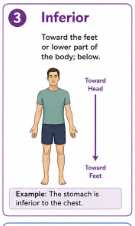
Inferior
Toward the feet or below another body part.
Example: The stomach is inferior to the heart.
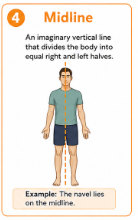
Midline
An imaginary line that divides the body into right and left sides.
Example: The nose lies near the body's midline.
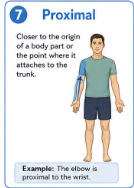
Proximal
Closer to the trunk or to where a limb attaches to the body.
Example: The elbow is proximal to the wrist.
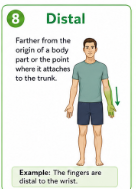
Distal
Farther from the trunk or from where a limb attaches to the body.
Example: The fingers are distal to the elbow.
What are the five basic human survival needs?
Nutrients
Oxygen
Water
Normal body temperature
Appropriate atmospheric pressure
Anterior
Toward the front of the body.
Example: The sternum is anterior to the heart.

Ventral
Toward the front or belly side of the body.
Example: The belly button is on the ventral side of the body.

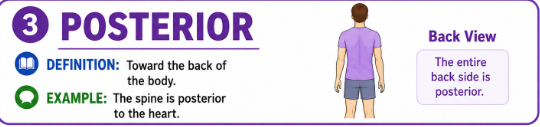
Posterior
Toward the back of the body.
Example: The spine is posterior to the heart.
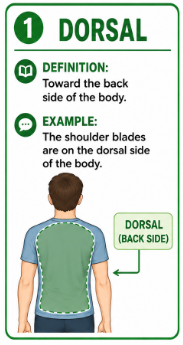
Dorsal
Toward the back side of the body.
Example: The shoulder blades are on the dorsal side of the body.
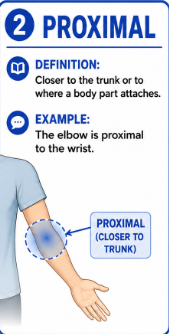
Proximal
Closer to the trunk or closer to where a body part begins or attaches.
Example: The elbow is proximal to the wrist.
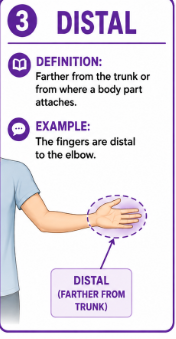
Distal
Farther from the trunk or farther from where a body part begins or attaches.
Example: The fingers are distal to the elbow.
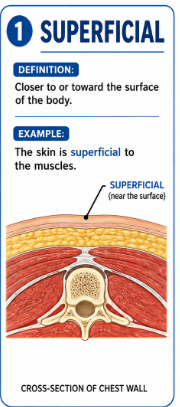
Superficial
Closer to or toward the surface of the body.
Example: The skin is superficial to the muscles.
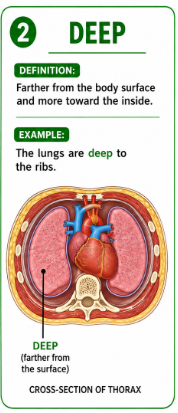
Deep
Farther from the body surface and more toward the inside of the body.
Example: The lungs are deep to the ribs.
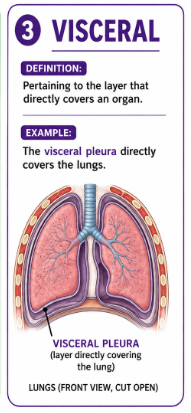
Visceral
Pertaining to the layer that directly covers an organ.
Example: The visceral pleura directly covers the lungs.
Easy idea: visceral touches the organ.
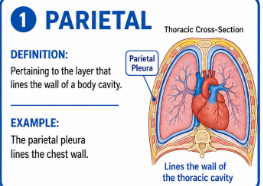
Parietal
Pertaining to the layer that lines the wall of a body cavity.
Example: The parietal pleura lines the inside of the chest wall.
Visceral vs Parietal
Visceral covers the organ.
Parietal lines the cavity wall.
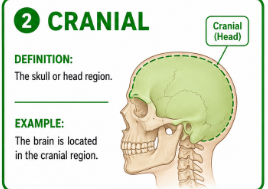
Cranial
The skull or head region.
Example: The brain is located in the cranial region.
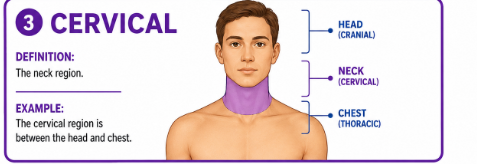
Cervical
The neck region.
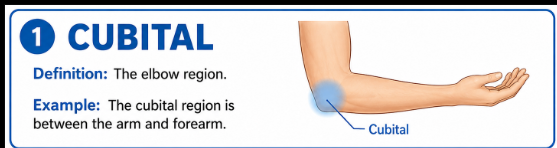
Cubital
The elbow region.
Carpal
The wrist region.

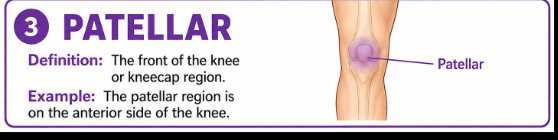
Patellar
The front of the knee or kneecap region.
Example: The patellar region is on the anterior side of the knee.
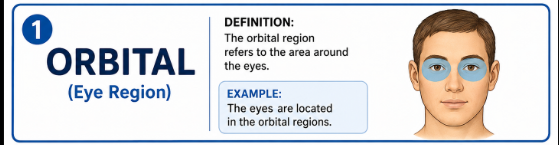
Orbital
The eye region.
Example: The eyes are located in the orbital regions.
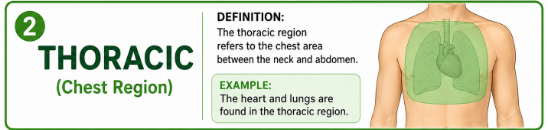
Thoracic
The chest region.
Inguinal
The groin region where the thigh meets the trunk.

Anterior vs Posterior
Anterior means toward the front.
Posterior means toward the back.
Proximal vs Distal
Proximal means closer to where a limb attaches to the body.
Distal means farther from where the limb attaches.
Superficial vs Deep
Superficial means closer to the body surface.
Deep means farther inside the body.
Body Plane
An imaginary flat surface used to divide the body or an organ into sections.
Example: A transverse plane can divide the body into upper and lower parts.
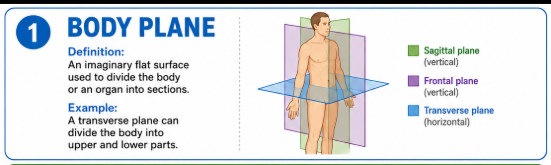
Sagittal Plane
A vertical plane that divides the body into right and left parts.
Example: A sagittal section of the brain shows structures from the side.

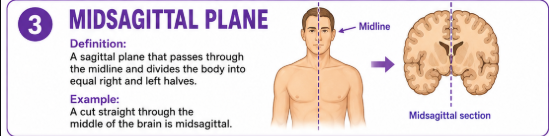
Midsagittal Plane
A sagittal plane that passes directly through the midline and divides the body into equal right and left halves.
Example: A cut straight through the middle of the brain is midsagittal.
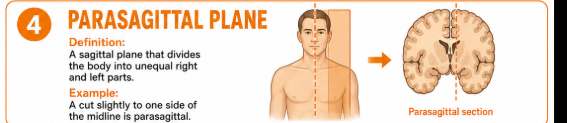
Parasagittal Plane
A sagittal plane that divides the body into unequal right and left parts.
Example: A cut slightly to one side of the midline is parasagittal.
Transverse Plane
A horizontal plane that divides the body into upper and lower parts.
Example: A horizontal slice through the abdomen is a transverse section.
Frontal Plane

Frontal Plane
A vertical plane that divides the body into front and back parts.
Example: A frontal section of the brain separates anterior and posterior portions.

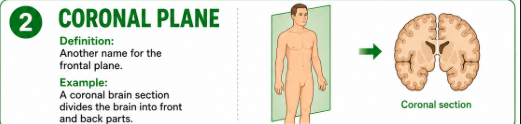
Coronal Plane
Another name for the frontal plane.
Example: A coronal brain section divides the brain into front and back parts.
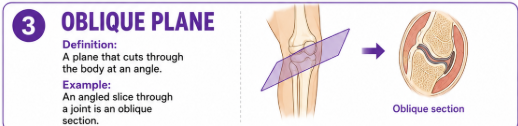
Oblique Plane
A plane that cuts through the body at an angle.
Example: An angled slice through a joint is an oblique section.
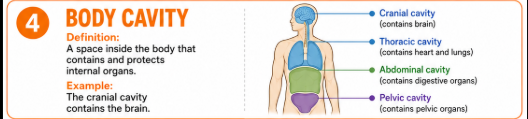
Body Cavity
A space inside the body that contains and protects internal organs.
Example: The cranial cavity contains the brain.
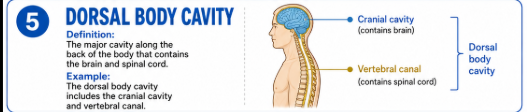
Dorsal Body Cavity
The major cavity along the back of the body that contains the brain and spinal cord.
It includes the cranial cavity and vertebral canal.
Ventral Body Cavity
The major cavity on the front side of the body that contains most internal organs.
It includes the thoracic and abdominopelvic cavities.

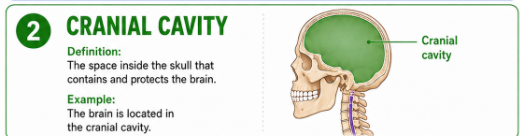
Cranial Cavity
The space inside the skull that contains and protects the brain.
Example: The brain is located in the cranial cavity.
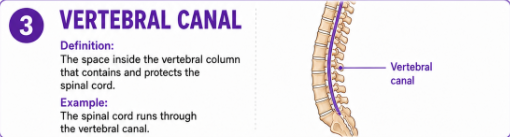
Vertebral Canal
The space inside the vertebral column that contains and protects the spinal cord.
Example: The spinal cord runs through the vertebral canal.
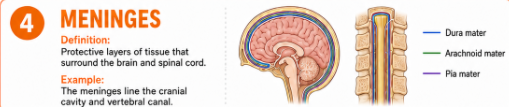
Meninges
Protective layers of tissue that surround the brain and spinal cord.
Example: The meninges line the cranial cavity and vertebral canal.
Thoracic Cavity
The chest cavity located above the diaphragm. It contains structures such as the heart and lungs.
Example: The lungs are located in the thoracic cavity.

Diaphragm
A large muscle that separates the thoracic cavity from the abdominopelvic cavity and helps with breathing.
Example: The diaphragm moves downward when you breathe in.

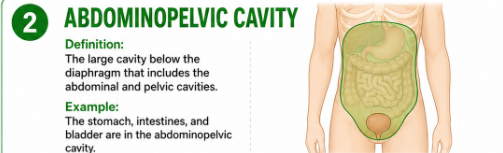
Abdominopelvic Cavity
The large cavity below the diaphragm that includes the abdominal and pelvic cavities.
Example: The stomach, intestines, and bladder are in the abdominopelvic cavity.
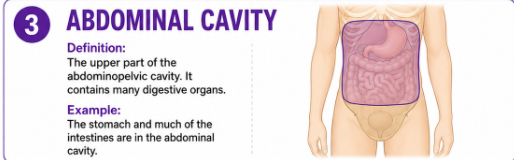
Abdominal Cavity
The upper part of the abdominopelvic cavity. It contains many digestive organs.
Example: The stomach and much of the intestines are in the abdominal cavity.