Physics T3 2026
 Call Kai
 Learn
Learn Practice Test
 Spaced Repetition
 Match
Match Flashcards
 Knowt Play
1/23

There's no tags or description
Looks like no tags are added yet.
Name | Mastery | Learn | Test | Matching | Spaced | Call with Kai | Chat |
|---|
No analytics yet
Send a link to your students to track their progress
24 Terms
Waves transfer___
Energy
Distinguish between mechanical and electromagnetic waves
Mechanical waves need a medium, can be transverse or longitudinal and are caused by particles of a medium oscillating, whereas electromagnetic waves do not need a medium, are always transverse and are caused by oscillations in electrical and magnetic fields.
Compare transverse and longitudinal waves
Both kinds of waves are methods of energy transfer, however, transverse waves have particle movement perpendicular to the direction of propagation of the wave, whereas longitudinal waves have particle movement parallel to the direction of propagation of the wave.
Compare mechanical and electromagnetic waves.
Both kinds of waves are methods of energy transfer, however, mechanical waves require a medium for propagation, whereas electromagnetic waves do not. Also, electromagnetic waves are always transverse, whereas mechanical waves may either be transverse or longitudinal.
3 examples of longitudinal waves
Sound waves, seismic P-waves, compression waves in a spring
3 examples of transverse waves
Electromagnetic waves, vibrations in a string, seismic S-waves
compression, rarefaction, crest, trough, displacement, amplitude, period, frequency, wavelength, and velocity on diagram
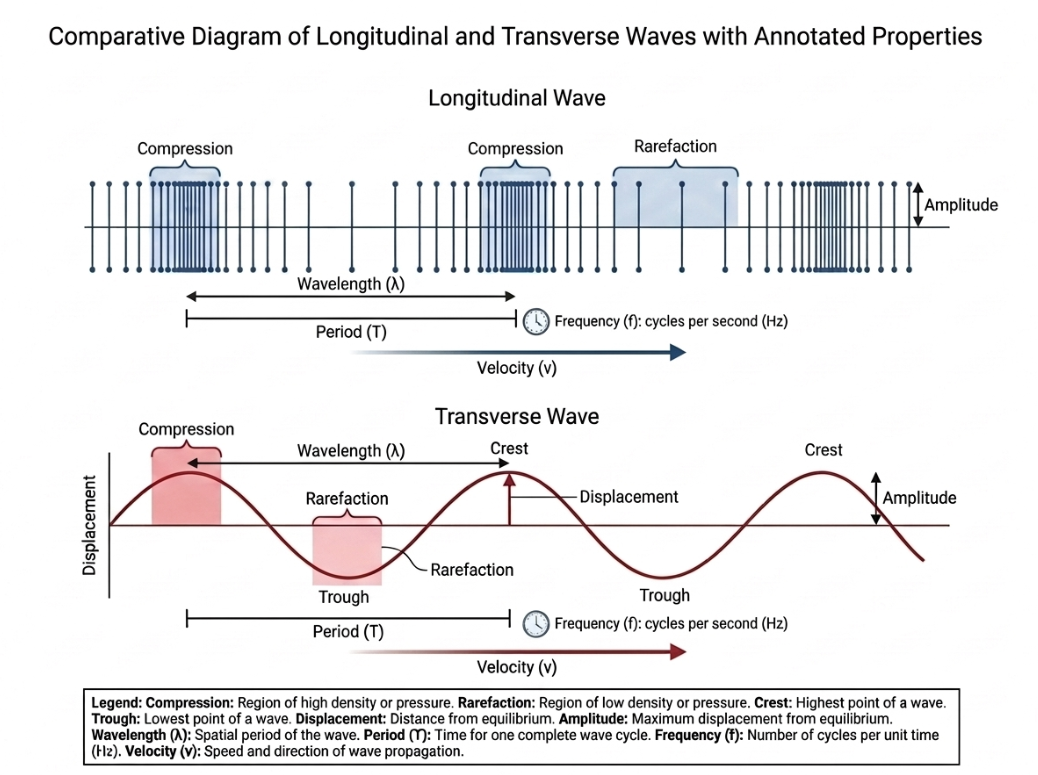
Compression
Region where particles are close together in a longitudinal wave
Rarefaction
Region where particles are spread apart in a longitudinal wave
Crest
Highest point of a transverse wave
Trough
Lowest point of a transverse wave
Displacement
Distance of a particle from its equilibrium position
Amplitude
Maximum displacement from the equilibrium position
Period
Time taken for one complete wave cycle
Frequency
Number of complete wave cycles per second
Wavelength
Distance between two consecutive identical points on a wave
Wave velocity
Speed at which a wave travels
The sun is a source of ___
white light