NCLEX Hurst Resources Notes
 Call Kai
 Learn
Learn Practice Test
 Spaced Repetition
 Match
Match Flashcards
 Knowt Play
1/176

There's no tags or description
Looks like no tags are added yet.
Name | Mastery | Learn | Test | Matching | Spaced | Call with Kai | Chat |
|---|
No analytics yet
Send a link to your students to track their progress
177 Terms
What is required for high-alert medications?
What are the top 5 high-alert medications and their routes of administration?
An independent double-check is required for high-alert medications—Another licensed nurse will perform a second check to identify the medication, dose, and route to be administered
Insulin – subcutaneous and IV
Opiates and Narcotics – IV, transdermal, oral
Injectable Potassium Chloride or Phosphate Concentrate
Intravenous Anticoagulants (Heparin)
Sodium Chloride Solutions above 0.9% concentration
What can be used in conjunction with the administration of blood and blood products?
What do all blood products require?
What should be completed prior to blood product administration?
What verifications must be made before administration?
Only NS may be used in conjunction with administering blood and blood products
All blood products require: A filter
Set of baseline VS b/f administering the blood + each client must have a type and screen and crossmatch in the lab prior to obtaining a blood product (each type and screen is only good for 72 hr)
A designated person in the blood bank verifies with the RN, and the RN verifies with another RN at the bedside.
The following verifications must be made:
The client’s name, date of birth, blood bank number, unit number, expiration date of unit of blood or blood product, blood type and group, primary healthcare provider’s prescription
How quickly should an infusion of blood be started after receiving it from the blood bank?
How quickly must blood products be completed?
W/in 30 minutes of receiving the blood from the blood bank
All blood from each unit must be completed within a 4 hour time frame. If the unit of blood is not completed in a 4 hour time frame the blood must be discarded
During what time period of a blood product administration is a patient most likely to have a transfusion reaction?
List s/s of a transfusion reaction
Transfusion reaction is most likely to occur w/in the 1st 15 minutes of the infusion, so the client needs to be observed closely, especially for the 1st 15 minutes—if no reaction is observed in the 1st 15 minutes, the infusion rate may be increased
S/s:
Chest pain
Hives or skin rash
Hypotension/Hypertension
Fever
Chills
Anxiety
Wheezing
Headache or muscle pain with fever
Flushing
Back pain
Dizziness
Itching
Urticaria
Tachycardia
Tachypnea
Dyspnea
GI symptoms: nausea and vomiting
If an adverse reaction to a blood transfusion occurs, as the nurse you should:
Discontinue the transfusion IMMEDIATELY
Remove blood and blood tubing set.
Check your facility’s policies and procedure manual. You may have to return the blood and tubing to the blood bank
Start normal saline with new primed tubing at keep vein open rate
Check and document vital signs. Stay with client
Notify primary healthcare provider and monitor client closely for anaphylaxis
Notify lab/ blood bank of transfusion reaction
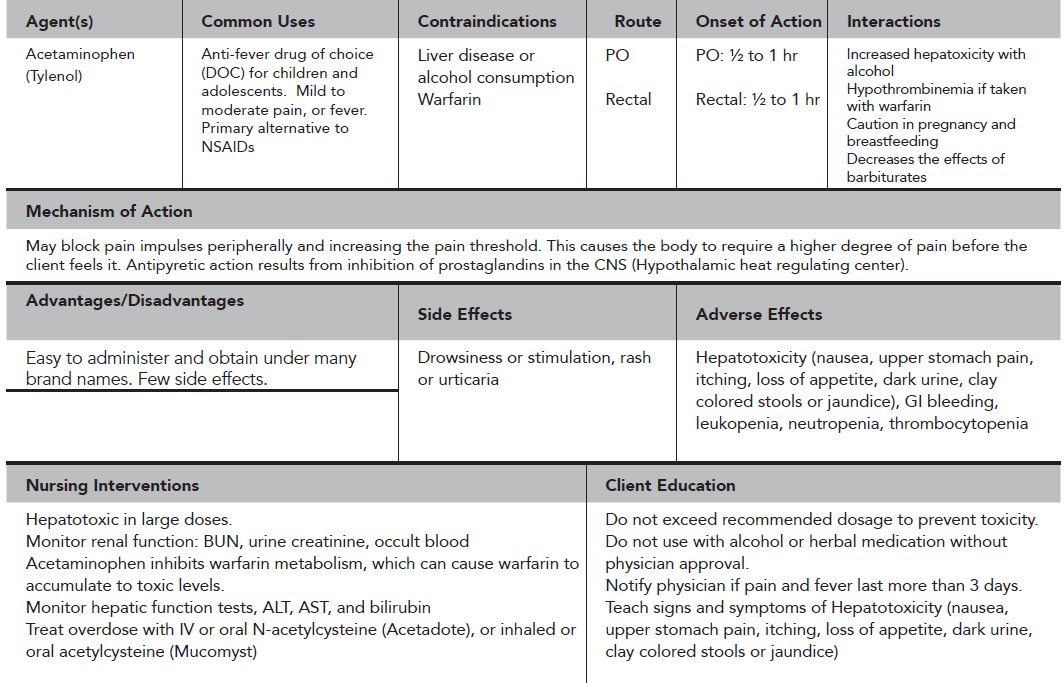
For the analgesic/antipyretic: Acetaminophen
Common uses?
Contraindications?
Routes?
Interactions?
MOA?
Advantages/Disadvantages?
Side effects?
Adverse Effects?
Nursing Interventions?
Client Education?
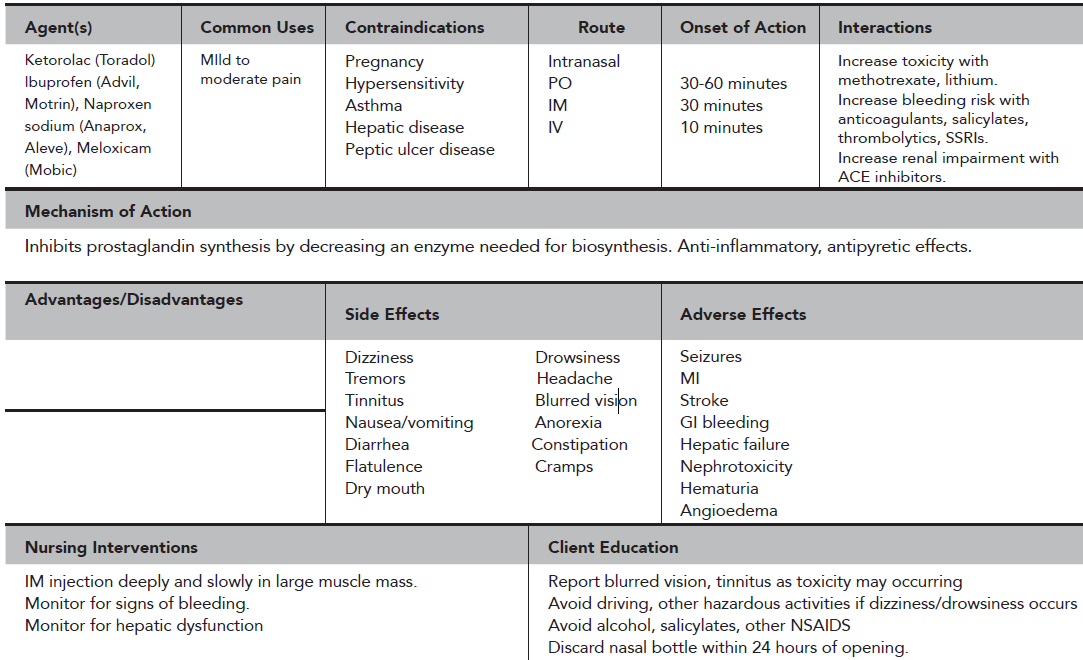
For the pharmacologic class: NSAIDs
List common agents
Common uses?
Contraindications?
Routes?
Interactions?
MOA?
Advantages/Disadvantages?
Side effects?
Adverse Effects?
Nursing Interventions?
Client Education?
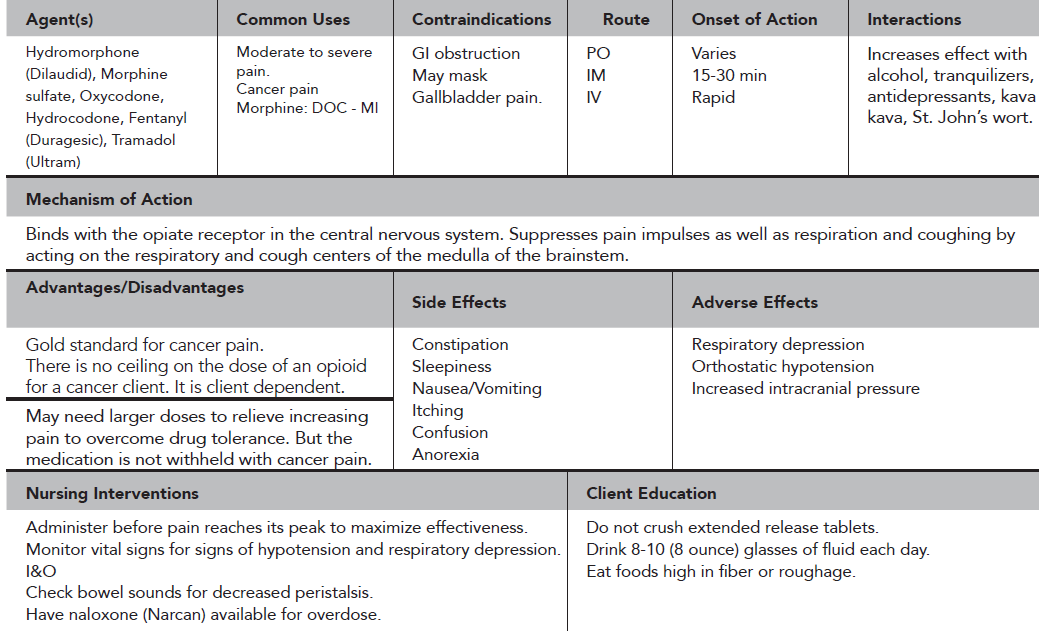
For the pharmacologic class: Opioids
List common agents
Common uses?
Contraindications?
Routes?
Interactions?
MOA?
Advantages/Disadvantages?
Side effects?
Adverse Effects?
Nursing Interventions?
Client Education?
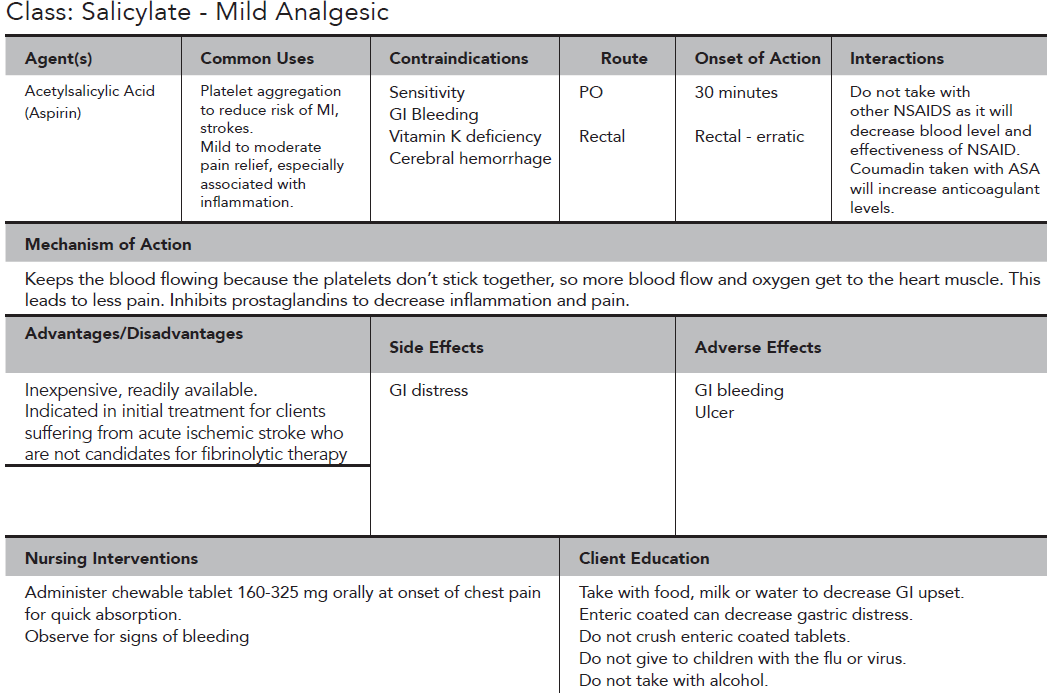
For the pharmacologic class: Salicylate
List common agents
Common uses?
Contraindications?
Routes?
Interactions?
MOA?
Advantages/Disadvantages?
Side effects?
Adverse Effects?
Nursing Interventions?
Client Education?
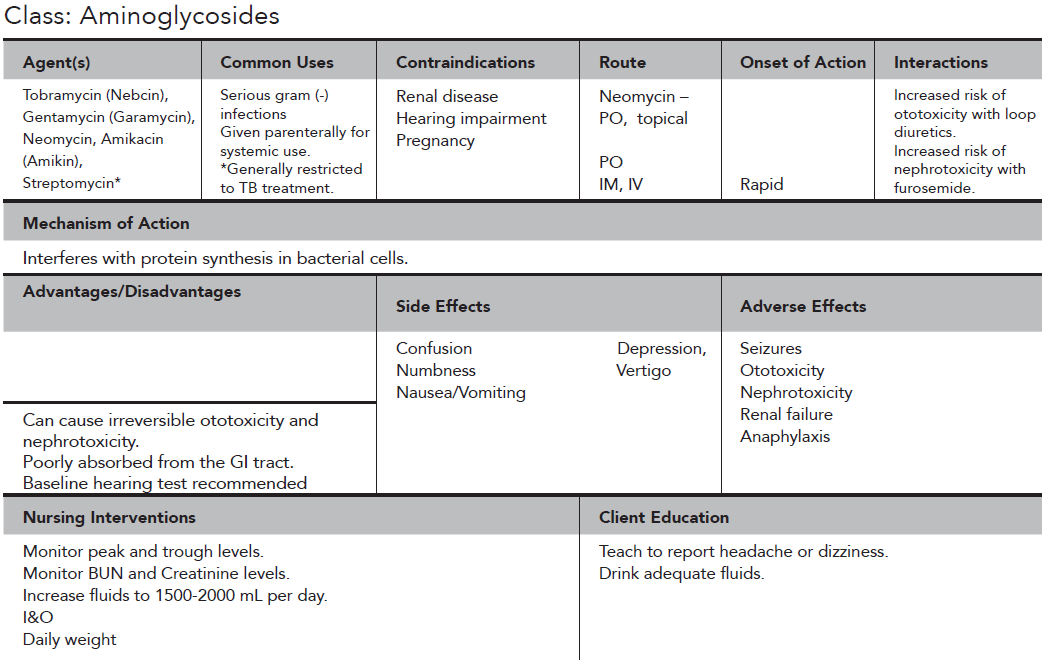
For the medication class: Aminoglycosides (antibiotic)
List common agents
Common uses?
Contraindications?
Routes?
Interactions?
MOA?
Advantages/Disadvantages?
Side effects?
Adverse Effects?
Nursing Interventions?
Client Education?
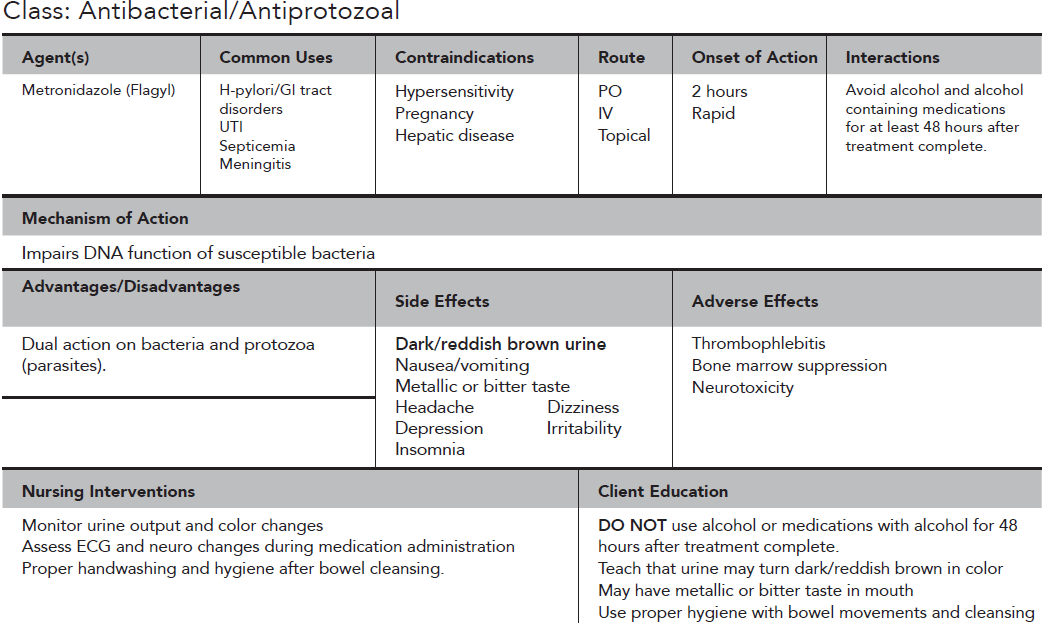
For the medication class: Antibacterial/Antiprotozoal
List common agent(s)
Common uses?
Contraindications?
Routes?
Interactions?
MOA?
Advantages/Disadvantages?
Side effects?
Adverse Effects?
Nursing Interventions?
Client Education?
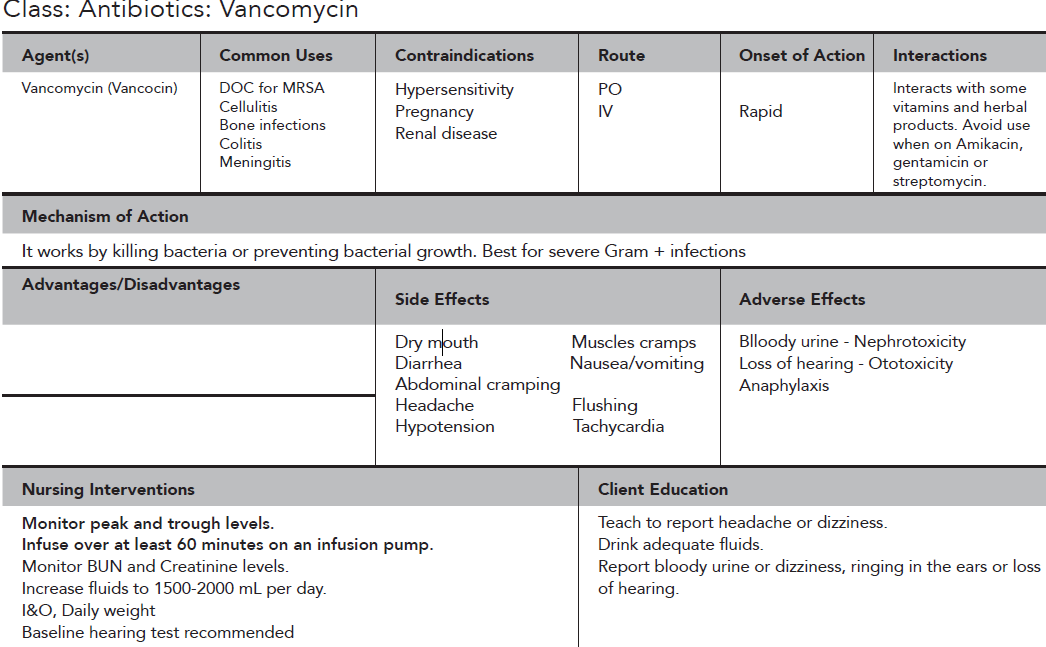
For the medication: Antibiotics—Vancomycin
Common uses?
Contraindications?
Routes?
Interactions?
MOA?
Advantages/Disadvantages?
Side effects?
Adverse Effects?
Nursing Interventions?
Client Education?
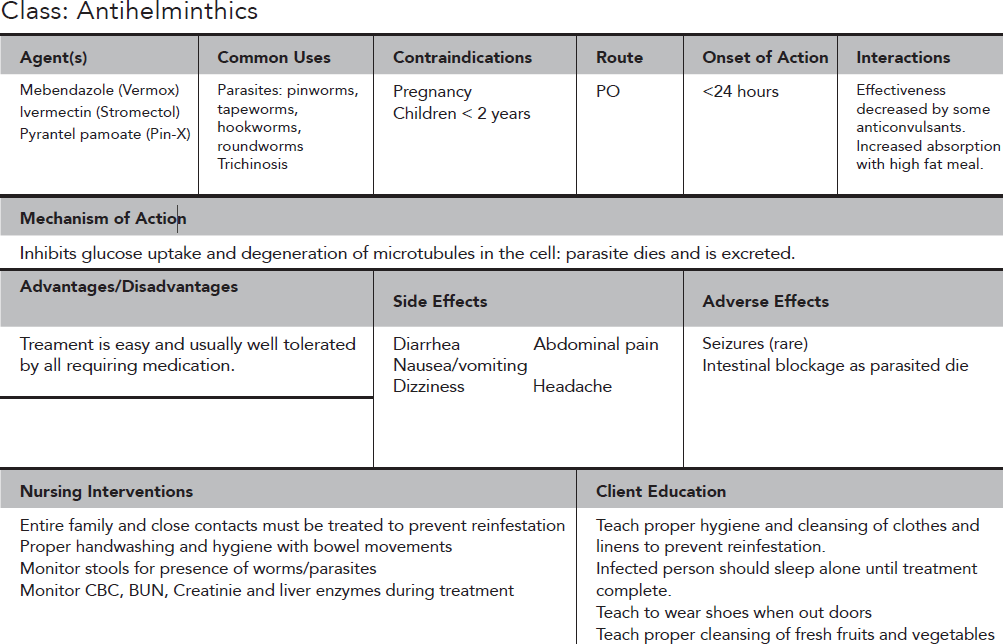
For the medication class: Anthelminthics
List common agent(s)
Common uses?
Contraindications?
Routes?
Interactions?
MOA?
Advantages/Disadvantages?
Side effects?
Adverse Effects?
Nursing Interventions?
Client Education?
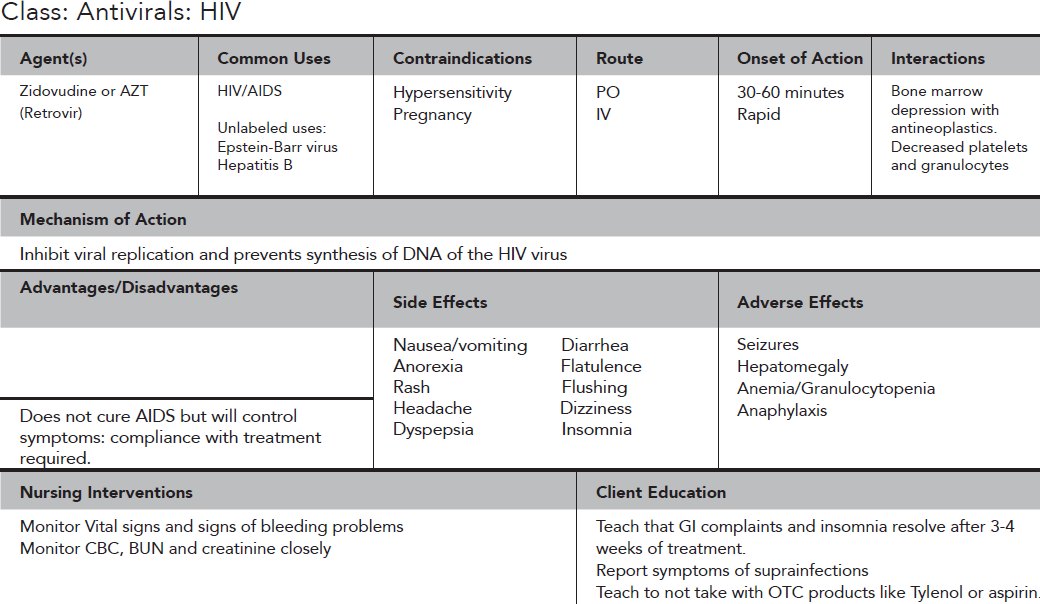
For the medication class: Antivirals—HIV
List common agent(s)
Common uses?
Contraindications?
Routes?
Interactions?
MOA?
Advantages/Disadvantages?
Side effects?
Adverse Effects?
Nursing Interventions?
Client Education?
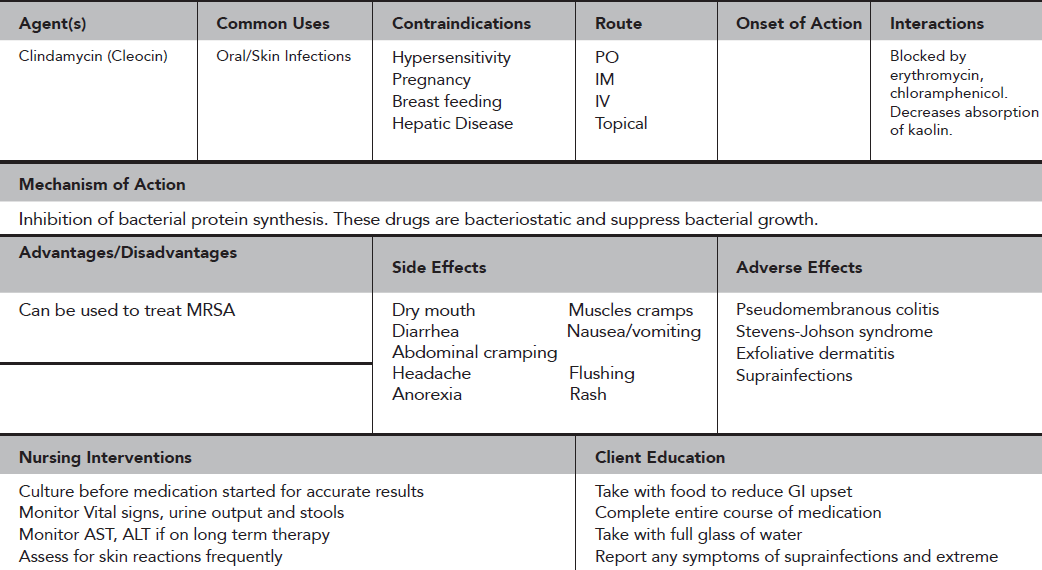
For the medication class: Broad Spectrum Antibiotics—Clindamycin
Common uses?
Contraindications?
Routes?
Interactions?
MOA?
Advantages/Disadvantages?
Side effects?
Adverse Effects?
Nursing Interventions?
Client Education?
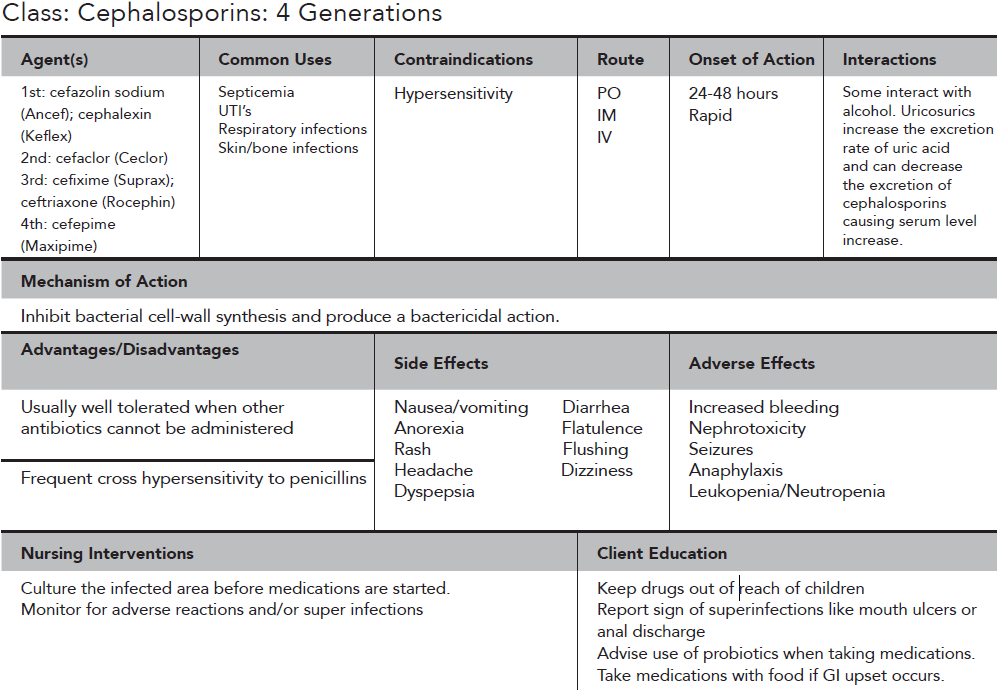
For the medication class: Cephalosporins—4 Generations of them
List common agent(s) for each generation
Common uses?
Contraindications?
Routes?
Interactions?
MOA?
Advantages/Disadvantages?
Side effects?
Adverse Effects?
Nursing Interventions?
Client Education?
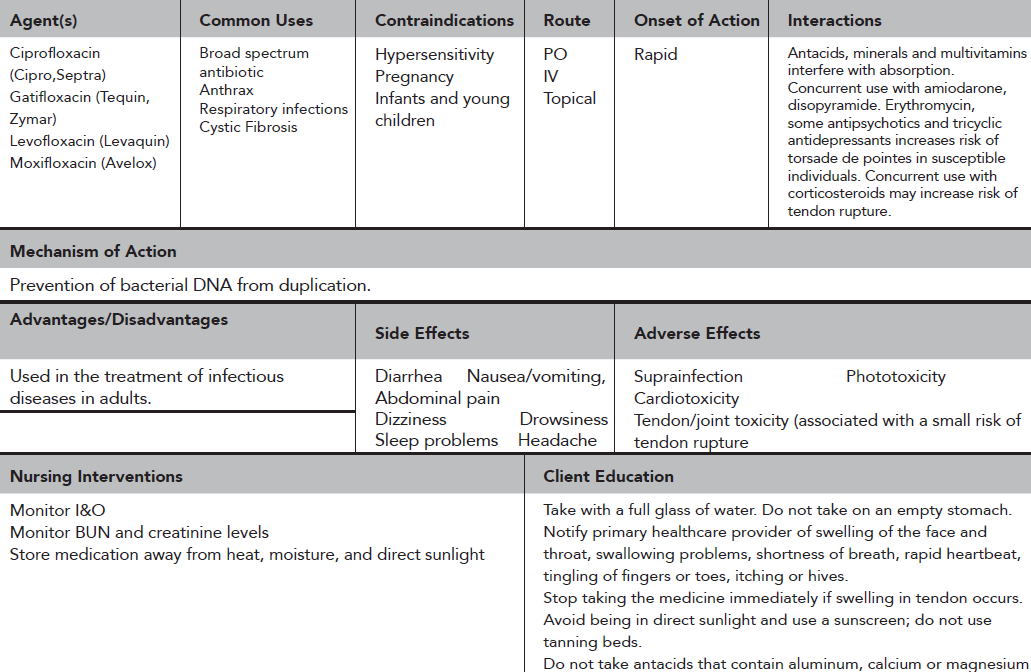
For the medication class: Fluoroquinolones
List common agent(s)
Common uses?
Contraindications?
Routes?
Interactions?
MOA?
Advantages/Disadvantages?
Side effects?
Adverse Effects?
Nursing Interventions?
Client Education?
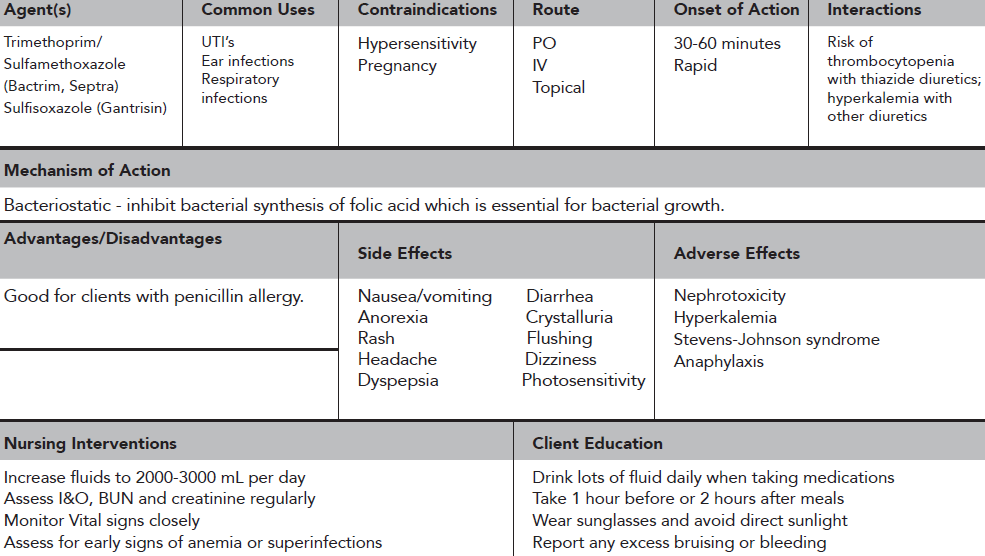
For the medication class: Macrolides
List common agent(s)
Common uses?
Contraindications?
Routes?
Interactions?
MOA?
Advantages/Disadvantages?
Side effects?
Adverse Effects?
Nursing Interventions?
Client Education?
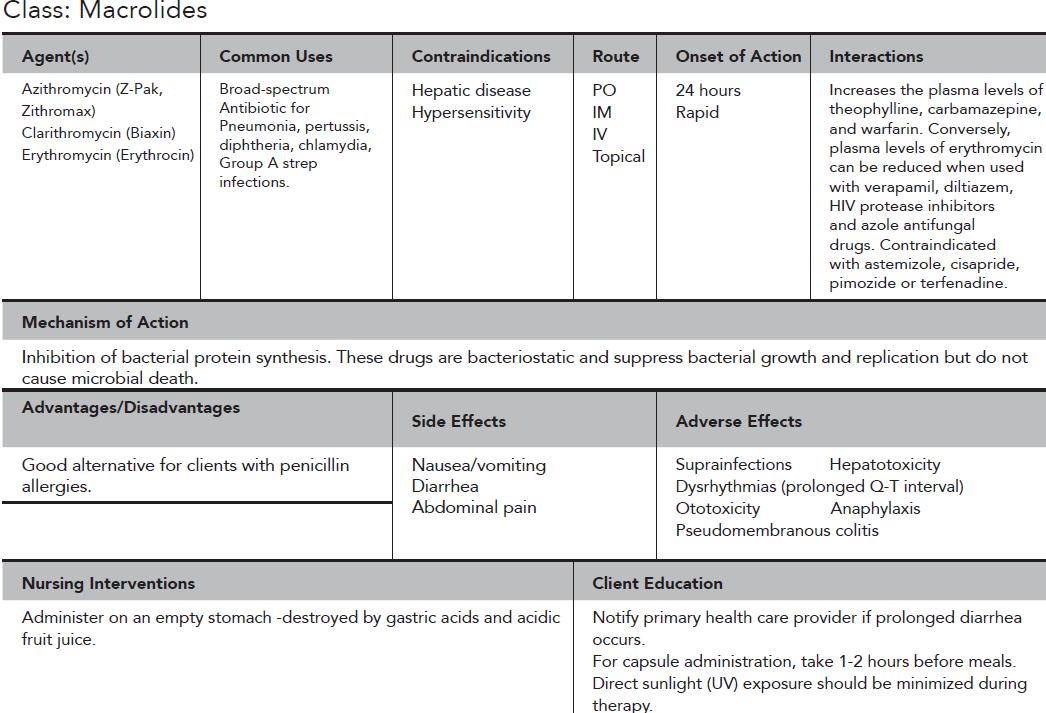
For the medication class: Non-HIV Antivirals
List common agent(s)
Common uses?
Contraindications?
Routes?
Interactions?
MOA?
Advantages/Disadvantages?
Side effects?
Adverse Effects?
Nursing Interventions?
Client Education?
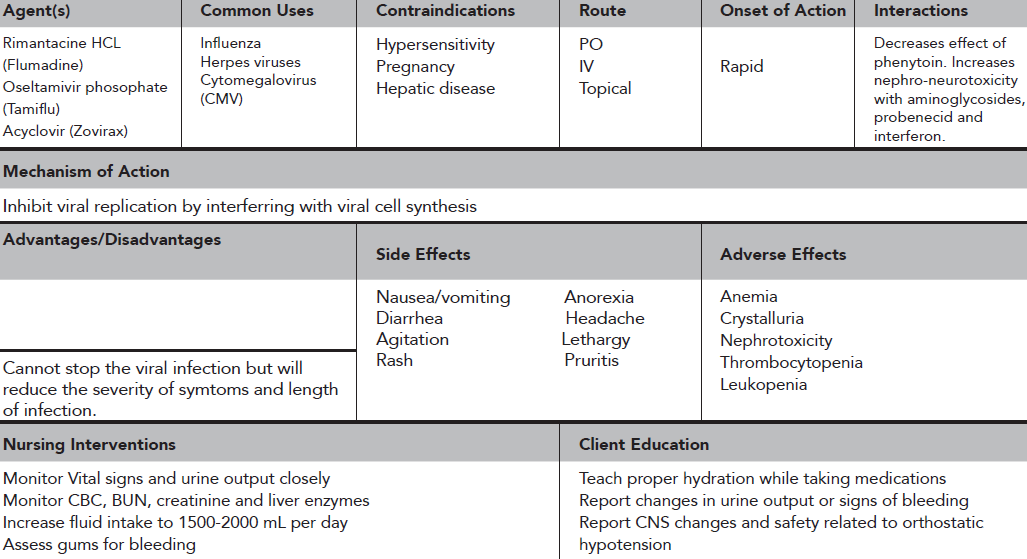
For the medication class: Penicillins
List common agent(s)
Common uses?
Contraindications?
Routes?
Interactions?
MOA?
Advantages/Disadvantages?
Side effects?
Adverse Effects?
Nursing Interventions?
Client Education?
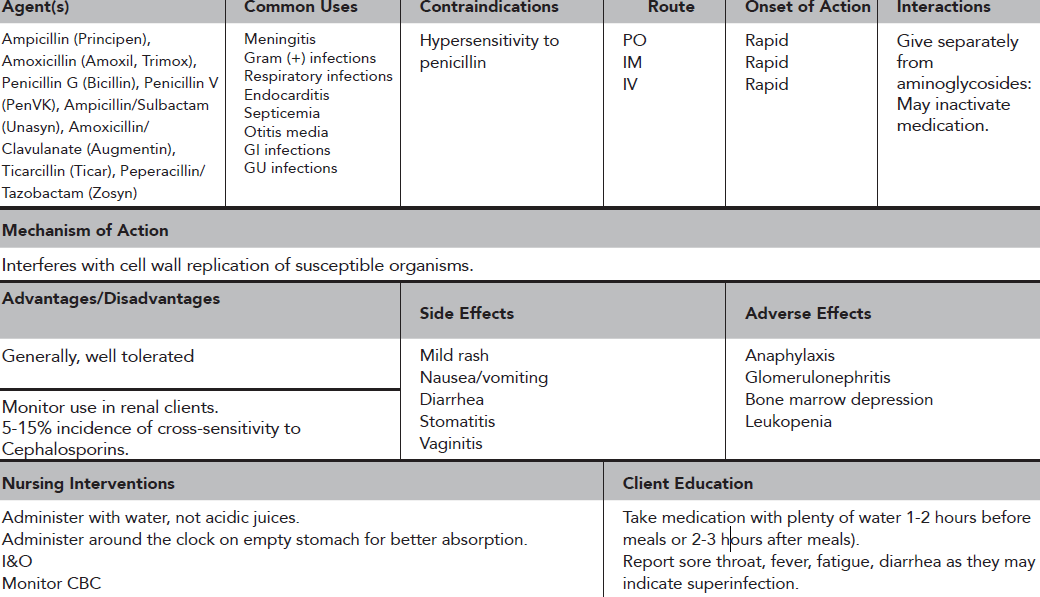
For the medication class: Sulfonamides
List common agent(s)
Common uses?
Contraindications?
Routes?
Interactions?
MOA?
Advantages/Disadvantages?
Side effects?
Adverse Effects?
Nursing Interventions?
Client Education?
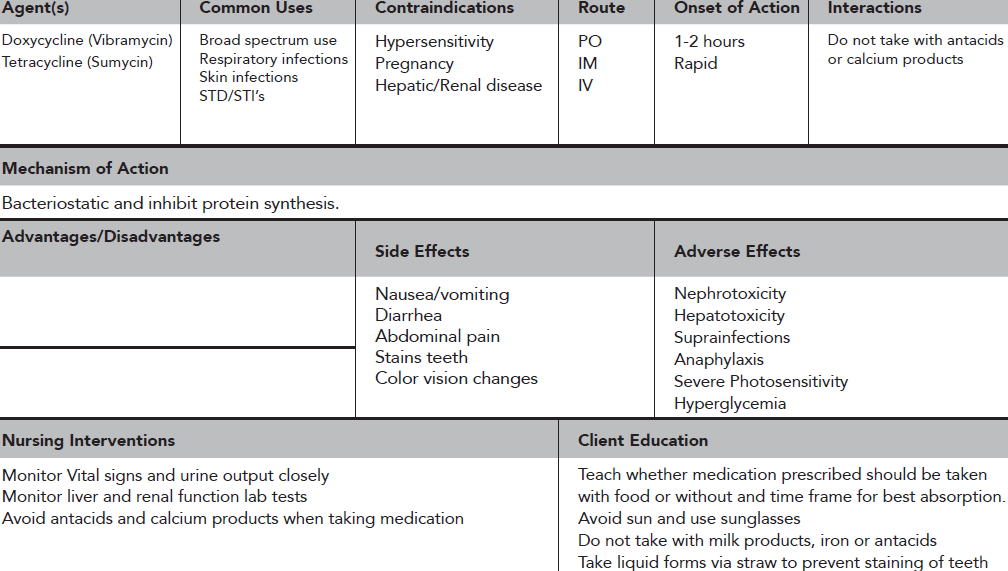
For the medication class: Tetracyclines
List common agent(s)
Common uses?
Contraindications?
Routes?
Interactions?
MOA?
Advantages/Disadvantages?
Side effects?
Adverse Effects?
Nursing Interventions?
Client Education?
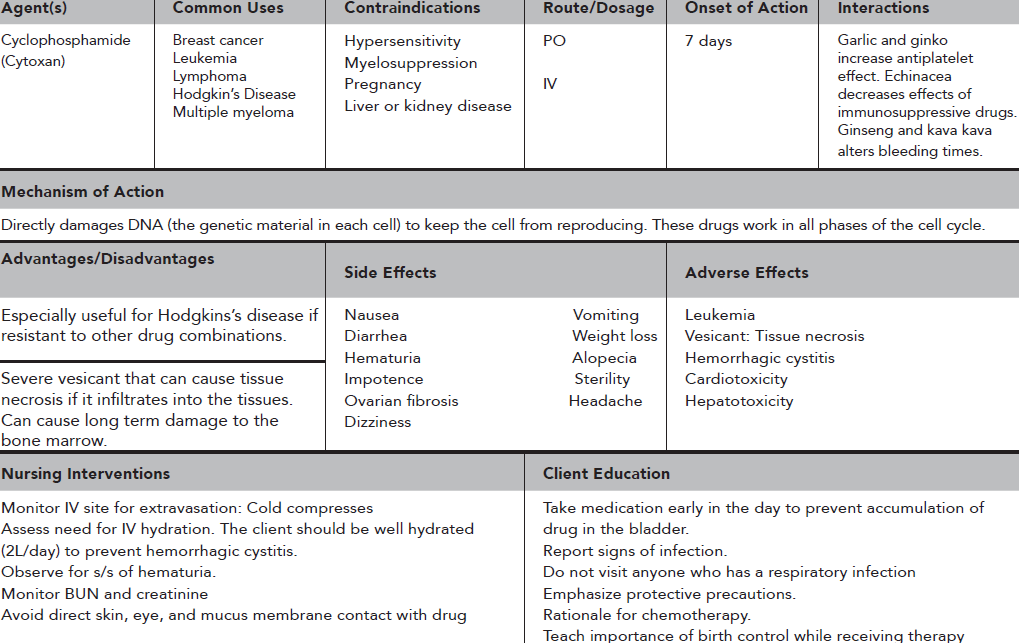
For the medication class: Alkylating Agents (Chemotherapy)
List common agent(s)
Common uses?
Contraindications?
Routes?
Interactions?
MOA?
Advantages/Disadvantages?
Side effects?
Adverse Effects?
Nursing Interventions?
Client Education?
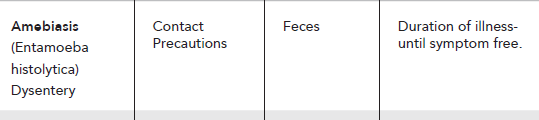
What isolation/precautions are necessary for Amebiasis(Entamoeba histolytica) Dysentery
Infective material?
Duration of isolation?
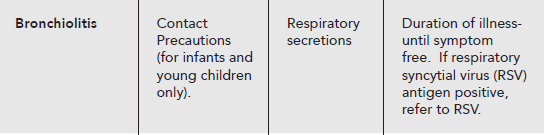
What isolation/precautions are necessary for Bronchiolitis?
Infective material?
Duration of isolation?
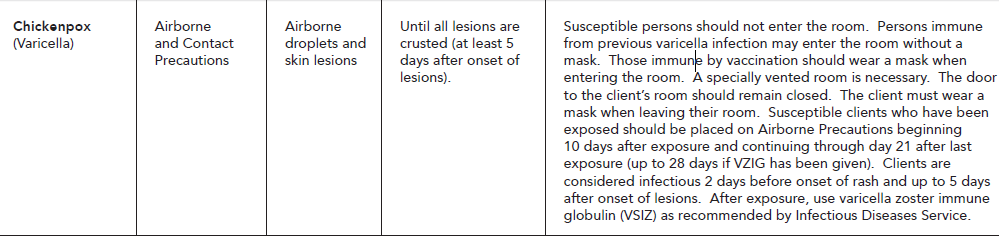
What isolation/precautions are necessary for Varicella (chicken pox)
Infective material?
Duration of isolation?
Describe the precautions necessary
What isolation/precautions are necessary for Clostridium dificile enterocolitis
Infective material?
Duration of isolation?

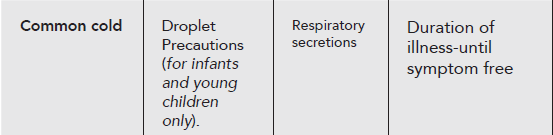
What isolation/precautions are necessary for the “common cold”
Infective material?
Duration of isolation?
What isolation/precautions are necessary for conjunctivitis (viral or bacterial)
Infective material?
Duration of isolation?

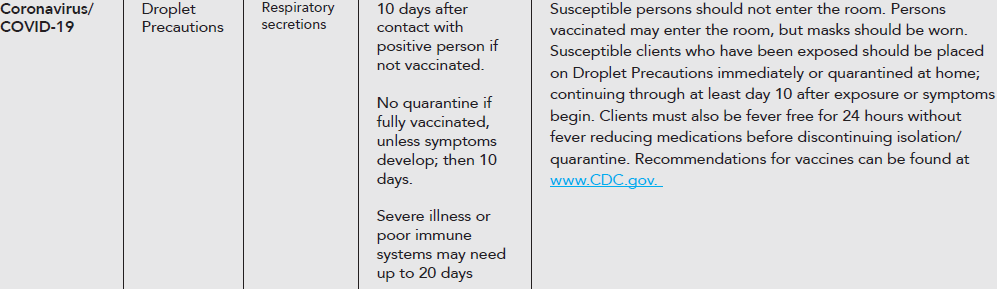
What isolation/precautions are necessary for COVID-19
Infective material?
Duration of isolation?
Describe the additional precautions/recommendations for COVID-19
What isolation/precautions are necessary for diphtheria (cutaneous)
Infective material?
Duration of isolation?

What isolation/precautions are necessary for diphtheria (pharyngeal)
Infective material?
Duration of isolation?

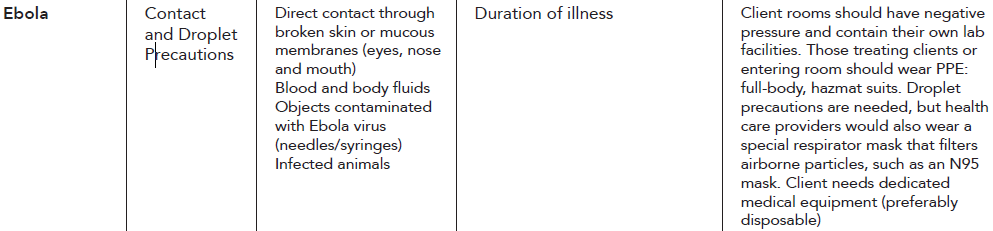
What isolation/precautions are necessary for Ebola
Infective material?
Duration of isolation?
Describe the additional precautions/recommendations for Ebola
What isolation/precautions are necessary for Epiglottitis
Infective material?
Duration of isolation?
What is the common cause?

What isolation/precautions are necessary for Fifth’s Disease/Erythema Infectiosum (Parvovirus B19)
Infective material?
Duration of isolation?

What isolation/precautions are necessary for Rubella
Infective material?
Duration of isolation?
Describe the additional precautions/recommendations for Rubella

What isolation/precautions are necessary for Meningitis
Infective material?
Duration of isolation?

What isolation/precautions are necessary for Pneumonia
Infective material?
Duration of isolation?

What isolation/precautions are necessary for Herpes zoster (Shingles)
Infective material?
Duration of isolation?

What isolation/precautions are necessary for Measles (rubeola, red measles)
Infective material?
Duration of isolation?
Additional comments/recommendations?

What isolation/precautions are necessary for MDROs (MRSA and VRE)
Infective material?
Duration of isolation?
Additional comments/recommendations?

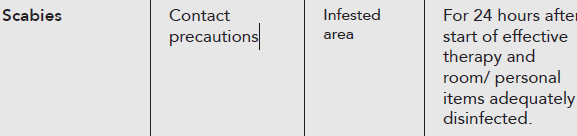
What isolation/precautions are necessary for Scabies (same for pediculosis)
Infective material?
Duration of isolation?
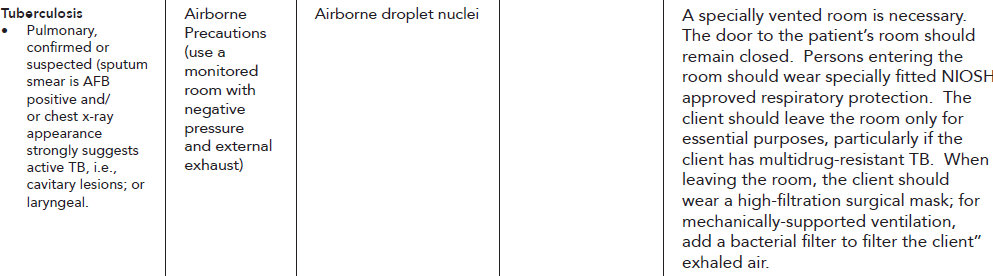
What isolation/precautions are necessary for Tuberculosis
Infective material?
Duration of isolation?
Additional comments/recommendations?
What isolation/precautions are necessary for Pertussis (whooping cough)
Infective material?
Duration of isolation?
Additional comments/recommendations?

What isolation/precautions are necessary for Zika?
Infective material?
Duration of isolation?
Additional comments/recommendations?

What do standard precautions apply to, and when should they be used?
List what is included in standard precautions
Standard Precautions apply to 1) blood; 2) all body fluids, secretions, and excretions except sweat, regardless of whether or not they contain visible blood; 3) nonintact skin; and 4) mucous membranes.
Use Standard Precautions, or the equivalent, for the care of all clients
Included in Standard Precautions:
Handwashing
PPE—Gloves, Gown, Mask/eye protection/face shield,
Client-Care Equipment—properly cleaned reusable equipment before it is reused; single-use items discarded properly; prevent transfer of microorganisms from equipment to people
Linens—handle/transport/process soiled linen w/o transfer of microorganisms (to other people/environments)
Sharps Safety—needles/sharps placed directly into puncture-resistant containers; do not recap used needles or use two hand technique; sharps w/ built-in safety features used when available
Respiratory hygiene/cough etiquette—covering coughs and sneezes, wearing masks, and throwing away tissues
What is the correct order to don PPE?
Don PPE: Mnemonic = Don is a good man, and Good Men Get Got
Gown
Mask or respirator (N95)
Goggles or face shield
Gloves
What is the correct order to doff PPE?
—Doffing is in alphabetical order
Gloves
Goggles
Gown
Mask
What are contact precautions designed to do?
How are microorganisms transmitted in contact precautions?
List what is included in contact precautions
Contact Precautions are designed to reduce the risk of transmission of microorganisms by direct or indirect contact
Transmission:
Direct-contact transmission involves skin-to-skin contact and physical transfer of microorganisms to a susceptible host from an infected or colonized person, such as occurs when personnel turn clients, bathe clients, or perform other client-care activities that require physical contact
Indirect-contact transmission involves contact of a susceptible host with a contaminated intermediate object, usually inanimate, in the client’s environment.
Included in Contact Precautions
A. Client Placement
Place the client in a private room
When a private room is not available, place the client in a room with a client(s) who has active infection with the same microorganism but with no other infection
B. PPE and Handwashing
Wear gloves and gown
Remove gloves before leaving the client’s room and wash hands immediately with an antimicrobial agent or a waterless antiseptic agent. For a client with C. diff do not use an alcohol-based, hand rub because it is not effective on C. diff use soap and water
C. Client Transport
Limit the movement and transport of the client from the room to essential purposes only
If the client is transported out of the room, ensure that precautions are maintained to minimize the risk of transmission of microorganisms to other clients and contamination of environmental surfaces or equipment.
In what patient’s should airborne precautions be used?
List what is included in airborne precautions
Use airborne precautions in patient’s:
For clients known or suspected to be infected with microorganisms transmitted by airborne droplet nuclei or evaporated droplets containing microorganisms that remain suspended in the air and that can be dispersed widely by air currents within a room or over a long distance
A. Client Placement
Place the client in an airborne infection isolation room (AIIR), which is a
private room that has:
Monitored negative air pressure in relation to the surrounding areas 6 to 12 air changes per hour
Appropriate discharge of air outdoors or monitored high-efficiency filtration of room air before the air is circulated to other areas in the hospital.
Keep the room door closed and the client in the room
Client should have a private room
When a private room is not available, place the client in a room with a client who has active infection with the same microorganism but with no other infection
B. Respiratory Protection
Wear respiratory protection (N95 respirator) when entering the room of a client with known or suspected infectious pulmonary tuberculosis
Susceptible persons should not enter the room of clients known or suspected to have measles (rubeola) or varicella (chickenpox) if other immune caregivers are available. If they must enter, they should wear a respirator mask.
C. Client Transport
Limit the movement and transport of the client from the room to essential purposes only
If transport or movement is necessary, place a surgical mask on the client.
How is disease transmitted in patients with droplet precautions?
Transmission of Disease Via Droplets
Droplet transmission involves contact of the conjunctivae or the mucous membranes of the nose or mouth of a susceptible person.
Droplets are generated from the source person primarily during coughing, sneezing, or talking and during the performance of certain procedures such as suctioning and bronchoscopy.
Transmission via large-particle droplets requires close contact between source and recipient persons, because droplets do not remain suspended in the air and generally travel only short distances, usually 3 ft or less, through the air
A. Client Placement
Place the client in a private room
When a private room is not available, place the client in a room with a client(s) who has active infection with the same microorganism but with no other infection
B. Mask
In addition to wearing a mask as outlined under Standard Precautions, wear a mask when working within 3 ft of the client. (Logistically, some hospitals may want to implement the wearing of a mask to enter the room.)
C. Client Transport
Limit the movement and transport of the client from the room to essential purposes only
If transport or movement is necessary, place a surgical mask on the client.
What type of isolation precaution will the client be on with the following diseases?
1. Human Immunodeficiency Virus (HIV)
2. Multidrug- resistant organisms (MDROs) (e.g., MRSA, VRE, VISA/VRSA,
ESBLs, resistant s. pneumoniae)
3. Candidiasis (Thrush)
4. Varicella Zoster (Chicken pox)
5. Clostridium Difficile Enterocolitis (C. Diff)
6. Infectious Mononucleosis (Mono)
7. Rubella (German Measles)
8. Meningococcal Meningitis
9. Impetigo
10. Seasonal Influenza
11. Rubeola (Measles)
12. Tuberculosis (TB) with pulmonary involvement
13. Infectious Parotitis (Mumps)
14. Rotavirus
15. Pertussis (Whooping Cough)
16. Tetanus
17. Escherichia Coli Gastroenteritis (E coli)
18. Herpes zoster (Shingles) Localized
19. Herpes zoster (Shingles) Disseminated disease
20. Respiratory Syncytial Virus (RSV)
21. Lice (head)
22. Lyme disease
23. Coronavirus/COVID-19
1. Standard
2. Standard/ Contact*
3. Standard
4. Airborne and contact
5. Contact
6. Standard
7. Droplet
8. Droplet for 24 hours
9. Contact for 24 hours
10. Droplet
11. Airborne
12. Airborne
13. Droplet for 9 days
14. Contact
15. Droplet
16. Standard-not transmitted person to person
17. Standard-contact for diapered incontinent persons
18. Standard-localized
19. Airborne and contact
20. Contact
21. Contact-isolation up to 24 hours
22. Standard-not transmitted person to person
23. Droplet
List the five rights of delegation, and what is required of the nurse for each right of delegation
(1) Right task
The task must be within the capabilities of the auxiliary nursing staff as defined by federal and state statutes (Nurse Practice Act), organizational policies and procedures; job descriptions and accreditation guidelines
Assess each client before delegating. Ensure there is match between the client’s needs and the skills, abilities and experience of the Auxiliary Nursing Staff
Consider the client’s condition, the personnel’s capabilities, the complexity of the task, and how much supervision will be required
Assistive personnel should not be assigned duties requiring ongoing assessment, evaluation or decision making.
(2) Right circumstances
The care setting should be taken into consideration
—For example, the role of the LPN may differ in an acute care setting in comparison to their role in a long
term care setting
Client stability as well as the desired client outcomes should also be taken into
consideration
(3) Right person
Know your facility’s competency standards
Know the job descriptions of co-workers
Has the personnel been trained on the task?
Identify personal strengths and weaknesses of Auxiliary Nursing Staff
(4) Right direction and communication
The Registered Nurse is responsible for providing clear, concise, correct, and complete communication to Auxiliary Nursing Personnel at the time of delegation as well as providing continued direction on an ongoing basis
Communicate clearly about the delegated task
Be specific about how and when he/she should report back to you
Make sure the personnel understands what is expected, and do not hesitate to ask them if they know how to perform the task
(5) Right supervision and evaluation
You cannot just merely assign the task. You must guide, supervise, and evaluate the carrying out of the delegated task
You must ensure the work meets your expectations. If it does not, you must step in
Give credit and praise for accomplishments. Do not hesitate to offer observations and share concerns
You should give the personnel feedback and ask for theirs
Encourage input on how to resolve care issues and reach agreement on future course of action
You must evaluate the client’s outcome and the results of the task to ensure the desired outcome is achieved
REMEMBER: You may delegate a task, but the responsibility remains with you,
the RN!!
The Nursing Process and clinical judgment cannot be delegated by the Registered Nurse to Nursing Assistive Personnel
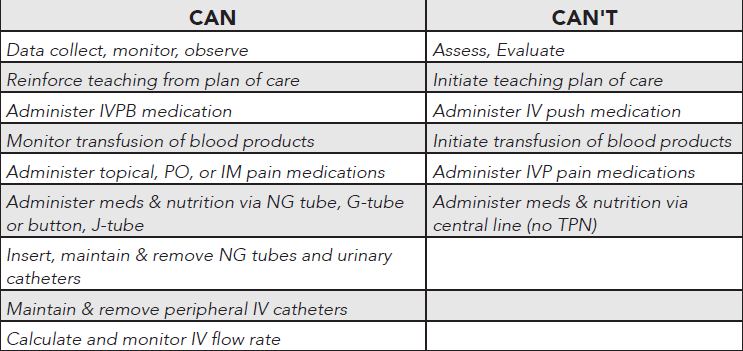
What can/can’t a PN (LPN) do?
Classify the following as stable or unstable:
Post-op client being discharged with no family New admission
Stable
Classify the following as stable or unstable:
New admission
Unstable
Classify the following as stable or unstable:
Client with COPD, stable vitals, and uses O2
Stable
Classify the following as stable or unstable:
Neuro checks suddenly change
Unstable
Classify the following as stable or unstable:
Diabetic with a wound, stable blood sugar, taking medications as ordered
Stable
Classify the following as stable or unstable:
Diabetic with low blood sugar
Unstable
Classify the following as stable or unstable:
Client with neurological problems, stable vital signs, no change in LOC/neuro checks
Stable
Classify the following as stable or unstable:
Client returning from an invasive procedure
Unstable
Classify the following as stable or unstable:
Client with dehydration, stable electrolytes, appropriate urine output, and improving hydration
status
Stable
Classify the following as stable or unstable:
Client with acid-base imbalance and respiratory distress with unstable vital signs
Unstable
Classify the following as stable or unstable:
Client with chronic hypertension, history of angina controlled with meds & lives alone
Stable
Classify the following as stable or unstable:
Client with syncope and chest pain
Unstable
Classify the following as stable or unstable:
Client with HIV+, medication compliance and works full time
Stable
Classify the following as stable or unstable:
Client with recent 2nd & 3rd degree burns
Unstable
Classify the following as stable or unstable:
Client with history of cancer in remission and young children in home
Stable
Classify the following as stable or unstable:
Client with infectious diseases - new onset
Unstable
Classify the following as stable or unstable:
Client with history of stroke, paresthesias, and rehab equipment
Stable
Classify the following as stable or unstable:
Client with multiple IV fluids & meds, plus lab & vital sign changes
Unstable
What is asthma?
What is happening in the airway of a person with asthma?
How is Asthma different from RSV?
Asthma: Chronic inflammatory disorder of the airway
What is happening in the person’s airway?
- Edema
- Inflammation
- Tenacious secretions,
- Smooth muscle spasms (wheezing and bronchospasm)
- Decreased expiratory airflow
How is asthma different from RSV?
Asthma is inflammation and bronchoconstriction of the airways, resulting in an obstruction
Also, asthma is not a virus
List causes/triggers of asthma
Allergy
Environmental allergens (dust mites and roaches)/Dust
Smoke (any form)
Medication
Pets
Exercise
Change in the weather (cold air)
Strong emotions
List s/s of asthma
Recurrent episodes of wheezing
Can’t catch their breath, dyspnea
Cough
Fatigue
Chest tightness/pain
Retraction in infants
Hyperresonance of chest with percussion
Coarse and loud breath sounds
Repeated episodes = barrel chest
Symptoms usually worse at night.
List s/s of an acute asthma attack
What will occur as the asthma attack becomes more severe?
Symptoms of acute asthma attack:
Child may start to report itching in the front of their neck or their upper back
Will start out feeling restless and report a headache
Will be tired, irritable, with a hacking non – productive cough
Their chest begins to tighten as secretions increase and their cough becomes rattling and productive (clear frothy sputum)
As the attack becomes more severe:
The child will try to breathe more deeply
The expiratory phase will be prolonged with audible wheezing
Appearance will be pale and may become cyanotic
Restlessness increases
Anxious expression
Sweating
Younger children may assume the tripod sitting position, whereas the older child will sit up with shoulders hunched over with hands on legs or bed to facilitate use of accessory muscles
How is asthma diagnosed?
Difficult to diagnose asthma in infants (many conditions can cause wheezing and retractions)
Chronic cough with no signs of infection and/or diffuse wheezing during expiration is sufficient to diagnose asthma
Pulmonary function test: Helps to determine the presence and degree of lung disease and response to respiratory therapy
Spirometry function test reliable for children older than 5 or 6 years
Peak expiratory flow rate (PEFR): Max airflow that can be forcefully exhaled in one second.
Each child’s PEFR based on age, race, height and gender
List the possible treatments for asthma
Chest Physiotherapy
Percussion, vibration, squeezing the chest and breathing exercises (blowing bubbles = pursed-lip breathing)
Do not administer this therapy during an acute episode
Monitor O2 sat
Allergy shots (Allergy proof the house) **Only administer allergy shots if emergency equipment is available in case of anaphylactic shock
Small frequent meals – to prevent abdominal distention and help prevent the diaphragm from expanding
Encourage fluids to thin secretions, but no extremely cold fluids be cause cold can induce a bronchospasm
Evaluate participation in exercise activities on an individual basis
Humidified O2
Respiratory medications
Bronchodilators (beta adrenergic agonists)-SABAs (Albuterol, Terbutaline), LABAs (Salmeterol)
Bronchodilators (Antileukotriene/Leukotriene Receptor Antagonists)—Montelukast, Zafirlukast
How is live attenuated influenza vaccine given?
Live attenuated influenza vaccine = FluMist
—given via the intranasal route
How is rotavirus given?
Orally
When administering SubQ injections:
What gauge needle should you use?
What needle length should be used for infants?
What needle length should be used for children 12 months and older?
Use a 23-25 gauge needle
Needle length for infants (1-12 months) is 5/8”
Children 12 months and older 5/8” to 1 inch
When giving IM injections using a 22-25G needle:
What is the needle length used in the first 28 days of life?
What about infants (2-12 months) in the anterior thigh?
What about Toddlers/Children in the anterolateral thigh, and the deltoid?
5/8”
1”
1-1 ¼” for anterolateral thigh and a 5/8” needle for the deltoid
What is a ventricular septal defect (VSD)?
S/s?
Tx?
Is this a cyanotic or acyanotic defect?
This is when there is an opening between the left and right ventricle (in
the septum)
This increases the volume on the right side of the heart. The right side
is having to pump harder so this can lead to right sided heart failure.
Many close spontaneously during the first year of life, but if not will have
surgical repair.
Signs and Symptoms:
- Signs of heart failure
- Murmur
What is coarctation of aorta?
S/s?
Tx?
Is this a cyanotic or acyanotic defect?
The aorta has a narrowing (pretend there is a tourniquet tied around the
aorta). This makes it harder for the LV to pump so the client may wind up
with left sided heart failure.
Signs and Symptoms:
- Hallmark Sign: There is a BIG difference in the pulses and BP of the
upper and lower extremities. For example, you may have a pediatric
client with an Upper extremity BP = 100/60 and Lower extremity
BP = 70/40
- The upper pressures are much greater than the lower pressures.
Treatment:
- Surgery
- Angioplasty in some
What is the purpose of the ductus arteriosus in normal fetal circulation?
What is patent ductus arteriosus (PDA)?
What does this lead to?
S/s?
Tx?
Is this a cyanotic or acyanotic defect?
Normal fetal circulation: Blood goes Right Atrium….Right Ventricle….
Pulmonary Artery…doesn’t go to lungs….instead when blood leaves PA
it goes straight over to the aorta via the ductus arteriosis. Why does the
blood do this? Because in utero the baby’s lungs are collapsed, and the
baby gets oxygen through the placenta.
This ductus arteriosis is supposed to close when the baby is born and
takes their first breath. When it closes then blood flows from the
Pulmonary Artery to the lungs etc….just like in the adult. But when it
doesn’t……
This leads to increased workload on the left side of the heart and therefore
left sided heart failure.
Some blood is going like it’s supposed to, but some is going over to the right
side because the left side is pushing it to the right.
Signs and Symptoms:
- May be asymptomatic
- May be in heart failure
- They have a machinery - like murmur
Treatment:
- Indomethacin (Indocin®) (prostaglandin inhibitor) will close PDA
- May need surgery to close the ductus
What occurs in transposition of the great vessels?
Is this a cyanotic or acyanotic defect?
S/s?
Tx?
in your cardiac lecture?)
In transposition of the great vessels, the pulmonary artery and the aorta
have swapped places. The aorta is still going to the right side of the heart
and the pulmonary artery is going to the left but they never connect or
cross.
So you wind up with 2 separate sets of circulation going in and out of the
heart. Yes, some blood is getting out to the systemic circulation, or the
client would be dead at birth. Instead, the baby is cyanotic at birth, but
alive. What’s keeping the baby alive?
- Usually there is some other defect that is allowing that baby to get
just enough oxygen to stay alive. (often it is a PDA)
Signs and Symptoms:
- Usually cyanotic at birth
- If not picked up on until older……decreased growth, poor feeding
Treatment:
- Surgery
What does tetralogy of Fallot consist of?
Is this a cyanotic or acyanotic defect?
S/s?
Tx?
Consists of 4 defects:
a. Ventricular Septal Defect (VSD)
b. Pulmonary Artery Stenosis
c. Overriding Aorta
d. Right Ventricular Hypertrophy
Signs and Symptoms:
- Infants may be cyanotic at birth: others may have mild cyanosis that
progressively worsens during first year
- Murmur
- Acute cyanotic or hypoxic spells (blue spells/Tet spells)
*usually seen during crying, after feeding, during bowel movements
*at risk for sudden death, seizures
- Older children: Squatting, nail clubbing, poor growth, exercise
intolerance
Treatment:
- Surgery
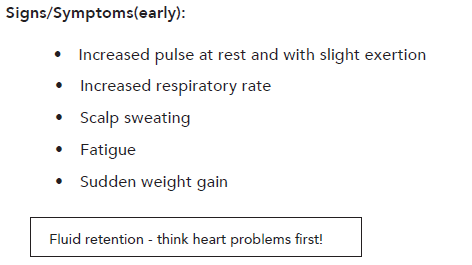
What are the early s/s of heart failure in children?
What is included in the treatment of heart failure in children?
• Ongoing Assessment
• Listen to the lungs
• Control room temperature
• Sit them up
• Rest a lot
• Decrease stimuli
• Cool humidified oxygen
• Uninterrupted sleep
• Medications:
Digoxin (Lanoxin®) Normal Digoxin Level = 0.8-2.0 ng/mL
ACE Inhibitors
Furosemide (Lasix)
List instructions regarding the administration of digoxin to a pediatric patient
GIVE DIGOXIN (LANOXIN ®) 1 HOUR BEFORE OR 2 HOURS AFTER FEEDING
• Do Not mix with food or fluid
• If you miss a dose and it is 4 hours past due on the dose, you are
going to hold the dose and give the next dose on time.
• Do not give more if the baby vomits
• If two doses in a row are missed, call the primary healthcare
provider
• ALWAYS check the dose with another nurse
What is normal digoxin level?
Main s/s of toxicity in a pediatric patient?
When should you hold the dose for infants?
When should you hold the dose for children?
What is common regarding the dose of digoxin for infants?
Normal Digoxin Level = 0.8-2.0 ng/mL
Main signs of toxicity are bradycardia and vomiting
For infants, hold the dose if the pulse is < 110
For children, hold the dose if the pulse is < 70
Infants rarely get more than 1 mL of digoxin (Lanoxin ®) per dose.
Common ACE inhibitors?
What should you watch for regarding ACE inhibitors?
How do they work?
Common Ace Inhibitors: captopril (Capoten®) and enalapril
(Vasotec®)
With Ace Inhibitors, watch for:
1) decreased blood pressure
2) kidney problems
3) a cough
Work by blocking aldosterone
When would furosemide be used to treat a pediatric patient with heart failure?
May be needed to decrease volume (as evidenced by crackles on auscultation, edema, JVD, ect.)
For the pediatric client with heart failure, list nutrition guidelines
• Well rested prior to eating
• Small frequent feedings
• Increase calories
• Good feeding schedule for a heart baby is every 3 hours
• Don’t prolong infant feedings past 30 minutes
• Use a soft nipple with a larger opening, so the baby won’t have to
work so hard
• Breastfed babies may need additional supplements for calories
What are the effects of chronic hypoxia on pediatric patients with heart failure?
• Polycythemia: increased red blood cells
Why does this happen? The body senses that the body is hypoxic
and makes more red blood cells to carry oxygen, but there’s no more
oxygen to carry. So the blood gets really thick.
Keep them hydrated to keep the blood thinned out.
With polycythemia, there are so many RBCs, there’s no room for
platelets.
• Clubbing
*Late sign of chronic hypoxia
• Poor growth and development
• Squatting
What is pneumonia?
List potential causes
S/s?
Tx?
Pneumonia
. Disease marked by inflammation of the lung parenchyma.
A. Causes: can be bacterial, viral, mycotic or aspiration of a foreign
substance.
1. Viral: Common viral causes are RSV, adenovirus or parainfluenza
2. Bacterial: Usual culprit is strep pneumonia.
Children <4 years of age have the greatest % of attacks.
3. Mycotic: or “walking pneumonia” is primarily in adolescents
and is caused by Mycoplasma pneumonia.
4. Aspiration pneumonia: As the name implies, occurs when
something other than air has gotten into the lungs
e.g. peanuts, marshmallows, water, etc.
B. Signs and Symptoms:
1. Fine crackles or rhonchi, with a cough that is either productive
or non-productive
2. Decreased or absent breath sounds over the lung fields.
3. Abdominal distention
4. Back pain
5. Fever that is usually quite high
6. Chest pain
Treatment: (depends on the type of pneumonia)
1. The first priority is always the ABC’s
2. Oxygen
3. Plenty of fluids to keep hydrated
4. If bacterial, then antibiotics are ordered
5. If viral, we generally provide supportive care: hydration,
antipyretics, nebulizer
What age range is considered infancy?
What is the Erikson stage for this age range?
List the basic principles of this growth/development stage
Infancy is birth to 12 months of age: Trust vs Mistrust (Erikson)
Basic Principles:
• This is a time when the primary source of activity is through
the mouth; examples are rooting and sucking reflex, feeding,
and pacifier.
• Repeated use of reflexes develops experiences
• Young infants are totally self-centered; they have little tolerance
for delayed gratification
• At 4-8 months they can perform a desired activity that will produce
a result. Example: secures object by pulling on a string
• Late infancy: develops the concept of object permanenceunderstands
parents are present even if not in line of vision,
works to get toy that is out of reach
• Comprehends simple commands and meaning of words
• Can say bye-bye and blow kisses
• Begins to explore their surroundings
• Infants trust that their needs will be meet (feedings, diaper
changes, comfort, stimulation)
• The trust developed during infancy is the foundation for all
relationships and for the progression of further development
• The single most important element in developing trust is consistency
in caregivers. Infants love routines! So do things like having a
regular feeding schedule, bathe every night then give a bottle and
go to bed.
List assessment guidelines for the assessment of an infant (birth to 12 months of age) in the following areas:
Important things to focus on when assessing the infant
Weight
Fontanels
Verbal skills
Important things to focus on when assessing an infant
– Head control: should have no head lag by 4 months
– Pincer grasp: should have established pincer grasp by
11 months of age. Remember up until 1 month of age
hands are closed, grasping at 2-3 months is a reflex.
By 5 months, infants can voluntarily grasp an object.
– Rolling over: should be able to roll over from abdomen
to back at 5 months of age. No your baby isn’t advanced
if they rolled over at 2 months…..it was an ACCIDENT!!
• Weight: gain 5-7oz weekly for first 6 months; at 2 weeks, the
infant should have gained back to their birth weight, then
weight should double around 5 months of age and triple by age 1
• Posterior fontanel closes by 2 months of age anterior fontanel
closes by 18 months of age
• Verbal skills: should be able to imitate sound around 6 months,
by 8 months combines syllables like dada but doesn’t know the
meaning, 9 months responds to simple commands, comprehends
no-no, 10 months says dada and mama with meaning attached,
12 months says 3-5 words
List the important developmental milestones of infancy (birth to 12 months)
Developmental Milestones
• Some important developmental milestones to remember:
– By 2 months can try to pull up with some head control
– By 7 months should bear weight on feet, can sit with support,
transfers object from one hand to the other
– By 8 months can move from sitting to kneeling, sits
without support
– By 9 months can stand holding onto furniture, creeps on hands
and knees
– 9-10 months takes deliberate steps
– By 12 months walks with 1 hand held, can sit down from standing
position without help
What are signs that an infant may be in pain?
– Facial grimaces
– Postural changes, thrashing
– Crying loud and excessively
– Inconsolable