T6 : Rate and extent of chemical change
 Call Kai
 Learn
Learn Practice Test
 Spaced Repetition
 Match
Match Flashcards
 Knowt Play
1/20

There's no tags or description
Looks like no tags are added yet.
Name | Mastery | Learn | Test | Matching | Spaced | Call with Kai | Chat |
|---|
No analytics yet
Send a link to your students to track their progress
21 Terms
ROR and ways to measure
how fast the reaction progresses - the rate at which reactants are converted into products
RORmean = quantity (amount of reactant used) / time
we can measure using quantity of reactant used up, quantity of product formed in either g or cm³ for gas
the mean ROR is the average ROR throughout the whole reaction - gives a simple number even if ROR is constantly changing
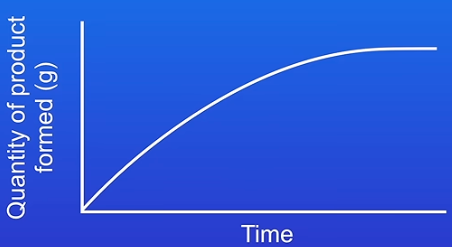
interpreting an ROR graph for a basic reaction
slope of the line shows ROR at specific points, steeper the slope the faster the reaction
initially ROR is v high as lot of product is being made in a short time as there is a great availability of reactant molecules so lots are reacting and forming product
gradually the slope becomes less steep as the ROR is ↓ ∵ lot of the reactant molecules have alr reacted and turned into product ∴ fewer reactant molecules to react
at the end the slope is 0 so the reaction has stopped bc all the reactant molecules have reacted
need for tangents of ROR graphs
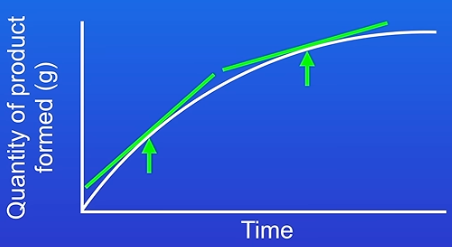
because the ROR graph is curved, the ROR is constantly changing, meaning that it is difficult to find the ROR at any specific point
draw a straight line that just touches the curve at the point, draw the triangle of the tangent and find dy/dx to find the gradient of the tangent - ROR
tangents show that the start of the reaction has a greater ROR than the end bc of their gradients
collision theory and application to reaction progress
chemical reactions only take place when the reacting particles collide with eachother, with sufficient E, the ROR is determined by the frequency (collisions per second) of the successful collisions
reactions are initially rapid bc large no of reactant molecules large no of cps
reactions then slow down bc no of reactant molecules run out ∴ smaller cps
finally reaction stops ∵ all reactant molecules have ran out // cps = 0
conc and pressure effect on ROR
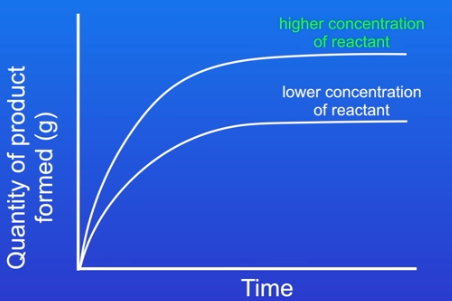
increasing conc. of reactants will ↑ ROR bc there is a greater availability of reactant molecules per unit volume ∵ cps will be higher
bc the rate ↑ if we increase the conc, ROR is proportional to the conc.
two containers of the same vol of reactant in solution but one w double conc. will have double the ROR bc double the cps
on a graph the ROR is higher bc more cps but also more quantity of end product as we started w more reactant (for the same vol )
effect of pressure on ROR
the concept if conc also applies to gases in terms of pressure - the larger the pressure, the smaller volume that the molecules can be in directly ↑ conc ∴ ↑ availability of reactant molecules per unit volume ∴ ↑ cps
also at a proportional scale, doubling pressure doubles conc and ∴ doubles ROR
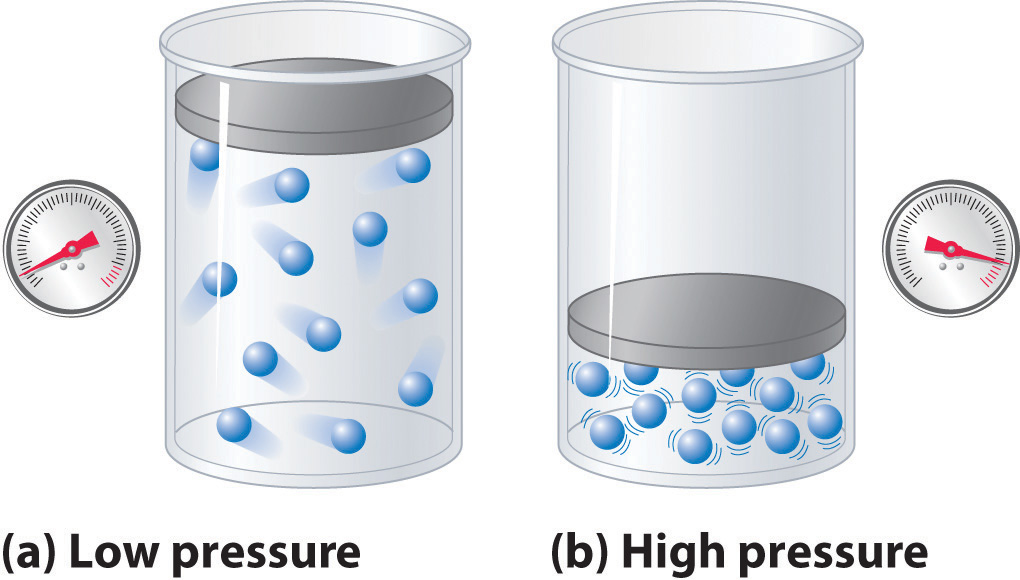
explore the effect of conc on ROR as a testable hypothesis - proposal that could explain a fact
sodium thiosulfate (aq)+ HCL (aq) → S (s) sulfur makes the sol go cloudty (turbidity) which we can use to see how long the reaction takes to finish
using a meas cyll to put 10cm³ of sodium thiosulfate (aq) into a flask and then place on a printed black cross on a white tile
then use a meas cyll for 10cm³ of HCl (aq) to add to the flask and start a stopwatch
swirl every 5 seconds and look down from the flask and stop when the cross can no longer be seen
now repeat for mean time for turbidity and then repeat at diff concs of HCl and avoid anomalies
effect of reactant conc on a gas vol
reacting Mg w HCl gives MgCl2 + H2(g)
use a meas cyll for 50cm³ HCl aq into a conical flask then attach to a bung and del tube then to a water trough meas cyll system
add a 3cm strip of mg and seal the flask and measure the vol of gas produced every 10 seconds and continue until no more is given out
then repeat the experiment w diff concs of HCl
reproducibility with the turbidity of sodium thiosulfate and why effect of conc on ROR is reproducible
A measurement is reproducible if it can be repeated by another person or using a different technique or equipment and still get the same result.
The problem with this experiment is that different people have diff eyesights ∴ some people can see the cross for longer than others so they may not get the same results.
but because all the students use the same size printed cross, this problem may not be too great.
both experiments show that ↑ conc ↑ ROR and because it is shown by 2 diff experiments we can say that the finding is reproducible
effect of SA on ROR
↑ SA ↑ ROR ∵ greater exposure ∴ availability of a reactant molecules on the surface to collide with the other reactant molecules ∴ ↑ cps
smaller sized blocks have a greater SA:V than larger blocks meaning that they have more particles on the surface so there are more cps which ↑ ROR
effect on SA on ROR experiment
explore this by using a certain vol and conc of HCl and varying SAs of MgCO3 with constant mass in a del tube water displacement trough setup. find the vol of gas produced and time using a stopwatch to find mean ROR
bc of the rapid bubbles measuring the vol of gas can be difficult w a meas cyll ∴ use a gas syringe for accuracy
or use the same reactions but on a balance w cotton wool on top of the flask bc as CO2 is produced the mass decreases and use this to find ROR - the wool allows gas to esc but not acid splashes that could decrease mass → anomalous
effect of temp on ROR
↑ temp ↑ ROR ∵ ↑ temp ↑ E of particles and ∴ move faster which ↑ the frequency of collisions → ↑ cps
each collision now has more E ∴ more particles can now overcome the Ea barrier and collide successfully - which is needed for particles to react
bc ROR ↑ w temp - the ROR is proportional to the temp
catalyst effect on ROR
catalysts ↑ ROR of a chem reaction are are not used up during the reaction. they do this by proving an alternative reaction pathway with a lower Ea barrier meaning for the set lower temp more successful collisions take place (∴ ↑ ROR)
and ROR depends of freq of successful collisions that overcome the Ea barrier
catalysts allow us to carry out reactions quickly without needing to ↑ temp which saves money
and they can be reused again and again as they are not used up
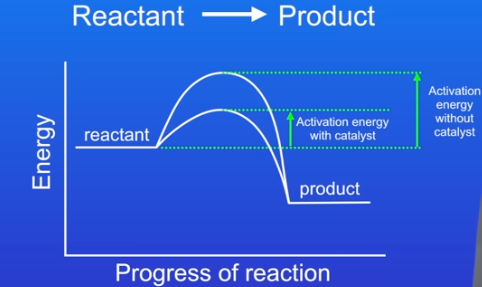
catalysts
We do not include catalysts in the chemical equation for a reaction. That is because they are not used up in the reaction. Catalysts are not a reactant.
Different reactions need different catalysts.
Enzymes act as catalysts in living organisms.
reversible reactions
where the products of the reaction can react to reform the original reactants
e.g. hydrated copper sulfate ⇌ anhydrous copper sulfate + water
HCS is blue and when heated forms white ACS + water : by heating we are putting energy in ∴ the forward reaction is endo
and if we take the ACS and add water the reaction reverses and E is released ∴ the reaction is exo
so if a reversible reaction is exo in one direction it must be endo in the other direction w the same amount of E transferred in each case
reversible reaction dynamic equilibrium + Le Chatelier’s principle
if this reaction is taking place in a sealed container, it stops any reactants or products from escaping and so at some point the reverse and forward reactions will constantly take place at exactly the same rate assuming sustained conditions like temp and pressure
If a system is at equilibrium and a change is made to the conditions, then the system responds to counteract the change
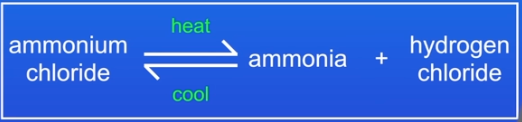
effect of concentration on reversible reactions
take example of 2NO2 ⇌ N2O4
if we ↑ conc of NO2, then the system is not in equil - forward reverse reactions not taking place @ same rate, meaning that more N2O4 will be formed from the NO2 until constant concentration to reach equilibrium
if you decrease N2O4 conc, more NO2 will react until equil is reached again
and if you inc conc of N2O4, more of it will react into NO2 until concs are same (equil)
effect of temp on reversible reactions -
take example of 2NO2 ⇌ N2O4
the forward reaction is exo (temp ↑ ) and reverse is endo (temp ↓ )
if we increase the temp then by LCP the system responds to counteract change - ∴ the endo reaction rate will ↑ : equil shifts left to reduce the temp ∴ NO2 yield would ↑ and N2O4 yield will ↓
and if decrease temp then equil shifts to right exo to ↑ temp ∴ more N2O4 is produced and NO2 decreases
effect of pressure on equilibrium reactions
of the example N2(g) + 3NH2(g) ⇌ 2NH3(g)
affects reactions involving gases, and pressure depends on the number of molecules (per unit vol)
On the left side there are 4 molecules and on the right 2 ,
if we ↑ pressure on a rev reac at equil, the position of equil shifts to the side w fewer no of molecules (right)
and if ↓ then equil shifts to the larger no of molecules (left)
if there are equal molecules on both sides pressure has no effect on equil
Haber process to manufacture ammonia : reactants.
N2(g) + 3NH2(g) ⇌Fe catalyst 2NH3(g)
Nitrogen can be extracted from the air and Hydrogen from reacting methane w steam
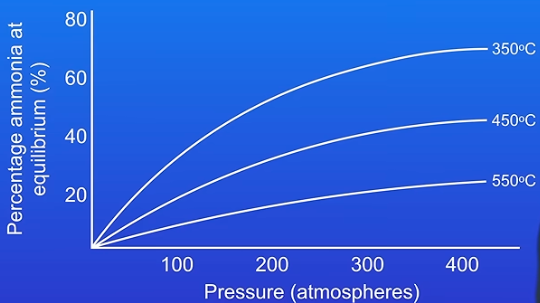
the pure reactants are passed over an iron catalyst at ~450c @ 200 atm causing some of the H2 and N2 to form ammonia but the catalyst has no effect on the position of equi
but bc reversible some of the NH3 breaks back down into N2 and H2 so to ↑ yield we now cool the ammonia and turn it into a liquid which is removed and then recycle the unreacted N2 and H2 back over the catalyst
haber process in equilibrium and tradeoffs
the forward reaction is exo ∴ cool temp will shift equi to the right and ↑ yield but the cool temp makes the reaction slow and so there is a trade off between ROR and position of equi so 450c is a compromise temp to get a relatively fast ROR and a relatively high yield of NH3 and the catalyst also ↑ ROR
(low temp reduces the rate but a high temp reduces the yield high temp requires more E so the 450 compromise is used)
bc of molecules a greater pressure will push equi to the RHS ; % NH3 also ↑ at v high pressure, but maintaining a high pressure is extremely expensive and dangerous so there is a compromise temp of 200 atm