nunes test 4
 Call Kai
 Learn
Learn Practice Test
 Spaced Repetition
 Match
Match Flashcards
 Knowt Play
1/104

There's no tags or description
Looks like no tags are added yet.
Name | Mastery | Learn | Test | Matching | Spaced | Call with Kai | Chat |
|---|
No analytics yet
Send a link to your students to track their progress
105 Terms
What are the three layers of the heart?
Epicardium, myocardium, endocardium.
Which layer is thickest?
Myocardium.
Why is the LV myocardium thicker?
It pumps blood to systemic circulation (higher resistance).
What does the endocardium line?
Chambers, valves, chordae tendineae, papillary muscles.
Where is the RA located?
Superior, right lateral border, posterior/right of RV, anterior to LA.
Where is the LA located?
Superior and most posterior chamber.
Where is the RV located?
Most anterior chamber, beneath sternum.
Where is the LV located?
Posterior to RV; forms apex.
Where is the tricuspid valve located?
Between RA and RV; more apical than MV.
Where is the mitral valve located?
Between LA and LV; anterior leaflet continuous with posterior aortic root.
Where is the aortic valve located?
LVOT between LV and aorta.
Where is the pulmonic valve located?
RVOT between RV and main pulmonary artery.
Where is the Thebesian valve located?
At coronary sinus opening into RA.
Where is the Eustachian valve located?
At IVC entrance into RA.
What is the Chiari network?
Fenestrated/web‑like portion of Eustachian valve.
What is the fossa ovalis?
Closed remnant of fetal foramen ovale on interatrial septum.
What are atrial appendages made of?
Pectinate muscles Also known as auricles.
Where is the RA appendage located?
Extends from RA and laps over aortic root.
Where is the LA appendage located?
Anterior‑lateral surface of LA beside pulmonary artery.
Why is the LA appendage important?
Common site for thrombus.
What separates RV inflow/outflow?
Crista Supraventricularis.
What is the moderator band?
Muscle carrying right bundle branch in RV.
Which chamber is heavily trabeculated?
Right ventricle.
Which chamber forms the apex?
Left ventricle.
What is a pericardial effusion?
Fluid buildup in pericardial sac.
Normal pericardial fluid amount?
10–50 mL.
What pathology can be seen at PSSA Aortic level?
ASD, RV dilation, bicuspid AV, valve thickening.
What pathology can be seen at PSSA Papillary level?
Papillary muscle rupture, LV wall motion abnormalities.
What causes pericardial effusion?
Disease states increasing fluid.
What does pericardial fluid do?
Prevents friction during contraction/relaxation.
What is regurgitation?
Backward flow due to improper valve closure.
Which valves can be assessed for regurgitation in PSSA Aortic level?
Tricuspid valve and pulmonic valve.
What are the causes regurgitation?
Leaflet dysfunction, annular dilation, structural abnormalities.
What does the right heart do, and which side is low pressure?
The right heart receives deoxygenated blood and pumps it to the lungs, and it is the low‑pressure side of the heart.
What does the left heart do, and which side is high pressure?
The left heart receives oxygenated blood and pumps it to the body, and it is the high‑pressure side of the heart.
Normal aortic valve area?
2–4 cm².
Normal pulmonic valve area?
2–4 cm².
Normal mitral valve area?
4–6 cm².
Normal tricuspid valve area?
7–9 cm².
What does PSSA show?
Cross‑sections of heart from base to apex.
What is seen at Aortic level?
Aortic valve (3 cusps), RA, LA, TV, PV, IAS, MPA.
What is seen at Mitral level?
RV, IVS, LV, AML, PML, LVPW.
What is seen at Papillary level?
RV, IVS, LV, anterolateral & posteromedial papillary muscles.
What is seen at Apex level?
Apical short axis view LV/RV; wall motion; thrombus.
How is PSSA obtained?
Rotate PSLA 90° toward left shoulder.
How do you move from Aortic → Mitral → Papillary → Apex?
Angle beam inferiorly and laterally.
Aortic level pathology?
ASD, RV dilation, Bicuspid aortic valve.
Mitral level pathology?
Mitral stenosis, leaflet thickening.
Papillary level pathology?
Papillary muscle rupture.
Apex pathology?
LV apical thrombus.
Akinetic
No wall motion
Hypokinetic
Slow movement
Hyperkinetic
Fast movement
Dyskinetic
Abnormal wall motion- walls moving in the same direction
Paradoxical
Wall moves in the opposite direction than normal
Three aortic cusps?
RCC, LCC, NCC.
Structure posterior to LA?
Descending thoracic aorta.
Structure anterior to aortic valve?
RVOT.
Mitral leaflets seen?
AML and PML.
Shape of MV opening?
Fish‑mouth appearance.
Two papillary muscles?
Anterolateral and posteromedial.
LV wall segments seen?
Anteroseptal, anterior, anterolateral, inferolateral, inferior, inferoseptal.
When do AV valves open?
When atrial pressure greater than ventricular pressure.
When do semilunar valves open?
When ventricular pressure greater than great vessel pressure.
Four phases of diastole?
sovolumic relaxation → Rapid filling → Diastasis → Atrial systole.
What happens during rapid filling in early diastolic?
80% of ventricular filling.
What happens during diastasis?
Pressure equalization; MV/TV close.
When does atrial systole occur?
At the end of ventricular diastole, with onset of the P wave.
Which valves are open during atrial systole?
AV valves (open a second time).
What happens during atrial systole?
Atrial contraction adds 20% of filling (atrial kick).
Isovolumic relaxation?
Semilunar closed; AV closed; pressure drops.
Isovolumic contraction?
AV closed; semilunar closed; pressure rises.
What valves are open during isovolumic contraction?
None — all valves are closed.
What happens to ventricular pressure and volume during isovolumic contraction?
Pressure rises; volume does not change.
What begins diastole?
End of T wave.
When does ventricular systole occur?
Begins with QRS and ends with T wave.
What happens during ventricular systole?
Blood is ejected into the great arteries.
What are the two phases of ventricular systole?
Rapid ejection and reduced ejection.
When is ventricular volume lowest?
At peak ventricular systole.
What ends diastole?
Start of QRS.
When does ventricular systole occur?
During the QRS → T wave.
Which valves are open and which valves are closed during ventricular systole?
During ventricular systole, the semilunar valves (aortic & pulmonic) are open, and the AV valves (mitral & tricuspid) are closed.
Blood flow order?
SVC/IVC → RA → TV → RV → PV → PA → Lungs → PV → LA → MV → LV → Aorta.
Cycle steps?
Isovolumic contraction → Ventricular ejection → Isovolumic relaxation → Ventricular filling.
Parasternal window position?
Left 3rd–5th intercostal space.
Apical window position?
Left mid‑clavicular line.
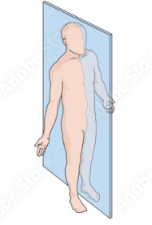
Sagittal plane?
Left/right.
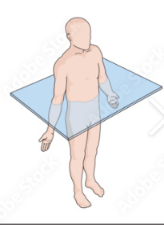
Transverse plane?
Top/bottom.
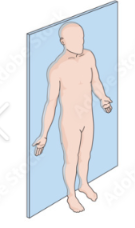
Coronal plane?
Front/back.
What is the IAS?
Interatrial septum.
What is the IVS?
Interventricular septum.
Which ventricle is crescent‑shaped?
Right ventricle.
Which ventricle is conical/ellipsoid?
Left ventricle.
What is the LVOT?
Left ventricular outflow tract.
What is the conus arteriosus, and what is the infundibulum?
The conus arteriosus is the right ventricular outflow tract (RVOT), and the infundibulum is another name for the RVOT.
What is the sinus of Valsalva?
Dilated pouch behind each aortic cusp.
Which sinuses give rise to coronaries?
Right and left coronary cusps.
What is the nodulus of Arantius?
Supports aortic cusps.
What is trabeculae carneae?
Irregular muscular ridges inside ventricles.
Which chamber is smooth inside?
Left atrium (except appendage).