TEN STEPS CH9: Argument
 Call Kai
 Learn
Learn Practice Test
 Spaced Repetition
 Match
Match Flashcards
 Knowt Play
1/31

There's no tags or description
Looks like no tags are added yet.
Name | Mastery | Learn | Test | Matching | Spaced | Call with Kai | Chat |
|---|
No analytics yet
Send a link to your students to track their progress
32 Terms
A good argument is not an
emotional experience in which people’s feelings get out of control, leaving them ready to start throwing things. Instead, it is a rational discussion in which each person advances and supports a point of view about some matter.
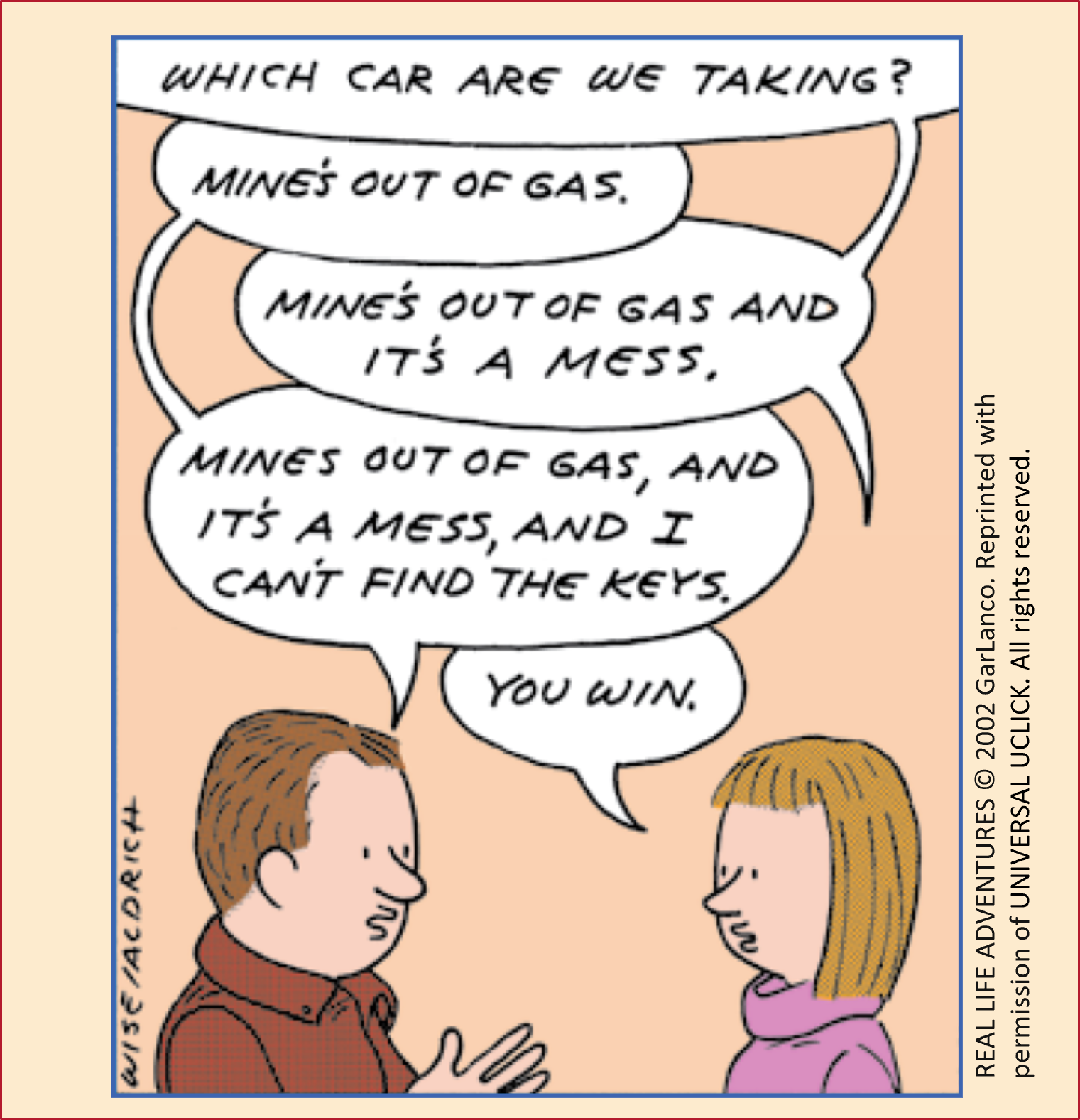
In an argument (such as the one going on in the above cartoon),
the two parties each present supporting evidence. The goal is to determine who has the more solid evidence to support his or her point of view.
Argumentation is a part of our everyday dealings with other people. It is also an important part of
much of what we read. Authors often try to convince us of their opinions and interpretations.
Very often the most important things we must do as critical readers are
Recognize the point the author is making. Decide if the author’s support is relevant. Decide if the author’s support is adequate.
A good argument is
one in which you make a point and then provide persuasive and logical evidence to back it up.
Point: Even though the apartment is nice, I don’t think you should move there.
This statement hardly discourages us from moving into the apartment.
Point: Even though the apartment is nice, I don’t think you should move there.
1: The closest washer and dryer are in a laundromat three miles away.
2: Next door to the apartment building is an all-night bar.
3: Several bugs scurried into dark holes when the kitchen sink cabinet door was opened.
Clearly, these details provide solid support for the point. In light of these details, we may consider looking for another apartment to rent.
Clear thinking in an argument means:
making a point and providing support that truly backs up that point.
A valid argument may also be described as
a conclusion supported by logical reasons, facts, examples, and other evidence.
Point: The corner convenience store is run poorly.
1: Milk is routinely kept on the shelves several days after the suggested date of sale.
2: The “fresh” fruits and vegetables are often spotted and wrinkled.
3: At busy times of the day, there’s not enough help in the store, so the lines are very long.
The solid support convinces us that a logical point has been made.
To evaluate an argument you need to
recognize its point and support.
To see if a sentence is a statement of support, try inserting the word
because in front of it. If the statement sounds right, it is probably a statement of support. For example, we could say, “Because the closest washer and dryer are three miles away, and because several bugs were visible below the kitchen sink, I’ve come to the conclusion that you should not move into that apartment.”
In the pair of statements below, one statement is the point, and the other is support for that point. Which is the support?
B. You’re always borrowing money from me.
In the three statements below, one statement is the point, and the other two are support for that point. Which is the point?
B. You can eat a healthy diet in restaurants with a little care.
In the four statements below, one statement is the point, and the other three are support for that point. Which is the point?
A. In the 19th century, theatergoers often felt free to “participate” in the performance.
Once you identify the point and support of an argument, you need to decide if each piece of evidence is relevant—in other words,
if it really applies to the point.
Relevant Support is
Support that really applies to the point.
In their enthusiasm for making an argument, people often bring up
irrelevant support. For example, the fan of potato chips in the cartoon does not offer relevant support for his point that potato chips are diet food.

In trying to get your cousin to take you to dinner, you might say, “You just got your paycheck.”
Point: You should take me to dinner.
Support: You just got your paycheck.
the support is
not relevant. The fact that she just got her paycheck is beside the point; the question is whether she wants (or is able) to spend any of it on you.
Which of the statements below is relevant support for this point that pigs make good pets?
Point: Pigs make good pets.
B. Pigs are friendly and intelligent.
Which of the statements below is relevant support for this point that pigs make good pets?
Point: Pigs make good pets.
C. Pigs can be taught to walk on a leash.
Read the paragraph and see if you can find the topic sentence.
“(1)When you go to college, you should live off campus. (2)In a rented apartment you can enjoy the privacy and convenience of your own kitchen and bathroom. (3)If you live off campus, getting to and from classes will take more time. (4)However, off-campus apartments give you more living space than a dormitory room for the same price or less. (5)An off-campus apartment is usually quieter than a dorm. (6)It also gives you a better chance to develop a sense of the larger community, the town or city in which your college is located.”
1.
Read the paragraph and see if you can find the statement that does not support the point of the argument.
“(1)When you go to college, you should live off campus. (2)In a rented apartment you can enjoy the privacy and convenience of your own kitchen and bathroom. (3)If you live off campus, getting to and from classes will take more time. (4)However, off-campus apartments give you more living space than a dormitory room for the same price or less. (5)An off-campus apartment is usually quieter than a dorm. (6)It also gives you a better chance to develop a sense of the larger community, the town or city in which your college is located.”
3.
Read the paragraph and see if you can find the statements that does support the point of the argument.
“(1)When you go to college, you should live off campus. (2)In a rented apartment you can enjoy the privacy and convenience of your own kitchen and bathroom. (3)If you live off campus, getting to and from classes will take more time. (4)However, off-campus apartments give you more living space than a dormitory room for the same price or less. (5)An off-campus apartment is usually quieter than a dorm. (6)It also gives you a better chance to develop a sense of the larger community, the town or city in which your college is located.”
2, 4, 5, and 6
A valid argument must include not only relevant support but also an
adequate amount of support—enough to prove the point
Adequate Support is
Support substantial enough to prove the point
Point: A government tax cut is a bad idea.
Support: My taxes will still be too high.
the support is
Not Adequate. It would not be valid to argue “A government tax cut is a bad idea” if this were one’s only support. Such an important issue would require more support than one person’s tax situation.
Supports: Lately Valerie has looked thinner and paler than usual. She used to go to all the parties, but now she stays home in the evenings. At work, she has been seen crying in the ladies’ room.
Which point do the above reasons adequately support?
B. Something is troubling Valerie.
A valid argument must have support that is substantial enough to prove the point. If the evidence is insufficient to support the argument, the point will
not stand.
In most textbook writing, argument takes the form of
well-developed ideas or theories.