Epithelial Tissue
 Call Kai
 Learn
Learn Practice Test
 Spaced Repetition
 Match
Match Flashcards
 Knowt Play
1/37

There's no tags or description
Looks like no tags are added yet.
Name | Mastery | Learn | Test | Matching | Spaced | Call with Kai | Chat |
|---|
No analytics yet
Send a link to your students to track their progress
38 Terms
Proteins
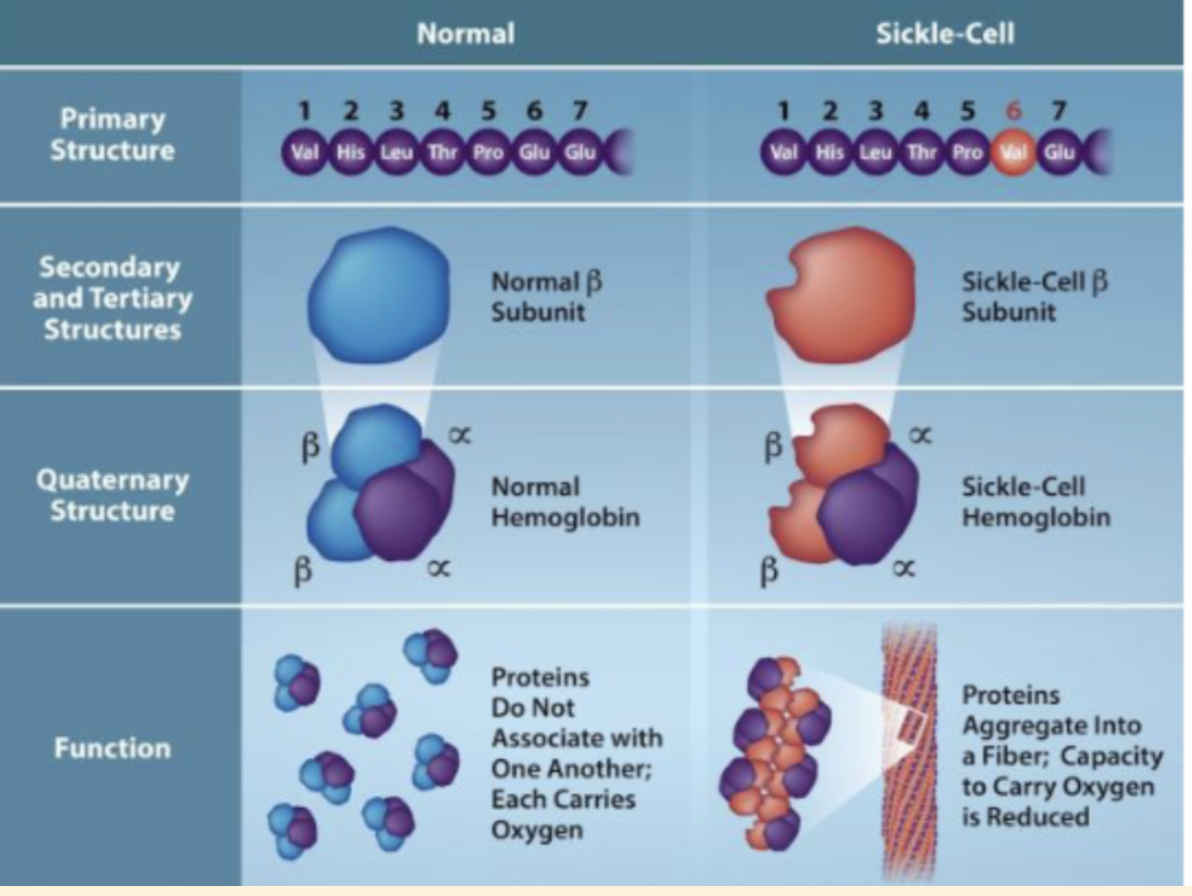
fold up into specific shapes according to the sequence of amino acids in the polymer
the protein function is directly related to the resulting 3D structure
Random mutation
can change function of proteins
ex: sickle cell → changes function
Chromosome
Threadlike structure of nucleic acids and protein found in the nucleic acids and protein found in the nucleus of most living cells, carrying genetic information in the form of genes
Each gene occupies a unique locus (location) on a particular chromosome
Parental Copies of Genes
Each parent contributes half: DUring reproduction, the mother’s egg cell and the father’s sperm cell each contain 23 chromosomes.
Fertilization restores the full set: When sperm and egg join, the resulting zygote has 46 chromosomes-23 from each parent
Homologous pairs are formed: The child’s chromosomes are organised into 23 pairs, where one chromosome in each pair comes from the mother and the other from the father.
Genes come in pairs (alleles): each parent’s version of a gene (allele) combines to determine the child’s traits
Mitosis
produces two genetically identical “daughter” cells from a single “parent” cell, whereas meiosis produces cells that are genetically unique from the parent with half as much DNA
2 daughter cells → each enter their own interphase and begin a new round of the cell cycle
Mitosis is 10% of average cells lifetime

Somatic cells
all the cells in the body that are not reproductive cells
Diploid (2 copies) → 46 chromosomes in human
Mitosis
Gametic cells (reproductive cells)
sex cells that fuse together during fertilization to create a new organism
Haploid (1 copy of each chromosome) → 23 chromosomes in human
Meiosis

Interphase
grows, replicates its chromosomes, and prepares for cell division
Cells are in Interphase usually. Interphase is 90% of the average cell's lifetime.
Cytokinesis
Division of cytoplasm, producing two daughter cells. Each daughter cell can start a new cell cycle
How daughter cells are separated
Creates identical cells in mitosis

G1 checkpioint
A cell has to receive a go-ahead signal at the G1 checkpoint. If it does not receive a go-ahead signal at that point, it may exit the cycle, switching into a nondividing state called the G0 phase

Connective tissue
supports and connects the body’s organs and tissues
Ex: bones, fat, ligaments
Muscle tissue
allows the body to move
skeletal muscle, smooth muscle
nervous tissue
carries messages throughout the body
neurons
Protection
Epithelial tissue protects the body from the outside environment
The protection can be physical like skin or chemical like stomach lining
Absorption
Epithelial tissue absorbs nutrients from the digestive tract and other body cavities
Secretion
Epithelial tissue secretes various substances, such as mucus, hormones, and enzymes
Sensation
Epithelial tissue contains sensory receptors that allow us to sense the outside environment
These receptors can detect touch, temperature, pain, and other stimuli
ECM
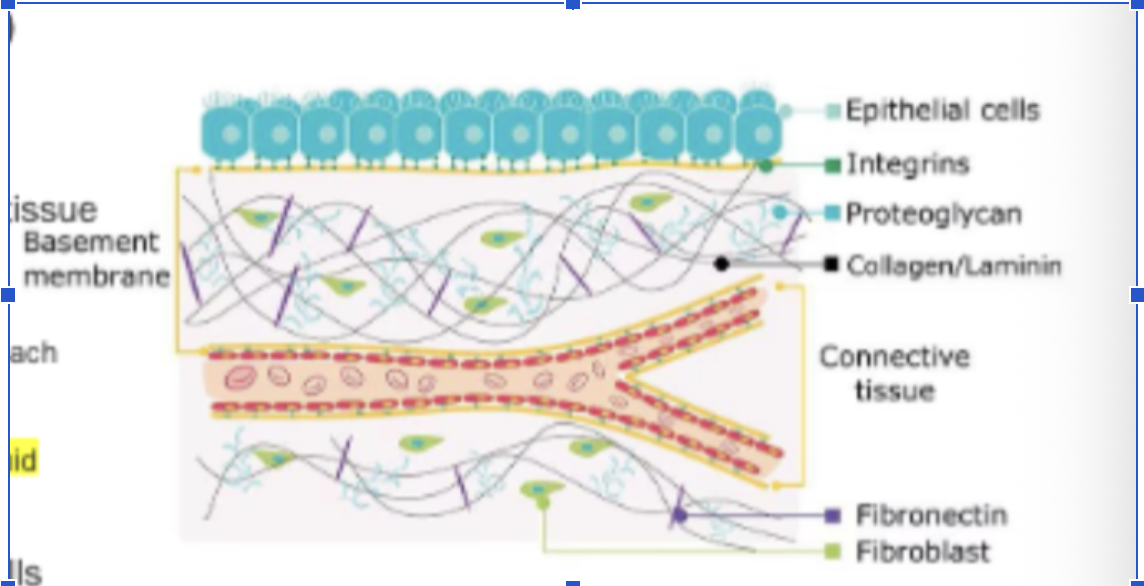
network of fibrous substances that surround/support cells in tissue
Varies greatly depending on tissue
ECM is made by the cells within the tissue; therefore, it is both unique to each tissue and plastic, depending on the activity of the cells
Example: the ECM of bone tissue is solid while the ECM of the blood is liquid
In the ECM, cells are held in place, guided in their movement (for cells that move), and supported
Collagen fiber
main component of ECM
strong protein strands

Proteoglycans
are protein that are chemically modified with sugar molecules
main component of ECM
Tight junctions
fuses the membranes of two neighboring cells together tightly so that there is no extracellular space between them.
Blocks the movement of substances through the extracellular space between cells.
Important feature of the intestine
Gap junctions
clusters of channels that allow diffusion of ions and small molecules between adjacent cells
Epithelial Tissue
large sheets of cells covering all the surfaces of the body.
Main function is protection, found in locations that are exposed to the “outside” world, i.e skin and lining of mouth
Lines hollow organs and body cavities
Inside vs outside spaces
“Inside” spaces are sterile and no bacteria should be found within them. Blood vessels
Endothelium lines “inside structures”
“Outside” spaces are nonsterile: the airways, the digestive tract, and the urinary and reproductive systems
Epithellium lines “outside structures”
apical side
“Top surface” of the epithelia
Epithelial cells often have either cillia (A) or microvilli (B) on their apical surface
Basal side
“bottom surface”
Polar (for ET)
cells have distinct sides that are structurally and functionally different from each other
Cillia
Sweep materials off the apical surface
Microbilli
TO expand the surface area of the cell
Simple ET
is for tissue with a single layer of cells
Stratified ET
is for tissue consisting of several layers
Simple Epithelium
every cell rests on the basal lamina
Stratified epithelium
only the basal layer of the cell rests on the basal lamina
These epithelia are found in places where the apical surface is subject to more friction and the multiple cell layers protect the underlying tissue from wear and tear
To maintain the number of layers in the tissue, the cells at the basal layer are constantly undergoing mitosis to generate new layers
Stratified squamous epithelium
the most common type of stratified epithelium in the human body
Found in moist places of the body, such as lining the inside of your cheeks. Cells shed frequently.
When stratified squamous epithelia are found in places of the body that are dry, such as the surface of your skin, the epithelium is modified to help retain moisture.
The apical layer of living cells is topped by additional layers of dead cells that are filled with protein keratin
Epithelial tissue
are sheets of cells that cover exterior surfaces of the body, line internal cavities and passageways, and form certain glands
Consist of:
Primary epithelium, covering of surfaces
Glandular epithelium, forms glands
Endocrine gland
if it secretes within the body and bloodstream
Both exocrine and endocrine gland formed by glandular epithelium
Endocrine glands are always ductless and release their secretions directly into surrounding tissues and the bloodstream
Secretions (hormones) are released into the interstitial fluid, diffused into the bloodstream, and delivered to cellular receptors
The endocrine system is part of a major regulatory system coordinating the regulation and integration of body

Exocrine gland
if it secretes onto an epithelium to the outside of the body
Both exocrine and endocrine gland formed by glandular epithelium
Sweat glands and the glands of the digestive system are two examples of exocrine glands
Exocrine glands often have a duct through which the gland’s secretions leave to reach the epithelium
Exocrine glands release their contents through a duct that leads to the epithelial surface
Mucus, sweat, etc, are examples of secretion from exocrine glands
Most exocrine secretions are released through tubular ducts

Goblet cells
Mucus-secreting cells that are technically unicellular exocrine glands
Also thought to be involved with immunoregulation
Mucus forms a protective gel-like layer over the surface epithelium and protects against bacterial invasion
GOBLET CELLS DO NOT HAVE DUCTS. RELEASE THEIR SECRETION ON THEIR ATYPICAL SURFACE