Ecology
 Call Kai
 Learn
Learn Practice Test
 Spaced Repetition
 Match
Match Flashcards
 Knowt Play
1/95

There's no tags or description
Looks like no tags are added yet.
Name | Mastery | Learn | Test | Matching | Spaced | Call with Kai |
|---|
No analytics yet
Send a link to your students to track their progress
96 Terms
Abiotic Factors
Non-living elements of an ecosystem like temperature, water, light
Biotic Factors
Living elements of an ecosystem
Things like plants, animals, etc
Species
A group that can interbreed and have viable, fertile offspring
Population
A specific species living in a specific location
Habitat def
The type of environment where a specific organism lives
Includes other biotic and abiotic factors
Ecological Community
All the populations in a specific geographic area
Ecosystem
System of all the organisms (biotic factors) in an ecological community and their interactions with the abiotic factors
Density Dependent Factors
Examples
Depend on population density
Disease, resources, competition
Density independent factors
Climate, weather
Biome
A large area of land or water defined by its biotic factors, which are adapted to the climate and geography of that region
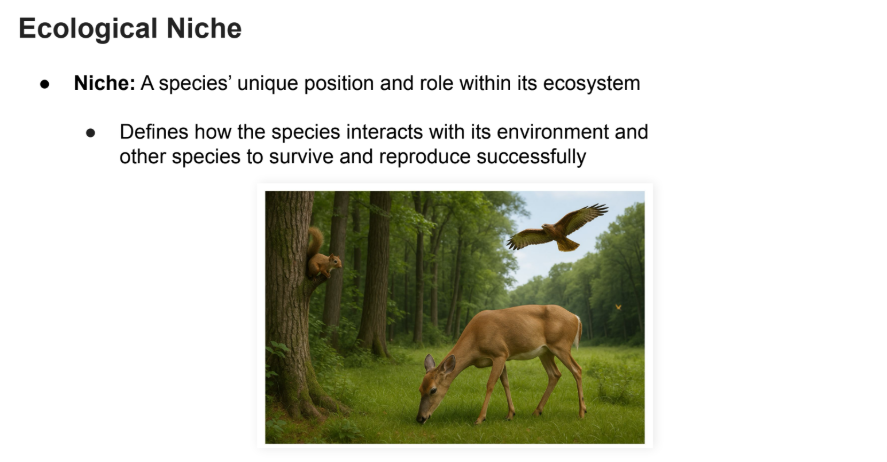
Ecological Niche
A species’ unique position and role within its ecosystem
Defines how the species interacts with its environment and other species to survive and reproduce successfully
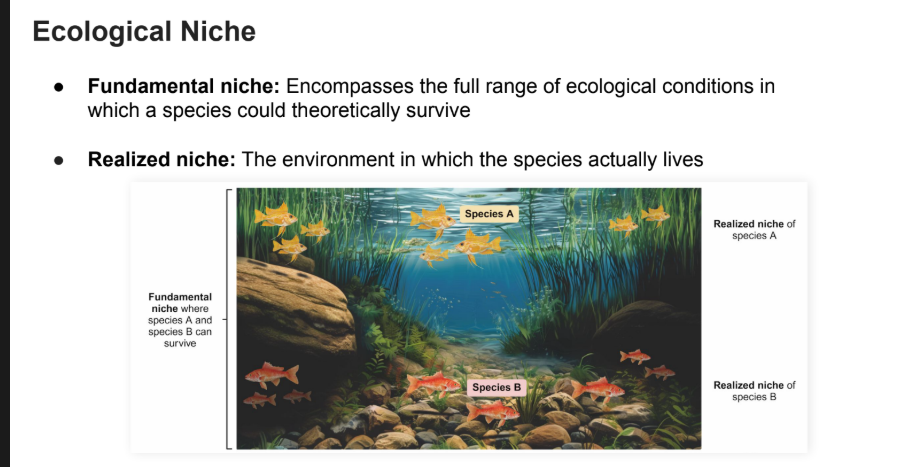
Fundamental Niche
Encompasses the full range of ecological conditions in which a species could theoretically survive
Realized Niche
The environment in which the species actually lives
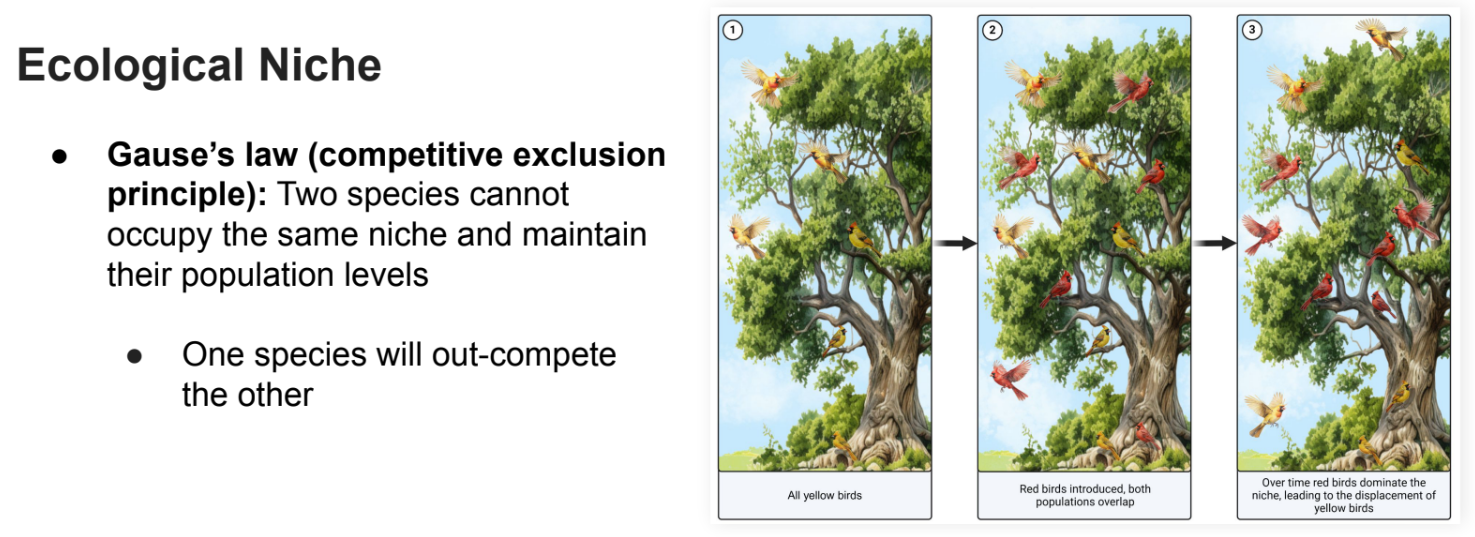
Gause’s Law → Competitive Exclusion Principle
Gause’s law (competitive exclusion principle):
Two species cannot occupy the same niche and maintain
their population levels
One species will out-compete the other
Resource Partitioning
Resource partitioning: Species may coexist by utilizing resources in different ways, at different times, or in different places
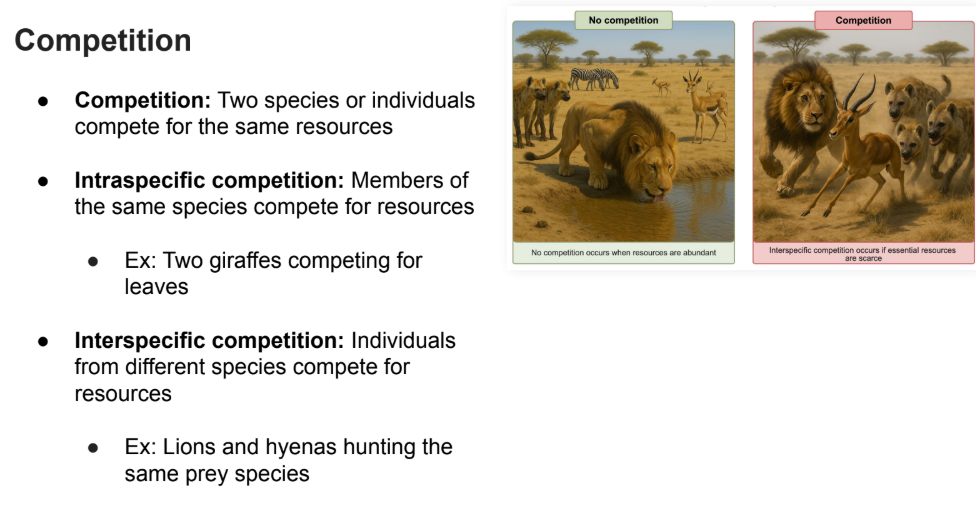
Competition
Two species or individuals compete for the same resources
Intraspecific Competition
Members of the same species compete for resources
Ex: Two giraffes competing for leaves
Interspecific competition
Individuals from different species compete for resources
Ex: Lions and hyenas hunting the same prey species
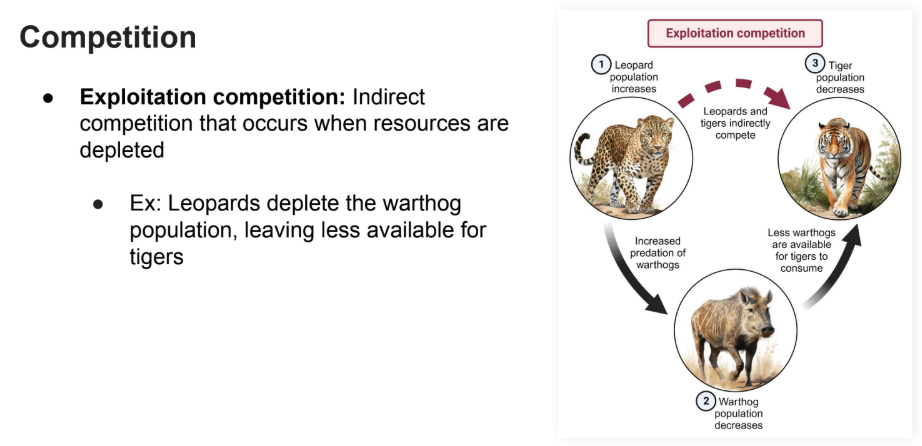
Exploitation Competition
Indirect competition that occurs when resources are depleted
Ex: Leopards deplete the warthog population, leaving less available for tigers
Apparent Competition
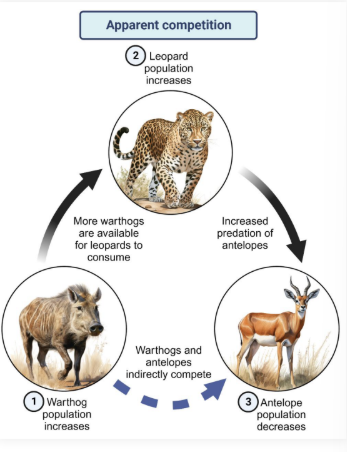
Apparent competition: Indirect competition that occurs between two species of prey that share a common predator
Ex: Increased warthog population allows for increased leopard population, which increases antelope predation
Interference Competition
Interference competition: Occurs when one species directly prevents the establishment of another that would compete for mutual resources
Allelopathy
Plants that secrete toxic chemicals
Symbiosis
A close, long-term interaction between two organisms (symbionts)
Mutalism
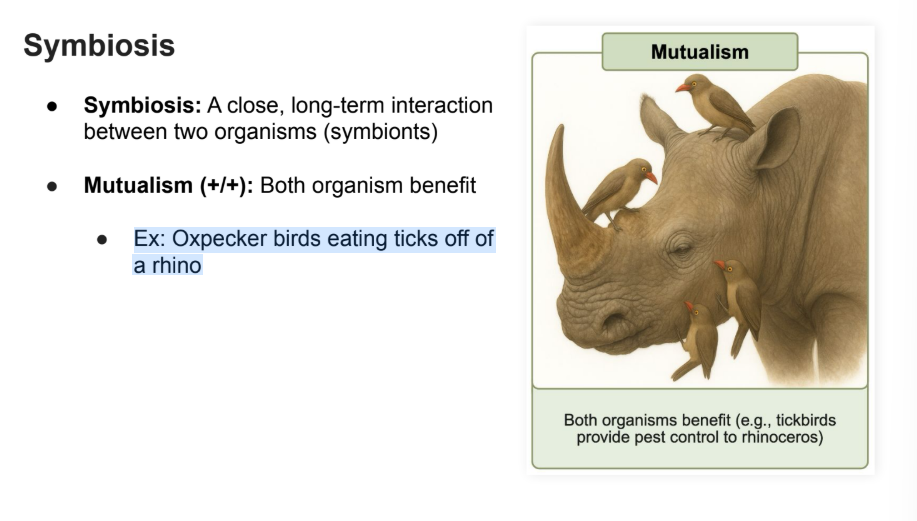
Both organisms benefit
Ex: Oxpecker birds eating ticks off of a rhino
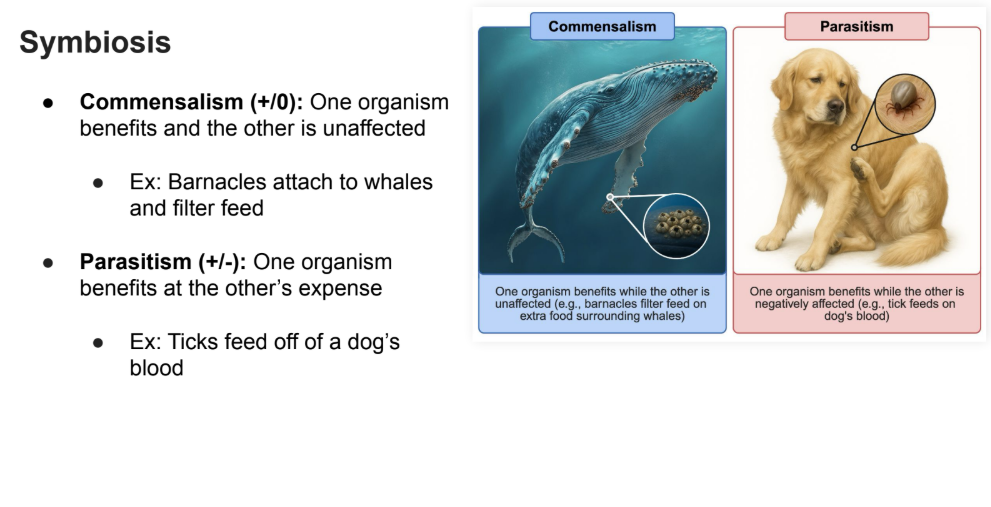
Commensalism
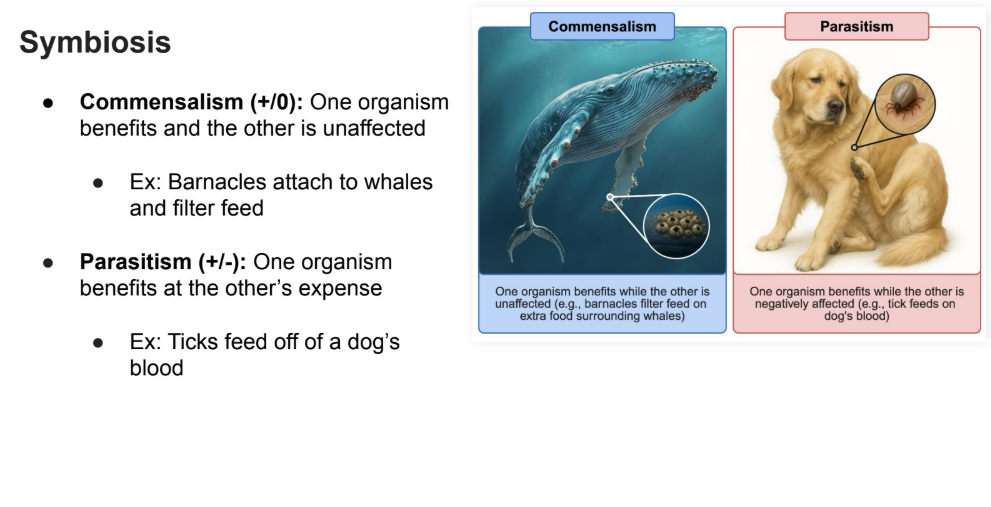
Commensalism (+/0): One organism benefits and the other is unaffected
Ex: Barnacles attach to whales and filter feed
Parasitism
One organism benefits at the other’s expense
Ex: Ticks feed off of a dog’s blood
Food chain
Linear depiction of what eats what
Ex: Carrot → rabbit → fox → lion
Food Web
More complex diagram depicting interconnections between food chains
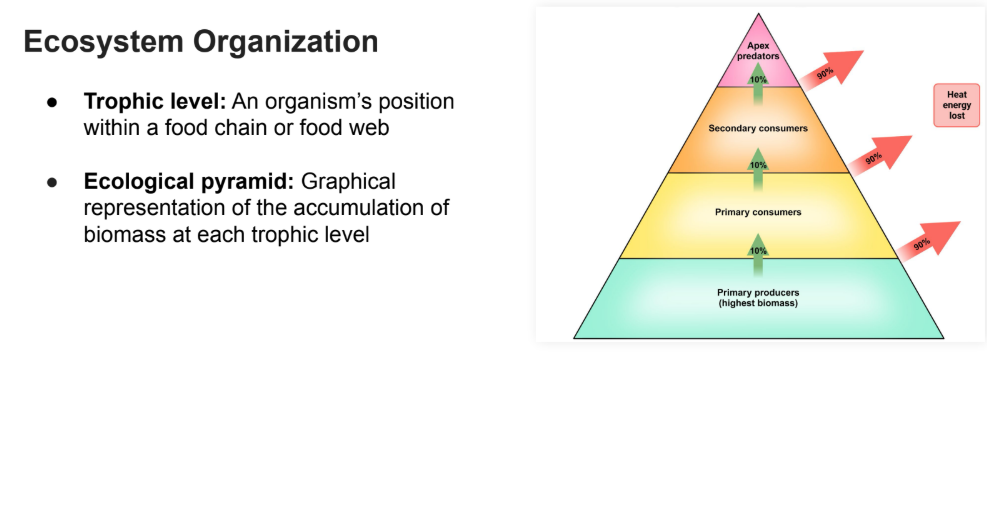
Trophic Level
An organism’s position within a food chain or food web
Ecological Pyramid
Graphical representation of the accumulation of biomass at each trophic level
Autotrophs
Autotrophs: Produce organic compounds from abiotic factors (sunlight, water, CO2, etc.)
Heterotrophs:
Must ingest organic compounds to generate energy and survive
Predation def
Predation: Relationship between predator (hunter) and prey (hunted - plant or animal)
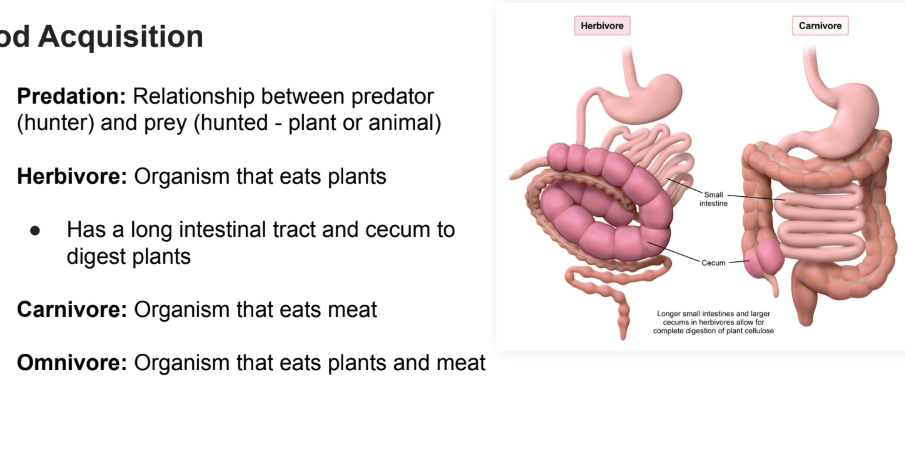
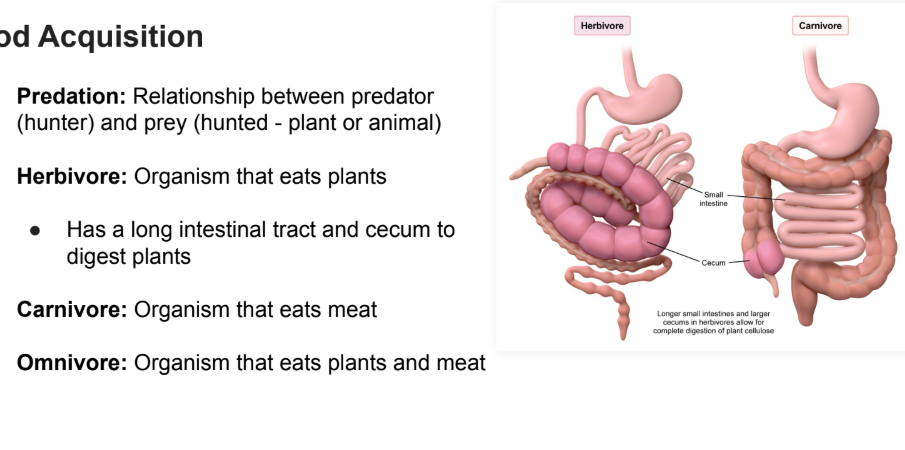
Herbivore
what makes their digestion different
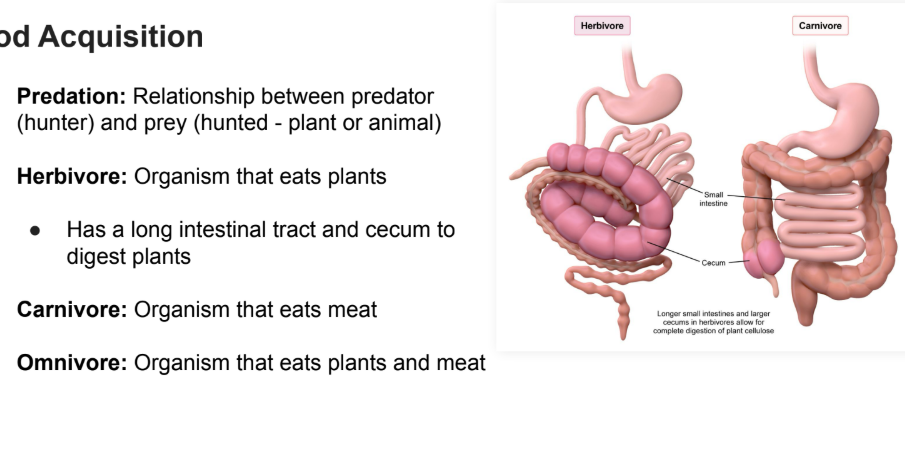
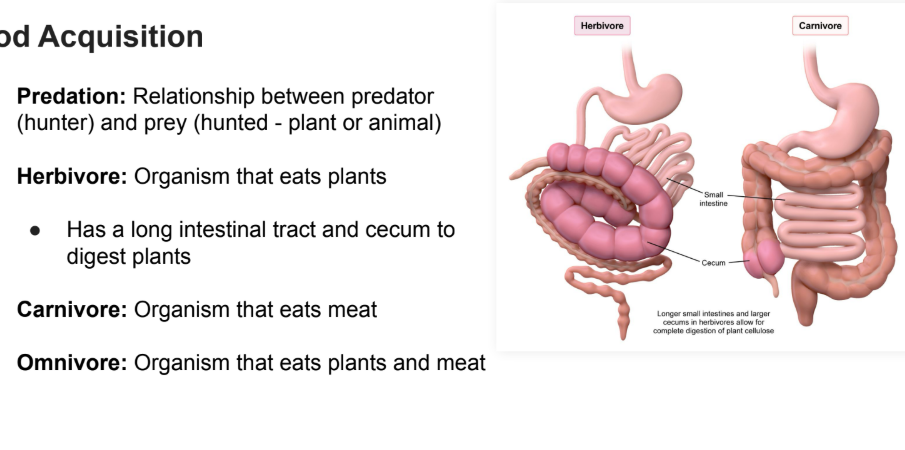
Herbivore: Organism that eats plants
Has a long intestinal tract and cecum to digest plants
Carnivore
Organism that eats meat
Omnivore
Organism that eats plants and meat
Invasive Species
Non-native species that outcompetes native species and overtakes the ecosystem
Non-invasive species
Non-native species that survives in but does not overrun the ecosystem
Naturalized species:
Non-native species that spreads beyond its origin and reproduces sufficiently to maintain its population
Exotic Species
Non-native species that lives outside of its native distributional range due to human activity
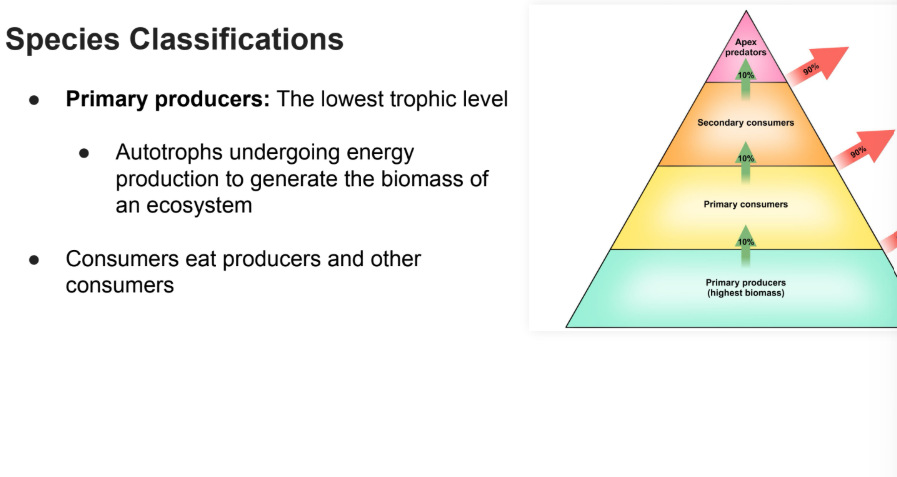
Primary Producers
The lowest trophic level
Autotrophs undergoing energy production to generate the biomass of an ecosystem
Consumers eat producers and other consumers
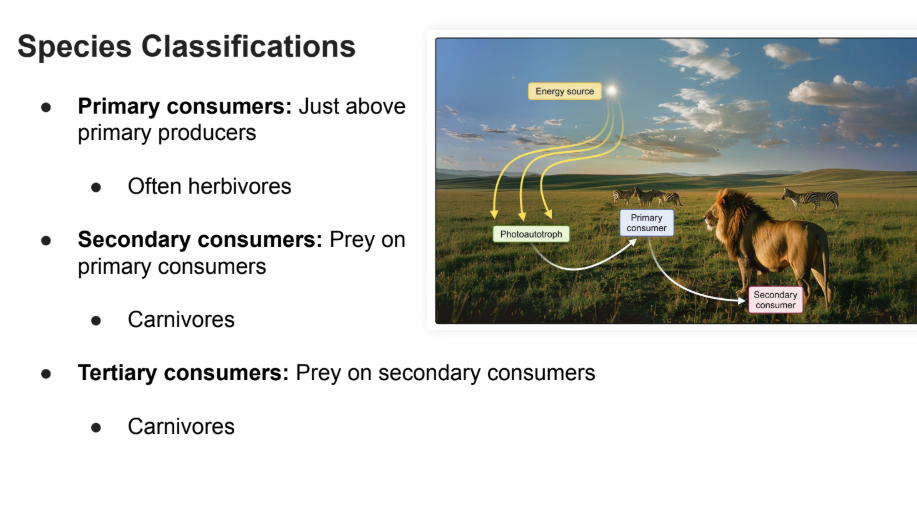
Primary Consumers
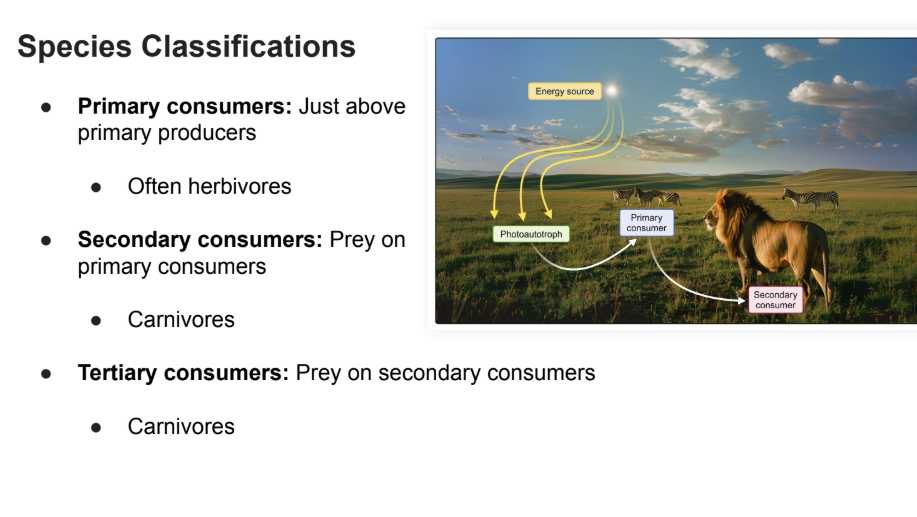
Just above primary producers
Often herbivores
Secondary consumers
Prey on primary consumers
Carnivores
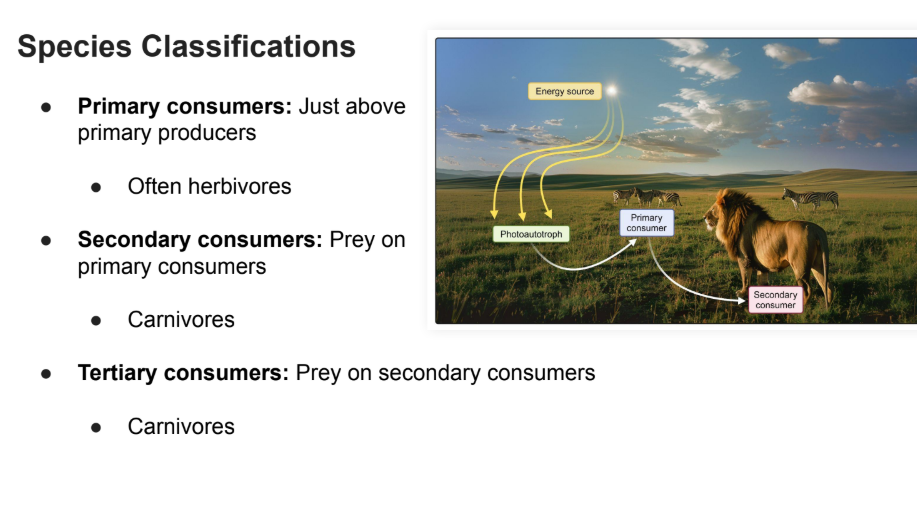
Tertiary Consumers
Prey on secondary consumers
Carnivores
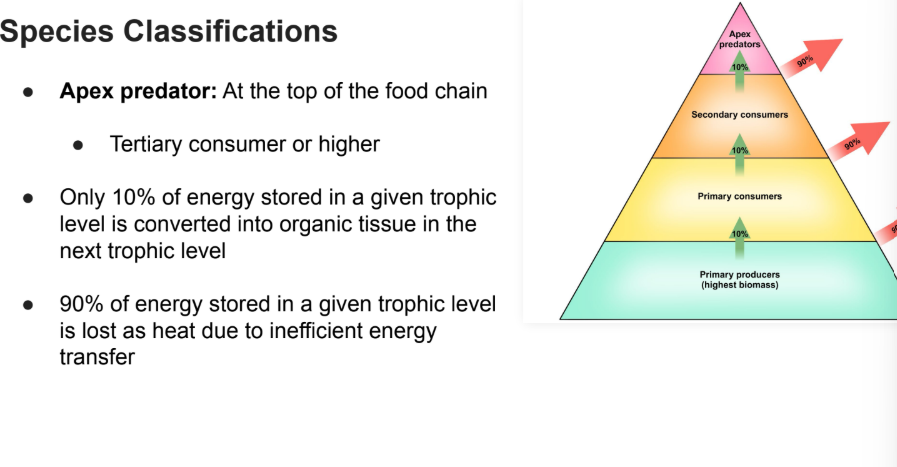
Apex Predator
At the top of the food chain
Tertiary consumer or higher
Movement of energy moving through trophic levels.
Only 10% of energy stored in a given trophic level is converted into organic tissue in the next trophic level
90% of energy stored in a given trophic level is lost as heat due to inefficient energy transfer
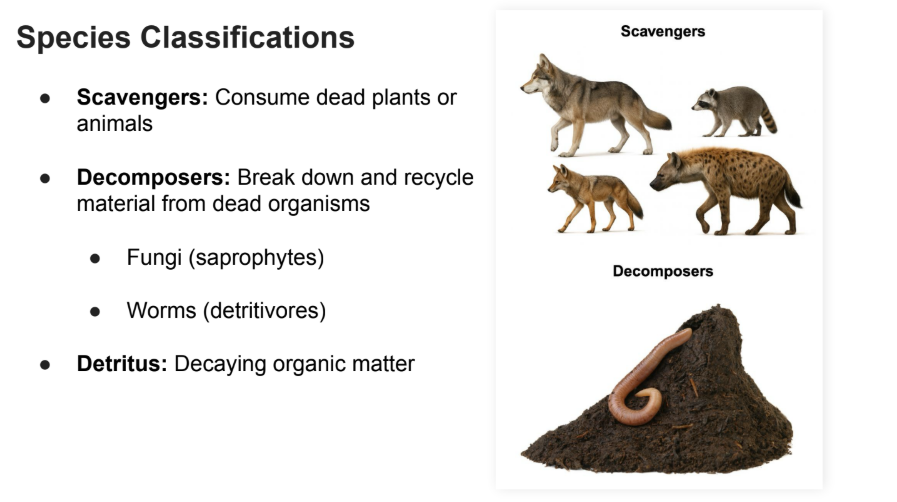
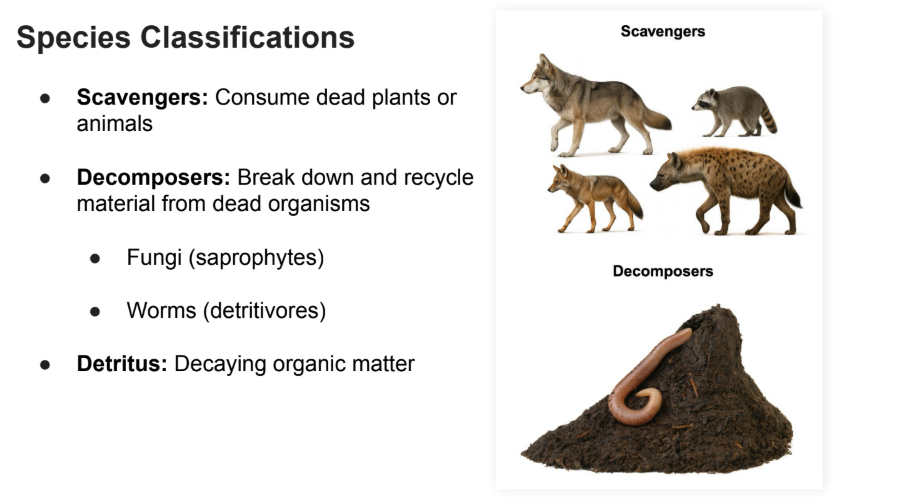
Scavengers
Consume dead plants or animals
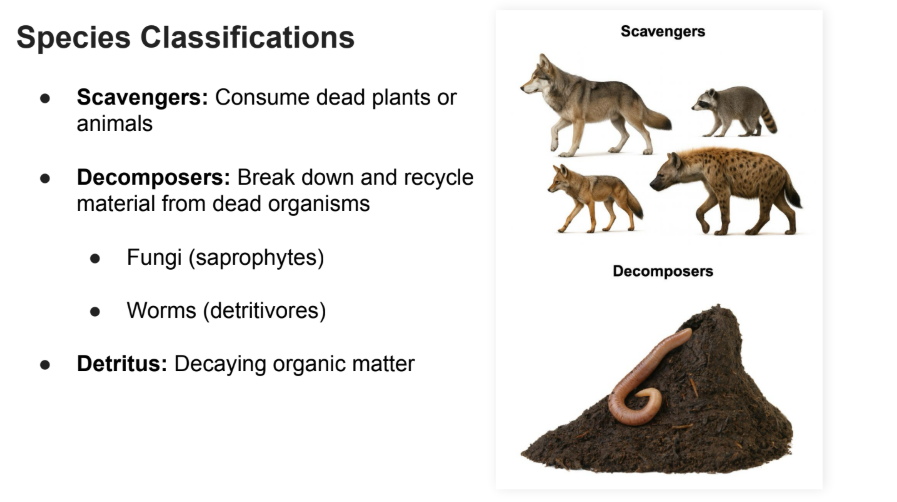
Decomposers
Break down and recycle material from dead organisms
Fungi (saprophytes)
Worms (detritivores)
Detritus
Decaying organic matter
Photoautotrophs
Energy source
Carbon Source
Energy source: Light
Carbon Source: CO2
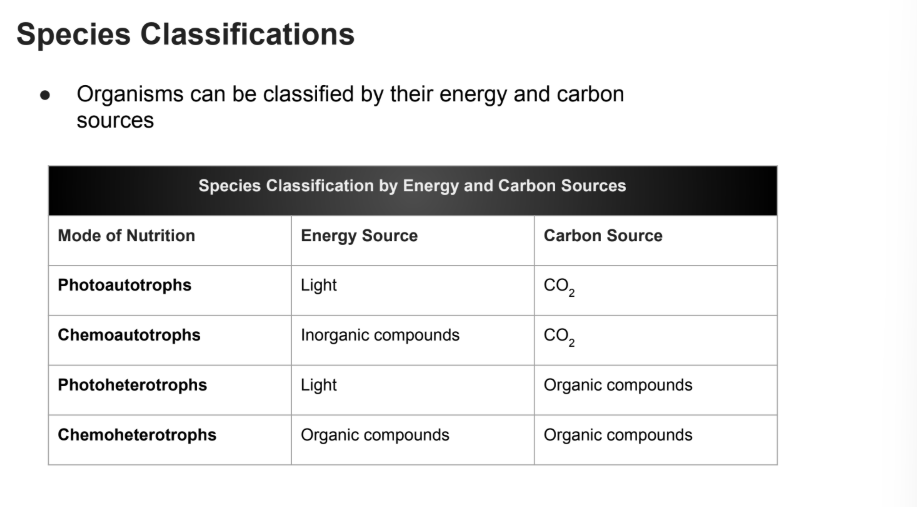
Chemoautotrophs
Energy source
Carbon Source
Energy source: Inorganic Compounds
Carbon Source: CO2
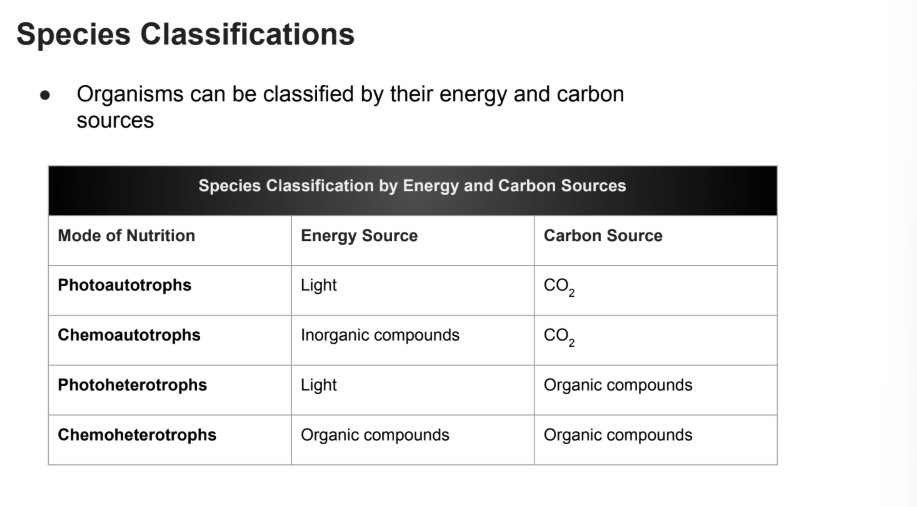
Photoheterotrophs
Energy source
Carbon Source
Energy source: Light
Carbon Source: Organic Compounds
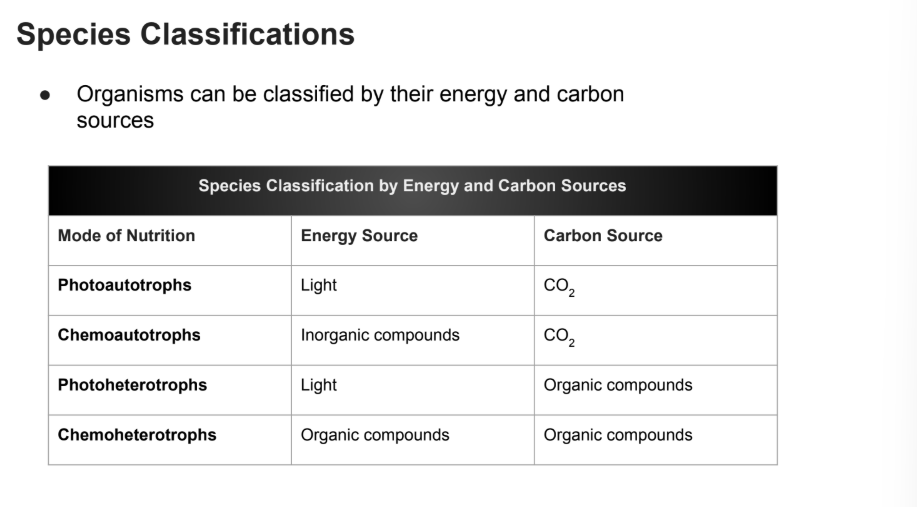
Chemoheterotrophs
Energy source
Carbon Source
Energy source: Organic Compounds
Carbon Source: Organic Compounds
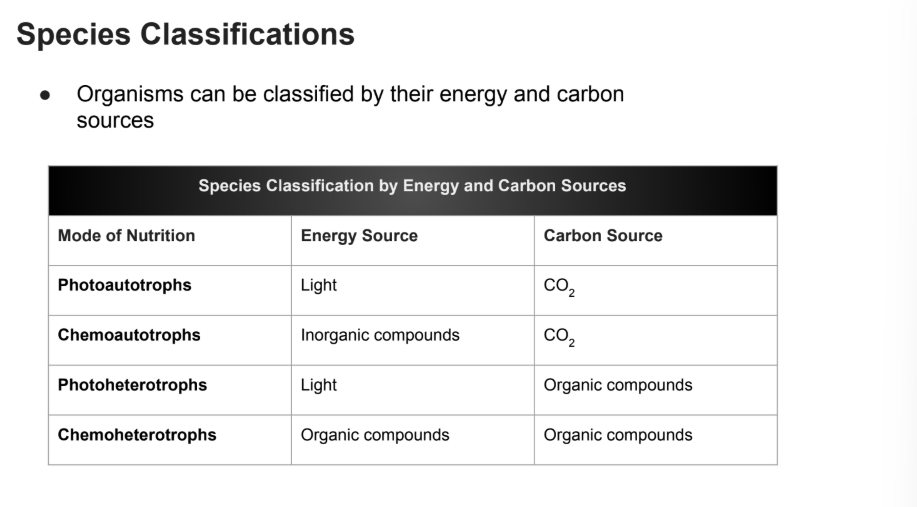
Autotrophs
How do they get their carbon
They can fix carbon.
Use inorganic CO2 as primary carbon source.
Heterotrophs
How do they get their carbon
Derive their carbon from organic compounds
Population Dynamics
Population dynamics: The study of how populations change in space and time and how they interact with their environment
Biotic Potential
A species’ ability to achieve its highest population growth
Occurs when conditions are ideal
Highest birth rates and lowest death rates
Carrying Capacity
The maximum population size an ecosystem can sustain
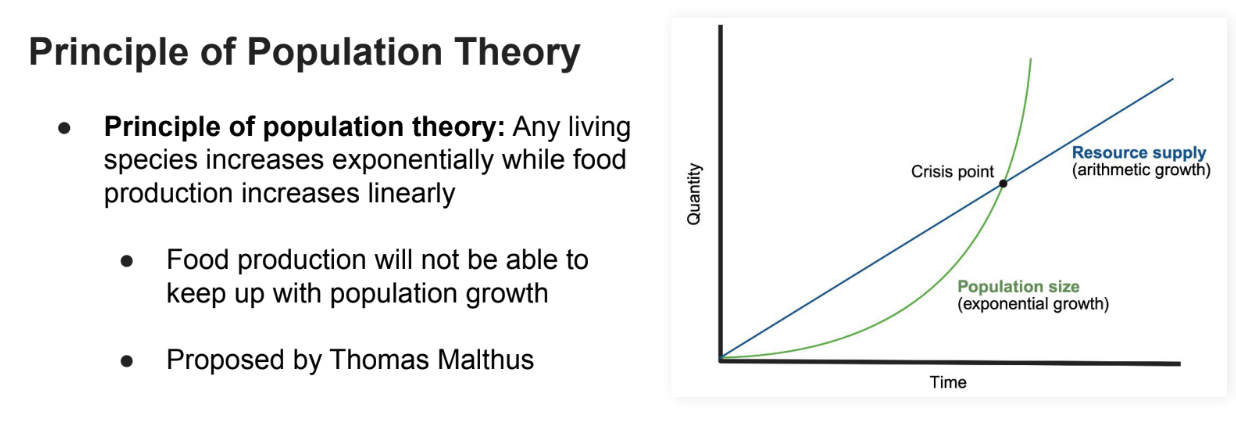
Principle of Population Theory
Any living species increases exponentially while food production increases linearly
Food production will not be able to keep up with population growth
Proposed by Thomas Malthus
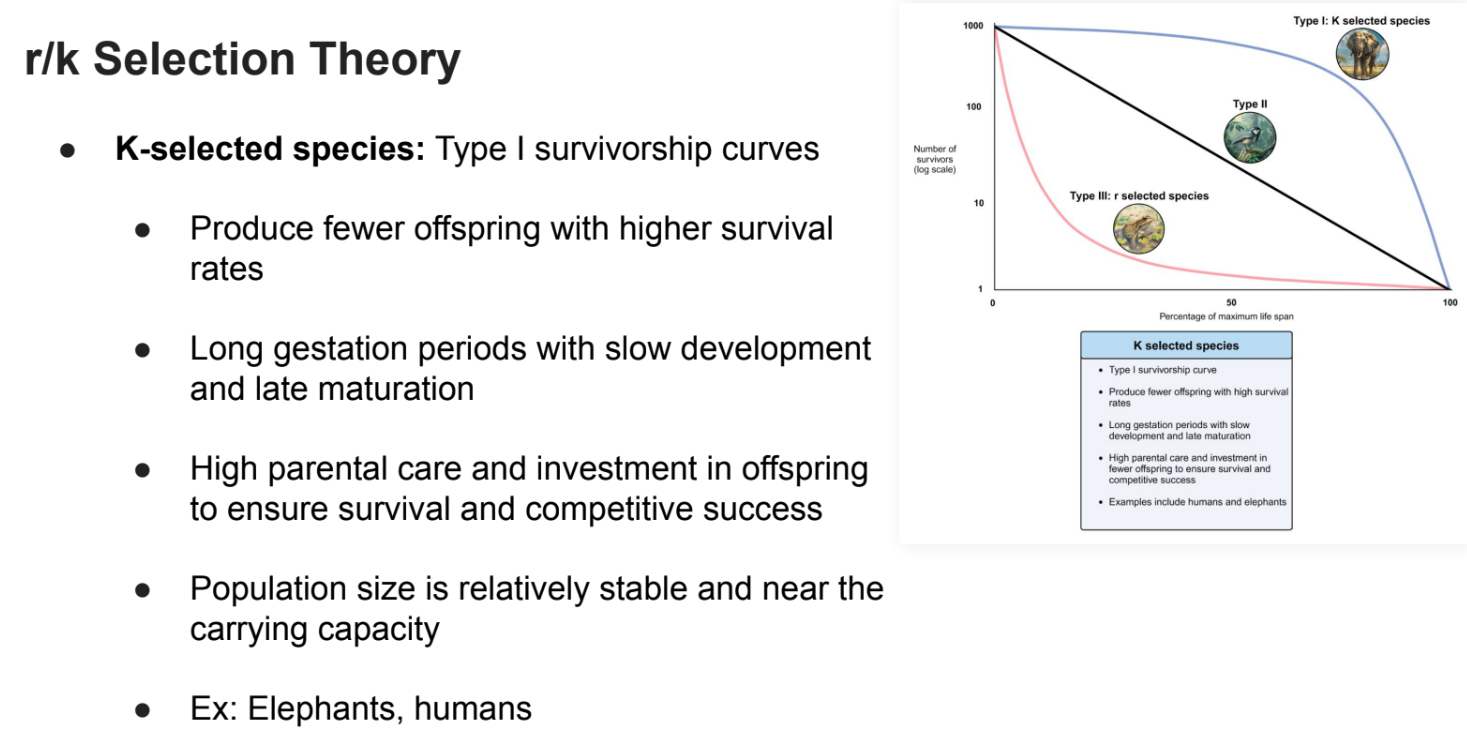
K - selected species
Population size
Reproductive rates
Parental care
Length of development and gestation
Survival rates
Offspring amounts
Example species
K-selected species: Type I survivorship curves
Produce fewer offspring with higher survival rates
Long gestation periods with slow development and late maturation
High parental care and investment in offspring to ensure survival and competitive success
Population size is relatively stable and near the carrying capacity
Ex: Elephants, humans
R - selected species
Reproductive rates
Parental care
Length of development and gestation
Survival rate
Offspring amounts
R-selected species:
Type III survivorship curve
Produce more offspring with lower survival rates
High number of offspring ensures some survive
Short gestation periods with quick development and early maturation
Low parental care in unstable environmental conditions
R selected species polpulation size
Population densities are well below carrying capacity of the enviroment.
Example species
Population size fluctuates wildly
Population densities are well below carrying capacity of the environment
Ex: Insects, frogs
Type II survivorship species
Mortality rate is roughly constant throughout the organism’s life span
Survival chances do not significantly increase or decrease at any stage of life
Ex: Many birds, small mammals, and some reptiles
Ecological Succesion
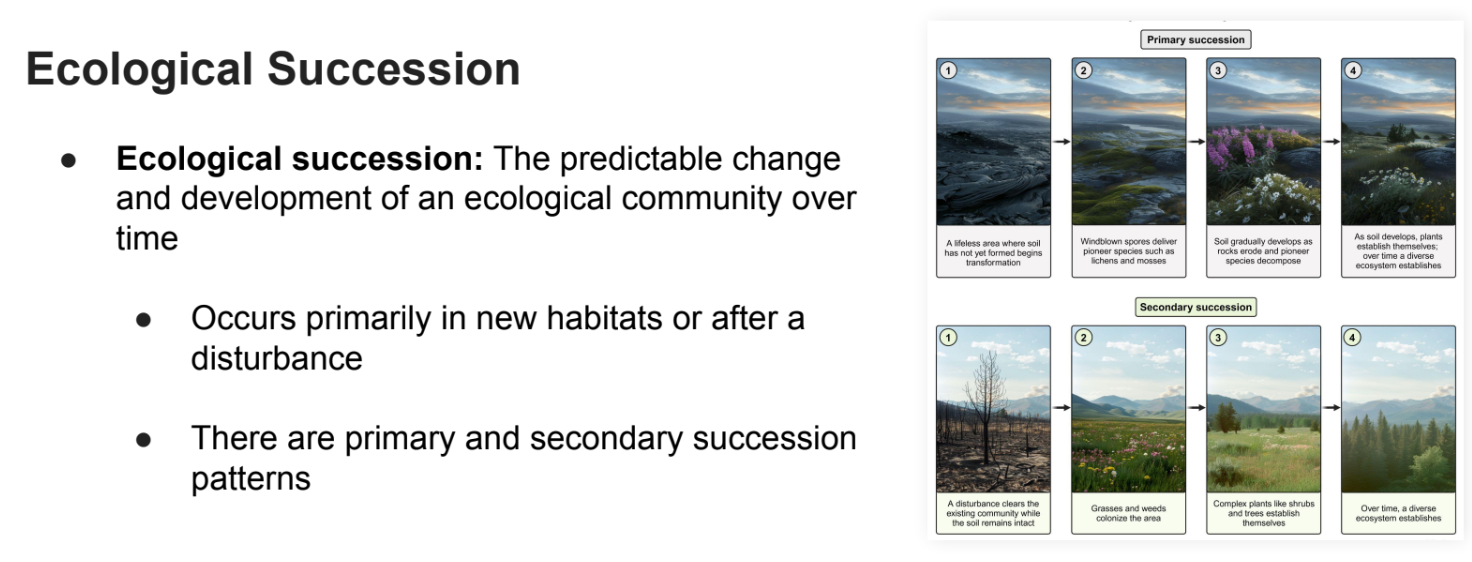
Ecological Succession
The predictable change and development of an ecological community over time
Occurs primarily in new habitats or after a disturbance
There are primary and secondary succession patterns
Primary Succession
Example
What causes it to occur
Occurs after a large disturbance in an area that has never supported life
EX: An example of a large disturbance is a volcanic eruption
What kicks of the of primary succession areas?
Example
Pioneer species
EX: Lichen, fungi, algae
Order of colonization species for primary succession
Pioneer species → thin soil → vascular plants (e.g., grasses, shrubs) → larger plants (e.g., trees) → animals
Climax Community
End result of primary succession
A steady state is reached and a balance of species is achieved
Secondary Succesion
What are the disasters that cause it.
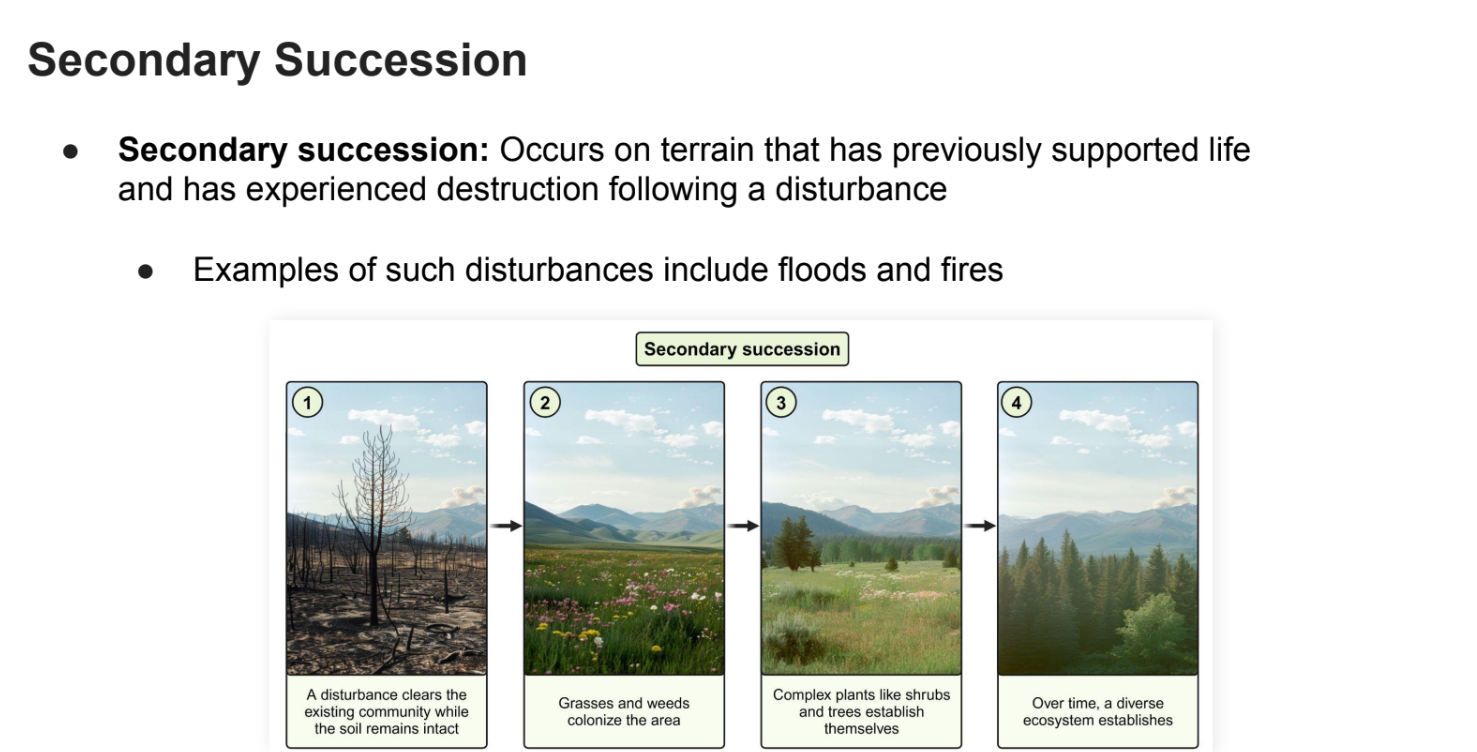
Occurs on terrain that has previously supported life and has experienced destruction following a disturbance
Examples of such disturbances include floods and fires.
Colonization pattern of secondary succesion
Secondary succession begins with grasses and shrubs (i.e, vascular plants)
Keystone Species:
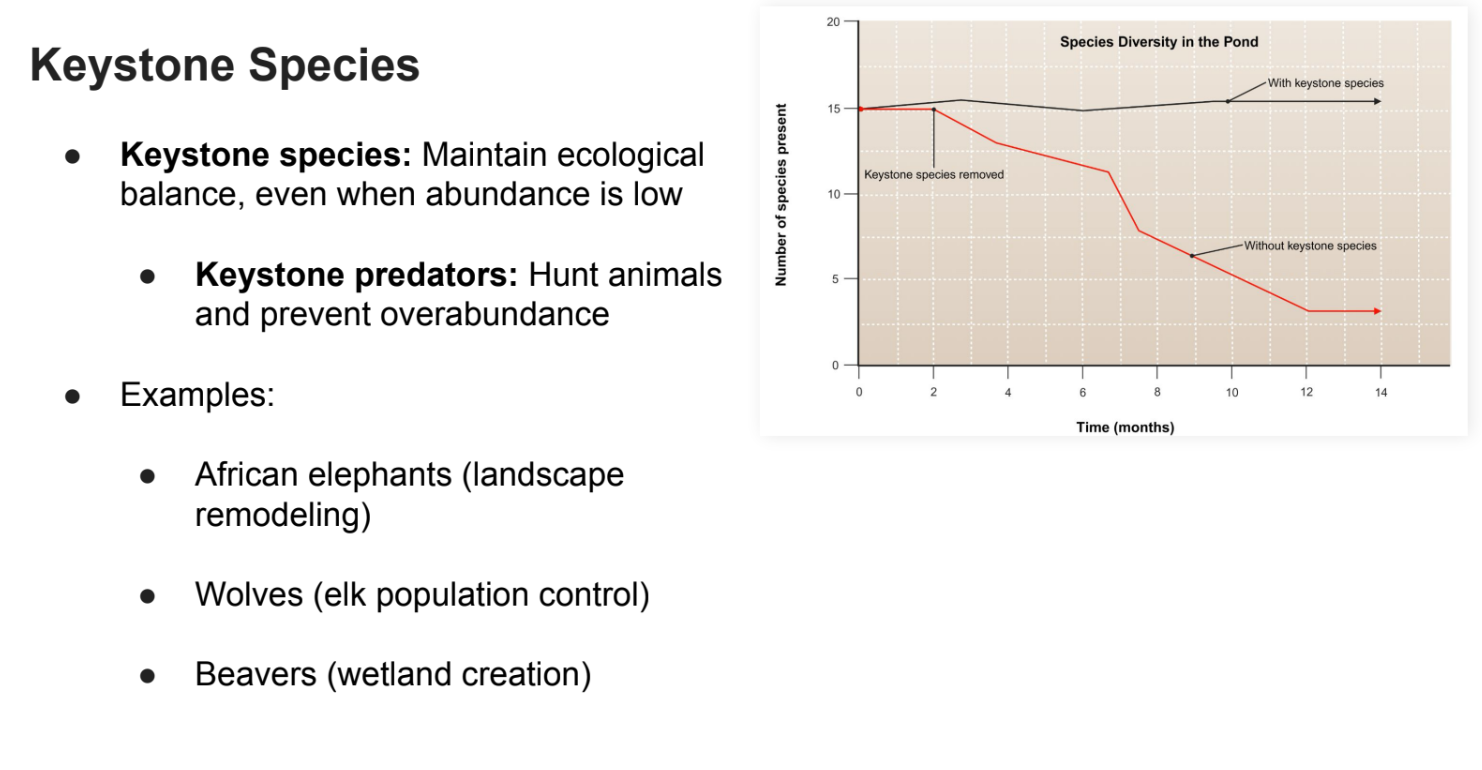
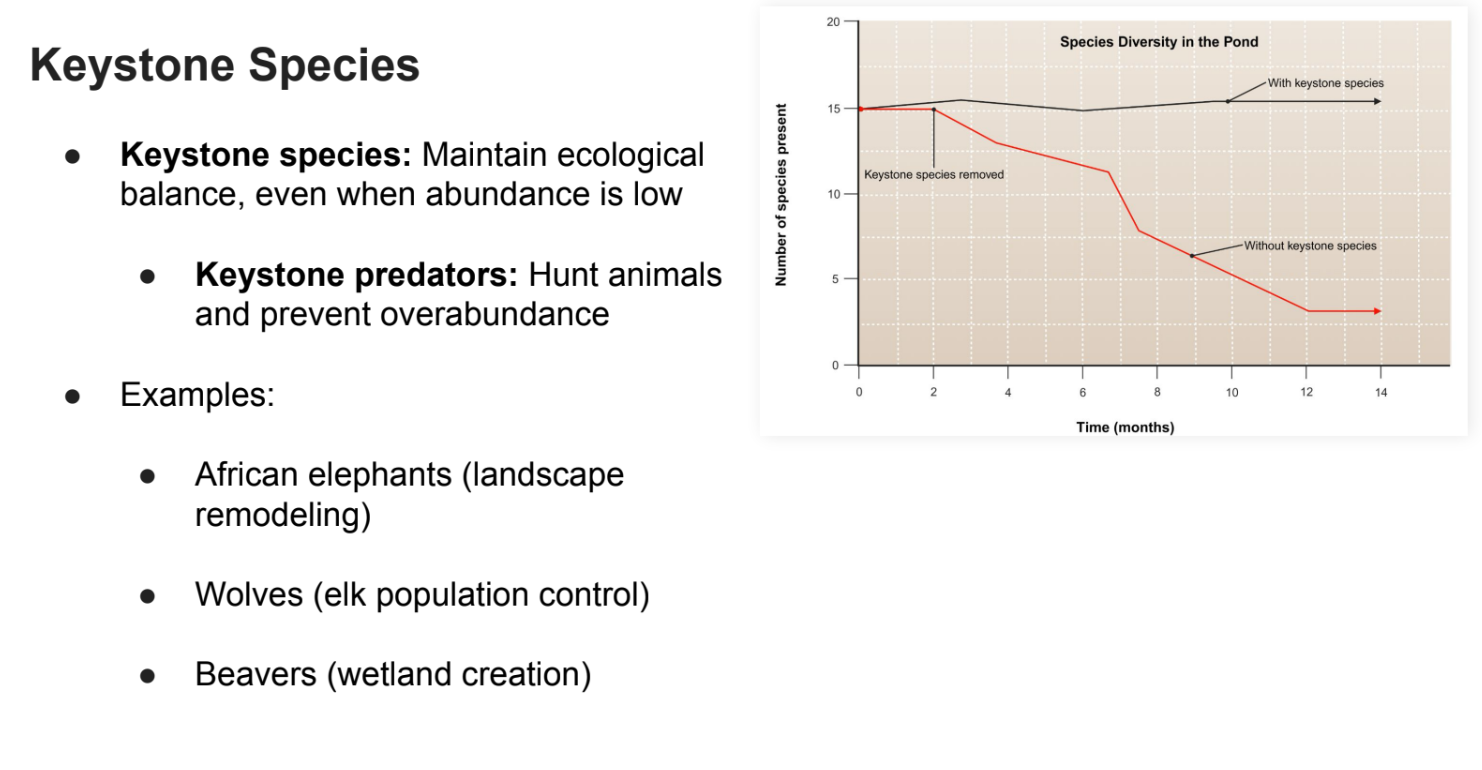
Maintain ecological balance, even when abundance is low
Examples:
African elephants (landscape remodeling)
Wolves (elk population control)
Beavers (wetland creation)
Keystone Predators
Hunt animals and prevent overabundance
Eutrophication
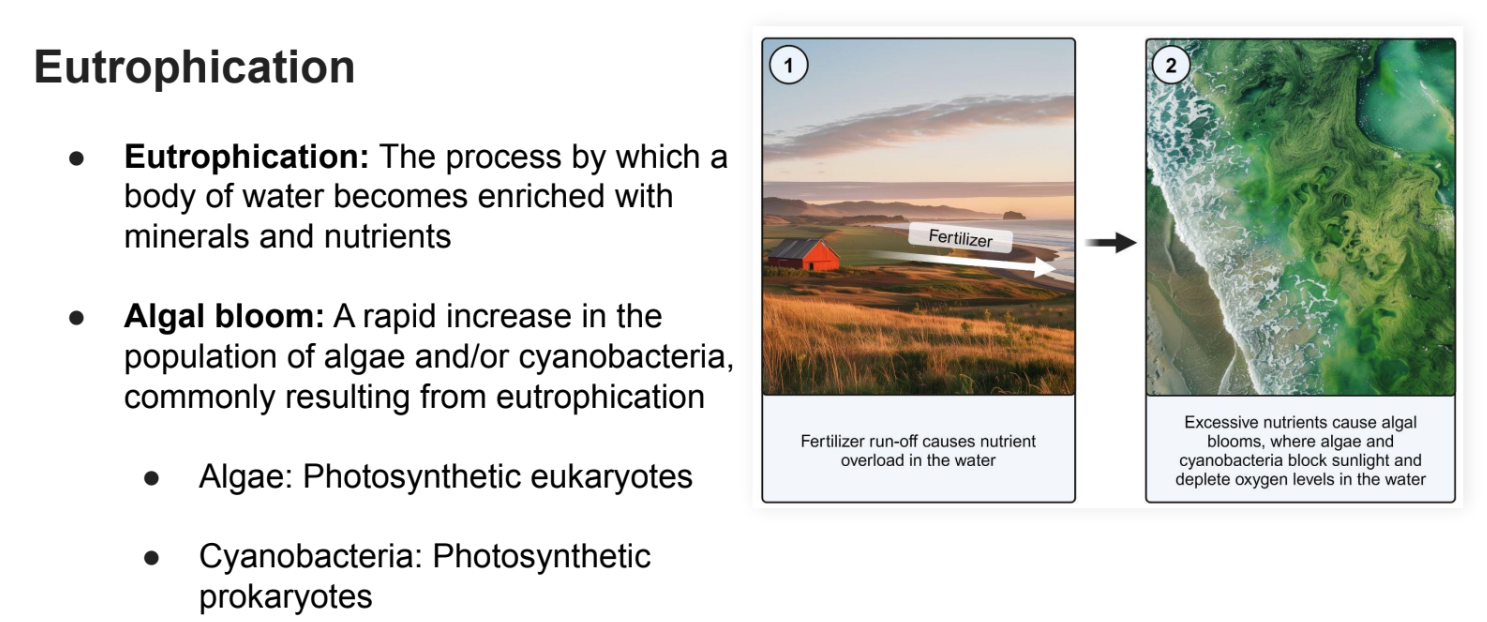
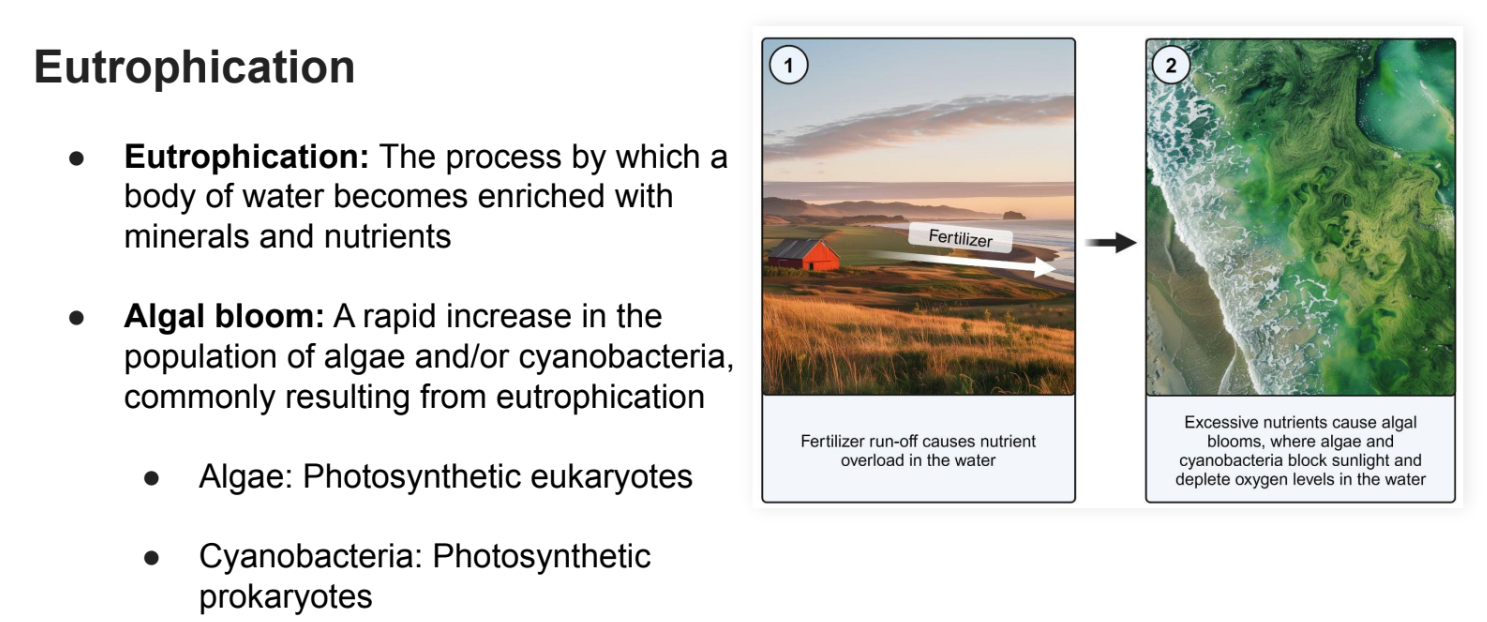
The process by which a body of water becomes enriched with minerals and nutrients
Algal Bloom
What causes it
A rapid increase in the population of algae and/or cyanobacteria, commonly resulting from eutrophication
Algae: Photosynthetic eukaryotes
Cyanobacteria: Photosynthetic prokaryotes
What do algae blooms cause?
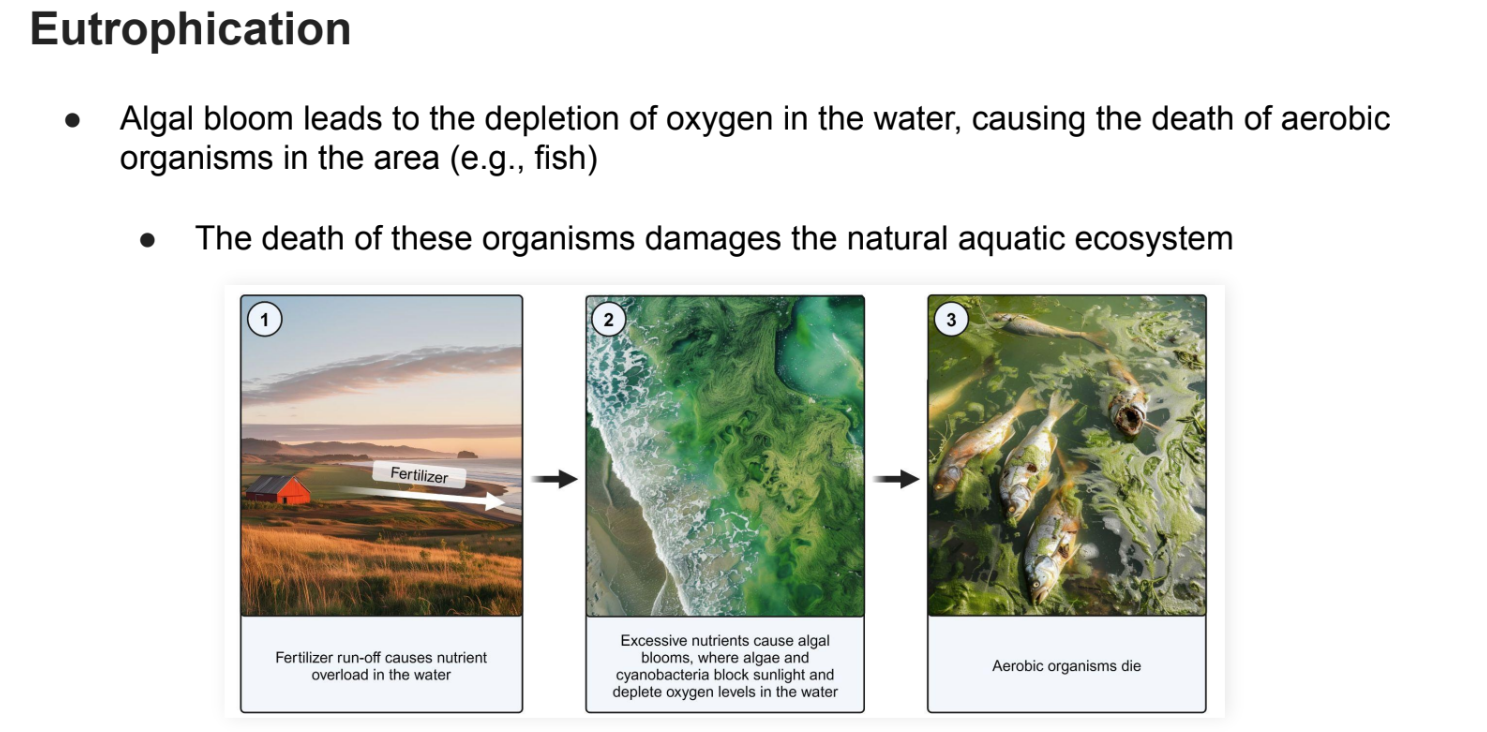
Algal bloom leads to the depletion of oxygen in the water, causing the death of aerobic organisms in the area (e.g., fish)
The death of these organisms damages the natural aquatic ecosystem
Common cause of eutrophication
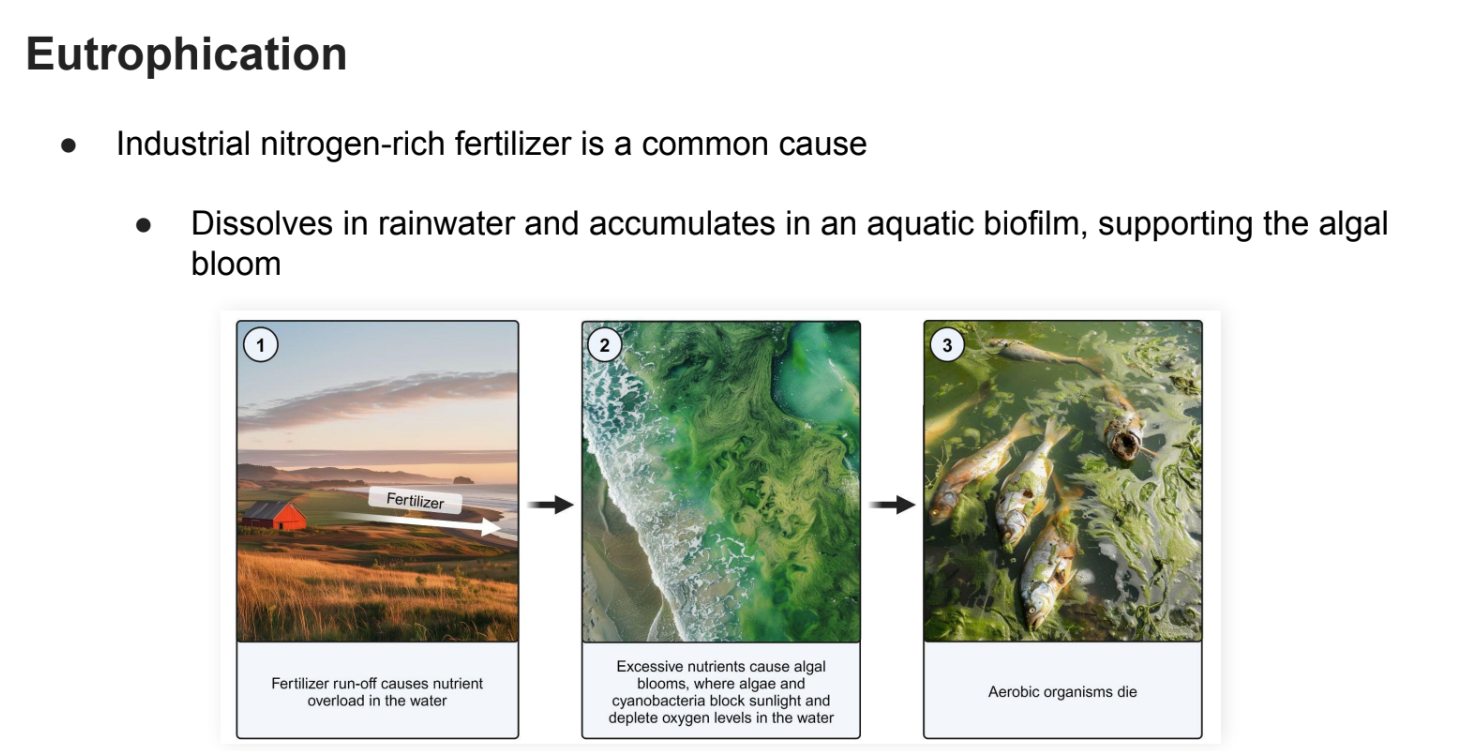
Industrial nitrogen-rich fertilizer is a common cause
Dissolves in rainwater and accumulates in an aquatic biofilm, supporting the algal bloom
Aquatic Biomes take up how much of the earth’s surface?
75%
What type of phtosynthetic organism contributes the most to earth’s atmospheric O2
Photosynthetic algae
Split of freshwater and saltwater
Divided into freshwater biomes (~3%) and saltwater biomes (~97%)
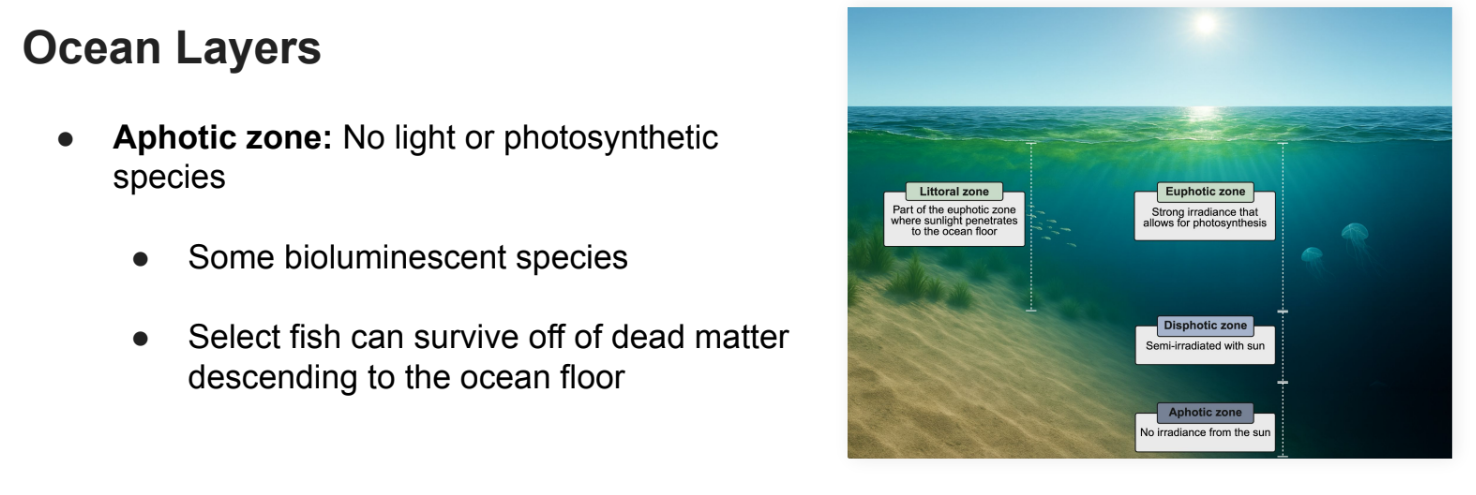
Ocean Layers
Euphotic zone
Littoral zone
Disphotic Zone
Aphotic Zone
Euphotic Zone
Euphotic zone: Closest to the surface, where strong irradiance allows plant survival and photosynthesis
ELDA
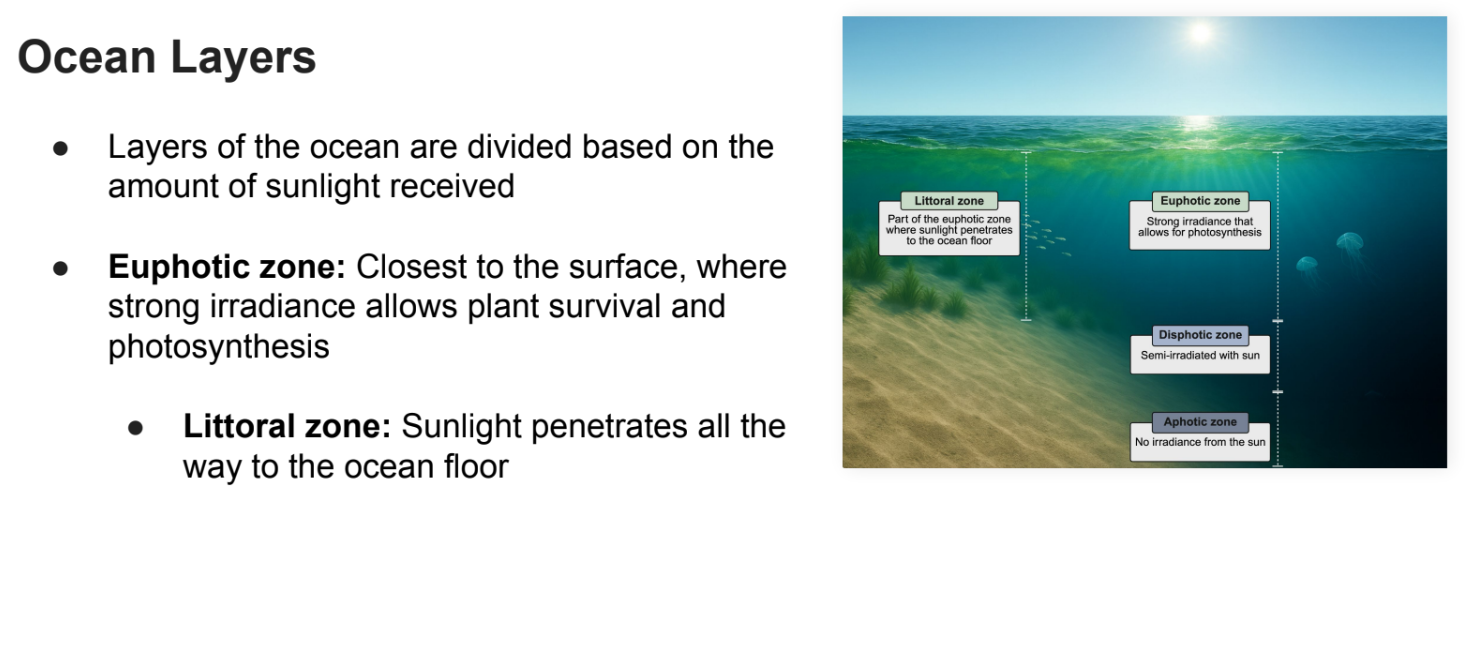
Littoral Zone
Where Sunlight penetrates all the way to the ocean floor (very shallow)
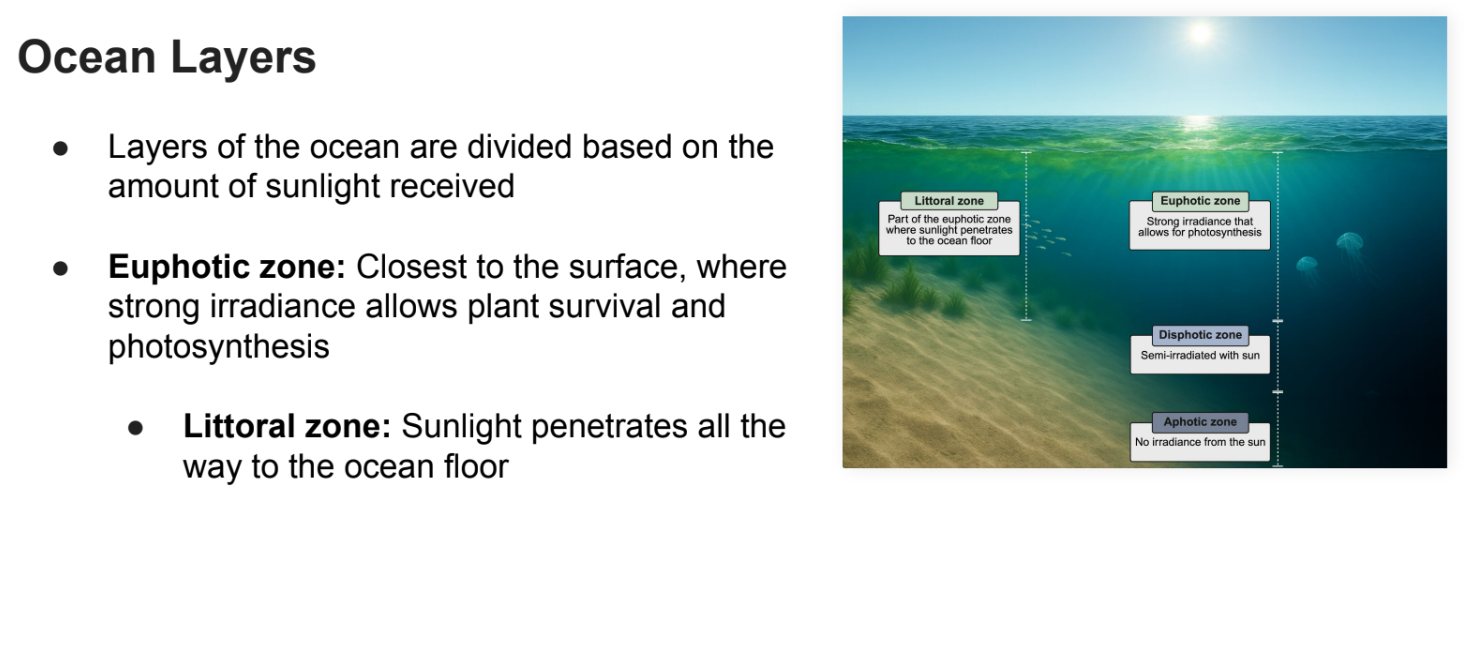
Disphotic Zone
Semi-irradiated with sun
Insufficient sun to support vegetation
Bioluminescent species live here and produce light
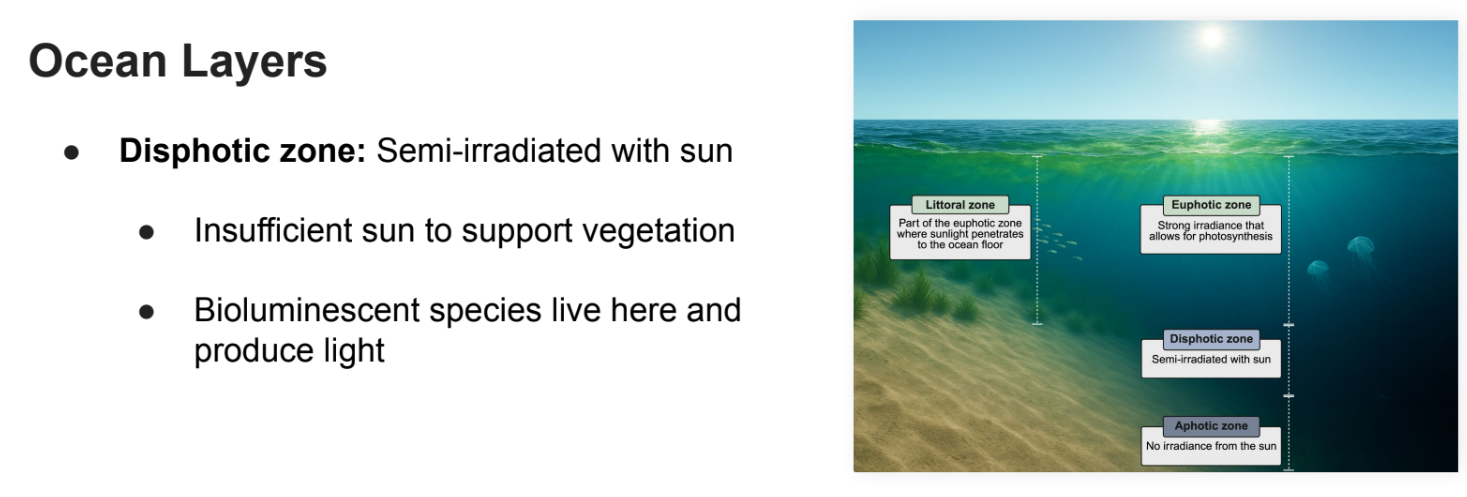
Aphotic Zone
Aphotic zone: No light or photosynthetic species
Some bioluminescent species
Select fish can survive off of dead matter descending to the ocean floor
Tropical Rainsforest
Temperature
Rainfall
Fun Fact
EX
● Consistent, hot temperatures
● Consistent, heavy rainfall
● Biome with the greatest amount of diversity
Amazon
Savannas
Temperature
Rainfall
Fun Fact
EX
● Savannas: Tropical grasslands with diffuse trees
● High temperatures and small amounts of rainfall (seasonal)
● Seasonal droughts and fires
Temperate Grasslands
Temperature
Rainfall
Fun Fact
EX
Temperate grasslands:
● Cool winters and hot summers
● Seasonal rain (less rain than savannas)
● Seasonal droughts and fires
EX: North American Prarie
Temperature Deciduous Forests
Temperature
Rainfall
Vegetation
EX
Warm summers and cold winters
Moderate precipitation; snow during winter
Trees shed leaves in the winter due to poor growing conditions
EX: Eastern North America
Chaparrals
Temperature
Rainfall
Vegetation
EX
Mild winters with hot, dry summers
Scattered vegetation, often with small tough leaves to conserve water
Common droughts and fires
EX: Mediterranean coast
Deserts
Temperature
Rainfall
Vegetation
Fun fact
EX
Hot days and cold nights with extreme temperature fluctuations
Very little rain, with plant growth occurring after rainfall
Animals are often nocturnal and water conservative (concentrated urine)
Plants have leather leaves or spines to conserve water
Arizona
Taigas (coniferous forests)
Temperature
Rainfall
Fun fact
EX
Cold winters with snowfall and warm, rainy summers
Largest terrestrial biome
Canada and alaska
Tundras
● Tundras:
● Cold with very little precipitation (mostly snow)
● Ground freezes during winter
● Topsoil thaws during summer, but deeper soil is permafrost (stays frozen)
Iceland
What decomposers externally digest dead organic matter
SAPROPHYTES
They secrete digestive enzymes outside their bodies, breaking down complex organic material into simpler compounds, and then absorb the nutrients.