Chapter 2.1: An Element’s Atomic Structure Determines Its Properties
 Call Kai
 Learn
Learn Practice Test
 Spaced Repetition
 Match
Match Flashcards
 Knowt Play
1/18

Name | Mastery | Learn | Test | Matching | Spaced | Call with Kai | Chat |
|---|
No analytics yet
Send a link to your students to track their progress
19 Terms
Atoms
The smallest unit of a chemical element, comprised of a nucleus with protons and neutrons as well as electrons in orbitals
Element
A substance consisting of only one kind of atom that cannot be converted to another substance by ordinary chemical means
Protons
Positively charged particles in an atom that reside in the nucleus
Electrons
Negatively charged particles in an atom that reside in orbital shells around the nucleus
Neutrons
Uncharged particles in an atom that reside in the nucleus; numbers of these can vary with the isotopes of an atom
Nucleus
Where protons and neutrons are gathered in an atom
Electron shells
Where rapidly moving electrons are found, far from the nucleus, such that atoms are mostly empty space
Atomic mass
The mass of the protons plus the mass of the neutrons
Dalton (Da)
The unit of measurement of atomic mass, formerly the atomic mass unit
Atomic number
The number of protons in the nucleus; usually the top number
Periodic table
Where elements are presented in order of atomic number and organized into vertical columns; elements in the same column have the same number of electrons in the outermost shell
Valence shell
The outermost shell of an element; how many electrons reside here in the outermost s and p orbitals determine an element’s chemical properties
Isotopes
Variations of an element with different neutron counts and thus atomic mass
Bohr model
The most common model for atoms proposed by physicist Niels Bohr, where electrons orbiting the nucleus are shown in electron shells differing in distance
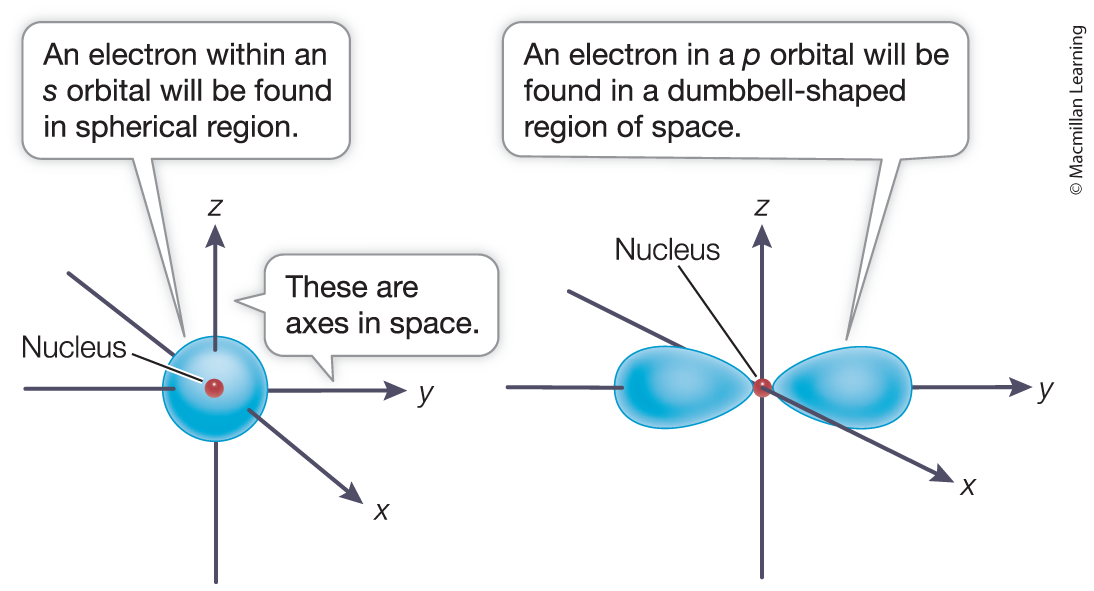
Atomic orbital
Where electrons actually move in each shell for a defined area of space, each with one or two electrons each, including:
Spherical s orbitals
Dumbbell-shaped p orbitals
More higher energy shells with distance
Octet rule
States that an atom will lose, gain, or share electrons to achieve 8 electrons in the outermost shell
Noble gases
The elements in the last column of the periodic table with 8 electrons in the outermost shell, being unreactive to other elements
Electronegativity
An atoms’s tendency to attract electrons from another atom; smaller atoms closer to 8 electrons have higher levels of this — like the most abundant atoms H, C, N, and O
Radioactive decay
The loss of atomic particles to become different isotopes of the same element, or even other elements
Seen with carbon-14 decaying to form nitrogen-14 for greater stability