Urinary System
 Call Kai
 Learn
Learn Practice Test
 Spaced Repetition
 Match
Match Flashcards
 Knowt Play
1/49

There's no tags or description
Looks like no tags are added yet.
Name | Mastery | Learn | Test | Matching | Spaced | Call with Kai | Chat |
|---|
No analytics yet
Send a link to your students to track their progress
50 Terms
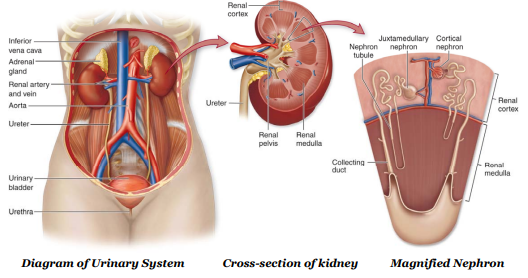
What is the urinary system? (2)
Aka renal system
Responsible for excretion and osmoregulation
What is excretion?
The process of removing metabolic waste from the cells, tissue fluid, and blood of living organisms
What is osmoregulation?
The control of water balance of the blood, tissue, or cytoplasm of a living organism
What are the structures in the urinary system?
Kidneys → ureters → urinary bladder → urethra
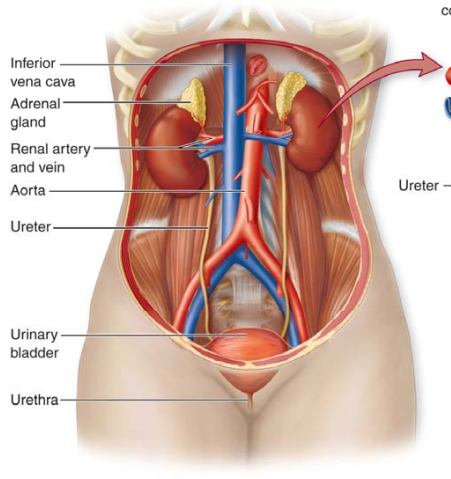
What is the main organ of the urinary system?
Kidney
What are the 3 tissues that surround the kidney?
Renal fascia,
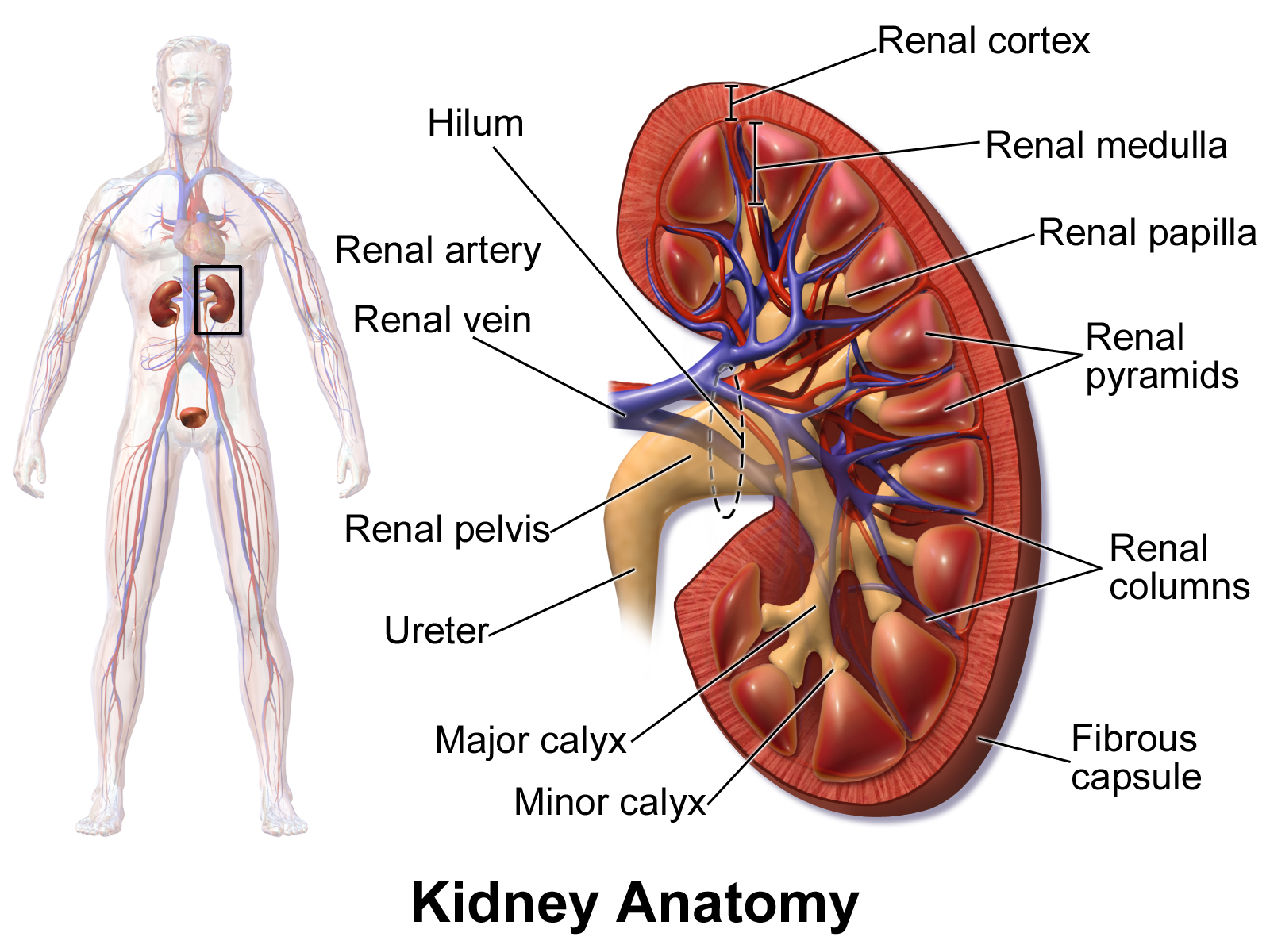
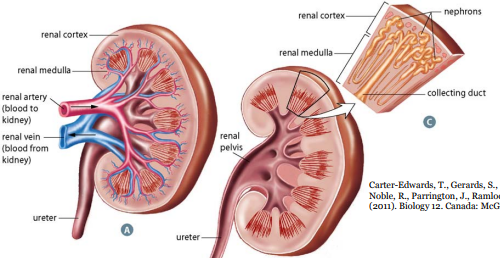
What are the 11 parts of the kidney?
Renal artery
Renal vein
Renal fascia
Adipose capsole
Renal capsule
Renal cortex
Renal medulla/ pyramids
Renal pelvis
Ureter
Minor calyx
Major calyx
Note: You don’t really need to know the last 2
What is the renal artery? (2)
Carries high-pressure arterial blood to the kidney to be filtered (cleaned)
This blood is high in nitrogenous wastes and oxygen
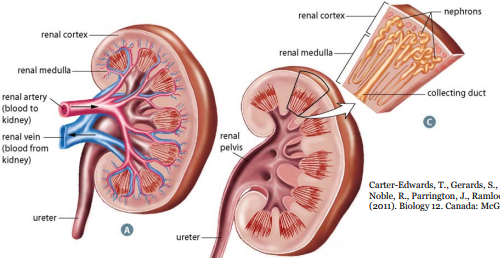
What is the renal vein?
Takes filtered venous blood away from the kidney
This blood is low in nitrogenous wastes and oxygen (which is used by renal cells to fuel ATP production)
What does the renal fascia do? (3)
Outermost layer
Thin layer of dense connective tissue
Anchors the kidney to the surroundings
What does the adipose capsule do?
Middle layer
Fatty layer
Prevents the kidney from trauma
What does the renal capsule do?
Deepest layer
Smooth, semitransparent sheet of dense connective tissue
Adheres tightly to the outer surface of the kidney and gives it its distinctive bean shape
What is the renal cortex?
The outer region of the kidney just below the capsule
This should be a different shade than the rest of the kidney
This is where the glomeruli and Bowman’s capsules are located
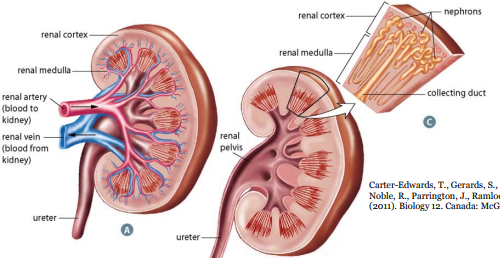
What is the renal medulla?
Inside part of the kidney with loops of Henle to control salt and water balance by pumping of Na+
ADH (antidiuretic hormone) works here
The region below the cortex that is segregated into triangular and columnar regions.
The triangular regions are called the renal pyramids, which should be striated (or striped) in appearance due to the collecting ducts running through them.
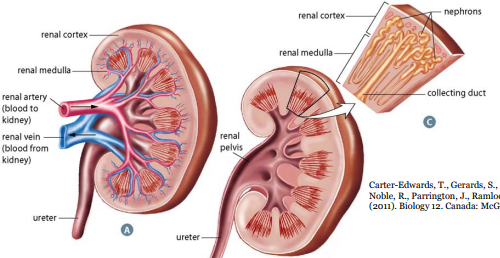
What is the renal pelvis?
Innermost region located below the renal pyramids
A hollow, sac-like cavity within the kidney that is connected to the ureter.
This is where urine is collected before draining into the ureter.
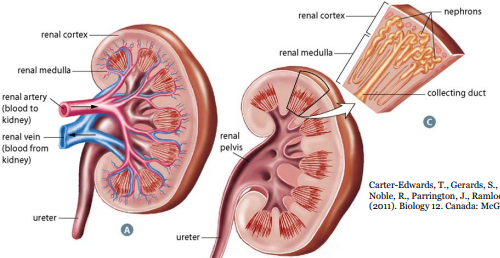
What is the ureter?
Tubes that carry urine from kidney to bladder for temporary storage until it can be released by urethra
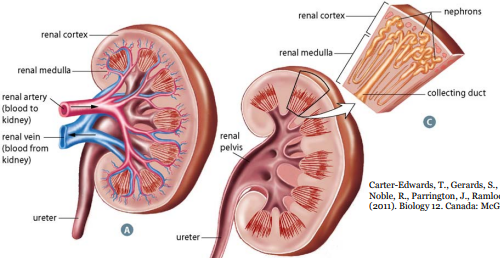
What are the nephrons?
The functional unit in the kidneys
Responsible for blood filtration and formation of urine
Note: There are more than 1 million nephrons in a human kidney
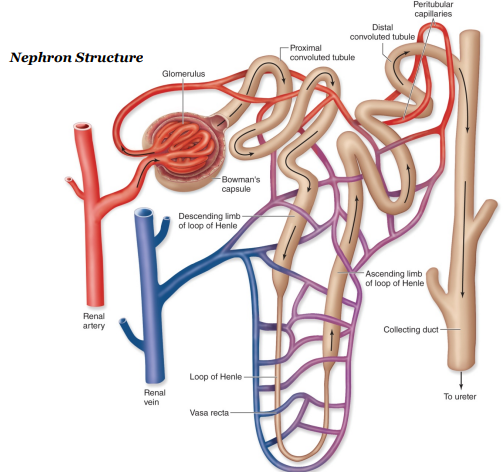
What are the 2 structural components of the nephrons?
Renal corpuscle and renal tubule
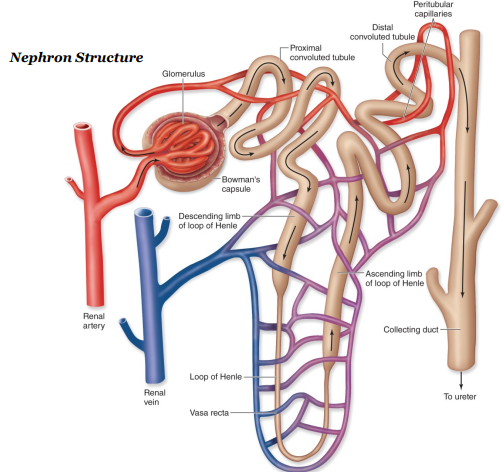
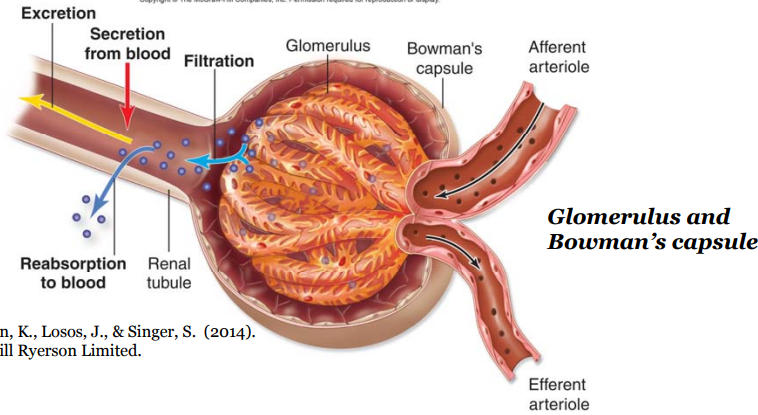
What are the 2 components in the renal corpuscle?
Glomerulus
A ball of capillaries that have pores
Surrounded by a membrane that filters the blood
Bowman’s capsule
A cup-shaped structure at the end of the nephron
Surrounds the glomerulus
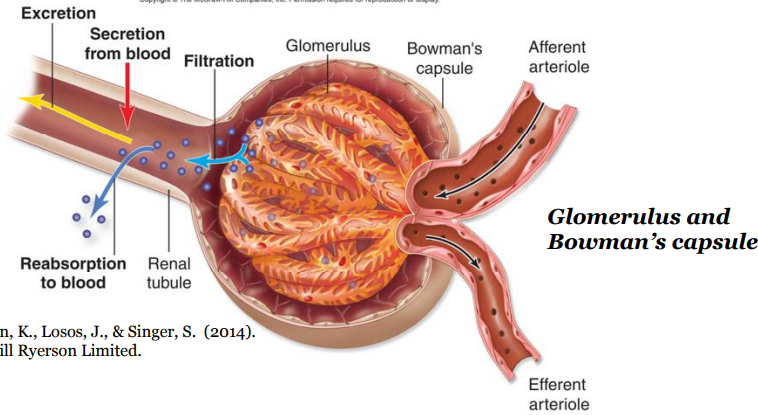
What is the afferent arteriole?
Takes blood to the glomerular capillaries from the renal artery
The blood is filtered through tiny pores where small solutes and water combine in what is now called the filtrate
The filtrate is captured by the Bowman’s capsule
What is the efferent arteriole?
Takes blood away from the glomerular capillaries into the peritubular capillaries and then into the renal vein
Note: Unlike other capillaries, the glomerulus does not transfer blood to a venule but rather to the efferent arterioles
What are the peritubular capillaries?
Part of the circulatory system (capillary network) surrounding the nephrons
What are the 4 components in the renal tubule?
Proximal convoluted tubule (PCT)
Lined with microvilli to increase surface area
Has many mitochondria to provide ATP for active transport
Nephron loop (aka the loop of Henle)
Carries the filtrate from the proximal tubule to the distal tubule
Descends into the medulla of the kidney
The concentration gradient of salt increases as you move down the medulla of the kidney
Distal convoluted tubule
Conducts urine from the loop of Henle to the collecting duct
It is the final place where blood pH and ions are balanced
Collection duct
Collects urine and carries it into the renal pelvis to the ureter
This is where the final water balance of the blood occurs
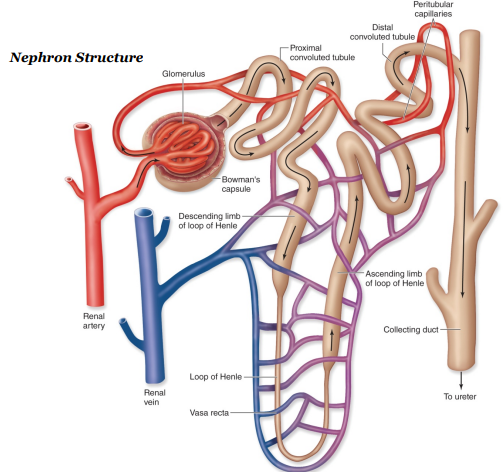
How does blood travel in the kidneys?
Aorta →renal artery → afferent arterioles → glomerulus → efferent arterioles → peritubular capillaries → renal veins → proximal tubule → loop of Henle →distal tubule → collecting ducts
What are the 4 main functions of the kidney?
Filter the blood and produce urine
Balances blood volume and water levels (aka Osmoregulation)
Regulates/balances blood pH
Endocrine Gland
How do the kidneys filter the blood and produce urine?
In 3 steps: glomerular filtration, reabsorption, and secretion
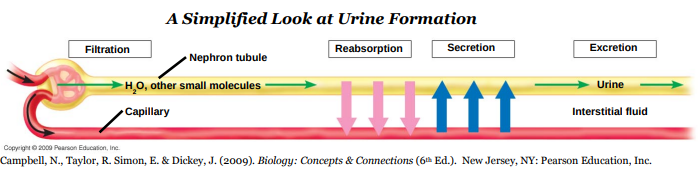
What happens in glomerular filtration?
Movement of materials from the blood → the Bowman’s capsule
Unfiltered blood is carried from the renal artery → afferent arteriole → glomerulus
The glomerulus receives blood under high pressure
Small molecules (water, salts, urea, glucose, and amino acids) diffuse into the Bowman’s capsule
This product is called the filtrate
Large substances (red and white blood cells, platelets, and plasma proteins) remain in the blood
They move through the efferent arteriole into a bed of peritubular capillaries surrounding the tubules, which eventually leave the kidney as the renal vein
What is the filtrate?
What happens in reabsorption?
Transfer of solutes and water from the nephron back into blood
Selective reabsorption takes place in the proximal tubule, loop of Henle, distal tubule, and collecting duct
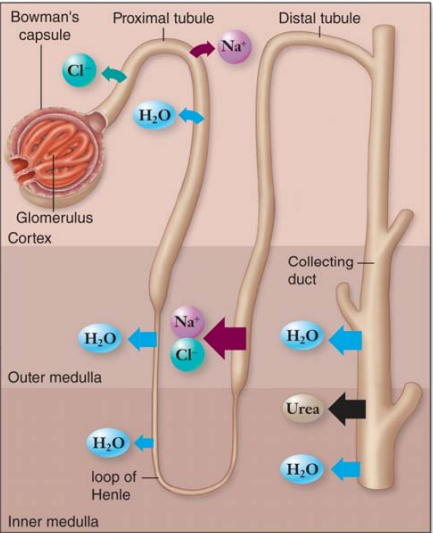
Why does selective reabsorption occur in the reabsorption process?
Changes in the permeability of cells lining the nephron
Change in solute concentration of tissue surrounding nephron
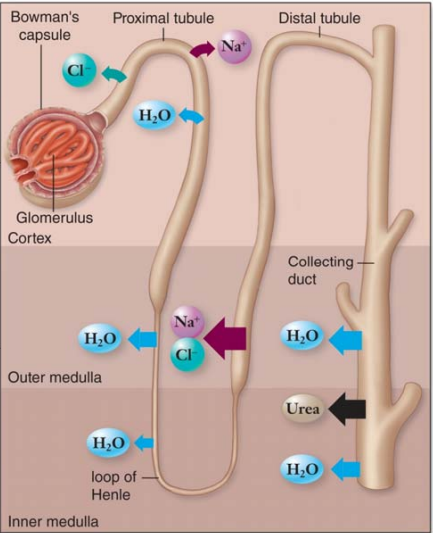
What happens in the reabsorption process at the 1st destination?
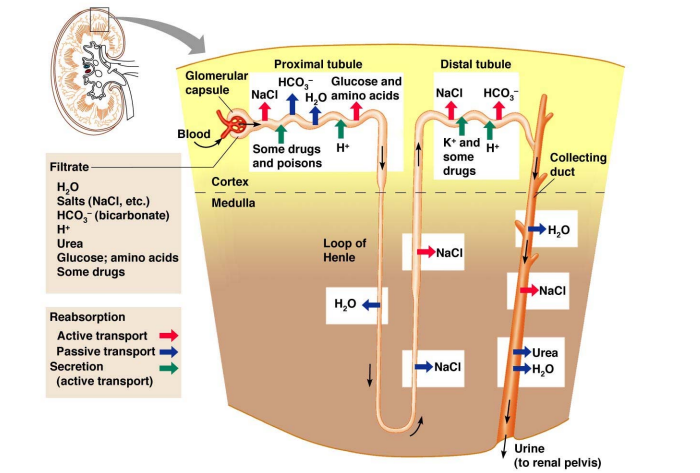
Filtrate enters the proximal tubule
Active transport of Na+ (while Cl- follows passively)
Passive transport of water via osmosis as a result of the active transport of sodium chloride
Active transport of glucose, vitamins, and amino acids
Reabsorbed into the interstitial fluid (fluid directly surrounding tubule) and eventually the peritubular capillaries
Reabsorption of glucose occurs until a threshold has been reached
Excess will remain in the nephron and be excreted in urine
What happens in the reabsorption process at the 2nd destination?
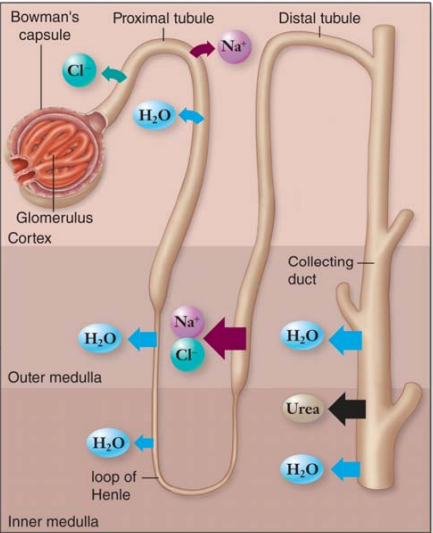
Filtrate descends the loop of Henle, which dips deep into the medulla of the kidney
The descending loop of Henle is impermeable to salts, but water leaves via osmosis
Results in the filtrate becoming increasingly more concentrated
Thus, the loop of Henle is hypotonic (higher salt concentration) to the medullary fluid (interstitial space)
The ascending loop of Henle is permeable to salt, but not water (reverse of the former)
As the filtrate ascends, Na+ and Cl- initially move out passively, then are actively pumped out at the top of loop
What happens in reabsorption at the 3rd destination?
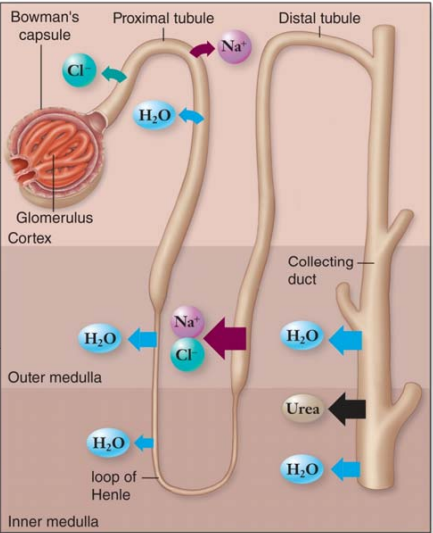
Filtrate enters the distal tubule
Na+, Cl-, and HCO3- are actively pumped out of the lumen of the loop of Henle into the interstitial space
Water follows passively (both substances are reabsorbed into the peritubular capillaries that surround it)
Producing a hypertonic environment
What happens in reabsorption at the 4th (last) destination?
Filtrate enters the collecting duct
Na+, Cl– and HCO3– are actively transported out of the collecting duct
Water and urea diffuse out as well
Formation of urine occurs at this point.
What happens in secretion?
Transfer of materials from blood into the nephron (reverse of reabsorption)
Excess H+, K+, and drugs are moved out of peritubular capillaries (blood) into the proximal and distal tubule lumen (filtrate) to be excreted.
Protein by-products such as ammonia are secreted into the proximal tubule
Substances typically move through active transport
Critical for balancing blood pH (secretion of H+).
What is urine?
A liquid waste product filtered from your blood by the kidneys
What does urine contain?
96% water
2% urea
2% uric acid, creatine, ammonia, sodium, potassium, chloride, phosphate, sulphate, oxalate
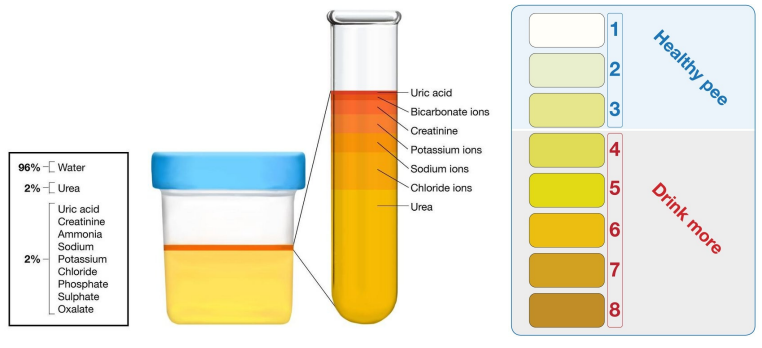
What are the 3 nitrogenous wastes?
Ammonia, urea, and uric acid
What is ammonia?
Extremely toxic
Requires a lot of water for biological excretion
Animals release ammonia across the whole body surface or through gills/ aquatic animals
What is urea?
Less toxic version of ammonia
Ammonia is converted into urea in the liver of mammals and most adult amphibians
The circulatory system carries urea to the kidneys, where it is excreted.
Conversion of ammonia to urea is energetically expensive, but uses less water than ammonia
What is uric acid?
Excreted by Insects, land snails, and many reptiles (including birds)
Largely insoluble in water
Can be secreted as a paste with little water loss
More energetically expensive to produce than urea
How do the kidneys balance blood volume and water levels?
Includes regulating extracellular fluid (ECF) levels
Regulating Blood Volume
Blood volume is directly related to water balance/osmoregulation and urine production
Increased water/fluid intake will result in greater blood volume which the kidney will counter by increasing urine production
Decreased water/fluid intake will result in lower blood volume which the kidneys will counter by decreasing urine production
How does the kidney regulate blood (osmotic) pressure?
When blood pressure (aka osmotic pressure) is high (due to excess sweating, dehydration)
Sensed by osmoreceptors in the hypothamus
Signals thirst → Increased fluid intake to lower osmotic pressure
Shruken hypothalamus cells signal the pituitary gland to sevrete the hormone ADH (antidiuretic hormone, aka vasopressin)
ADH acts on the collecting duct to increase water reabsorption (decrease urine production)
When blood pressure (aka osmotic pressure) is low (due to bloo lass, dehydration)
Specialized cells within the juxtaglomerular apparatus (part of the kidney) relase renin
Renin converts angiotensinogen to angiotensin
Angiotensin:
Causes constriction of blood vessels
Stimulates the adrenal gland to produce the hormone aldosterone → increases salt and water reabsorption by the kidneys/nephrons
How does the kidney regulate blood pH?
Blood pH must stay within a range of 7.3 – 7.5.
Regulated by the active transport of hydrogen ions (H+ ) into the urine.
As blood pH fluctuates, the secretion of H+ either increases or decreases until it returns to normal.
How do the lungs help in the regulation of blood pH?
The bicarbonate-carbonic acid buffer system
Via the selective secretion of [H+] ions
Bicarbonate-Carbonic acid buffer
If the blood is too acidic, excess H+ combine with HCO3 - (bicarbonate ion) to form H2CO3 (carbonic acid), which results in an increased production of CO2 . This process will increase the pH of the blood (become more basic).
Enzyme: Carbonic anhydrase
What is the secondary function of the kidneys in the endocrine system?
The kidneys produce and secrete 3 major hormones:
Renin
Regulates angiotensin and aldosterone
Helps regulate blood pressure
Calcitriol
The active form of vitamin D
Increases absorption of calcium in the intestines
And reabsorption of phosphate in the kidney (proximal convoluted tubule)
Erythropoietin
Released in response to hypoxia (low levels of oxygen)
Stimulates erythropoiesis (production of red blood cells) in the bone marrow
Makes red blood cells
What are 3 kidney diseases?
Diabetes Mellitus, Diabetes Insipidus, and Bright’s Disease
What is diabetes mellitus?
Caused by inadequate secretion of insulin from islet cells in the pancreas
Blood sugar levels tend to rise without insulin
Excess sugar remains in the nephron and provides an osmotic pressure that opposes the osmotic pressure created by other solutes that have been actively transported out of the nephron
Excretion of large volumes of urine
Often thirsty
What is diabetes insipidus?
Destruction of the ADH-producing cells of the hypothalamus or the destruction of n
What are diseases of the kidney?
Nephrology - internal medicine, deals with kidney function and disease related to renal malfunction – dialysis and organ transplantation
Urology - surgery, deals with kidney structural abnormalities – cancer, cysts, urinary tract (bladder) issu