chemistry camlpr mltprep 1
 Call Kai
 Learn
Learn Practice Test
 Spaced Repetition
 Match
Match Flashcards
 Knowt Play
1/30

There's no tags or description
Looks like no tags are added yet.
Name | Mastery | Learn | Test | Matching | Spaced | Call with Kai | Chat |
|---|
No analytics yet
Send a link to your students to track their progress
31 Terms
Question: A patient is scheduled to collect a 24-hour urine specimen for creatinine clearance. Which instruction is MOST important?
A. Collect the first morning void to establish the start time, then gather subsequent urine for 24 hours.
B. Discard the first morning void, then collect all urine for 24 hours into separate containers kept at room temperature.
C. Discard the first morning void, then collect all subsequent urine for the next 24 hours, including the void at the same time the following day.
D. Begin collection after the second morning void, then gather urine for 24 hours, concluding with the first void the following morning.
Answer: C
Explanation: The first morning void is discarded because it represents urine produced before the collection period. The collection begins after that void and ends by collecting the urine at the same time the following morning.

d; Nitric acid is a strong oxidizing acid and must be segregated from organic and flammable material such as methanol and glacial acetic acid, with which it can react violently. Storing it with other mineral acids on a shared shelf still leaves it beside those organics in the same cabinet. Open storage under a fume hood gives no containment and blocks the working surface.
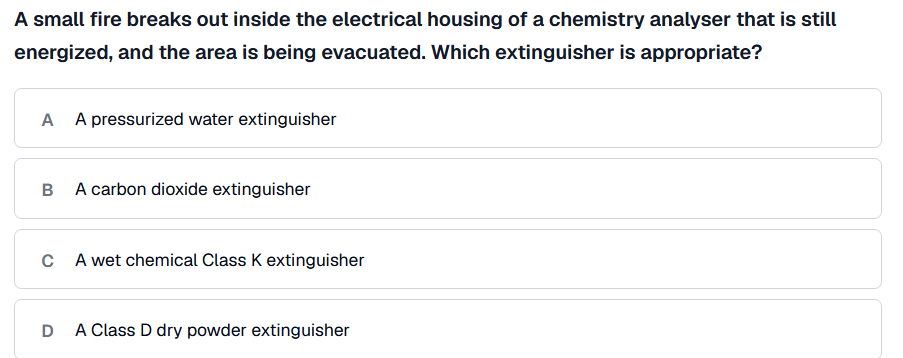
b; A fire in energized electrical equipment is Class C, and carbon dioxide smothers it without conducting current back to the operator and without leaving residue on the instrument. Water conducts electricity and creates a shock hazard. Wet chemical units are made for cooking oils and Class D powders for combustible metals, neither of which is burning here.

d; A biological indicator contains heat-resistant Geobacillus stearothermophilus spores, and their failure to grow after incubation is direct proof that conditions lethal to the most resistant organisms were reached throughout the load. Chemical strips and tape only confirm that a temperature was touched, not that it was held long enough at the required steam quality. Physical charts record what the chamber did, not what happened inside a packed container.

c; bc k+
Question: What is the PRIMARY purpose of verifying two unique patient identifiers before specimen collection?
A. To confirm the patient's identity matches the health card for provincial billing.
B. To ensure the specimen is matched to the correct patient and prevent misidentification errors.
C. To comply with accreditation standards requiring consent documentation.
D. To verify allergy status and reduce adverse reactions.
Answer: B
Explanation: Two identifiers (e.g., full name + DOB) primarily protect patient safety by ensuring the specimen is linked to the correct patient. This prevents misidentification, incorrect results, and potentially incorrect treatment.
Question: An MLT must collect blood for a CBC, INR, troponin, and plasma electrolytes. The tubes are lavender-top EDTA, light-blue sodium citrate, gold-top serum separator, and green-top lithium heparin. Which order of draw is CORRECT?
A. Light blue → Gold → Green → Lavender
B. Lavender → Light blue → Green → Gold
C. Light blue → Green → Gold → Lavender
D. Gold → Light blue → Lavender → Green
Answer: A
Explanation: The order is:
Light blue → Gold → Green → Lavender
Citrate is collected first, followed by serum, heparin, and finally EDTA. This minimizes additive carryover that could affect results.
Question: Following routine centrifugation of an SST, the gel barrier has not fully separated the cellular layer from the serum. What should the MLT do FIRST?
A. Allow the specimen to clot for an additional 60 minutes.
B. Gently invert the tube five times to redistribute the gel and repeat centrifugation.
C. Re-centrifuge the specimen using the parameters specified in the laboratory SOP.
D. Discard the tube and request recollection.
Answer: C
Explanation: If the specimen has not separated properly, follow the laboratory SOP and re-centrifuge using the specified parameters. Do not manipulate the gel unnecessarily or automatically reject the specimen
Question: A 68-year-old male with COPD has an ABG showing pH 7.31, pCO₂ 62 mmHg, and HCO₃⁻ 31 mmol/L. Which disorder BEST represents these results?
A. Fully compensated metabolic alkalosis
B. Uncompensated respiratory acidosis with hypoxemia
C. Partially compensated respiratory acidosis
D. Partially compensated metabolic acidosis
Answer: C
Explanation:
pH ↓ = acidosis
pCO₂ ↑ = respiratory cause
HCO₃⁻ ↑ = renal compensation
pH is still abnormal → compensation is partial
Therefore: partially compensated respiratory acidosis, consistent with chronic CO₂ retention in COPD.
Question: A chemistry analyzer generates a creatinine result of 226 µmol/L and displays a HEM interference flag. The patient's previous creatinine was 102 µmol/L. What is MOST appropriate?
A. Release the result with a comment indicating significant haemolysis and recommend recollection if clinically indicated.
B. Withhold the result because haemolysis completely invalidates the Jaffe method.
C. Release without comment because the Jaffe method is unaffected by haemolysis.
D. Repeat using an enzymatic creatinine method on the same haemolysed specimen.
Answer: A
Explanation: Haemolysis can cause positive interference with the Jaffe creatinine method, producing a falsely elevated result. The large change plus haemolysis suggests possible analytical interference. Report according to SOP, with an appropriate interference comment and recommendation for recollection when clinically indicated.
Question: An MLT obtains a serum potassium of 6.9 mmol/L on a non-haemolysed specimen. The laboratory critical high value is 6.0 mmol/L. Which sequence is CORRECT?
A. Repeat on a new specimen → call provider → document.
B. Call provider → read result aloud → document in the patient's EHR.
C. Call responsible healthcare provider → obtain verbal readback → document communication in the LIS.
D. Page provider → leave voicemail → document once callback is received.
Answer: C
Explanation: For a confirmed critical value:
Notify provider → obtain readback → document
Readback confirms that the critical result was communicated accurately.
Question: During a routine run, QC fails the 2-2s Westgard rejection rule. Six patient results were already released. What should the MLT do FIRST?
A. Contact the ordering physicians directly.
B. Immediately notify the supervisor verbally about the QC breach and released results.
C. Investigate the root cause first.
D. Place holds on the six results and repeat QC.
Answer: B
Explanation: When a QC breach is discovered, especially after patient results have already been released, the first action is to notify the supervisor. The supervisor directs subsequent actions such as holding results, investigating the cause, determining whether recollection is required, and communicating with clinical staff.
uestion: When preparing a reagent in-house for use in clinical chemistry, which information is REQUIRED on the container label?
A. Preparation date, expiry date, and storage temperature only.
B. Product name/identification, preparation date, expiry date, lot number, and applicable WHMIS hazard symbols.
C. Concentration, solvent, preparation date, and analyst signature only.
D. Expiry date, lot number, and WHMIS symbols only.
Answer: B
Explanation: Proper reagent identification requires enough information to ensure traceability, safety, and correct use, including product identification, preparation/expiry information, lot number, and applicable WHMIS hazards.
Question: A serum specimen has a cherry-red appearance and a haemolysis index of 3+. Which group of analytes is MOST likely to yield unreliable results?
A. Potassium, AST, and LDH
B. Sodium, lipase, and iron
C. Calcium and total bilirubin
D. TSH, cortisol, and CRP
answer: A
Explanation: Haemolysis releases intracellular contents.
High-yield haemolysis analytes:
K⁺ ↑
AST ↑
LDH ↑
These are highly concentrated inside RBCs, so haemolysis can significantly alter their results.
Question: A 74-year-old oncology patient has albumin of 27 g/L (reference 35–50 g/L) with no previous results. Which action BEST reflects CAMLPR competency?
A. Flag as a delta-check failure and withhold until a previous result is found.
B. Treat it as a critical value and immediately telephone the ward.
C. Release after verifying QC because abnormal albumin is expected in oncology.
D. Correlate the low albumin with clinical context, follow SOP for abnormal results, and refer to a supervisor/specialist if indicated.
Answer: D
Explanation: The MLT should correlate abnormal results with clinical context. Hypoalbuminaemia can occur in oncology patients because of malnutrition, acute-phase responses, or protein loss. It is not automatically a critical value or delta-check failure.
Question: A 45-year-old patient has potassium 7.4 mmol/L and glucose 28.9 mmol/L. The specimen is non-haemolysed and QC is acceptable. There are no previous results. What should the MLT do FIRST?
A. Repeat both critical values in duplicate.
B. Immediately notify the healthcare provider.
C. Review collection circumstances, confirm correct tube type, rule out IV contamination, and assess transport conditions.
D. Dilute the specimen and reanalyse potassium.
Answer: C
Explanation: When unexpected results occur, especially multiple simultaneous abnormalities, first investigate possible pre-analytical causes.
Think:
Wrong tube?
EDTA contamination?
IV-line contamination?
Transport problems?
Specimen identity?
Question: At the end of a chemistry shift, all requested analytes are resulted except lipase, which was not processed. What action is CORRECT?
A. Cross-reference completed results against the original requisition, confirm lipase is outstanding, investigate the reason, and resolve before sign-off.
B. Request a new specimen because lipase must always be collected the same day.
C. Release everything and mark lipase as unavailable.
D. Transfer responsibility to the next MLT.
Answer: A
Explanation: Before sign-off, the MLT must ensure all requested tests were actually performed. A missing test must be investigated and resolved rather than simply passed to the next shift.
Question: A new lot of creatinine reagent is being introduced. Which validation step is MOST essential?
A. Calibrate the new lot and run two QC levels.
B. Perform lot-to-lot comparison using patient specimens spanning the analytical range, calibrators, and QC materials.
C. Run one normal QC material 20 times.
D. Run calibrators and QC only and ensure results fall within manufacturer's reference intervals.
Answer: B
Explanation: Lot-to-lot comparison determines whether the new reagent produces significantly different results from the existing lot. Patient specimens should span the analytical range, with calibrators and QC used to evaluate accuracy and precision.
Question: An MLT receives these specimens simultaneously:
STAT troponin
STAT CSF glucose
Routine cortisol, currently 90 minutes after collection
Fasting lipid panel
Which processing order is CORRECT?
A. STAT troponin → CSF glucose → cortisol → lipid panel
B. Cortisol → STAT troponin → CSF glucose → lipid panel
C. CSF glucose → STAT troponin → cortisol → lipid panel
D. STAT troponin → cortisol → CSF glucose → lipid panel
Answer: C
Explanation: CSF is unconditionally high priority because it comes from an invasive lumbar puncture and is essentially irreplaceable. Process:
CSF → STAT troponin → cortisol → lipid panel
Question: A midstream clean-catch urine shows 25–35 WBCs/HPF, many rod-shaped bacteria, 3+ leukocyte esterase, and positive nitrites. Which condition is MOST likely?
A. Asymptomatic bacteriuria
B. Acute pyelonephritis
C. Urethral contamination with flora
D. Lower urinary tract infection
Answer: D
Explanation: The combination of:
Increased WBCs
Bacteria
Positive leukocyte esterase
Positive nitrites
is consistent with an active UTI. The absence of RBC casts or other evidence of renal involvement supports a lower UTI.
Question: When examining urine sediment for casts, which microscopy technique is MOST appropriate for initial detection?
A. Low-power objective (10×) with reduced condenser light, then high-power (40×) to characterize.
B. High-power objective (40×) with reduced condenser light throughout.
C. Low-power objective with fully open condenser aperture.
D. Phase-contrast microscopy at low power is mandatory before brightfield.
Answer: A
Explanation: First scan at low power because casts are relatively large structures. Reduced condenser light increases contrast, making transparent hyaline casts easier to see. Once found, use high power to characterize them.
Question: A patient's creatinine increases from 91 to 318 µmol/L in one day. QC passes and the specimen is non-haemolysed. No kidney disease is documented. What should the MLT do FIRST?
A. Immediately contact the physician and recommend nephrology consultation.
B. Repeat the test in duplicate and release if confirmed.
C. Inspect for turbidity/lipemia and re-spin.
D. Review collection circumstances: verify specimen identity, check for IV contamination, and review recent contrast administration.
Answer: D
Explanation: An extreme unexpected delta requires systematic pre-analytical investigation before reporting.
Check:
Patient/specimen identity
IV contamination
Recent radiographic contrast
Other collection issues
Question: A digitally scanned urine sediment slide appears blurry, with indistinct cell outlines and poorly assessable casts. Which preparation defect is MOST likely responsible?
A. The slide was not adequately coverslipped, causing uneven surface/focal depth.
B. Insufficient centrifugation speed.
C. Excess mounting medium under the coverslip.
D. The prepared slide was allowed to air-dry before scanning.
Answer: A
Explanation: An improperly coverslipped slide can create an uneven surface, causing inconsistent focal depth during whole-slide scanning and producing a blurry image.
Question: During the pre-analytical phase, an MLT performs gross examination of a urine specimen. What information is MOST essential to document in the LIS?
A. Specimen volume, container type, and transport conditions.
B. Patient DOB, health card number, and ordering physician.
C. Specimen gross characteristics — colour, clarity, visible abnormalities — plus collection date, time, and site.
D. Anticipated analyte results and reference intervals.
Answer: C
Explanation: Gross examination focuses on what the specimen actually looks like:
Colour
Clarity
Turbidity
Visible abnormalities
Collection date/time/site
These observations provide important context for interpreting results.
(its not B bc that happens during accessioning)
Question: Pleural fluid triglyceride is 3.4 mmol/L. The diagnostic threshold for chylothorax is ≥1.24 mmol/L. Which action BEST reflects CAMLPR RC-8 competency?
A. Release with a comment but require repeat testing within 24 hours.
B. Release with an interpretive comment noting that the value exceeds the chylothorax threshold and specialist referral criteria are met.
C. Telephone the physician as a critical value.
D. Withhold the result and request lipoprotein electrophoresis.
Answer: B
Explanation: The MLT can recognize that a result meets an established diagnostic/referral criterion and communicate this through appropriate documentation. The MLT should not independently diagnose the patient.
Question: A patient's cortisol specimen was collected at 4:00 PM. The requisition states "baseline cortisol" for suspected adrenal insufficiency. What is MOST appropriate?
A. Use the morning reference interval.
B. Request an 08:00 AM recollection because afternoon cortisol is invalid.
C. Report the numeric result without a reference interval.
D. Release the result with an interpretive comment documenting the collection time and its effect on reference-range application.
Answer: D
Explanation: Cortisol has a diurnal rhythm:
Highest ≈ morning → lowest ≈ late afternoon/evening
Therefore, collection time affects interpretation. The MLT should document the collection time and apply the appropriate reference interval according to laboratory procedure.
Question: An MLT receives:
STAT troponin — collected 8 minutes ago
Urgent creatinine — pre-dialysis patient
Routine CBC
STAT neonatal bilirubin — light-sensitive and already protected
What is the BEST processing order?
A. Troponin → creatinine → neonatal bilirubin → CBC
B. Neonatal bilirubin → troponin → creatinine → CBC
C. Creatinine → neonatal bilirubin → troponin → CBC
D. Troponin → neonatal bilirubin → creatinine → CBC
Answer: D
Explanation: Priority is:
STAT > Urgent > Routine
Between the two STAT specimens, the troponin is more time-sensitive because it is unprotected and related to an acute coronary syndrome timeline. The bilirubin is already light-protected, so it follows the troponin.
Question: Which reporting convention is CORRECT for squamous epithelial cells in urine sediment?
A. Grade rare/few/moderate/many per HPF and flag moderate or greater as possible contamination.
B. Report rare/few/moderate/many per HPF and interpret many as renal tubular injury.
C. Enumerate as an exact count per LPF and flag >5/LPF.
D. Grade semi-quantitatively as rare/few/moderate/many per LPF and flag "many" as possible urogenital contamination.
Answer: D
Explanation: Squamous epithelial cells are reported semi-quantitatively per low-power field (LPF). Numerous squamous cells suggest urogenital contamination, rather than renal tubular injury.
Question: A chemistry analyzer reports glucose of 0.6 mmol/L. The laboratory's critical low threshold is <2.5 mmol/L. QC is in control and there are no haemolysis, lipemia, or icterus flags. What is MOST appropriate?
A. Repeat on the same specimen; if confirmed, collect a new specimen before notifying the care team.
B. Release immediately because QC is in control.
C. Dilute 1:2 and multiply by the dilution factor.
D. Repeat on the same specimen; if confirmed, immediately notify the responsible healthcare provider with readback.
Answer: D
Explanation: For a critical result:
Repeat same specimen → confirm → immediately notify provider → readback → document
A new specimen should not delay communication of a confirmed critical result.
Question: An ICU patient has:
pH = 7.20
pCO₂ = 28 mmHg
HCO₃⁻ = 10 mmol/L
Na⁺ = 138 mmol/L
Cl⁻ = 108 mmol/L
Glucose = 32 mmol/L
Creatinine = 280 µmol/L
What is the MOST complete classification?
A. Normal anion gap metabolic acidosis with partial respiratory compensation.
B. Fully compensated metabolic acidosis with appropriate respiratory response.
C. Elevated anion gap metabolic acidosis with inadequate respiratory compensation, consistent with mixed aetiology including DKA and uraemia.
D. Uncompensated metabolic acidosis with concurrent respiratory acidosis.
Answer: C
Explanation:
Step 1: pH 7.20 → acidaemia
Step 2: HCO₃⁻ 10 → metabolic acidosis
Step 3: Calculate anion gap:
AG = Na − (Cl + HCO₃⁻)
AG = 138 − (108 + 10) = 20 mmol/L
→ elevated AG metabolic acidosis.
Step 4: Winter's formula:
Expected pCO₂ = (1.5 × HCO₃⁻) + 8 ± 2
= (1.5 × 10) + 8 ± 2
= 23 ± 2 mmHg
Expected = 21–25 mmHg
Actual pCO₂ = 28 mmHg
→ pCO₂ is too high → inadequate respiratory compensation / concurrent respiratory acidosis.
High glucose suggests DKA, while elevated creatinine suggests uraemic acid accumulation.
Question: On a Levey-Jennings chart, 12 consecutive potassium Level 1 QC results fall on the same side of the mean. Every result is within ±2 SD. Which Westgard rule is violated?
A. 10x rule — reject the run and investigate systematic error.
B. 12x rule — continue the run until another result exceeds 2 SD.
C. 22s rule — reject because two consecutive results exceed 2 SD.
D. 41s rule — reject because four consecutive results exceed 1 SD.
Answer: A
Explanation: The 10x rule is triggered when 10 or more consecutive QC results fall on the same side of the mean, even if each individual result is within ±2 SD.
It indicates systematic error, such as:
Calibration problems
Reagent deterioration
Control material changes
Temperature instability
Action: reject the run and investigate systematic error.
(no such thing as 12x)