protein synthesis
 Call Kai
 Learn
Learn Practice Test
 Spaced Repetition
 Match
Match Flashcards
 Knowt Play
1/38

There's no tags or description
Looks like no tags are added yet.
Name | Mastery | Learn | Test | Matching | Spaced | Call with Kai | Chat |
|---|
No analytics yet
Send a link to your students to track their progress
39 Terms
introduction
the central dogma states that genetic information is encoded in the DNA and transferred to the mRNA during transcription
tRNA and rRNA are also transcribed
eukaryotic transcription: pre-mRNA synthesised is then processed to form mature mRNA
during translation: information on mRNA is used to synthesise polypeptides, which are folded into functional proteins
DNA contains the codes for synthesis of polypeptide chains ⇒ sequence of bases in DNA determines sequence of amino acids in a polypeptide chain (primary structure)
the central dogma of molecular biology
refers to the unidirectional flow of genetic information from DNA (gene) through mRNA to the protein
involves 2 processes
transcription
translation
however, the discovery of reverse transcription challenged the central dogma
reverse transcription: RNA to DNA (e.g. HIV virus)
a gene
a gene is a unit of inheritance:
which contains the nucleotide sequence for synthesis of a functional gene product → e.g., a polypeptide chain, tRNA, rRNA [not always a protein]
it includes BOTH coding sequences (exons) and non-coding sequences (introns)
if the gene product is a polypeptide chain, the sequence of nucleotides in the DNA codes for the sequence of amino acids in a polypeptide chain (primary structure)
coding sequences (exons):
the sequence of nucleotides in the DNA exon that codes for sequence of amino acids (primary structure) in a polypeptide chain
non-coding sequences (introns):
these nucleotides sequences that do not code for any sequence of amino acids
within the gene are introns
other examples of such non-coding sequences are the promoter, enhancers, silencers, important for controlling the transcription of a gene
genes in eukaryotes
an exon is coding sequence of DNA that codes the sequence of amino acids in a polypeptide chain
an intron is a non-coding sequence of DNA interspersed between exons
exons and introns are transcribed to the pre-mRNA which undergo processing so that only exons are joined together to form a continuous coding sequence and all introns are removed
genetic code
the genetic code determines the amino acid sequence of a polypeptide chain
during transcription, the specific sequence of DNA nucleotide (or base sequence) of the gene is copied into a specific sequence of nucleotides in the mRNA
during translation, the mRNA sequence is decoded, giving rise to the amino acid sequence of the polypeptide chain
DNA → proteins
4 types of nucleotides in a DNA strand ⇒ adenine, guanine, thymine and cytosine
different genes have different nucleotide sequences
20 amino acids commonly found in nature
different proteins have different sequences of amino acids
the sequence of nucleotides in DNA defines sequence of amino acids
[FAQ] how many nucleotides codes for one amino acid → need to know how to calculate
1 nucleotide codes for 1 amino acid → single code
only 4 amino acids can be coded < 20 amino acids found in nature
if 2 nucleotides code for 1 amino acid → doublet code
42 = 16 amino acids can be coded < 20 amino acids found in nature
if 3 nucleotides code for 1 amino acid → triplet code
43 = 64 amino acids can be coded
with only about 20 amino acids to code, some triplets can be redundant
features of the genetic code
it is a triplet code made up of 3 nucleotides
3 nucleotides of a gene exon code for one amino acid in a protein
the DNA code is first transcribed into mRNA
3 bases in the mRNA are called codons
each triplet of bases / codon is complementary to the DNA template strand from which it is transcribed
each codon codes for one amino acid
template strand of DNA
number of hydrogen bonds
mRNA
A
2
U
T
2
A
C
3
G
G
3
C
the code is degenerate
degenerate: more than one codon can code for the same amino acid
some amino acids are coded for by several codons
e.g. the amino acid glycine is coded by 4 different codons
note that the first 2 of the 3 nucleotides must be the same, but the third nucleotide can be different
the code is non-overlapping
each nucleotide in a triplet code is used only once
when the mRNA is read, the codons in the genetic code do not overlap
the code is punctuated
presence of a start codon: AUG → signals the initiation of translation of the mRNA into a sequence of amino acids
presence of stop codons: UGA, UAG, UAA → act as “stop signals” for the termination of translation
they are codons which do not code for any amino acid
the code is universal
the same 3 bases code for the same amino acids in almost all organisms
differences between prokaryotes and eukaryotes → for protein synthesis
differences between prokaryotes and eukaryotes
absence of nucleus in prokaryotes
prokaryotic genes do not have introns
process of protein synthesis is similar in prokaryotes and eukaryotes, but differences are also present
prokaryotes
eukaryotes
location of transcription and translation
both in cytosol (no nucleus and nuclear envelope)
• transcription in nucleus
• translation in cytoplasmoccurrence of transcription and translation
both occurs simultaneously
transcription occurs first in the nucleus followed by translation
post-transcriptional modification
does not occur
takes place between transcription and translation in the nucleus
RNA splicing
does not occur because there are no introns present
occurs
protein synthesis in eukaryotes
in eukaryotes, DNA molecules are too large to fit through nuclear pores in the nuclear envelope
part of the genetic information carried by the DNA is copied into smaller messenger RNA (mRNA) molecules which pass through the nuclear envelope
ribosomes bind to mRNA and transfer RNA (tRNA) to translate information in the mRNA molecule into a polypeptide with the correct amino acid sequence
for a gene to be expressed, the genetic code stored in the DNA directs the synthesis of a polypeptide chain
this is done via two key mechanisms: transcription and translation
transcription → definition
transcription is the process by which the base sequence in the DNA template of a gene is copied into the complementary base sequence of RNA (mRNA, tRNA, rRNA)
requirements for transcription
RNA polymerase
the enzyme which catalyses the formation of phosphodiester bonds between free ribonucleotides to form an RNA molecule
synthesizes a polyribonucleotide chain in the 5’ → 3’ direction
does not require a primer to start synthesizing the RNA molecule
lack 3’ to 5’ exonuclease proof-reading ability (unlike DNA polymerase)
to speed up transcription of certain genes, many molecules of RNA polymerase may simultaneously transcribe the same gene
free ribonucleotides
monomers of an RNA molecule
they are matched by complementary base pairing to nucleotides on the DNA template during transcription
DNA
number of hydrogen bonds
RNA
A
2
U
T
2
A
C
3
G
G
3
C
DNA template
the DNA strand (only one) in a double helix used for transcription to form the RNA molecule
the mRNA has a complementary nucleotide sequence to the template DNA strand
before the start of transcription in eukaryotes
chromatin must uncoil (i.e., loosen the histone complex) so that Transcription Factors (TF) and RNA polymerase can access promoter of the gene to ensure assembly of the Transcription
Initiation Complex (TIC)transcription starts at the promoter and ends at the terminator sequence
stage 1: initiation → transcription
transcription starts at the promoter near the beginning of the gene
the promoter contains the TATA box (a short sequence of T and A nucleotides)
proteins called general / basal transcription factors recognise and bind to TATA box and other sequences in the promoter
[further explanation] the TATA-Binding Protein (TBP) is a general transcription factor which recognises and binds to the TATA box, and it distorts the DNA, causing the helix to partially unwind and placing strain on the two DNA strands
general transcription factors recruit RNA polymerase (an enzyme) to bind to the promoter, to form the transcription initiation complex (TIC)
the formation of TIC causes DNA double helix to completely unwind
only one exposed strand of DNA (template strand), is used as template for mRNA synthesis
the other strand which is not transcribed is known as the non-template strand
stage 2: elongation → transcription
RNA polymerase continues to unwind the DNA helix by breaking hydrogen bonds between complementary bases
RNA polymerase reads the template strand from 3’ to 5’
free ribonucleotides base pairs with template strand via complementary base pairing
adenine in DNA pairs with uracil
thymine in DNA pairs with adenine
guanine in DNA pairs with cytosine
cytosine in DNA pairs with guanine
RNA polymerase catalyses the formation of phosphodiester bonds between adjacent ribonucleotides
the new RNA strand is synthesized in the 5’ to 3’ direction
as the RNA polymerase continues to move along the template strand, the DNA double helix behind it will re-wind/reform
three main types of RNA can be produced from this process: messenger RNA (mRNA), ribosomal RNA (rRNA) and transfer RNA (tRNA)
stage 3: termination → transcription
in eukaryotes, RNA polymerase transcribes the sequence at the end of the gene which codes for the termination signal/polyadenylation signal AAUAAA on the pre-mRNA
this signals the end of transcription to release the newly formed pre-mRNA (in eukaryotes)
proteins bind to the pre-mRNA 10–35 nucleotides past the AAUAAA sequence to cut and release the pre-mRNA from the polymerase
this cut site is also the site of addition of the poly(A) tail
finally, the entire DNA rewinds
relationship between gene products and products of transcription
genes coding for | products of transcription | note |
|---|---|---|
ribosomal RNA (rRNA) | rRNA | rRNA is the final products of the genes that code for them |
transfer RNA (tRNA) | tRNA | tRNA is the final products of the genes that code for them |
polypeptide | mRNA | mRNA is not the final product of the gene → mRNA needs to be translated to give rise to polypeptide which is the final product of the gene |
post-transcriptional modification (RNA processing)
in eukaryotes, transcription gives rise to pre-mRNA
pre-mRNA is processed (in nucleus) to form the mature mRNA (transported to cytoplasm) before translation takes place
mRNA processing ⇒ post transcriptional modification
takes place in the nucleus of the eukaryotic cell
enzymes modify pre-mRNA to form the mature mRNA which exits the nucleus via nuclear pore to the cytoplasm
steps: addition of 5’ cap, polyadenylation at 3’ end, RNA splicing
addition of 5’ cap
a modified (methylated) guanine nucleotide is added to 5’ end of the newly synthesized pre-mRNA
addition of 3’ poly(A) tail/polyadenylation
a poly(A) tail consisting of 50-250 adenine molecule is added to the cut site at the 3’ end of the pre-mRNA by an enzyme
RNA splicing
introns are removed (excised) and exons are joined (spliced) together to form a mature mRNA with a continuous coding sequence
splice sites (short nucleotide sequences) are located at ends of introns where they act as signals for RNA splicing
small nuclear RNA (snRNA) in the small nuclear ribonucleoproteins (snRNPs) recognize and binds to splice sites at each end of an intron via complementary base pairing
snRNPs join to form a spliceosome (enzyme)
spliceosome cuts at specific points to release intron (hydrolyse phosphodiester bonds) and exons are spliced (joined) together (catalyse the formation of phosphodiester bonds)
spliceosome dissociates and mature mRNA (containing only exons) is released
mature RNA exits the nucleus via nuclear pore to the cytoplasm
for translation to take place
alternative RNA splicing
during RNA splicing, alternative splicing may occur whereby
different exons are removed together with introns
certain exons are treated as introns and so are excluded from the mature mRNA
[how] different cell types/organisms at different stages of development contain different snRNPs
different splice sites on the mRNA are recognised, leading to different parts of the gene recognised as introns
outcomes of alternative splicing
results in different mature mRNA, each coding for a slightly different polypeptide to be formed the same pre-mRNA
one gene can give rise to different proteins ⇒ explains why total number of different proteins a eukaryote cell can synthesise is more than total number of genes in the DNA
significance of post-transcriptional modification
both 5’ cap and 3’ poly(A) tail
facilitate export of mature mRNA from nucleus into cytoplasm via nuclear pore
protect mature mRNA from degradation by RNase (nuclease) in the cytoplasm
facilitate binding of certain proteins (i.e. translation initiation factors) and small ribosomal subunit to 5’ end of the mature mRNA for translation to occur
the length of 3’ poly(A) tail
determines the half-life / stability of the mRNA, hence the duration of translation before the mRNA is degraded by enzymes
shorter → less stable ⇒ shorter duration
RNA splicing
the main function is to form an mRNA molecule with a continuous coding sequence
alternative splicing ensures different mature mRNAs formed from the same pre-mRNA ⇒ different types of proteins are synthesized from the same gene (e.g., antibodies)
alternative splicing does not occur all the time in all cells
translation → definition
translation is the process by which sequence of nucleotides in a mRNA molecule directs the incorporation of amino acids into a polypeptide at the ribosome
RNA → requirements for translation
3 main types of RNA molecules (mRNA, rRNA & tRNA) can be produced when DNA is transcribed ⇒ all involved in protein synthesis
all single-stranded
messenger RNA (mRNA)
constitutes 3 – 5% of total RNA of the cell
in eukaryotes, pre-mRNA synthesized in the nucleus, undergoes RNA processing to form mature mRNA before transported to cytoplasm for translation
structure of mRNA
single-stranded molecule with a base sequence complementary to sequence on the DNA it was transcribed from
role of mRNA in protein synthesis
acts as a carrier molecule, to carry genetic information from nucleus to ribosomes (either free or bound) in the cytoplasm for translation to occur
the sequence of nucleotides is complementary to the DNA template
the codons on the mRNA specify the order in which amino acids are joined to form a polypeptide chain
each codon (triplet of bases) codes for one amino acid
structural features of mRNA
significance and contribution to function of molecule
smaller size than DNA
• allows mRNA to move out of nucleus via nuclear pores
• acts as carrier molecule, carrying genetic information from nucleus to ribosomes for translation to occur in the cytoplasmsequence of codons complementary to bases on the DNA template strand from which it was transcribed
• each codon (triplet of bases) codes for one amino acid
• the codon sequence on mRNA specifies amino acid sequence (i.e. primary structure) of the polypeptide chainsingle-stranded
• allows amino acyl-tRNA complex with complementary anticodon to base-pair with codon on the mRNA
during translationpresence of start codon, AUG
• recognition site for binding of large ribosomal subunit
• site where translation is initiated → codes for 1st amino acid, methioninepresence of stop codon, UAA, UAG, UGA
• site of recognition for binding of release factors
• signals termination of translation for the polypeptide is released from the ribosome
transfer RNA (tRNA)
constitutes 15% of total RNA in the cell
there are at least 20 different tRNA molecules in a cell, with at least one (or more) for each of the 20 amino acids required for protein synthesis
structure of tRNA
single-stranded RNA about 80 ribonucleotides long
folds back on itself (form L-shaped structure) and is held in shape by hydrogen bonding between complementary base pairs at certain regions
5’ end of the tRNA ends in a guanine (G)
3’ end of the tRNA ends in the sequence CCA → binds to specific amino acid to tRNA molecule
the anticodon is a specific three bases complementary to a codon on the mRNA
each tRNA molecule is specific because it only carries a specific corresponding amino acid
role of tRNA in protein synthesis
tRNA carries a specific amino acid to the ribosome during translation (at least 20 specific types of tRNA)
the anti-codon forms complementary base pairs with codons on the mRNA which allows for correct sequencing of amino acids on the polypeptide chain
structural features of tRNA
significance and contribution to function of molecule
single-stranded
• hydrogen bonds between complementary base pairs at different regions cause tRNA to fold back on itself
• this forms a 3D L-shaped structure to fit into the E, P, A sites on the large ribosomal subunitCCA site at 3’ end
• for attachment of specific (activated) amino acid to form an amino acyl-tRNA complex
• allows tRNA molecule to carry a specific amino acid to the ribosomeanticodon of triplet base sequence (3 bases) found at the extending loop
• anticodon forms complementary base pairing with codon of mRNA
• this ensures the correct amino acyl-tRNA complexes occupy the ‘P’ and ‘A’ site of the ribosome during translation
• this allows for correct sequencing of amino acids on the polypeptide chain coded for by the gene
attachment of amino acid to tRNA [amino acid activation]
the attachment of a specific amino acid to its tRNA forms aminoacyl-tRNA complex
amino acid is attached to the 3’ end of tRNA and is activated by reacting with one ATP molecule
catalysed by a group of enzymes known as aminoacyl-tRNA synthetases
aminoacyl tRNA synthetase has an active site with two binding sites, each with shape complementary to:
the shape of a specific amino acid, and
the shape of the anticodon of a specific tRNA molecule
this makes the enzyme highly specific
there are at least 20 aminoacyl-tRNA synthetases, each bind to a specific amino acid ⇒ ensures the correct amino acid is joined to a tRNA
ribosomal RNA (rRNA)
constitutes 80% of total RNA of the cell
rRNA genes in the nucleolus code for rRNA
synthesised in nucleus
structure:
single-stranded molecule
folded into a highly compact, precise 3-D structure → different rRNA have different 3D shapes
held by hydrogen bonds between complementary bases at different parts of the molecule
role of rRNA in protein synthesis
combines with ribosomal proteins to form the large subunit and small subunit of ribosomes (site of protein synthesis)
within small subunit of ribosome:
a rRNA binds mRNA to ensure translation starts at the correct location on the mRNA
within large subunit of ribosome, rRNA forms:
the binding sites for tRNA, and
the catalytic site for peptide bond formation because the enzyme, peptidyl transferase is made up of rRNA
formation of the ribosome in the eukaryotic cell
rRNA is transcribed from rRNA genes in the nucleolus
in the nucleolus, rRNA combine with ribosomal proteins (from cytoplasm) to form immature large and small subunits (i.e. partially assembled in the nucleolus)
they exit the nucleus via nuclear pores, and combines with more ribosomal proteins to form the mature large and small subunits
large and small subunits are only assembled during translation
structure of ribosomes
20nm – 30 nm in size
made up of ribosomal proteins and rRNA
2 subunits are present in ribosomes
eukaryotes (80S): 60S (large subunit) and 40S (small subunit)
prokaryotes (70S): 50S (large subunit) and 30S (small subunit)
the ribosome has 4 sites
mRNA binding site
in small ribosomal subunit
binds to mRNA
peptidyl-tRNA site (P site)
in large ribosomal subunit
binds to aminoacyl-tRNA complex
aminoacyl-tRNA site (A site)
in large ribosomal subunit
binds to aminoacyl-tRNA complex
exit site (E site)
in large ribosomal subunit
release of tRNA
role of ribosome in protein synthesis
ribosomes are the sites of protein synthesis
it holds the tRNA and mRNA in close proximity so that anticodons of amino acyl tRNA can bind to complementary codons on the mRNA
structural features of ribosomes
significance and contribution to function of molecule
small subunit of ribosome with mRNA binding site
• to recognise and bind to 5’ cap of mRNA and moves along mRNA to identify the start codon
• so that binding of large subunit can take place to form translation initiation complexlarge subunit of ribosome
• to hold tRNA and mRNA in proximity
• allow anticodons of amino acyl tRNA complexes to bind to complementary codons on mRNA
• to ensure correct matching of codon and anti-codon pairs for accurate protein synthesis
• for the translation of mRNA codons into amino acid sequence“P” site of large subunit
• the site where initiator tRNA binds to the start codon, which results in binding of the large ribosomal subunit
• site of peptide bond formation catalysed by peptidyl transferase
on the large ribosomal subunit“A” site of large subunit
• the site of binding of next amino acyl-tRNA complex to allow the next amino acid to be joined to the existing polypeptide chain
“E” site of large subunit
• the site for release of tRNA to be recycled in the cytoplasm
formation of polyribosome
an mRNA molecule translated simultaneously by several ribosomes in cluster is called polyribosomes
each ribosome assemble at the start codon then moves along mRNA till it reaches the stop codon at the 3’ end
as soon as each ribosome moves a sufficient distance from the start codon, the next ribosome attaches to the mRNA and begins its translation activity
significance: many of the same polypeptide chain is formed at the same time ⇒ increases the rate of translation and hence rate of polypeptide synthesis
free amino acids
form the basic units of a polypeptide chain
must first be attached to a specific tRNA via a process called amino acid activation before they can take part in protein synthesis
stage 1: initiation of translation
small ribosomal subunit binds to 5’ cap of mRNA and moves along mRNA in the 5’ to 3’ direction until it reaches the start codon
initiator amino acyl-tRNA complex with anticodon UAC binds (forms hydrogen bonds) to start codon (AUG) on mRNA (by complementary base pairing)
tRNA with anticodon UAC always carries the amino acid methionine → usually the first amino acid in a polypeptide chain
now the large subunit of the ribosome binds to the small subunit, and the initiator amino acyl-tRNA complex is positioned at the “P” site of ribosome (translation initiation complex)
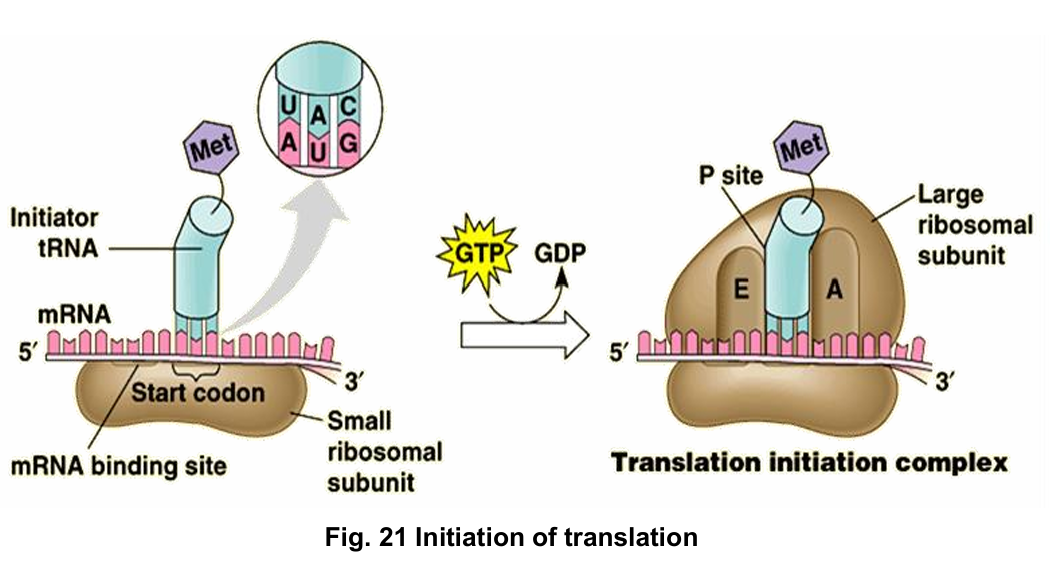
stage 2: elongation of polypeptide chain
the second amino acyl-tRNA complex with anticodon complementary to second codon on mRNA binds to mRNA at ”A” site of ribosome
formation of a peptide bond between first and second amino acid, using energy from hydrolysis of GTP (a molecule similar to ATP), catalysed by peptidyl transferase (RNA enzyme) on large subunit of ribosome
ribosome moves along mRNA to next codon in the 5’ to 3’ direction (once the peptide bond is formed)
the ribosome “reads” mRNA in the 5’ to 3’ direction
the first tRNA, now at ”E” site, is released into cytoplasm
recycled to attach to respective amino acid
the second amino acyl-tRNA complex moves from “A” site to “P” site, and the “A” site is available for next amino acyl-tRNA complex with anticodon complementary to third codon on mRNA [polypeptide chain is synthesized from the amino to carboxyl end]
the process is repeated until the ribosome reaches the “stop” codon on the mRNA
![<ol start="6"><li><p>the second amino acyl-tRNA complex with anticodon complementary to second codon on mRNA binds to mRNA at ”A” site of ribosome</p></li><li><p>formation of a peptide bond between first and second amino acid, using energy from hydrolysis of GTP (a molecule similar to ATP), catalysed by peptidyl transferase (RNA enzyme) on large subunit of ribosome</p></li><li><p>ribosome moves along mRNA to next codon in the 5’ to 3’ direction (once the peptide bond is formed)</p><ul><li><p>the ribosome “reads” mRNA in the 5’ to 3’ direction</p></li></ul></li><li><p>the first tRNA, now at ”E” site, is released into cytoplasm</p><ul><li><p>recycled to attach to respective amino acid</p></li></ul></li><li><p>the second amino acyl-tRNA complex moves from “A” site to “P” site, and the “A” site is available for next amino acyl-tRNA complex with anticodon complementary to third codon on mRNA [polypeptide chain is synthesized from the amino to carboxyl end]</p></li><li><p>the process is repeated until the ribosome reaches the “stop” codon on the mRNA</p></li></ol><p></p>](https://assets.knowt.com/user-attachments/64772605-13a7-476c-898e-299f01c55c6b.png)
stage 3: termination of translation
termination occurs when a stop codon (UAA, UAG or UGA) occupies A site on the ribosome
there is no tRNAs with anticodons complementary to the stop codons
instead, release factors (proteins) recognise and binds to stop codon at A site
release factors cause addition of a water molecule that hydrolyses the bond between last amino acid residue and tRNA
polypeptide synthesis stops
the polypeptide chain is released from ribosome, and it folds into its secondary and tertiary structure and may undergo modification at the Golgi apparatus
the ribosome dissociates from mRNA and separates into its subunits
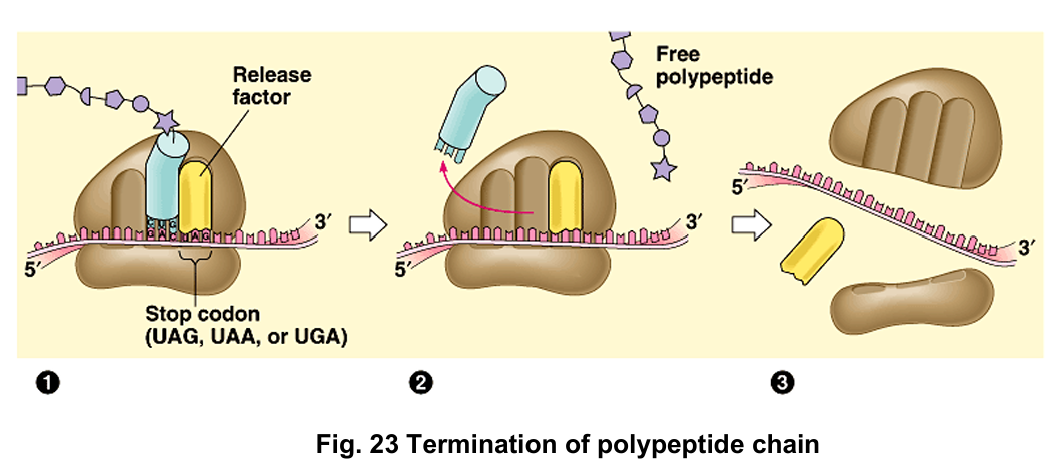
comparison between dna and rna
similarities
both are made up of polynucleotides
both can act as genetic/hereditary material
differences
feature | DNA | RNA |
|---|---|---|
monomer | deoxyribonucleotide | ribonucleotide |
sugar | deoxyribose sugar | ribose sugar |
nitrogenous bases | adenine, thymine, cytosine, guanine | adenine, uracil, cytosine, guanine |
number of strands | usually double stranded | usually single stranded |
stability | it is chemically stable due to: | it is chemically less stable due to: |
types | exists as 1 form as a double helix | exists at least in 3 forms: mRNA, tRNA, rRNA |
location | located in the | located in the |
size | it is a large molecule | it is a smaller molecule than DNA |
amount | the amount is the same in ALL cells of an organism, except gametes, which have | the amount is variable but abundant in cells actively synthesizing proteins |
comparison between transcription and replication
similarities
they both occur within the nucleus
complementary base-paring occurs
unwinding and rewinding of DNA strands occurs
separation of parental strands occurs progressively in short segments
differences
features | DNA replication | transcription |
|---|---|---|
enzyme involved | DNA polymerase | RNA polymerase |
raw materials | deoxyribonucleotides | ribonucleotides |
template | both strands of DNA molecule | only template strand of the DNA |
base pairing | • adenine with thymine and vice versa | • adenine on DNA with uracil on RNA |
proofreading property on enzyme involved | DNA polymerases carry out 3’ to 5’ exonuclease proofreading on daughter strand, ensuring precise complementary base | RNA polymerase does not carry out 3’ to 5’ exonuclease proofreading of RNA transcript |
product(s) | 2 DNA molecules | mRNA, tRNA or rRNA |
products destination | products remain in the nucleus | products leave nucleus via nuclear pore |
comparison between transcription and translation
feature | transcription | translation |
|---|---|---|
location of process | in the nucleus | on ribosomes in the cytoplasm |
template | DNA template strand | mRNA |
reading of template | DNA template read in the 3’ to 5’ direction | mRNA read in the 5’ to 3’ direction |
complementary base pairing | between ribonucleotides and | between codons on mRNA and anticodons on tRNA |
raw material | ribonucleotides | amino acids |
enzyme | RNA polymerase catalyses formation of phosphodiester bonds between ribonucleotides | peptidyl transferase in large subunit of ribosome catalyses formation of peptide bonds between amino acids |
products | mRNA, tRNA, rRNA | polypeptide chain |
involvement of ribosomes | no | yes |
involvement of tRNA | no | yes |