C4.1 - Biology Populations and communities
 Call Kai
 Learn
Learn Practice Test
 Spaced Repetition
 Match
Match Flashcards
 Knowt Play
1/37

There's no tags or description
Looks like no tags are added yet.
Name | Mastery | Learn | Test | Matching | Spaced | Call with Kai | Chat |
|---|
No analytics yet
Send a link to your students to track their progress
38 Terms
Definition population
An interacting group of organisms of the same species living in an area
Populations are often determined by a geographical barrier
Way to estimate population, general
Random sampling removes bias and is more effective and efficient than counting every individual
Definition sampling error
The difference between estimate and true size of population
How to estimate sessile populations
Random quadrant sampling
1) place quadrant and count how many are present
2) then find the mean and multiply to get an estimate of true population size
A quadrant is a grid with random co-ordinates
Definition sessile organisms
Organisms that stay in one place (e.g. coral and rooted plants)
Definition motile organisms
Organisms that are capable of moving independently
Types of population distributions
Uniform (lower standard deviation), clumped and random (higher standard deviation and variation)
How to estimate the population of motile populations
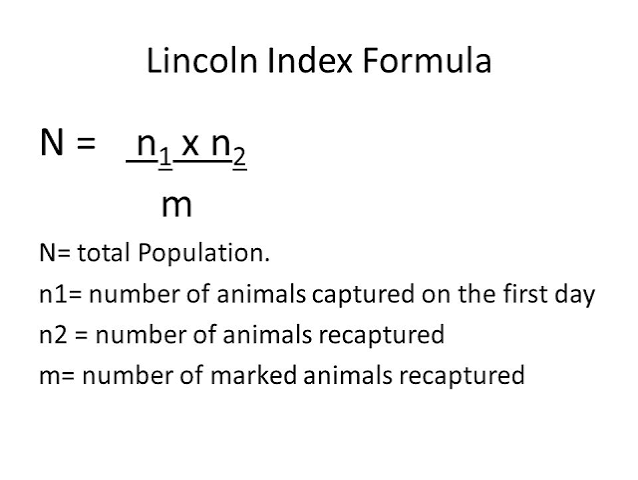
Capture-mark-release and recapture with the Lincoln index
What is the Lincoln Index?
Population size estimate = (M*N)/R
M is number of organisms captured and marked for the 1st sample
N is total captured 2nd capture
R is number of organisms recaptured so that were marked in 2nd capture
What are the assumptions made with the Lincoln Index?
No migration out of the population, no births and no deaths
Marked individual mix naturally back and behaviour / likelihood of caught again not influenced
Marks remain visible
Ratio in the 2nd population is representative of the entire population
Population growth curve
Population graphed over time
Sigmoid growth curve with ups and downs at plateau
K is carrying capacity

What is the exponential growth phase?
Beginning part of population growth curve, J shape
Reproduction means exponential growth, at an accelerating rate
Positive feedback
Little inhibiting growth, there are plenty of resources and space
What is the transition phrase?
2nd part of population growth curve
Population growth is slowing down
Resources start to have a limiting effect
What is the plateau phase?
Last part of population growth curve
Population stabilises (up and down slightly)
Because of carrying capacity
Carrying capacity definition
Maximum size of population that an environment can support
Space, food, disease, water, light, soil (plants) and predation can limit population and determine carrying capacity
Definition density-independent limiting factors
Factors that have the same effect no matter the size of the population
Density-independent limiting factors examples
Forest fires kill plants and animals no matter how many were present before
Also seawater flooding
Density-dependent factors
Factors that increase the effect as population sizes increase
Negative feedback
Reduce larger populations and smaller populations thrive
Examples of density-dependent factors
Competition for limited resources like water, food and light
Predation (significant factor): cyclical processes (e.g. fox and rabbit, cheetah and gazelle)
Infectious diseases / parasitism / prey infestation, with an increase in the density there is an easier spread in the disease

Intraspecific relationships definition
Relationships between individuals of the same species
Types: competition and cooperation
How does competition as an intraspecific relationship work?
Organisms share an ecological niche
Compete for resources
Natural selection
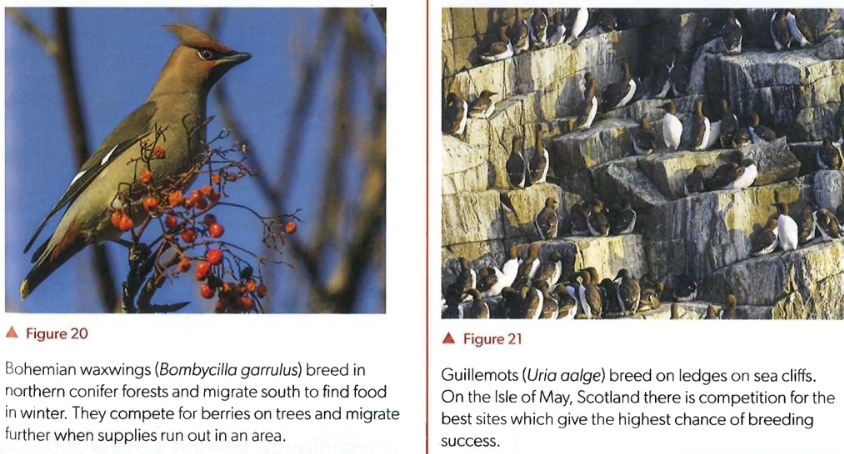
E.g. plants compete for light, flowers for pollination, bohemian waxwings migrate south for food and berries, guillemos compete for breeding sites on cliffs
How is cooperation an interspecific relationship?
More present with animals and less in plants
Strong benefit for all
E.g. all birds and mammals conserve body heat by huddling together, chimpanzees hunt in groups, fish form tightly packed bait ball, birds share parental care
Definition community
A group of populations living and interacting together in an area
Definition herbivory
Primary consumers feeding on producers (plants)
Definition predation
Consumer (predator) killing and eating another consumer (prey)
Definition mutualism
2 species living together in close association, both species benefit
Examples of mutualism
Root nodules and Fabaceae (legumes), bacteria called Rhizobium fix nitrogen from the air for the plant, providing carbs and receives a place to live
Mycorrhizae (fungi) in orchids, the fungi penetrate the seed and provide minerals and water, orchid provides carbs
Zooxanthellae (algae) in hard corals, algae photosynthesise and provide carbs and oxygen for coral, coral provides a safe place for carbon dioxide

Definition paratism
One species (a parasite) lives inside or on a surface of another species, obtaining nutrients
The host is harmed but the parasite benefits
Examples of paratism
E.g. tapeworms and ticks
Definition pathogenecity
One species (pathogen) living inside another species (host) causing a disease in it
E.g. potato fungus
Examples of interspecific competition
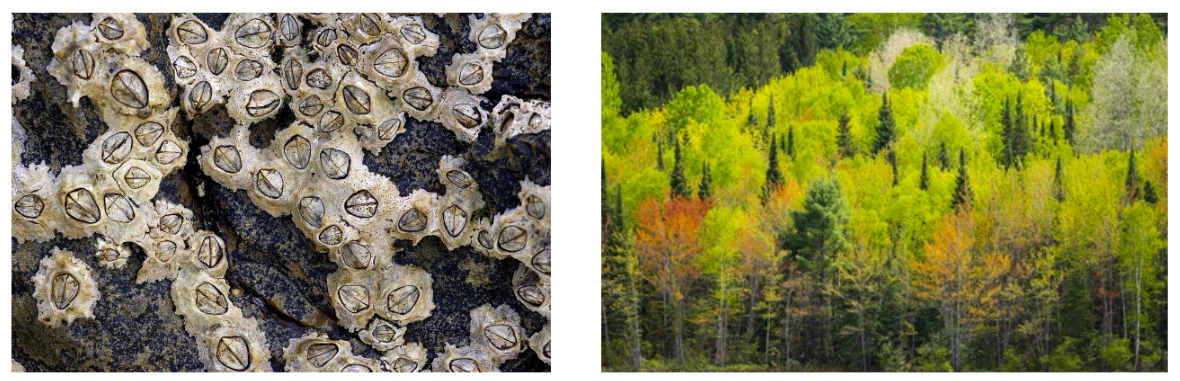
Barnacles compete for space and food on rocky shores
Trees compete for light in mixed woodlands
Interspecific competition
Two species competing for a limited resource
There is an endemic species and an invasive species
If endemic and invasive species are competing for resources, for a realised niche, usually endemic species is reduced, sometimes to extinction
Definition endemic and invasive species
Endemic is the species that naturally occur in an area
Invasive species are alien to that environment, introduced artificially and spread rapidly
Example of interspecific competition
Grey squirrel (invasive, only 30 were introduced) and red squirrel (endemic)
Red squirrel extinct in England, only present in North Wales and Scotland.
How to investigate interspecific competition
Field observations, random sampling over time
Field manipulation, remove 1 competing species and observe consequences
Laboratory experiments, controlled conditions, observe interactions and isolation
Allelopathy
Some plants release secondary metabolites into soil, impact the soil negatively, inhibiting root growth and photosynthesis
E.g. eastern black walnut tree releases chemical juglone into soil
Antibiotics
Secreted by some microorganisms to kill other competing microorganisms
E.g. fungus penicillium secrete penicillin (antibiotic) kills bacteria in soil
Top-down control