ECG Rhythm Characteristics and Interpretation
 Call Kai
 Learn
Learn Practice Test
 Spaced Repetition
 Match
Match Flashcards
 Knowt Play
1/28

Earn XP
Description and Tags
Vocabulary flashcards covering various cardiac rhythms, their ECG characteristics, rates, wave intervals, and definitions based on lecture transcript notes.
Name | Mastery | Learn | Test | Matching | Spaced | Call with Kai | Chat |
|---|
No analytics yet
Send a link to your students to track their progress
29 Terms

Normal Sinus Rhythm (NSR)

Sinus Tachycardia
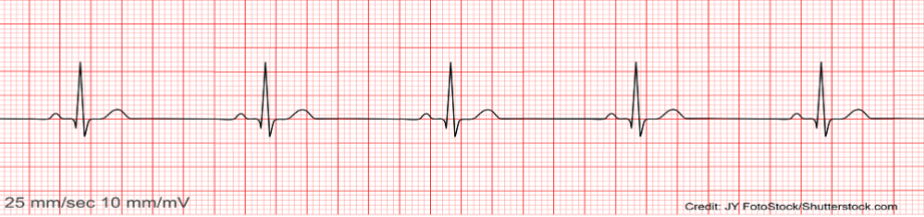
Sinus Bradycardia
Premature Atrial Contractions (PAC)
An irregular cardiac rhythm with a rate usually <100 per minute (dependent on underlying rhythm), featuring early and upright P waves that are different from sinus, PR interval of 0.12−0.20 seconds (different from sinus), and qRs of 0.04−0.10 second.
Atrial Flutter
An atrial rhythm with an atrial rate of 250−350 and ventricular rate commonly 150. Atrial rhythm is regular, ventricular is regular or irregular; P waves are not identifiable, featuring uniform F waves (sawtooth or picket fence), non-measurable PRI, and qRs of 0.04−0.10 second.
Atrial Fibrillation
An irregular rhythm with an atrial rate of 400−700 and ventricular rate of 160−180 per minute. Characterized by no identifiable P waves (f waves may be seen), unmeasurable PRI, and usually normal qRs.
Premature Junctional Contraction (PJC)
An irregular rhythm with rate usually <100 per minute (dependent on underlying rhythm), featuring P waves that are inverted before or after qRs or not visible, PR interval <0.12 second when inverted P is before qRs, and qRs of 0.04−0.10 second.
Junctional Rhythm
A regular rhythm with an accelerated rate of 61−100, featuring P waves inverted before or after qRs or not visible, PR interval <0.12 second when inverted P is before qRs, and qRs of 0.04−0.10 second.
Junctional Tachycardia
A cardiac rhythm sharing the same causes as Paroxysmal Atrial Tachycardia (PAT) and ECG characteristics of Junctional Rhythms, with a rate of 101−200.
Accelerated Junctional
A cardiac rhythm sharing the same causes as Paroxysmal Atrial Tachycardia (PAT) and ECG characteristics of Junctional Rhythms, with a rate of 60−100.
Supraventricular Tachycardia (SVT)
A term used when unable to distinguish which rhythm is present, characterized by an absolutely regular rhythm, rate >150 per minute, non-visible P waves (PRI not measurable), and normal qRs of 0.04−0.10 sec.
Premature Ventricular Complex (PVC)
An ectopic impulse with rate dependent upon underlying rhythm, R-R rhythm, usually absent P waves (if present, not associated with PVC), qRs of 0.12 second or greater (bizarre and notched), and ST & T often opposite in direction to qRs.
Isolated PVC
A PVC timing classification corresponding to one Premature Ventricular Complex in a row on an ECG strip.
Pair / Couplet (PVC)
A PVC timing classification corresponding to two Premature Ventricular Complexes in a row.
Bigeminy
A PVC pattern where a Premature Ventricular Complex occurs every other beat.
Trigeminy
A PVC pattern where a Premature Ventricular Complex occurs every third beat.
Uniformed PVC
Premature Ventricular Complexes that exhibit a similar shape or morphology.
Multiformed PVC
Premature Ventricular Complexes that exhibit different shapes or morphologies.
R-on-T Phenomenon
A PVC location timing where a Premature Ventricular Complex falls directly on the T wave of the complex preceding it.
Ventricular Tachycardia
A rhythm consisting of a group of three or more PVCs in a row at a rate >100 per minute (usually not >220); rhythm is usually regular with wide (0.12 sec) bizarre qRs and ST/T wave in the opposite direction of qRs.
Ventricular Fibrillation
A cardiac rhythm with no rate, no regularity (chaotic undulating waves), no P waves, no qRs, no ST/T wave, no organized activity, and no cardiac output or pulse.
Idioventricular Rhythm
A rhythm with a rate of 20−40 per minute, regular R-R, no P waves associated to qRs, qRs >0.12 sec (notched, bizarre appearance), and ST/T in the opposite direction of qRs.
Accelerated Idioventricular Rhythm
An Idioventricular Rhythm with a rate greater than 40 to 100 per minute.
Asystole
A state with a ventricular rate of 0 and no qRs complexes; rhythm is absent unless P waves are present (which may be regular or irregular).
1st degree AV Block
An AV block characterized by a 1P:1qRs ratio and a prolonged PR interval (>0.20 sec but not >0.40 sec).
2nd degree AV Block, Type I Mobitz I Wenckebach
An AV block with more P waves than qRs, unequal R-R intervals, and a PR interval that progressively increases in a cycle until a P wave appears without a qRs complex.
2nd degree AV Block, Type II Mobitz II
An AV block with more P waves than qRs, consistent PR interval, normal or wide qRs (bundle branch block), and R-R intervals that are either equal or not equal.
3rd degree AV Block
An AV block with more P waves than qRs where P waves are not related to qRs (P too close, P too far), PRI varies greatly, qRs is normal or wide, and R-R intervals are equal.
Pulseless Electrical Activity (PEA)
A condition caused by H's and T's, severe cardiac damage, or respiratory failure, where the ECG rhythm may look normal but will NOT have a pulse.